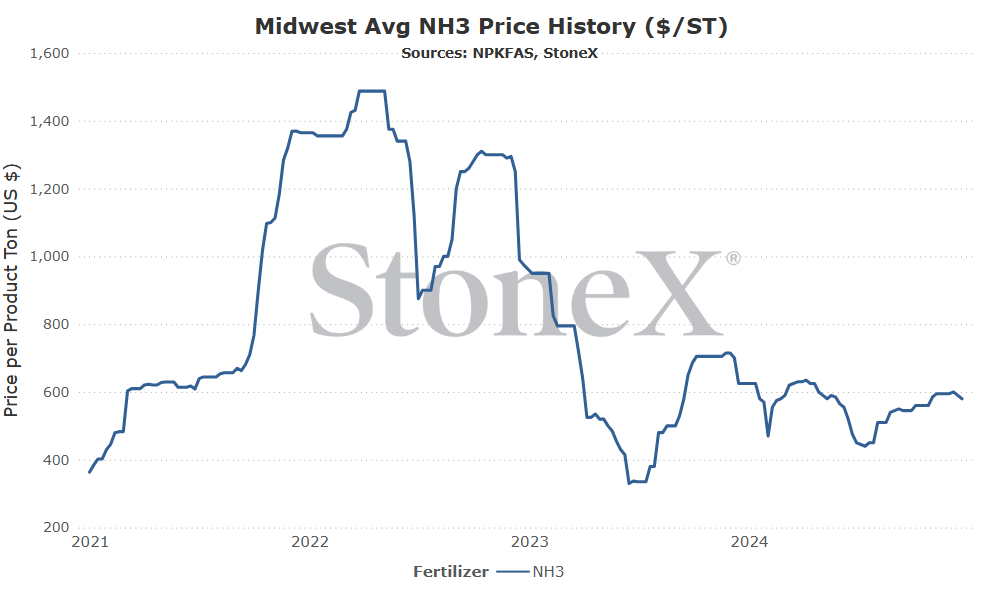
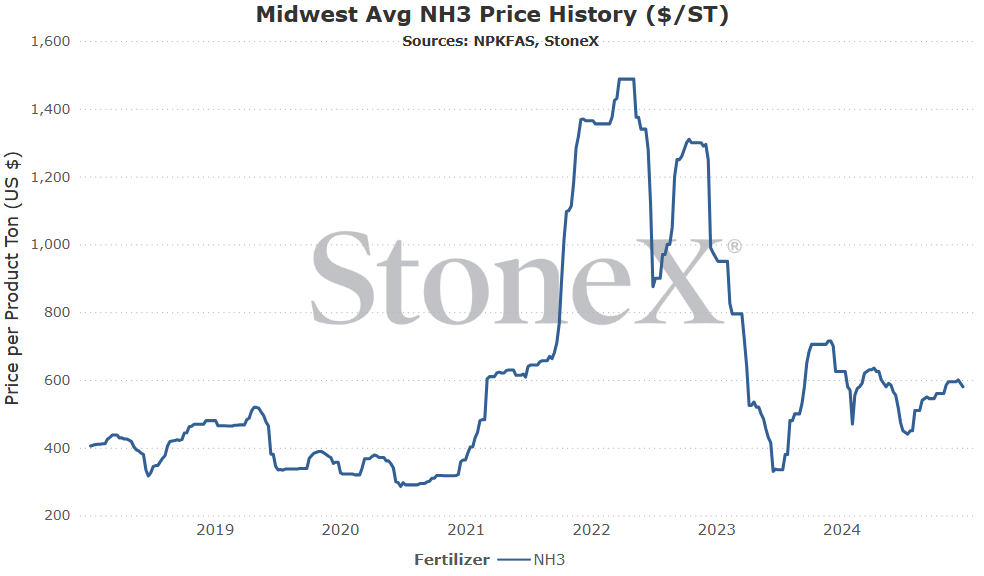
The first graph is the AVERAGE of the entire Midwest U.S. region. That means your local value WILL be different than what the graph reflects. Please do not take this into your retailer and say "why isn't my price the same as here". That is comparing apples to oranges. You might be on the cheaper or more expensive side of this graph. This doesn't take into account logistics/storage/interest/insurance/shrink/etc.
This graph looks at the price from a short ton and USD currency POV.
This second graph looks at the price set for Tampa NH3. This value does not have a high correlation to Midwest values. It is a talking point used when prices are rallying...yet somehow gets skipped on the way down. This price is more an indication of the global price. This price is set by two parties (purchaser - phosphate producer in Florida / seller - international producer providing NH3 to FL phosphate production).
This graph CAN be used as an indication of global market price direction/trends. This graph SHOULD NOT be used to determine a Midwest value. Tonnage is listed in short ton and currency in USD.
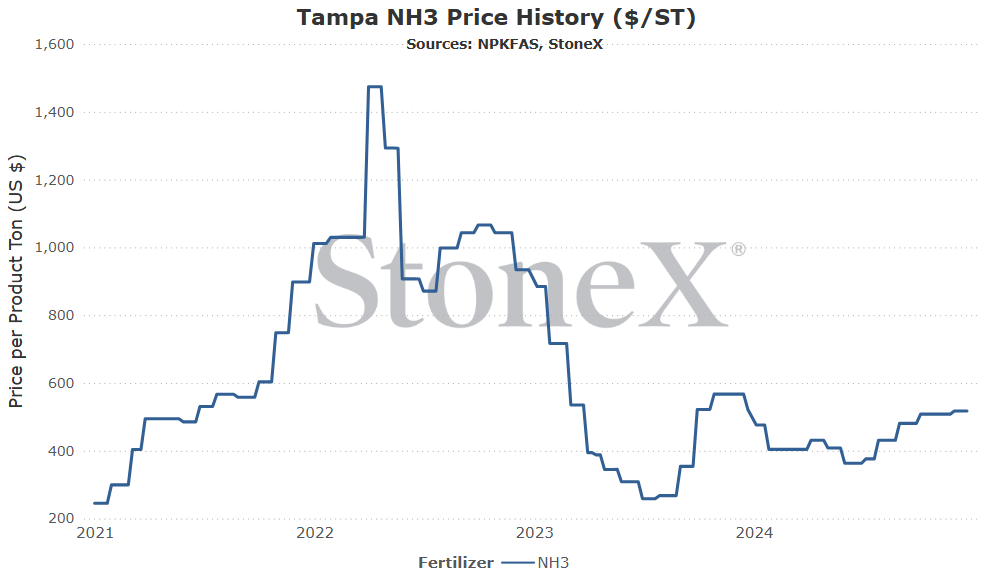
As I sat down to start this section, I received notification that the January Tampa NH3 price had been published $38 LOWER than December!! That is the first time since the summer month's (June, I believe) that we have seen the price lower.
Over the past 6 months, there have been several production issues around the world that have kept supplies tight. Just going off memory, this is the first month that I cannot remember a new major production hiccup. Sure, Europe is still producing at 75% of normal and Iranian production has ceased due to gas supply issues, but outside of that it is relatively quiet and stable. Quiet and stable typically begets faith in the market which typically lowers price ideas.
Now, as we look to 2025, I continue to keep my eye on Russia. Specifically, their Teman export facility. If/when that facility comes online, it will usher back the world's largest exporter of NH3. If/when that happens, it is going to be VERY hard to see values holding.
Short-term, barring any new production hiccups, we should see values flat to slightly lower globally. However, we MUST remember Russia. When they return to full form, exports/supply availability will jump by the millions of tons and should usher in a period of lower values. When that magic day is remains anyone's guess.
North America
Talk about a weird fall season. November was mostly a bust for application as wet conditions kept farmers/retailers out of the fields. All looked lost...and then Mother Nature came thru. As we neared Thanksgiving, moisture stopped and everyone took advantage.
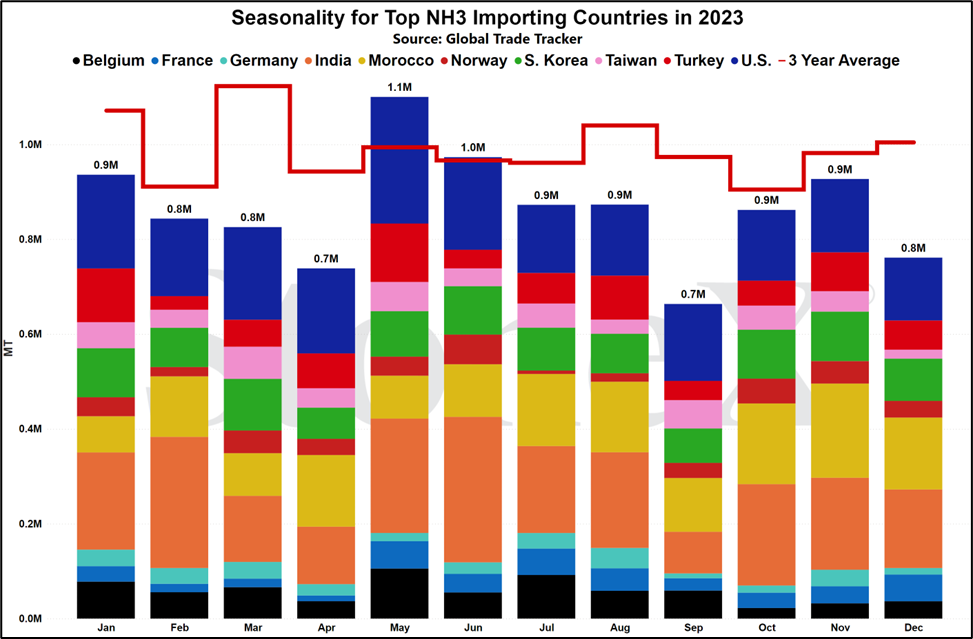
For reference, we had been forecasting fall demand in the 2.1 - 2.2M ton range. Today, we believe the market applied around 90% of that forecast, or approximately 1.9M tons. A "normal" fall run is 2M tons so we were right there. The only territory that we think fell short was the Northern Plains region. It got cold and stayed there. Once we started hearing more stories about ice fishing than application, it was all over!!
Today, we have already seen the manufacturers release their winter fill and spring prepay programs. The spring ship tons, those that set the market, were priced relatively flat to where fall pricing ended...and that makes sense. With the system relatively emptied, manufacturers know that there is plenty of space to refill. They just are not feeling much pressure today. They are also enjoying watching urea and UAN price ideas rise, which makes spring NH3 pricing appear more attractive.
Now that spring prepay programs are announced, I think we will see values relatively flat thru preplant. There will likely be pushback from the industry that values need to fall due to international weakness (i.e. Tampa falling $38 from Dec to Jan), but N.A. is a different beast. Demand remains solid and following a successful fall program, supplies remain tight. Couple that with strong urea/UAN outlooks.
Unfortunately, there just isn't much pressure on the market to lower price ideas. The market is still leaning in favor of the seller...and they know it.
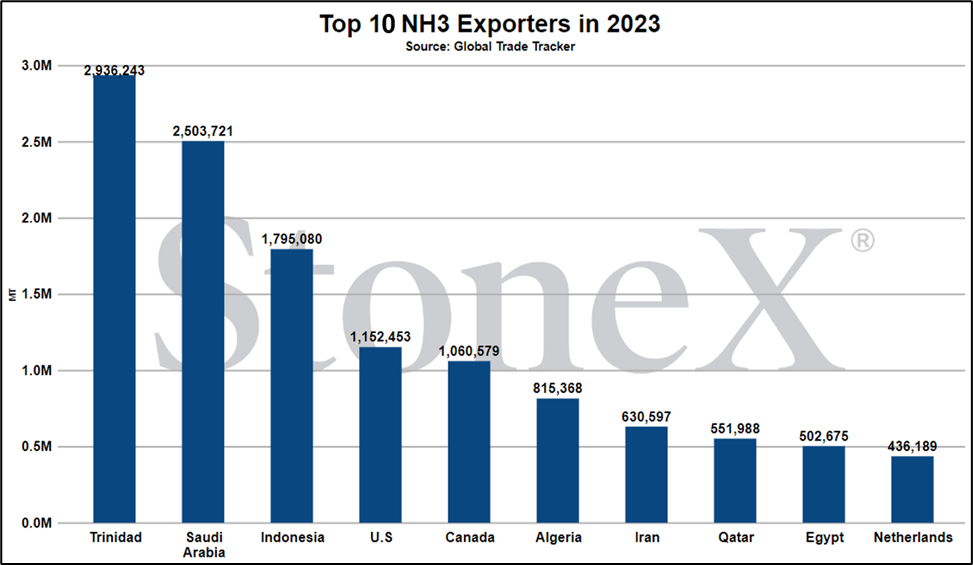
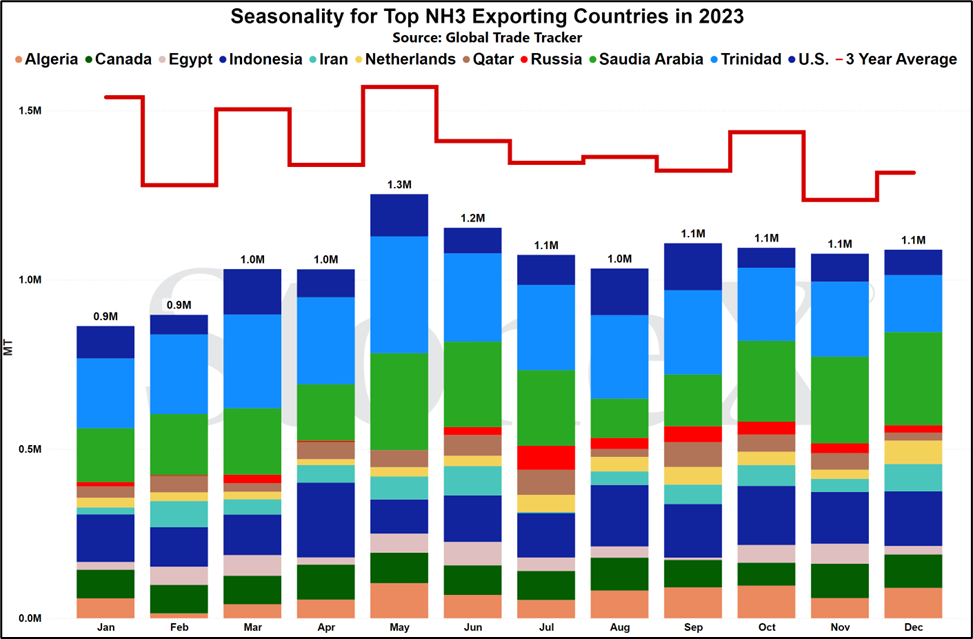
2025 NH3 market outlook
As we start a new year, I thought it might be worth going thru a quick list of the major stories that we are watching. There will be other stories. There will be surprises. The only guarantee is that things will change, but this is what we are keeping an eye on as we head into 2025.
- If/when Russian exports return - Russia was historically the world's largest NH3 exporter...that was until they decided to invade Ukraine. They went from being the world's largest with 2nd place being 7-figures lower to completely falling off the top 10 list with no real timeline of returning...but we expect them back at some point. Progress is continuing to be made at new facilities that will reach world markets, but getting firm updates on progress or timelines has been rough. Even once these facilities come online, then we need to worry about attacks from Ukraine who have shown an ability to strike Russian territory. Losing the world's largest exporter helped firm global values. Having them return should help soften price ideas...assuming they are allowed to stick around.
- Global economies/industrial demand - we always think about NH3 from an agricultural POV. Whether that be from a direct application perspective or in its use to be upgraded into either urea or UAN. However, something that is typically missed is the demand from the industrial sector which can be widely influenced by global economies. For a while, there was a lot of pent of fear that global recessions were coming. This would have hurt NH3 demand/helped lower NH3 pricing because recessions mean lowered industrial demand. Now, as we look ahead to 2025, I'm not going to say everything looks fantastic, but it is feeling better. As long as industrial demand remains solid, that helps to keep excess supplies from building up.
- N.A. weather - if you talk to any farmer that applies NH3, they will tell you that the most important factor for NH3 has nothing to do with pricing. It has everything to do with weather. Even if NH3 was free, if it is too cold and/or too wet, it doesn't matter. You are not able to get anything done. This fall was a reminder of that. We started with November looking horrible due to wet conditions. Then an application window was opened. Spring is no guarantee. If it stays cold too long or it remains wet, farmers will be forced to make a decision once it dries on whether they should apply NH3 or plant seed. I've yet to meet a farmer who says "I think I'll apply NH3 and plant later". Looking at spring, we will hope for the best...and watch for the worst.
- N.A. weather...again - this time in the form of production. As I write this, there are some real horror story forecasts being shown. Northern territories are used to it. It gets cold. It is part of life. However, the southern half of the U.S. isn't so used to it. If this cold gripes the south and stays there, we could see nitrogen production suffer. Manufacturers lock in gas contracts early at lower prices. If a cold comes thru, demand spikes. Spiking demand helps to really price ideas. At a certain price, it is more profitable for manufacturers to slow/stop production and sell back those futures at massive premiums. We have seen this the last couple years and with the forecast looking like it is, that could be a fresh event to start 2025.
There are other things that should be watched but these are the biggest stories that I will keep an eye on.
Still no new story regarding Russian exports
Yep, another month and another lack of update regarding Russian exports.
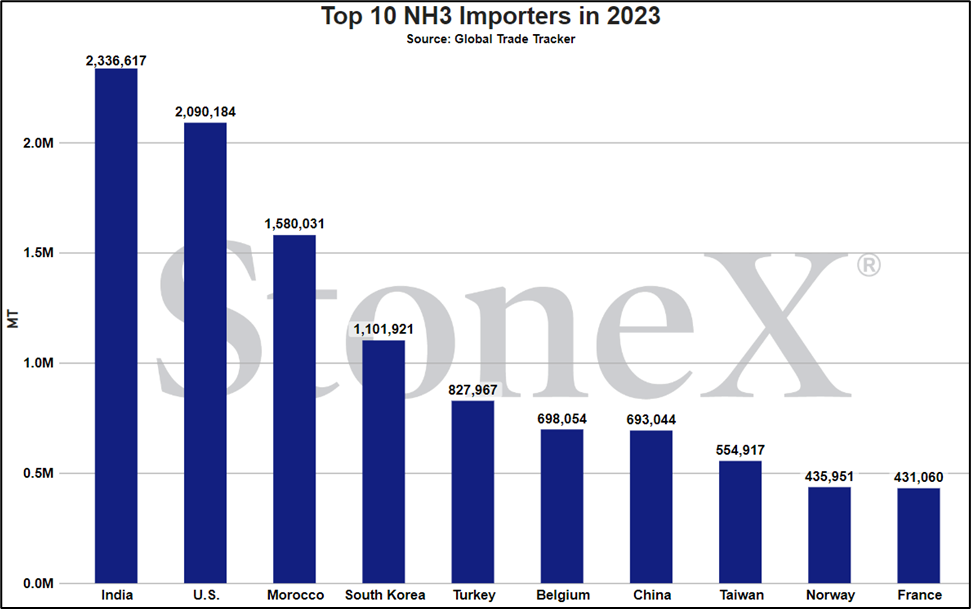
For those new, Russia was historically the worlds largest exporter of NH3. In 2021, they exported around 4.4M tons. For reference, the 2nd largest exporter was Trinidad/Tobago who came in at "only" 3.3M tons. By 2022, Russia completely fell out of the top 10 global exporter rankings...why?
It all has to do with their invasion of Ukraine.
For years, Russia was able to rely on using a pipeline that ran thru eastern/southeastern Ukraine. The productions plants were based in Russia, and they moved product thru this pipeline that ended in the Odessa region. Once there, product would be removed from the pipe, put onto ships and shipped around the world.
How many tons do you think Ukraine allowed Russia to ship after Russia invaded them?!
That pipeline was quickly shut down and Russian exports ceased to exist. Even if relations between the two countries suddenly improved, there have reportedly been damage caused to the pipeline during the fighting.
Because of this loss, Russia has been working on new export facilities. One is based just outside of St. Petersburg. The other appears more promising and resides in Teman. This is the one that we have been watching/anticipating as it gives the greater chance of Russia resuming their place in global rankings. However, we will be reluctant of relying on this facility if/when it comes on. It sits just east of Crimea which means it is WELL within range of Ukrainian attacks. This isn't to say that an NH3 export facility is going to be the most attractive target in their war against Russia, but it isn't outside the realm of possibilities.
Until Russia returns, the world is missing a significant portion of its supplies. This keeps the global S&D tight...and prices high.
What does this mean for farmers?
The world missing its largest NH3 provider is a massive loss...and one that is felt thru every NH3 channel.
This much of a supply loss means that NH3 prices are going to be far more supported than they normally would be. Does this mean that values cannot ebb and flow higher and lower? Of course not. This month proved that with Tampa falling nearly $40. However, the entire complex is higher priced than it would normally be.
Whether you care about NH3 because you apply it directly, because you use urea and UAN which NH3 creates, or you are an industrial user, it affects everything NH3 touches.
N.A. fall application season beats fears, nears normal volumes
As we wind down 2024, we have been doing work on trying to figure out what happened for the fall application season.
It certainly was a struggle and was anything but normal.
Most of November was a bust. With the exception of northern territories, very little got done. We went thru harvest with it very hot and dry and the outlook was poor. When the rain started, it didn't stop. Farmers were kept from applying, just for a completely different reason. It wasn't until Thanksgiving week that mother nature finally gave the first glimpse of a run.
Once the rains stopped, conditions were perfect. Soil moisture was built so that knives could cut the ground and be sealed behind. What happened was multiple weeks that retailers and farmers took full advantage of. In the end, it felt pretty good...but we needed the numbers to back it.
When we surveyed, the only area that didn't feel as though it got everything done it wanted to do was the Northern Plains. The window just never opened. Most other fall areas had the time and got the work done. We estimate that around 90% of our forecast was complete. With our fall forecast being slightly higher than normal (2.15M tons vs a "normal" 2M ton fall), we put the fall number at just under 1.9M. Not quite normal, but close enough and phenomenal when compared to mid-November expectations.
What does this mean moving forward?
Well, for starters, it meant that manufacturers were able to keep spring prices level to ending fall values. This fall run may not have completely emptied the system, but it removed a lot of inventory which leaves space for refill. Then there is spring to contend with. Demand continues to look solid, and this is being pushed higher with 2025 corn acreage expectations growing. We have now set our target at 92.5M acres...and others are saying it could be higher still. Every additional acre of corn means additional nitrogen demand.
Right now, manufacturers are still in control of the narrative...
What does this mean for farmers?
This means we hit the fall "sweet spot". We didn't apply so much that the entire system is completely empty and manufacturers will struggle to resupply before the start of spring. We didn't apply so little that spring demand will skyrocket well beyond logistical capabilities. We hit that area that allowed values to remain unchanged from the end of fall to the spring prepay programs.
Now, this does not mean that spring will go without a hitch. We could certainly see a situation where mother nature allows spring to start very early March and stay wide open. That early start and solid run would mean the supply chain is playing catch up. We could also see spring be cold/wet and delay application that runs well into planting season. That has happened in recent years.
Hopefully, spring will treat us just as nicely as fall did and we can have an uneventful season.
January Tampa NH3 price drops $38, first time lower since June
In a bit of surprise, the January Tampa NH3 price actually dropped $38 from December. This is the first drop that has been seen since June and starts 2025 on a bearish step.
However, given how much the price has rallied over the last several months, a $38 drop is not exactly large. My POV is that it signals that the massive global bullishness that we had been seeing has stalled out. When things go quiet in fertilizer, prices tend to drop. This is especially true for NH3. I would say think about the monthly interest cost and how that can build/eat into profits, but you all farm. You know this full well.
I would like to caution those who apply NH3 in the spring across N.A. from getting excited. I know that when this price rallies, there are some that like to use that story to justify higher inland prices. If that works on the way up, it should certainly work on the way down. Unfortunately, the correlation isn't great. As has been said in the past in these newsletters, the Tampa price direction is a better indication of global markets vs inland N.A. markets. The inland N.A. markets tend to trend along to their own S&D.
Still, we have seen this price higher for half of 2024. At this point, I'll take any bearish signal I can find.
What does this mean for farmers?
Honestly, not much of anything.
Tampa pricing can be a discussion point when values are rising, but it quickly falls to the side when it drops. This is not the retailers fault. They would love to see values lower just as much as you. It is just the way the market works.
U.S. Midwest Wholesale price average
Vs 30 days ago - -3% or approximately $15 lower
Vs 90 days ago - 6% or approximately $35 higher
Vs 6 months ago - 22% or approximately $105 higher
Vs 1 year ago - -7% or approximately $45 lower
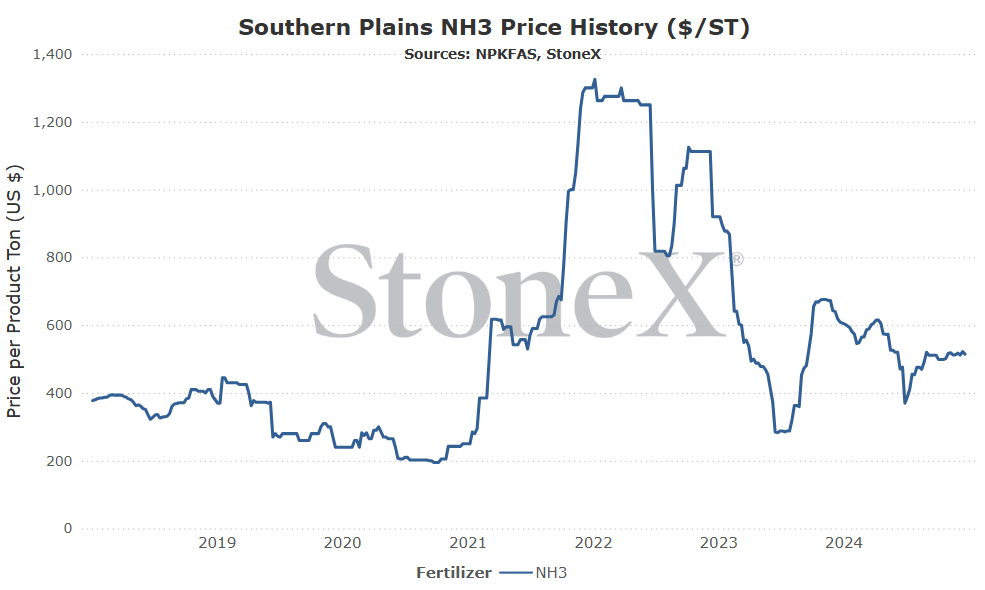
U.S. Southern Plains price average
Vs 30 days ago - unchanged vs last month
Vs 90 days ago - 1% or approximately $3 higher
Vs 6 months ago - 8% or approximately $38 higher
Vs 1 year ago - -15% or approximately $94 lower
- Russia's return is met by Ukrainian attacks - for months, I have been pointing out how quickly and largely Russia's NH3 export return would impact global markets. However, just because they return doesn't mean they will stay returned. Russia is relying heavily on their still in construction Teman facility to start loading vessels. Imagine the elation of global buyers when the first vessels get loaded. Now, imagine the devastation to global buyers if Ukraine attacks the facility. Not only would it fundamentally change the global NH3 market, but emotionally it would hurt. Time will tell.
- North American fall application near normal - when we start to look ahead to a new fertilizer year, we typically assume a "normal" 2M fall / 2M spring U.S. application. We then move those numbers higher/lower based on overall demand, pricing, crop progress, etc. While this fall ends at what we believe to be around 90% of what we forecasted (2.15M tons), that still means we got around 1.9M ton done. That is pretty close to normal and should mean storage is relatively empty heading into winter. That situation gives manufacturers more confidence to keep their values higher as they know they have plenty of space to fill.
- Further hiccups in the lead up to late Q1/early Q2 - while January values may have softened slightly, that does not mean that the global S&D is not still tight. There have been a lot of issues so far this fertilizer year and that has kept supplies low. As we move thru the next few months, any further disruptions should be felt even more than normal given the time of year. North America has seen artic blasts hurt production the last couple winters. Europe is still producing at low production rates due to high gas costs and that doesn't look to improve. The window is getting tight so any hiccups today hurt worse.
- Russia's export return - seriously, if I list this enough times in a row, it should eventually be true. That said, this still tops my list for biggest looming bearish factors. The world has been working without Russian NH3 exports for a while now and prices have reflected that. However, if/when they return, we should see a fundamentally different market. It doesn't mean values go back to what we considered normal from 2016 to 2020, but they should be down substantially from where they are today.
- Normalcy returns to the world - the last several years has seen a surge in fighting. Russia invaded Ukraine. China has been threatening Taiwan. Israel seems to be fending off most of the Middle East. All of these have been very real threats to the nitrogen markets and as such, there is a certain amount of war premium baked into current prices. While this might be hoping for a lot, the last time President Trump was in office, we saw the world very calm. Was this due to his brilliance in negotiations? Maybe. Was this due to the rest of the world being scared of what he might do with his hand on the most powerful military in the world?! Very possible! Regardless, the world was mostly peaceful. If that can happen during Trump 2.0, nitrogen markets could calm as well.
- Grain values cause nitrogen intensive crop switching - while this doesn't look likely today, the chance is certainly not zero. We are starting to revisit our fertilizer demand models to start 2025, and one of the first steps is looking at grains. While we certainly hear the points from farmers that crops like corn are too expensive to plant, we just have not seen enough to move our expectations for nitrogen demand lower...yet. There is still time, though. If we get closer to spring and suddenly see farmers making the switch, that hurts nitrogen demand and could completely upend our expectations. That would weigh on price ideas.
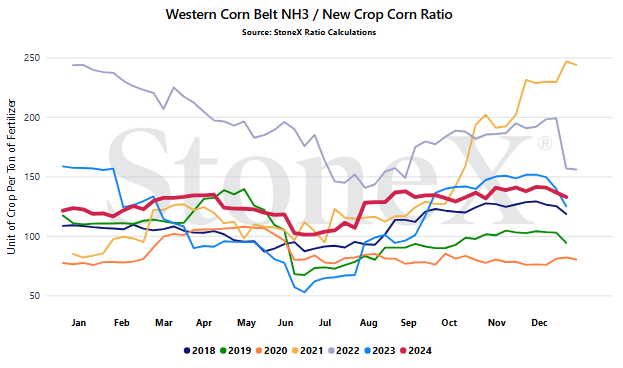
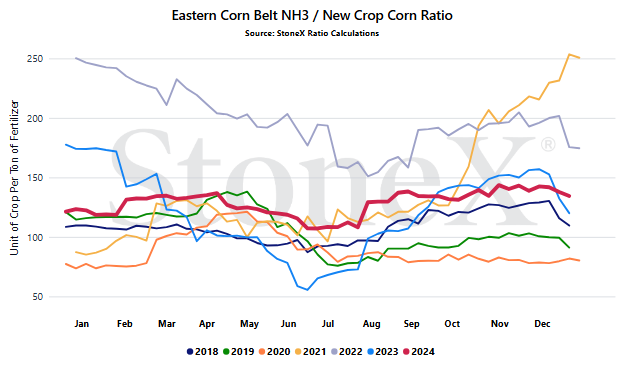
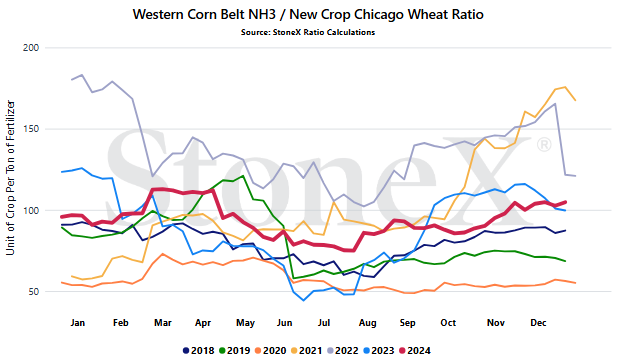
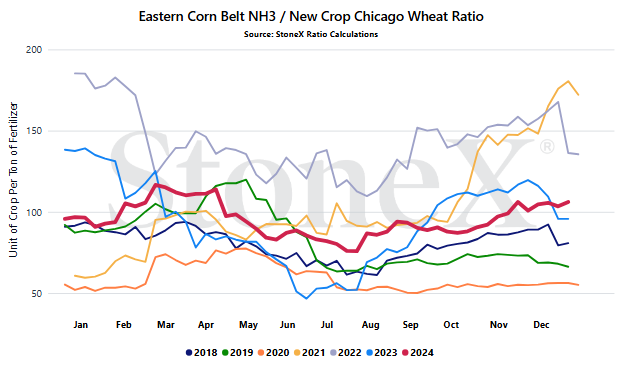
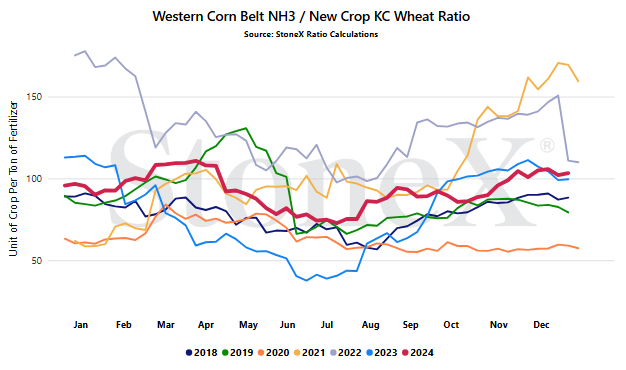
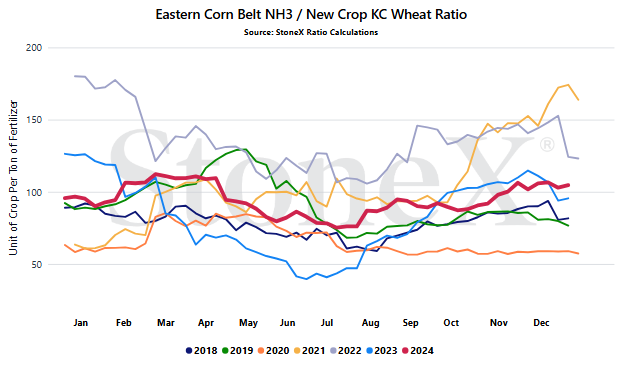
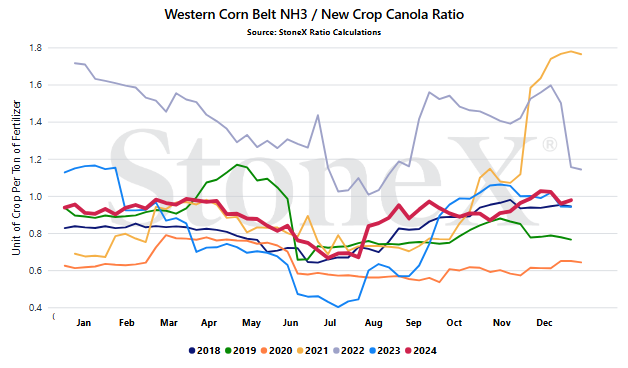
Where are the current NH3/grain ratio values today
We believe that only looking at the flat price of either grains or fertilizer can be misleading:
-
Only selling grain can hurt you if fertilizer prices rise substantially
-
Only buying fertilizer can hurt you if grain prices fall
We look at the ratio "value" to get a better indication of where we are or how many bushels of X does it take to pay for 1 ton of fertilizer.
Would you rather:
-
Spend 150 bushels to pay for 1 ton of potash
-
Spend 100 bushels to pay for 1 ton of NH3
When we compare the current ratio value against recent years, we start to see if we are high or low.
YOUR VALUES MAY LOOK DIFFERENT
This graph looks at the NOLA NH3 price vs the flat grain price. There are no logistics on either product. Your location will look different due to fertilizer logistical costs, grain basis, etc.
- When/if Russian exports resume - this will continue to be my top focal point until Russia's NH3 exports return to normal. Even then, it will probably stay on top until we see them exporting for a while without hiccups to their newly constructed facility and/or attack by Ukraine. Russia's export absence has left a gaping hole in global supplies that has forced their normal buyers to pivot to other sources. That increase in competition allows those areas to raise their price which forces buyers to the next location. When losing the top exporter, this domino effect travels around the world. Hopefully, when they return and stay return, we see the reverse domino effect...hopefully.
- How will Trump administration impact nitrogen production/trade flows - during Trump's 1st term, he started from a place that felt almost like "holy crap, I'm actually here? What do I do?". Now with his 2nd term set to begin, he knows the game and the process and he is coming in full throttle. We know that Trump enjoys using tariffs to implement his will around the world. We have already seen it threatened multiple times...and he is not yet in office. As we look ahead to 2025, we need to think about how tariff's can impact the global nitrogen markets. There is always speculation as to how they will work, where the costs are born, etc. Unfortunately, you know that crap rolls downhill and at the bottom of that hill...typically farmers.
- Relative short time before N.A. spring application - from a timeline POV, the fall was anything but normal. For most of November, the majority of North America didn't pull the toolbars out of the sheds because it was wet. Then things improved Thanksgiving week and farmers/retailers never looked back. By the end, we got real close to a normal fall season. That means the system should be relatively empty...and facing a short winter. That means little time to refill the system in time for round 2 that can start as early as March 1 for large swaths of the cornbelt. The system always finds a way. I am not saying there will be shortages. What I am saying is that under the right circumstances (early start to spring), we could see longer wait times for resupply to arrive. I believe, as the system always does, that everything will get done...but we need to watch mother nature as we near early March.
StoneX Ratio Calculation
The ratio calculation is derived from Bloomberg historical grains values as well as fertilizer values from StoneX, NPKFAS, and Argus.
The calculation is simply dividing the fertilizer price by each grain price.
All data was sourced from StoneX unless otherwise noted.