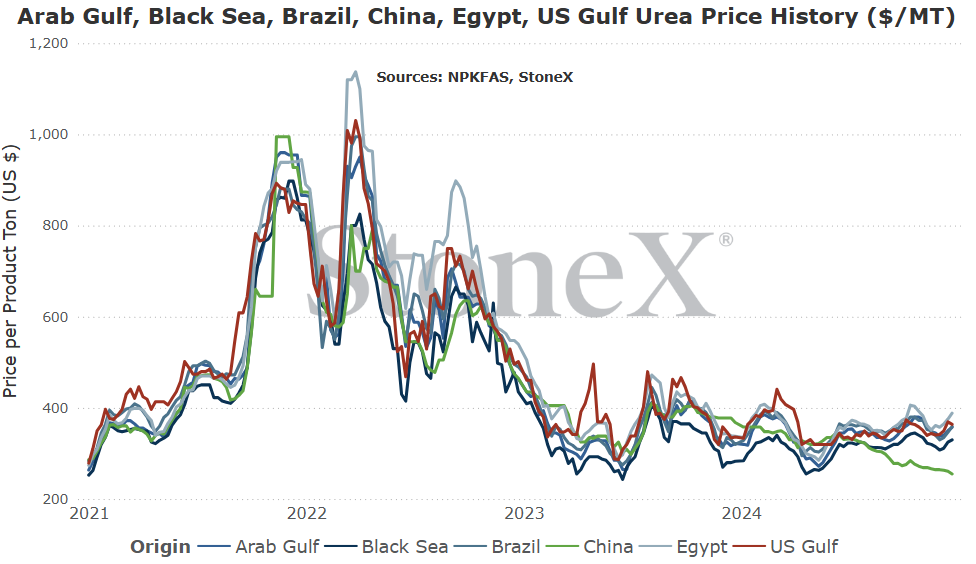
The intention of the below graphs are not to use to say "my price should be X based on this graph". These prices are derived from an FOB price point average. The intent is to show major global price movement trends. Your values will likely have significant basis difference (similar to your local grain price being different than the traded market price).
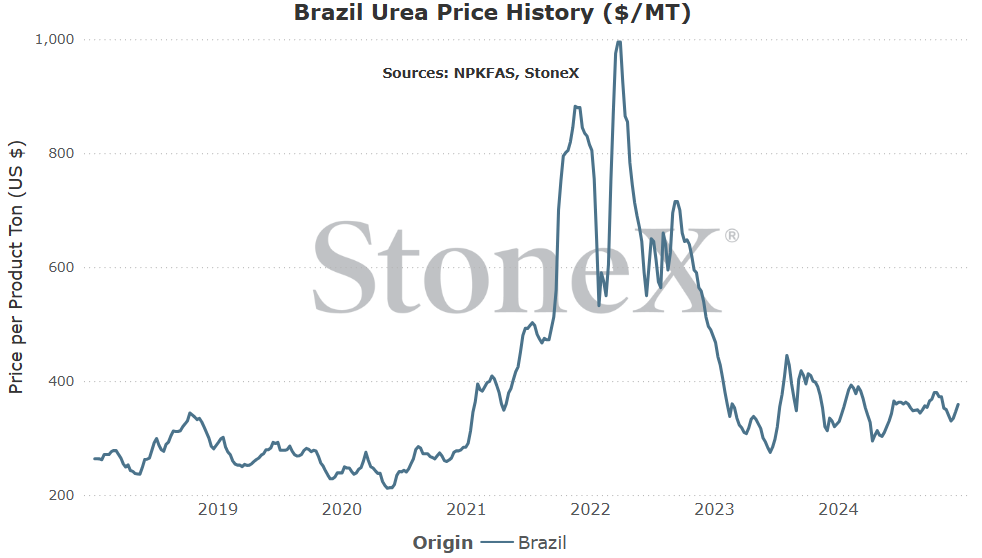
This graph is labeled as MT in USD currency.
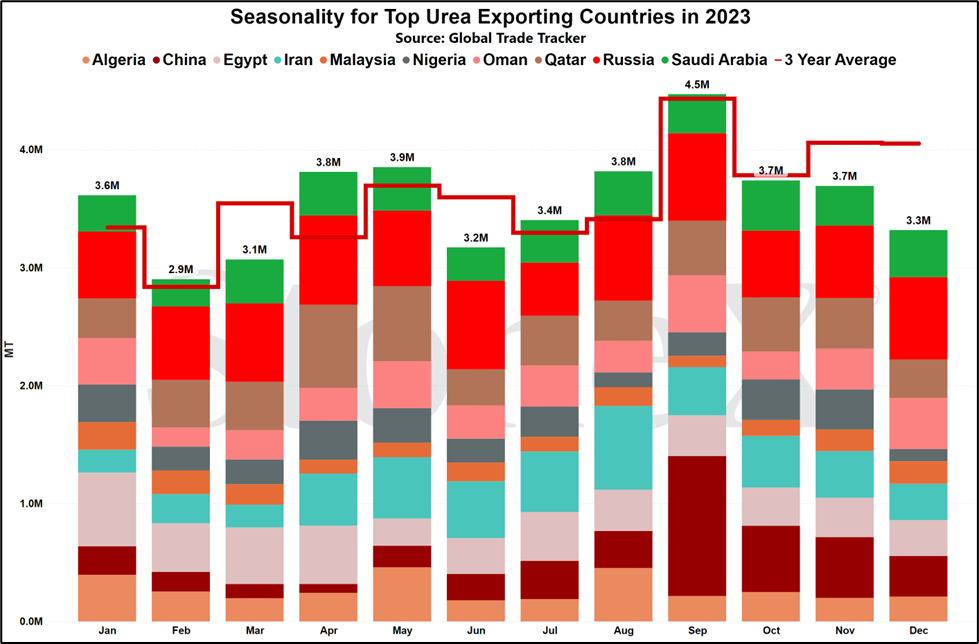
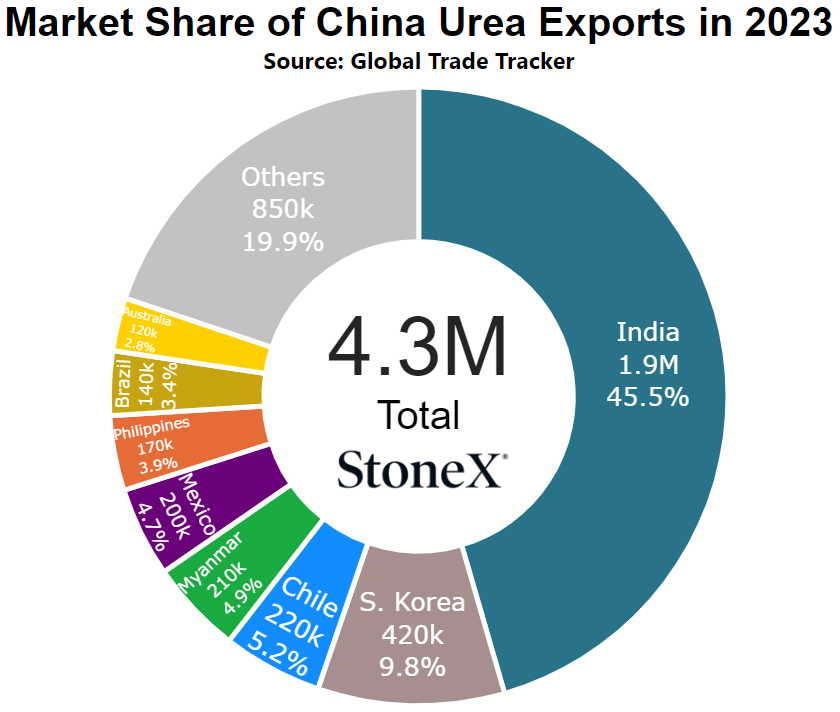
- Chinese exports still slow - calendar year 2024 Chinese urea exports should be the lowest in history. Normally, exports would total somewhere between 5 to 5.5M tons. This year thru November (the most recent month we have Chinese trade data), their exports are just shy of 260K tons. That is not a typo. Based on the information we have, the exact number is actually 259,583MT. December doesn't look promising and there is little to no sign of near term improvement. The global urea export market is typically in the 50 - 55M ton range which means China represents 10% of that market...that means 10% of that export market is missing. Now, with all things China, never count them out. One of the biggest bear factors we have been listing is their unexpected return. It doesn't seem likely today, but it isn't impossible. Regardless, as long as they are absent from the world, the global S&D remains very tight.
- European production still 75% normal - further adding to supply tightness is the ongoing European situation. Production rates have failed to get back to normal since the Nordstream pipeline was shut down and eventually destroyed underwater. European gas values skyrocketed and remain much higher than is historically normal. That means around 25% of European nitrogen production remains offline. For urea, that equates to roughly 3M tons. Not only is this 3M tons of production missing, it also represents a "new" 3M ton buyer as European farmers need to replace the product to raise their crops. Unfortunately, it is hard to see this situation improving near term. First, there is the political climate that is pressuring "old" production facilities. Then there are Russian relations. They are not great and do not look to improve short term. Even if those relations improved, they still have to start work on repairing the Nordstream pipeline. Those repairs would take time if they were on land...but they are not. They are deep underwater. While anything is possible, it is hard to see European production improving near term.
- Northern hemisphere spring demand looming - so I just listed 2 major supply issues...and demand is looming. Northern hemisphere spring season is just around the corner which means anyone who has been dragging their feet in hopes of lower prices are running out of time. Spring will be here before we know it and it takes time to ship product. According to our POV, most manufacturers are going to start 2025 very comfortable on their sales books. They shouldn't be heavy on unsold inventories which puts them in a powerful negotiations position.
I could dive further into some of my fear points for production/supply:
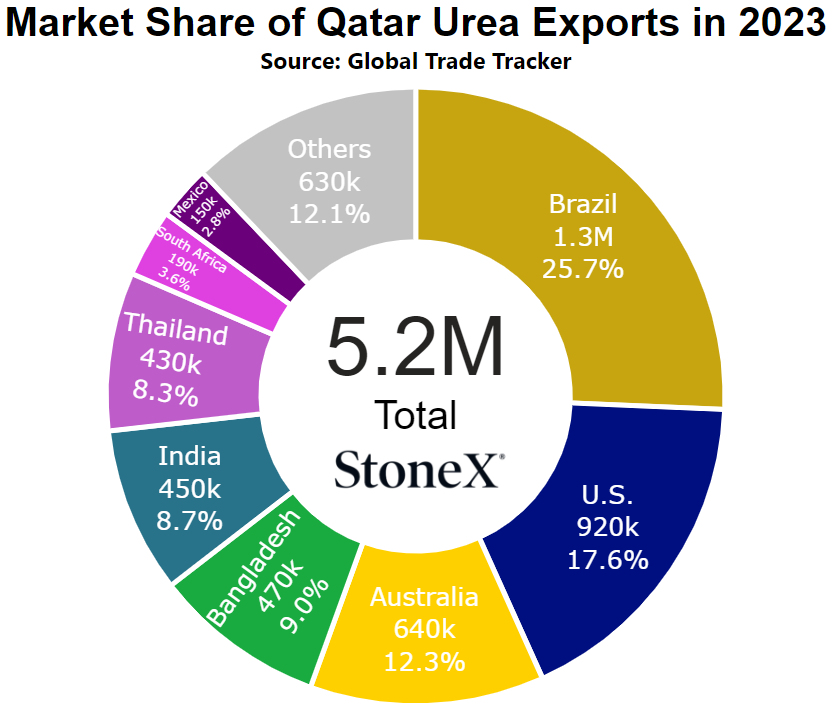
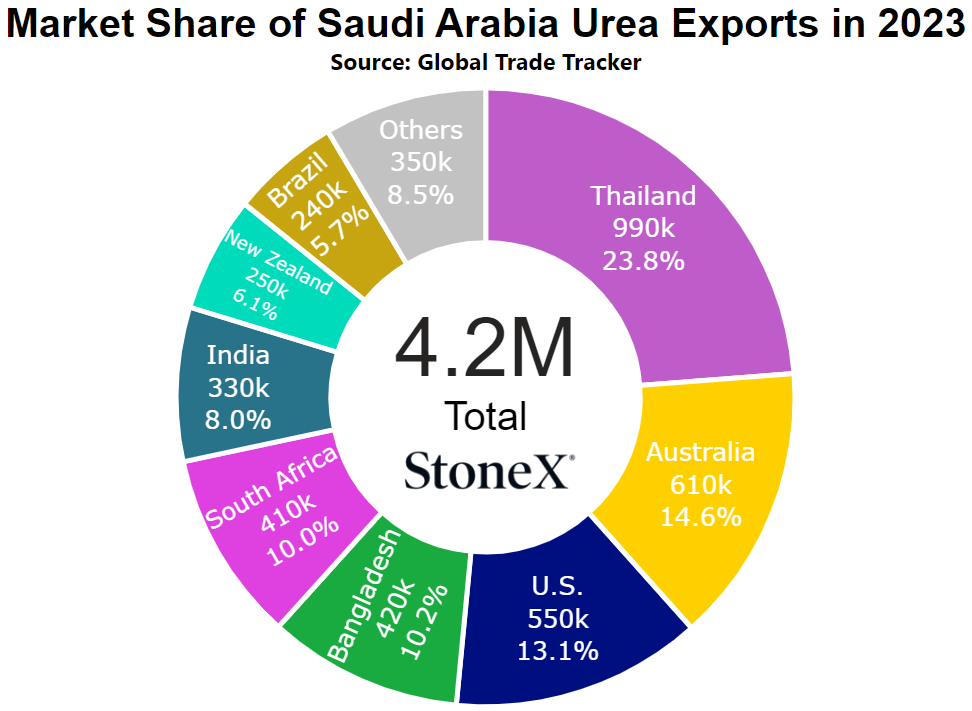
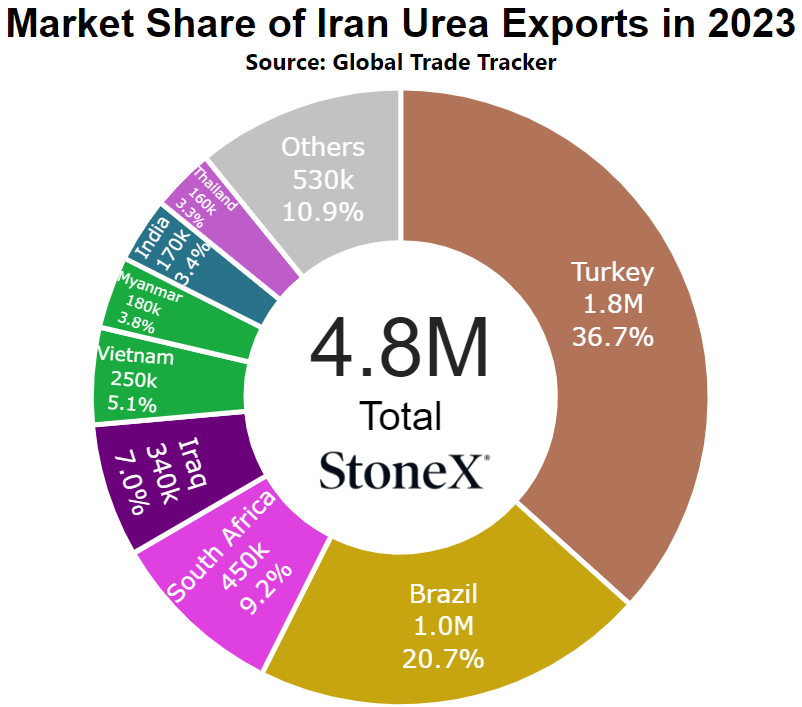
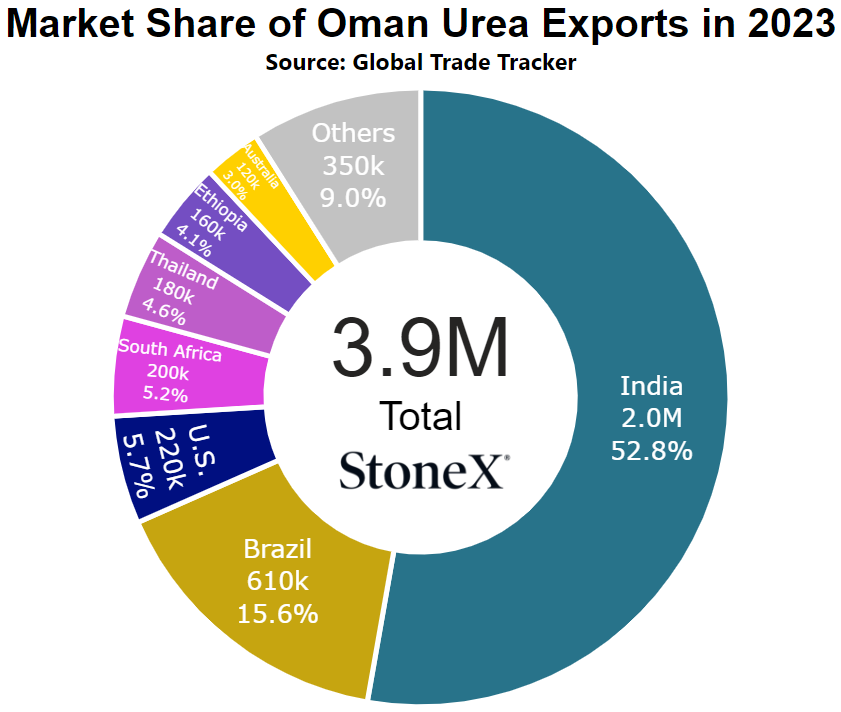
- What if Middle East erupts into war? Middle East/North Africa represents 1 out of every 2 tons of urea exports in the world.
- What if North America has an artic blast that shuts down nitrogen production? This has happened the last couple years and right now, the forecast looks frigid.
- What if shipping lanes start being targeted/attacked again? While this likely wouldn't change the fundamental S&D, it would certainly make things take longer to arrive in some instances. Dangerous this close to spring.
These are the points that are the root reason for my bullishness over the last several months. My fear is that these come to a head as we start 2025. My "feel" is that the market has been worried about moving prices too early due to poor farm economics...but eventually demand is forced forward and forced to face tight fundamentals.
Trust me when I say I would love to be wrong here because being wrong means lower prices for you...I just do not feel like I am.
- Looking to secure 1.5M tons (1M for west coast ports / 500K for east coast ports)
- Shipment period going thru February (relatively long shipment period with goal of lowering price ideas)
This could have been a big tonnage tender and that was our expectation...until we saw the offer breakdown.
India tender operate differently than most the rest of the world. Rather than just buying all the tons they need at all the different offered values, offers must drop their price to the lowest price offered to each coast. That lowest price is referred to as the "L1". Again, normally, you have a lot of tons that are offered at relatively close prices to that L1 due to the fact that the market has a general sense of where price ideas are. The success/failure of the tender falls to whether the higher priced offers are willing to drop their price to participate. If they all fall all over themselves to sell, it indicates the world is long supply and bearishness can be expected. If many opt to not meet the L1, it indicates that they see better/higher priced sales opportunities in the near future.
Well, there was nothing normal about either coast L1.
For the west coast, there was a $12 difference between the L1 and the next lowest price offered. I am assuming that most of the offers will refuse to participate and as such will force India to consider another tender announcement in the coming weeks.
For the east coast, there appears to be a typo. The L1 price was set at $299...the next lowest price offered was $385. It appears that the offer should have been $399, a typo was made...and now it sounds like India is holding that low price offers feet to the fire. That will end up being a steal for India, but it will mean that is likely going to be the only purchase they make for east coast ports.
My expectation is that when this thing shakes out (I'll update if we get the info before I send this out), India will not even reach 250K tons secured vs their original goal of 1.5M tons. That should mean India being forced to reengage the global market...who will be coming off of what they feel is a win. It will also mean India is reengaging the world as the rest of the Northern Hemisphere starts stepping forward for their own spring needs. This situation, coupled with ongoing supply problems with China/Europe, sure feels like it is going to support price ideas.
January 2 update: it looks like NFL/India is only going to secure 187K tons of urea on this tender...and may not get that many tons. The west coast L1 and one other offer are heard to be signing contracts. The east coast may very well get nothing. The L1 for the east coast does not sound like they are going to honor their offer that was a typo/substantially below market. I cannot think of another tender where an L1 has refused to honor their offer. It is never boring...
How does this affect farmers?
There are two ways to read this in terms of how it affects the global market, and it largely depends on the time of year as well as how global supplies sit.
The first is that all of the tons that were offered to India and were not secured are still in the market looking for a home. This is the scenario I would be using if it was any other time of the year and the world urea market was long product. In this case, all of these suppliers would be scared. They just offered, failed to sell anything and now are looking at the global market for alternatives. In that case, we could see price ideas fall out of desperation.
The second, and the one that I believe will play out if all other factors hold, is that offers have just proven that they do not have to drop their price to participate and the 2nd purchase announcement is likely to be done at higher prices. The world is moving into a heavier demand period with northern hemisphere spring just around the corner. Time is running out. Also, global supplies are tight as China/Europe continue to keep excess supplies low.
Unfortunately for global buyers, my interpretation of this tender is that it will support urea price ideas. I think we will see India back into the market with a fresh tender VERY soon and offers/manufacturers will read this as bullish.
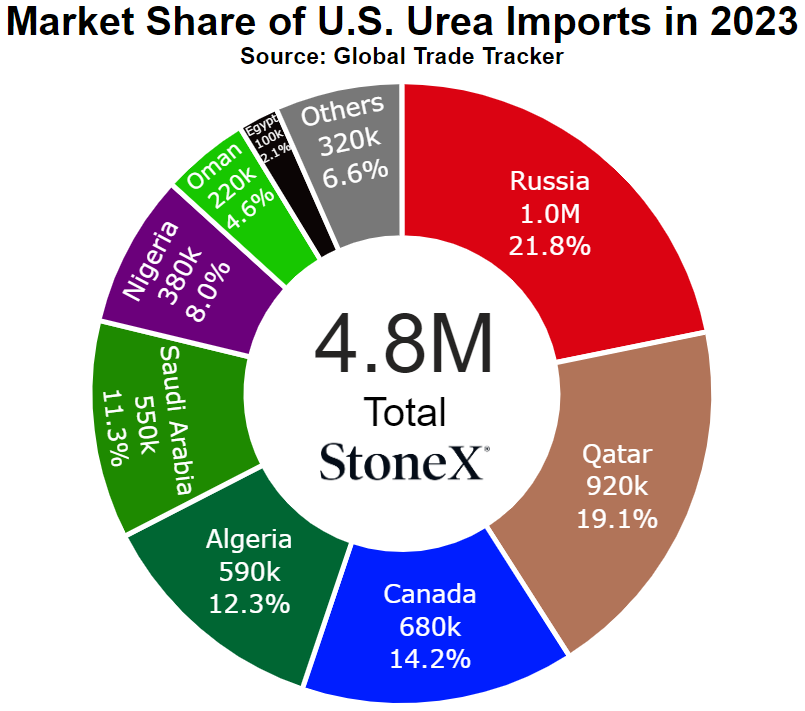
- The first is global supplies. If global supplies are more than adequate/long, then we can see NOLA values remain a discount and still see imports surge. When the world is long product, it is looking for the best/safest destination to offload positions. Even if NOLA is showing a discount, the near guaranteed demand and payment structure makes it an extremely safe destination. Unfortunately, our numbers are not showing a well supplied global market.
- The second is NOLA pricing vs the world. When the world is tightly supplied, like we believe it is this year, NOLA needs to move to even money or a premium to the rest of the world. If supplies are tight, global manufacturers/exports have options. They know they have plenty of places they can ship their goods and as such can hold out for the best value. If NOLA is below other alternatives, import flows suffer. If it suffers long enough, then NOLA needs to move to a premium to convince those tons to start arriving.
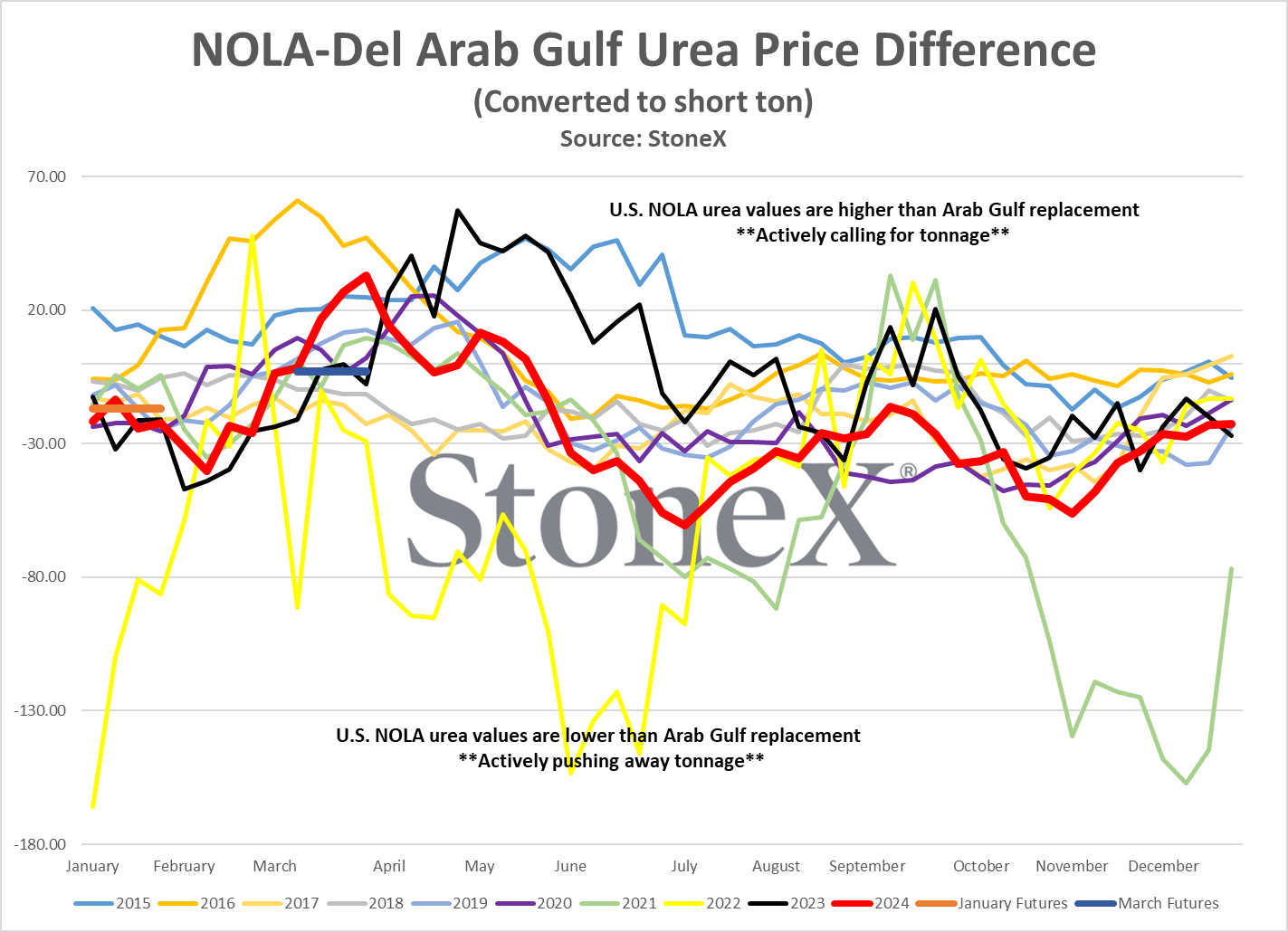
That second bullet point is where I think we are heading. NOLA has been a discount to Middle East replacement values for the entirety of this fertilizer year (started July 1). As such, imports have been slow...on pace for "normal" but still slow vs our ultimate needs.
We are now starting the 2nd half of the fertilizer year and the start of the calendar year. Spring is coming quickly, from a logistical POV. If you look at the graph below, the closer we get to spring season the more of a premium NOLA becomes to replacement values. That is the market asking/begging for tons to arrive.
Now, this change in price relationship can happen two ways. One is that global values fall while our prices hold tight. That can put NOLA at a premium without having to do any price work. It has happened before...but it is hard to see global values dropping given China/Europe supply issues. The other way is that NOLA needs to start moving higher to get ahead...which seems more likely today.
If you have been part of this for a while, you know I am a huge advocate for fertilizer being a world market. We have some influence on that global story, but we are not the global story. If global supplies remain snug as they have been, I am afraid that not only could we see further strength on global markets, but NOLA will be forced to start rallying hard to get ahead of the trend.
Again, I would love to be wrong because being right does not help pricing...
How does this affect farmers?
If global urea values hold or push higher, then North American values have a lot of work to do.
As always seems to be the case, this means higher prices.
My perspective is that global supplies are tight. Europe is still 75% of normal production and not improving. Chinese exports are still not returned and again, no sign of improvement today. That should mean that North America will need to compete to get the much needed imports (cannot sit back and wait for long global positions to dump product).
Basically, I do not think we are getting our imports while we are a $30 discount to the world. If we end up having to do the price work to get imports, we could see our prices rally $30 - $50 just to get "right sized".
NOLA/New Orleans, Louisiana
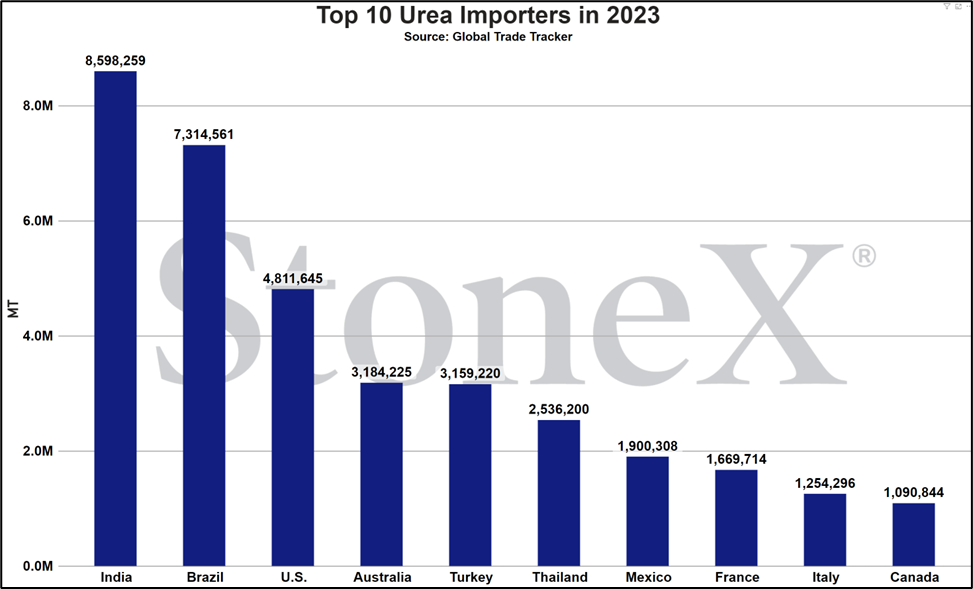
Number 3 global importer in 2022
Price comparisons
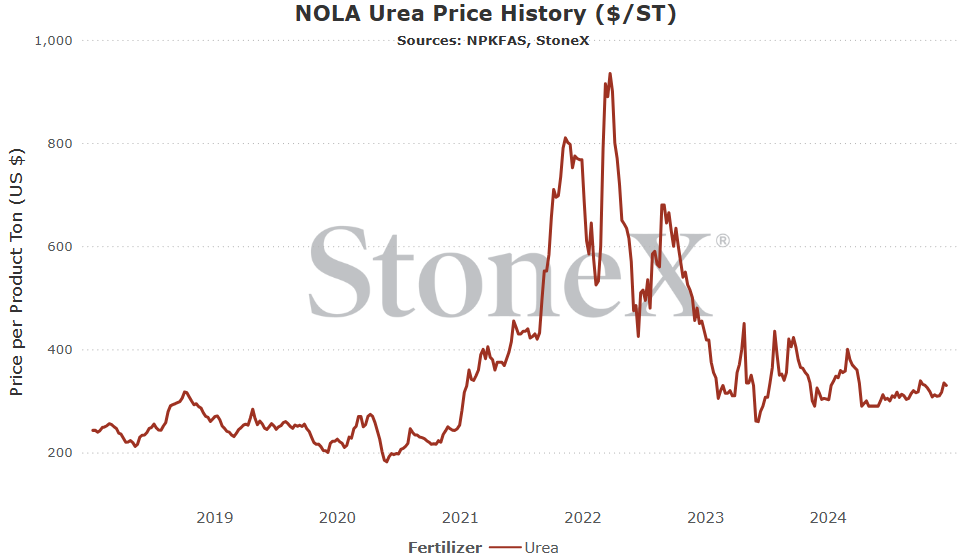
Vs 30 days ago - 7% or approximately $21 higher
Vs 90 days ago - 4% or approximately $14 higher
Vs 6 months ago - 9% or approximately $27 higher
Vs 1 year ago - 8% or approximately $25 higher
U.S. Midwest Average
Vs 30 days ago - 4% or approximately $16 higher
Vs 90 days ago - 8% or approximately $30 higher
Vs 6 months ago - 7% or approximately $27 higher
Vs 1 year ago - 11% or approximately $38 higher
U.S. Southern Plains Average
Vs 30 days ago - 2% or approximately $8 higher
Vs 90 days ago - 6% or approximately $23 higher
Vs 6 months ago - 8% or approximately $28 higher
Vs 1 year ago - 8% or approximately $30 higher
U.S. Northern Plains Average
Vs 30 days ago - 5% or approximately $18 higher
Vs 90 days ago - 7% or approximately $25 higher
Vs 6 months ago - 5% or approximately $17 higher
Vs 1 year ago - 1% or approximately $3 higher
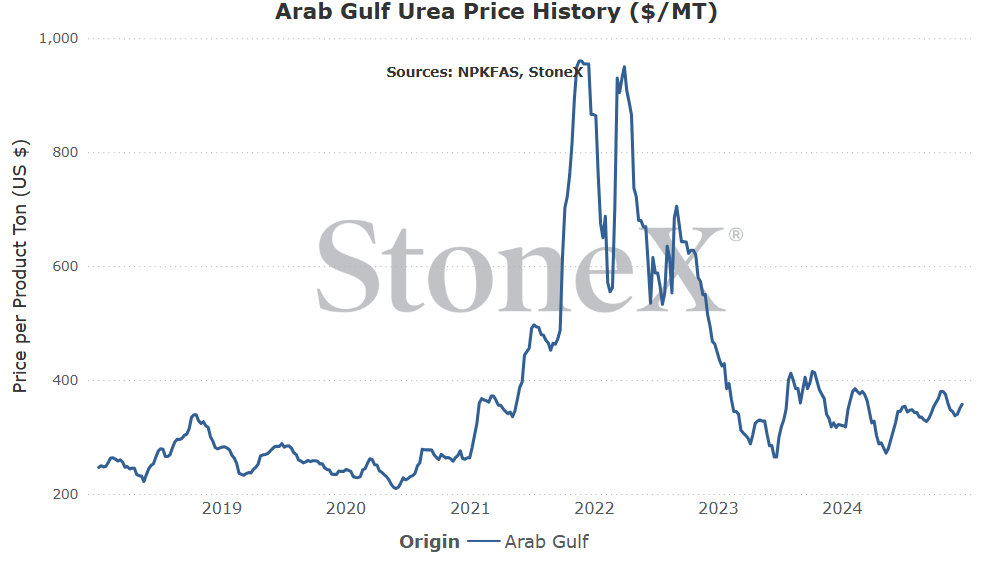
Middle East
Number 1 exporter (as a region, not as individual nations)
Vs 30 days ago - 4% or approximately $13 higher
Vs 90 days ago - 5% or approximately $16 higher
Vs 6 months ago - 5% or approximately $18 higher
Vs 1 year ago - 11% or approximately $36 higher
Egypt
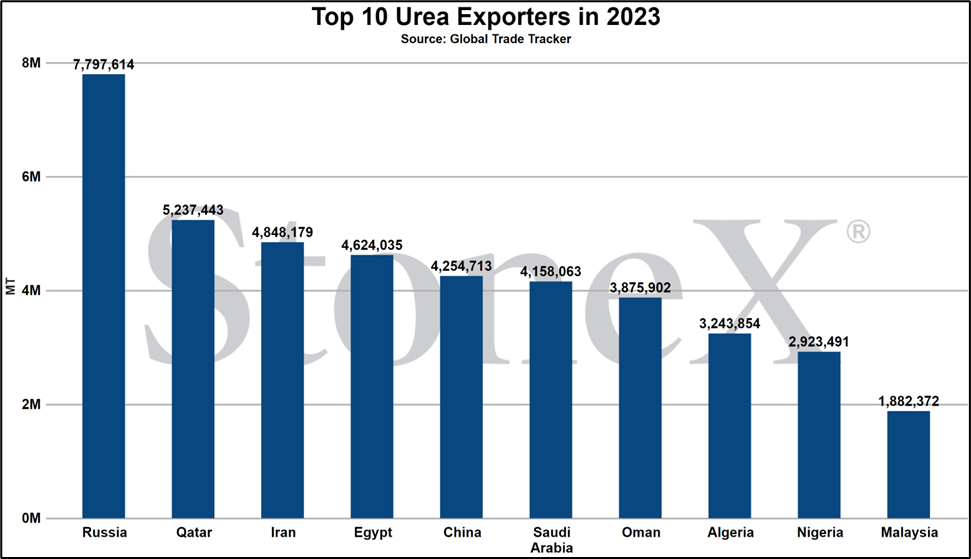
Number 4 global exporter in 2022
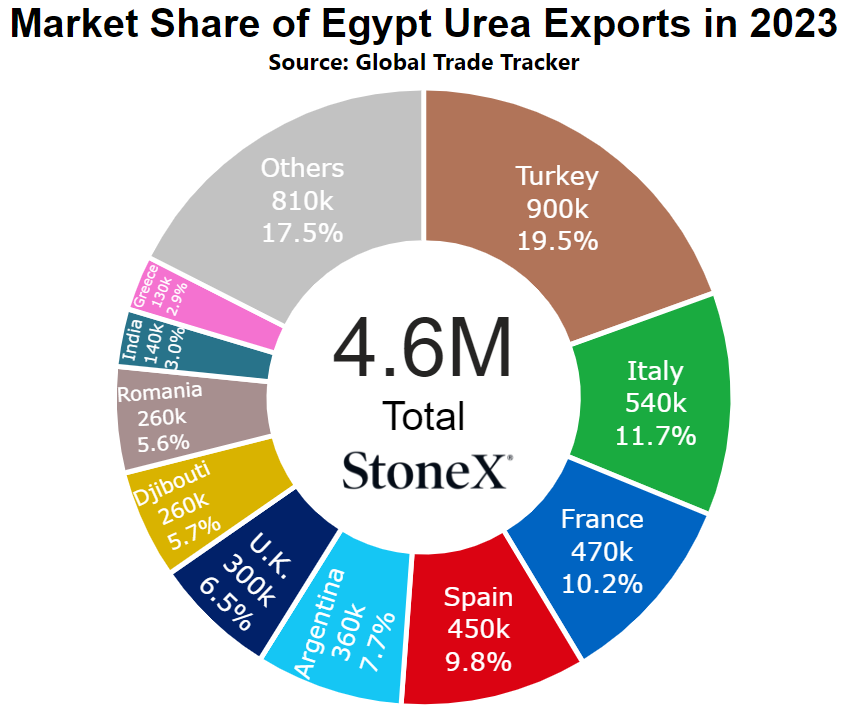
Price comparisons
Vs 30 days ago - 7% or approximately $27 higher
Vs 90 days ago - 7% or approximately $25 higher
Vs 6 months ago - 10% or approximately $36 higher
Vs 1 year ago - 15% or approximately $51 higher
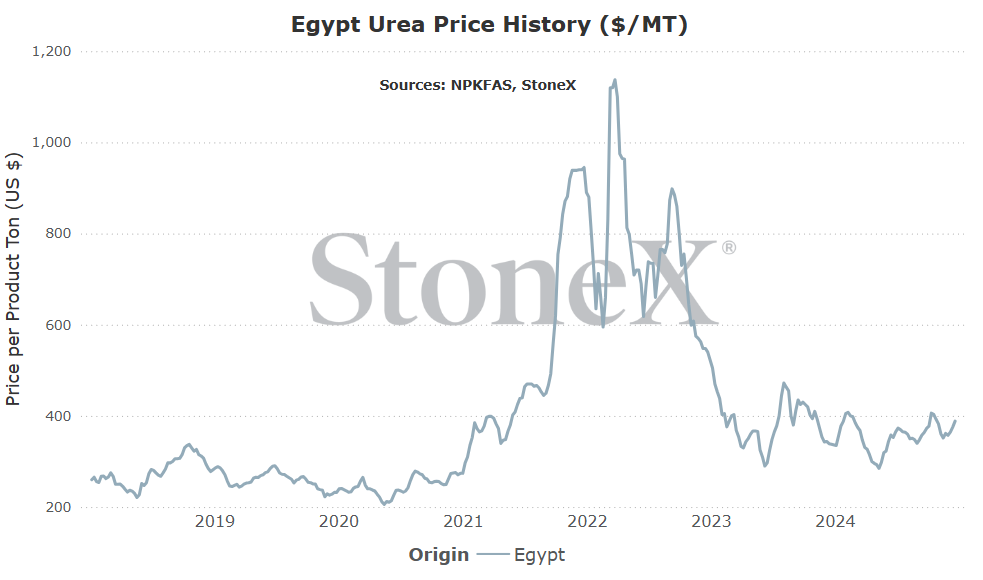
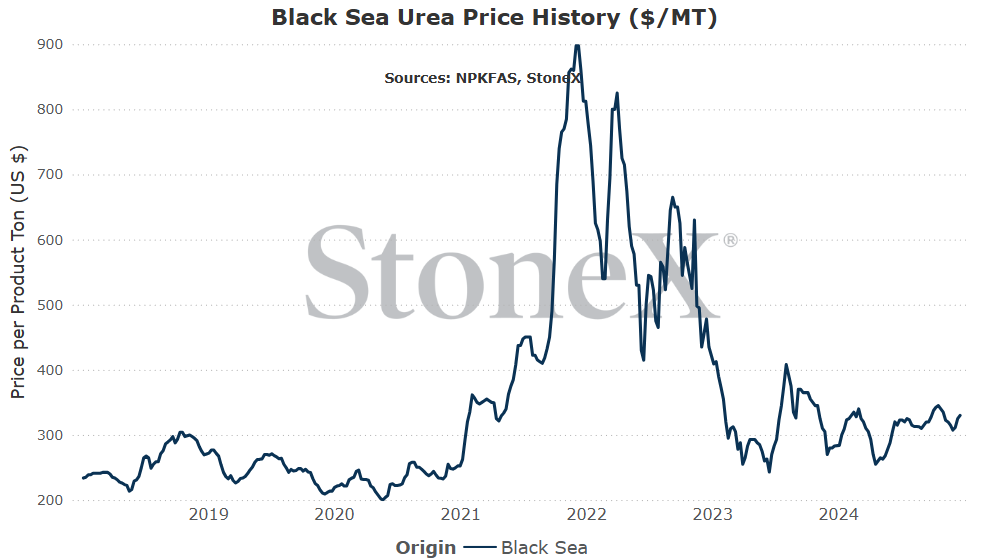
Black Sea
Number 1 global exporter in 2022
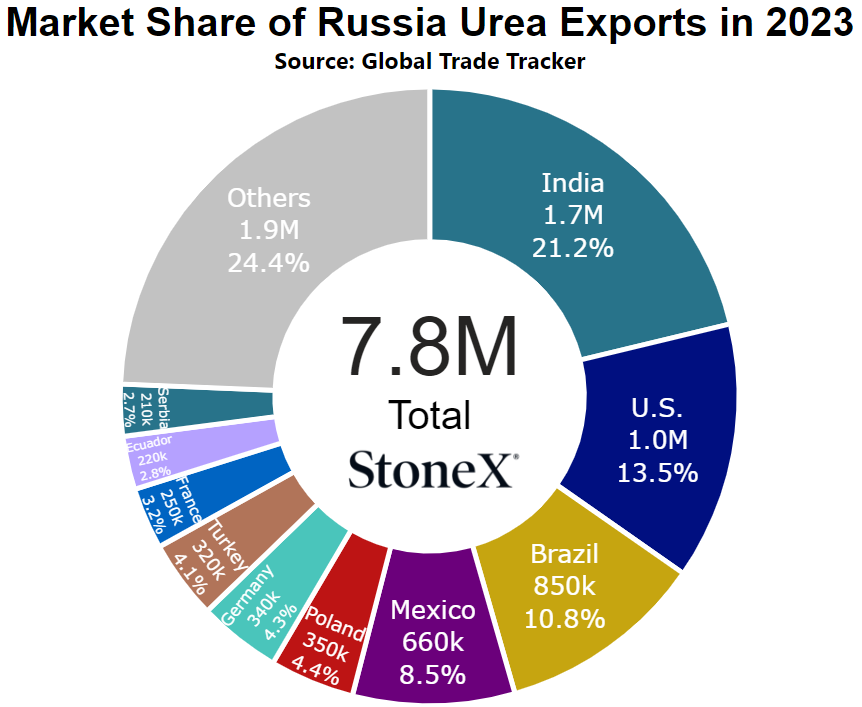
Price comparisons
Vs 30 days ago - 5% or approximately $15 higher
Vs 90 days ago - 3% or approximately $10 higher
Vs 6 months ago - 5% or approximately $15 higher
Vs 1 year ago - 17% or approximately $48 higher
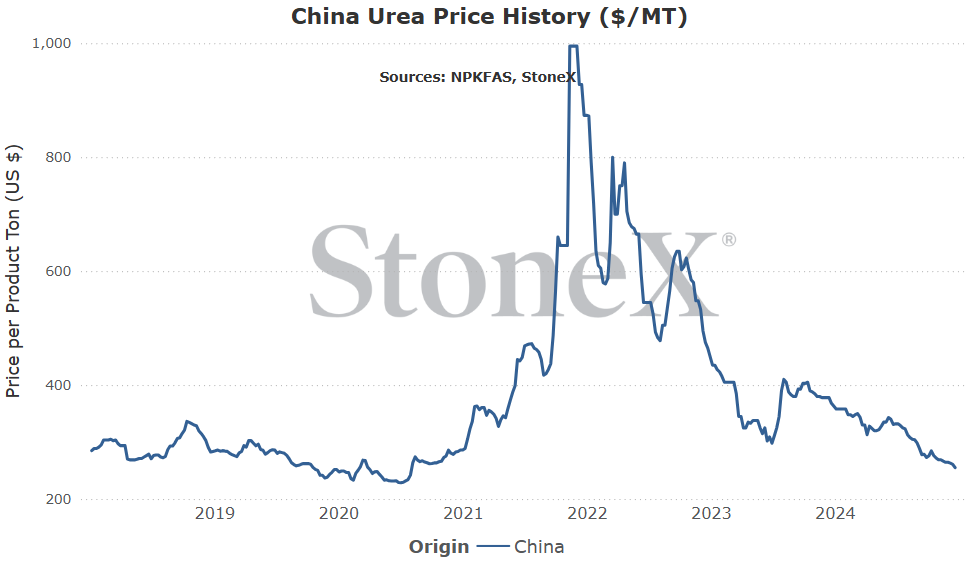
China
Number 9 global exporter in 2022
Price comparisons
Vs 30 days ago - -4% or approximately $10 lower
Vs 90 days ago - -8% or approximately $24 lower
Vs 6 months ago - -23% or approximately $76 lower
Vs 1 year ago - -31% or approximately $113 lower
Brazil
Number 2 global importer in 2022
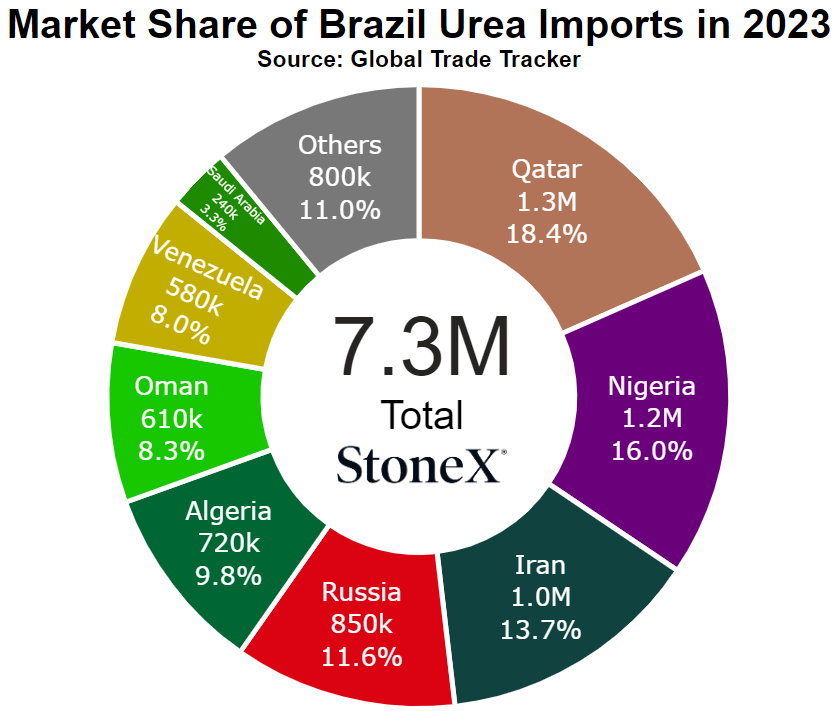
Price comparisons
Vs 30 days ago - 6% or approximately $19 higher
Vs 90 days ago - 1% or approximately $5 higher
Vs 6 months ago - unchanged vs 6-months earlier
Vs 1 year ago - 12% or approximately $39 higher
- Chinese exports remain historically low - unfortunately, most everything that I see today points to this story. 2024 Chinese urea exports have not only been low, they are historically low. I cannot remember ever seeing them like this and it doesn't look like it is improving near term. China typically exports 5 to 5.5M tons per year and for 2024, I doubt they hit 500K. That is 5M tons missing from a 50+M ton global export market. Doesn't matter how you cut it, losing that many tons keeps the S&D tight...and price ideas high.
- Pent up demand has no choice but to come forward - this is a weird time of the year. It feels like we are just starting winter and it is going to last forever. Unfortunately, logistically speaking, we are almost to spring and there is a lot of buying left to do. Buyers around the world have been struggling with low grain prices. That means dragging your feet on purchases until something better comes along. Well, at least here at home in Missouri, planting is only 90 days away. It is time to get off the pot, so to speak.
- Production hiccups continue - the world has already been dealing with low Chinese exports, summer production issues in North Africa, and European production being 75% of normal due to high gas costs. Now, we are seeing Iranian producers shutting down to gas issues. We also have to keep in mind that we have seen N.A. producers shut down the last couple winters due to artic blasts. Basically, the more production hiccups we see, the worse the S&D gets. We simply do not have the excess tons around the world to fall back on today.
- China does a 180 on exports - there are some that are still sticking to this belief. While I struggle with the possibility of this happening, I sure am not going to be one that guarantee's it will not happen. I've learned that painful lesson. Still, if we suddenly see Chinese exports resume, it changes the world. They are the player you do not want to go against. If they suddenly started to export, it would not fundamentally change the global S&D on day 1...but it sure would change the emotion/market outlook. China has that kind of power in urea.
- Low grain prices cause 2025 planting intentions to change away from N - I am going to be blunt on this. I do not expect this to happen. Here at home, we continue to hear some say that corn acres will be down substantially. That is not our view. In fact, in recent weeks, we have been more bullish on corn acres (shifting from 92 to 92.5M). Still, the only constant in life is change. If we did start to see farmers shifting away from input intensive crops like corn, it could hurt nitrogen demand and see values lower. Not likely, but something to watch as there is still time for changing.
- Incoming Trump administration brings peace - there is a lot of fear in some pretty important nitrogen production regions of the world. Russia exports a lot of nitrogen...and continues to invade Ukraine. Chinese exports have been extremely low which could be their stockpiling in case they decide to invade Taiwan. The Middle East continues to be a tinder box. Trumps 1st term saw the world much more at peace than in a long time. If he can replicate that in his 2nd term, then the global urea market no longer needs to fear some of these situations. Taking that war fear premium off the table could help usher lower values of urea.
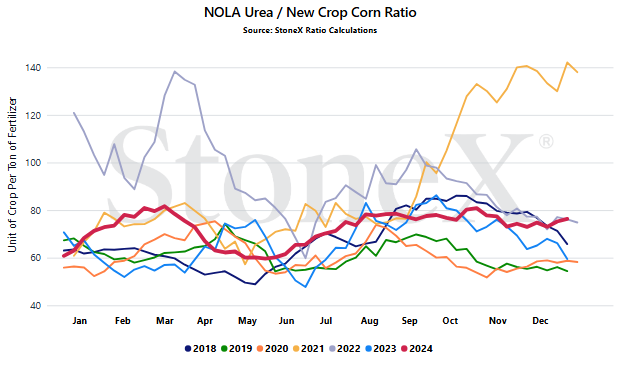
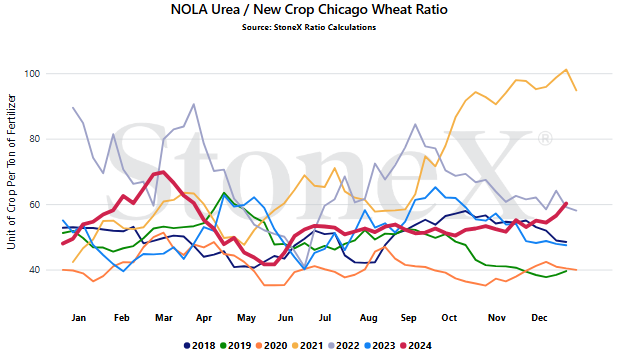
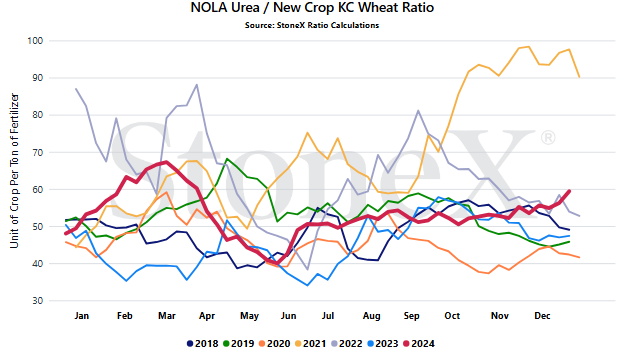
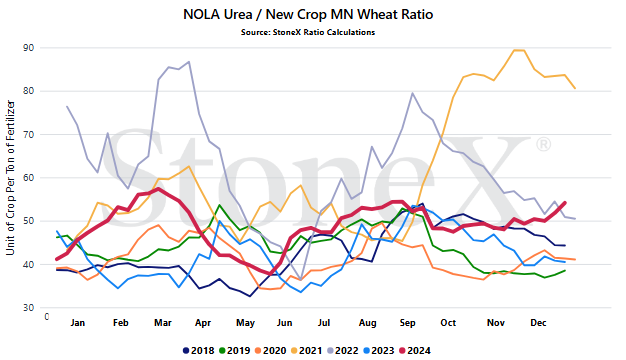
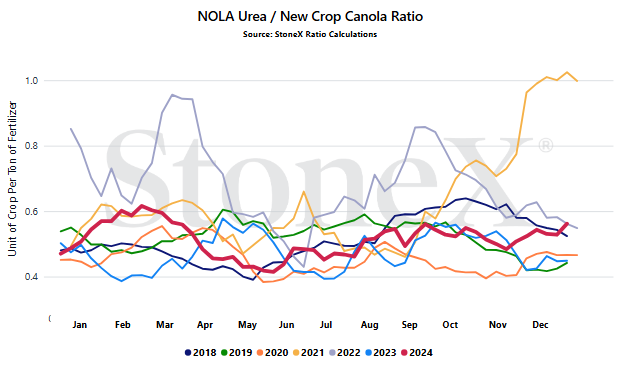
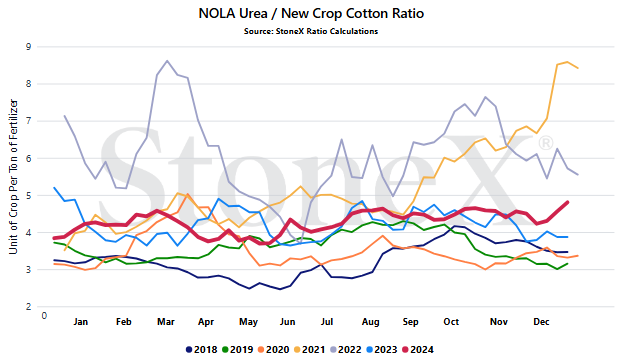
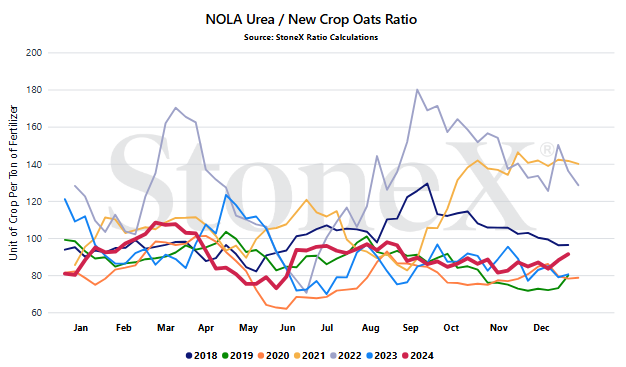
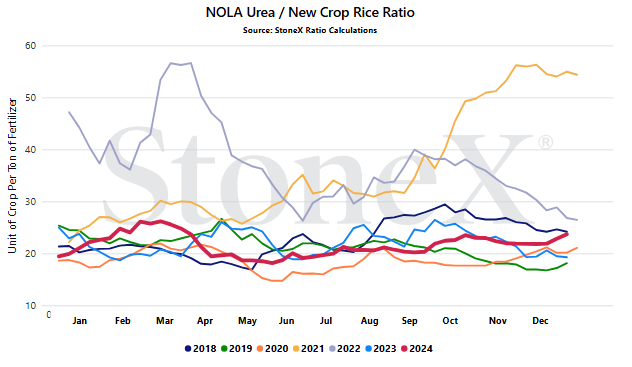
We believe that only looking at the flat price of either grains or fertilizer can be misleading:
- Only selling grain can hurt you if fertilizer prices rise substantially
- Only buying fertilizer can hurt you if grain prices fall
We look at the ratio "value" to get a better indication of where we are or how many bushels of X does it take to pay for 1 ton of fertilizer.
Would you rather:
- Spend 135 bushels to pay for 1 ton of urea
- Spend 55 bushels to pay for 1 ton of urea
When we compare the current ratio value against recent years, we start to see if we are high or low.
YOUR VALUES WILL LOOK DIFFERENT
This graph looks at the NOLA urea price vs the flat grain price. There are no logistics on either product. Your location will look different due to fertilizer logistical costs, grain basis, etc.
- Chinese export programs - well, we got China's November export data for urea and it didn't do anything to help the urea story. Only a few thousand tons were reported to have left Chinese territory, further pushing the narrative that their export flows will remain slow for the time being. Now, as with all things China, we know they can change quickly. Some still say that domestic storage is packed full and they will have little choice but to start exporting. Others still say that their demand has jumped as the government has challenged farmers to increase food production to become self sufficient. Regardless, we have to consider the world moving forward without China until they prove otherwise. They will leave a 5M ton hole in the 50 - 55M ton global urea export marketplace for 2024 and the early signs are that 2025 will start much the same. That hurts...and keeps prices supported.
- How India reacts to purchase tender failure - by all accounts, it looks like India's recent urea purchase tender is going to be an abject failure. They were looking to secure 1.5M tons between their west and east coast ports. Today, it looks like they are going to struggle to hit 250K tons. So how will they respond? We know that they have to return to the buying portal very quickly. Unfortunately for them, they will need to do that with a shorter timeline and sellers around the globe know it. They will also be returning to buy and having to compete with a lot of other global buyers which lends support to manufacturers/sellers. Things can change but it sure looks like India is going to help move global price ideas higher.
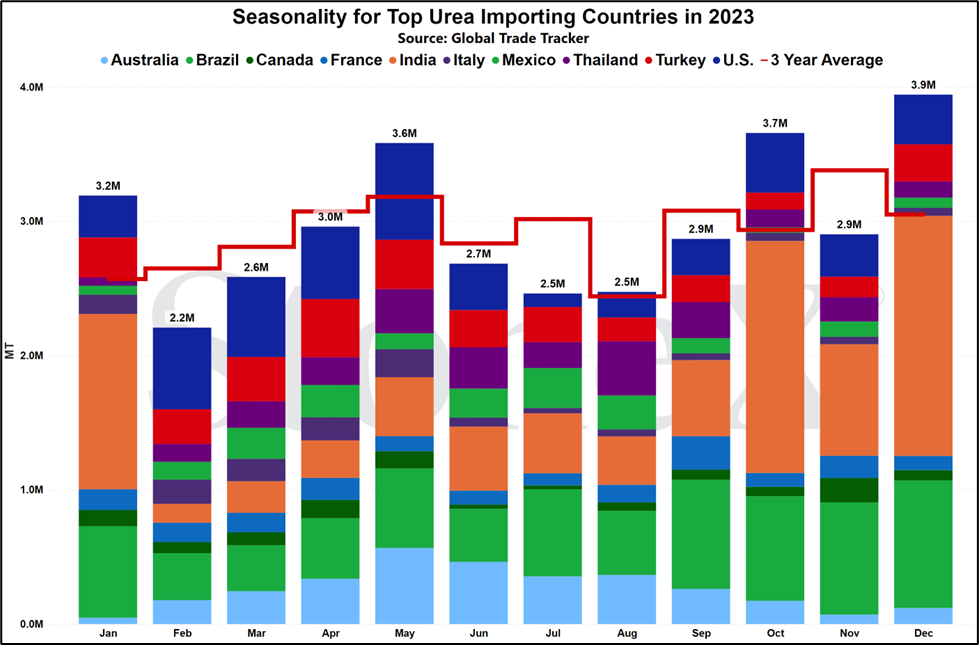
- N.A. values vs the world (import story) - N.A. urea values have been a discount to world replacement since the summer...and that is ok. This is very typical and our markets way of saying "we do not need large imports. What we produce is enough to meet demand." However, that story cannot last forever. We forecast that the U.S. needs to import around 5.1 - 5.2M tons to meet N.A. urea demand in the spring. At some point in the next few months, imports need to be called on. If the world was long product, NOLA values could remain discounted and likely still receive the needed tons...but the world doesn't feel long with export/production issues. If imports do not pick up, NOLA will need to move to even money/premium to start enticing the flows. When that happens is anyone's guess but it should need to happen. Spring is coming fast.
StoneX Ratio Calculation
The ratio calculation is derived from Bloomberg historical grains values as well as fertilizer values from StoneX, NPKFAS, and Argus.
The calculation is simply dividing the fertilizer price by each grain price.
All data was sourced from StoneX unless otherwise noted.