The intention of the below graphs are not to use to say "my price should be X based on this graph". These prices are derived from an FOB price point average. The intent is to show major global price movement trends. Your values will likely have significant basis difference (similar to your local grain price being different than the traded market price).
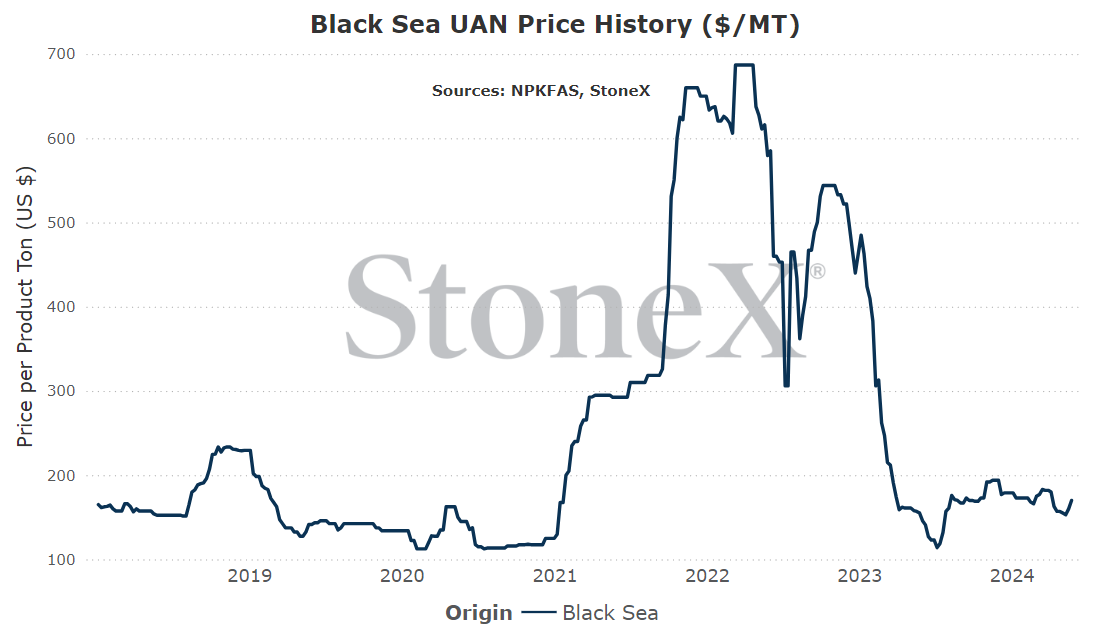
This graph is labeled as MT in USD currency.
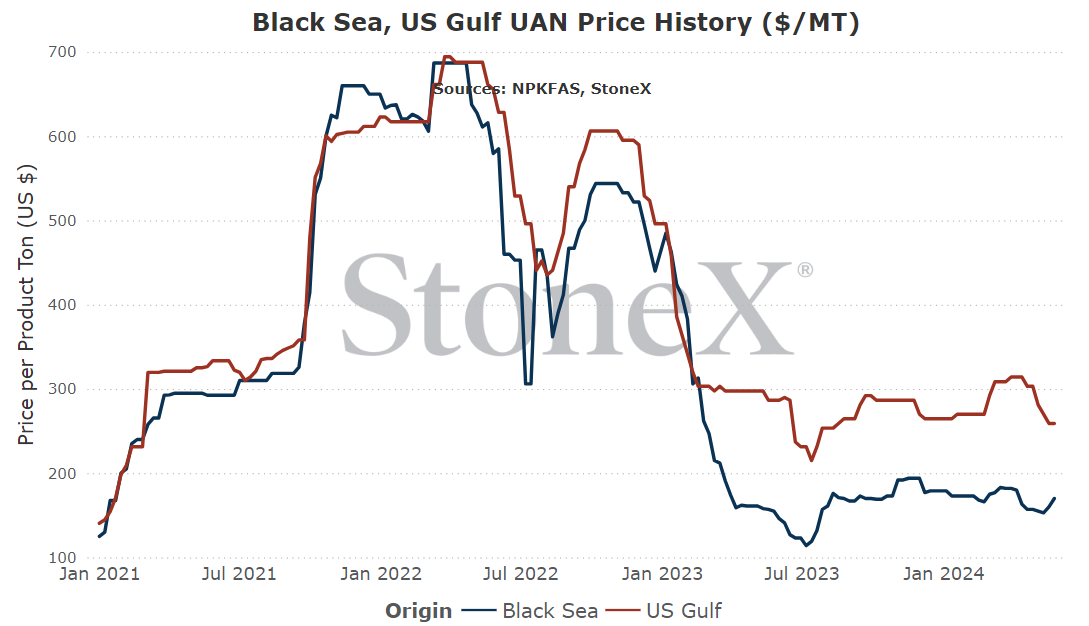
Values internationally are down huge from their high's. How could we think they go any lower?
Short term memory is going to be a danger to a lot of our market views. This period of tight inventory/high price lasted longer than many believed possible. It lasted long enough that it has almost become normal in our minds.
That said, take a look at the far left side of the graph above. That is closer to normal, historically speaking, than where we are today. Also, look at the dip from last summer. The world of UAN continues to appear to be in a better supply place than it was a year ago, so why shouldn't values go lower.
Assuming nothing huge happens to change market, I still believe we have more bearish work to do in this marketplace. Certainly if UAN manufacturers want to find any buyers.
Rising European Dutch TTF (natural gas) values dash hopes of nitrogen plant restarts
As of today, European nitrogen production remains cut by 25 - 35% of normal due to Dutch TTF/European natural gas values remaining high priced.
For backstory, Europe has historically been reliant on Russia for their natural gas supplies. However, in recent years, that supply was shut off. At first, it was the fight regarding Nordstream 2 pipeline that ultimately ended with a brazen attack in deeper ocean waters where repairs are very difficult. Any hope that negotiations would succeed were dashed. Hard to pump gas thru a pipe that has been destroyed...
Then, Europe learned just how reliant they were on Russia. Values quickly skyrocketed. Where historic norms were in the single digits, August 2022 saw futures rise to just over $103MMbtu. Needless to say, the majority of European based nitrogen turned off. It was simply too expensive to produce. Every ton made would be at a loss.
Fortunately, as open markets tend to do, a new normal was found. Other global natural gas supplies started to find their way to Europe and values started to fall. Eventually, that production rates climbed from the low of 25 - 35% of normal to the new plateau of 75%. Still short of normal but a huge gain.
Then, Dutch TTF values continued to fall and there was a rising hope that the remaining 25% would turn on again. That has not been the case.
It has been some time since we have heard of an offline production plant restarting. We can no longer use "plants are waiting for warmer temperatures" or "companies are waiting for demand to return". Both of those arguments have been put to the past with no change.
Now, we are seeing Dutch TTF values start to rise again. Certainly not to the previous high's, but they have breached double digits again and continue to trade around $10 - $11MMbtu, and it appears with little hope of going lower again.
To say that these plants will never come back is short sighted. A lot of money went into the building of the facilities as well as the maintenance. They hold a lot of jobs and support local ag industries so any decision to scrap the facilities would be met with a lot of local angst.
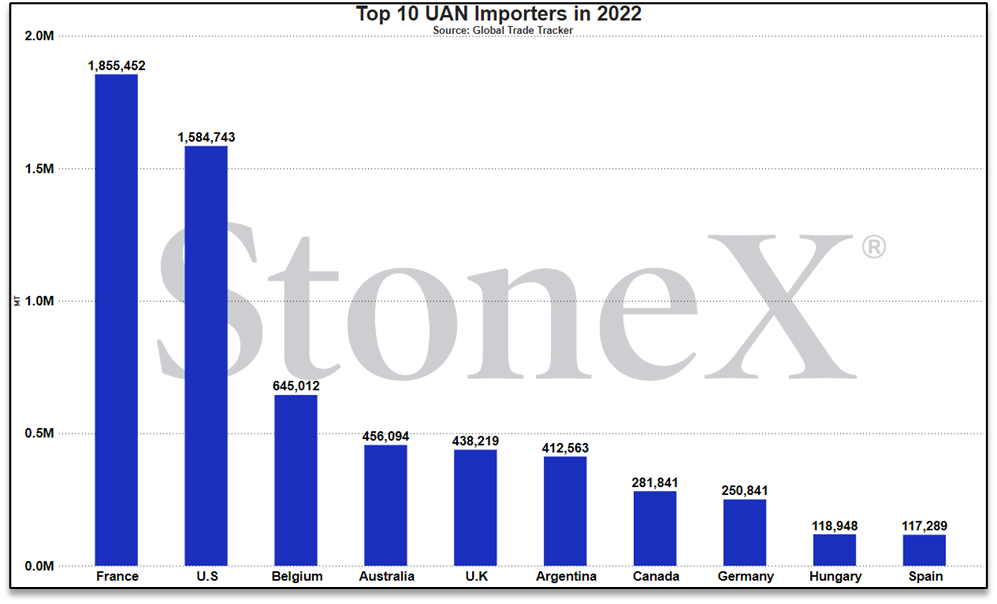
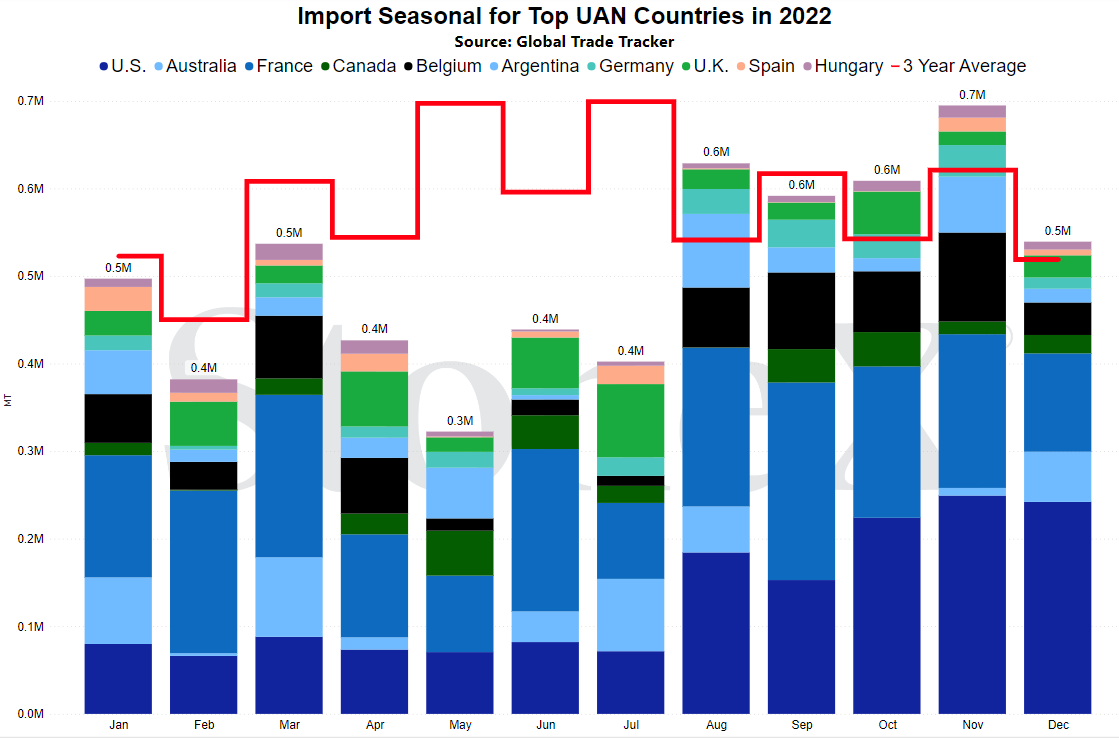
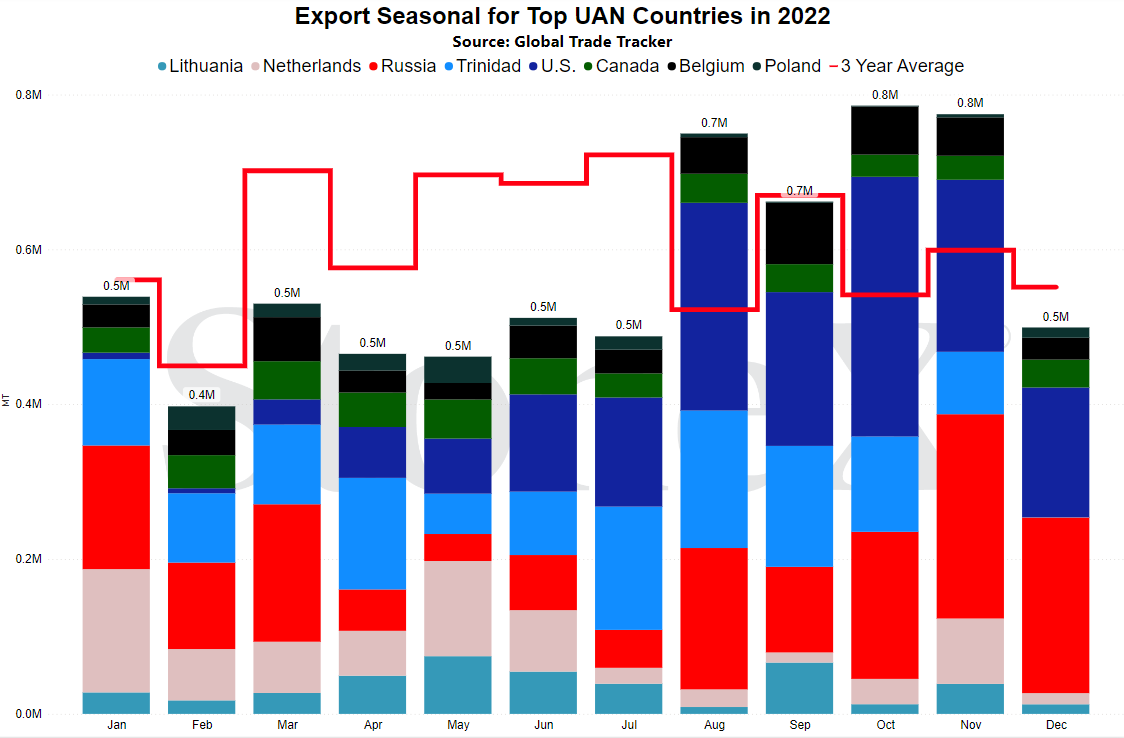
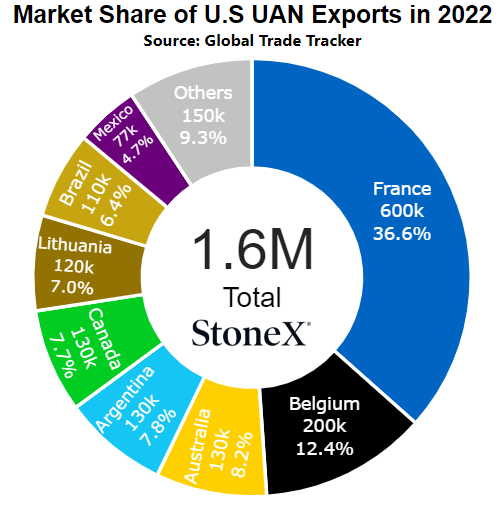
Now, what does this mean for global/domestic UAN markets? Europe represents nearly a third of all the UAN produced in the world. So losing a quarter of that is a big hit. In the absence of European production, we have seen N.A. manufacturers exporting UAN to Europe at a much higher rate that normal as it has provided a much better netback price than N.A. markets have. Assuming that Russia remains cut from sending UAN to Europe, this will continue until that offline production restarts. That means N.A. manufacturers have an "outlet valve" for any excess inventories they might produce which also gives a reason to keep price elevated. This seems to be a story that doesn't want to die.
Why does this matter to Aussie farmers?
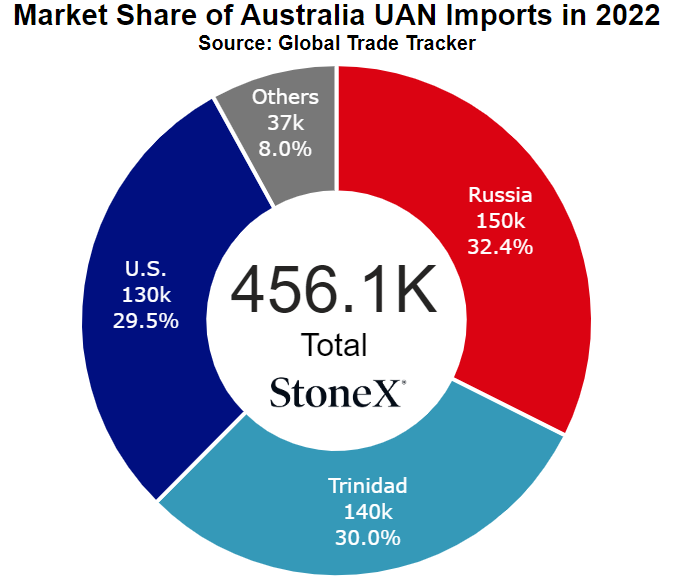
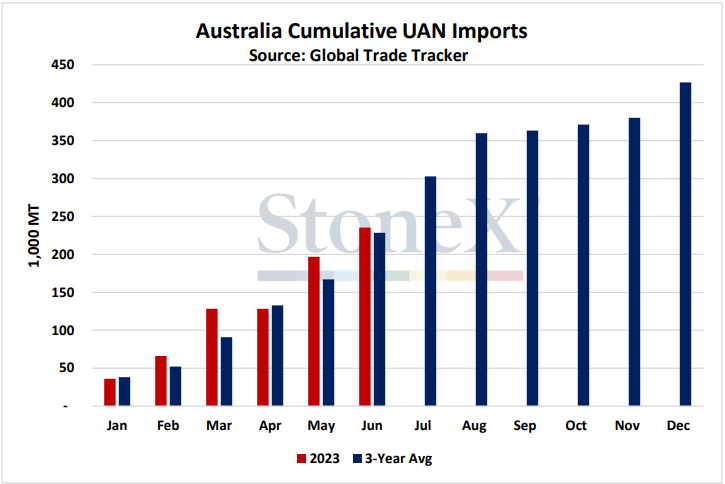
When European production went offline, U.S. manufacturers reaped the benefit by backfilling supplies with their production. While imports from Russia have helped keep supplies from getting too tight, which would cause values to rally, the fact that the export opportunity still exists helps to keep the S&D much tighter than it would be otherwise.
With Australia being so dependent right now on the U.S. for its UAN supply, what happens there happens here.
Should N.A. be worried about losing Russian imports?
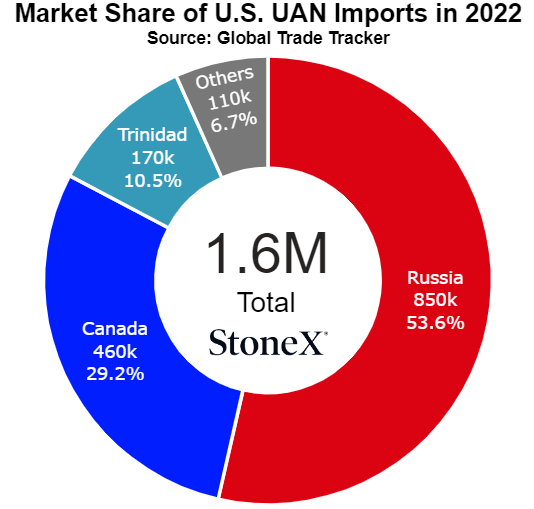
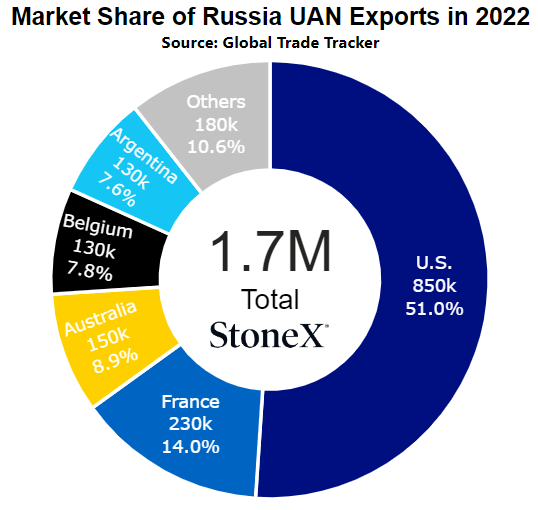
One of the things that has really helped keep the N.A. UAN market in control has been Russian import. While the Canadian government has blocked Russian imports, the U.S. never took that final step. As a result, Russia has shipped a lot of product to the U.S. marketplace which has been a huge help given that U.S. manufacturers have been shipping nearly the same amount of tons to Europe.
You heard me right. For almost every ton imported to the U.S., nearly the same number of tons are being exported.
Fertilizer Year 2024 Cumulative UAN Imports - 1.7M
Fertilizer Year 2024 Cumulative UAN Exports - 1.4M
So it makes sense that we should be very cautious and watchful for any attempt to block those imports.
...well, we may have heard the first salvo be fired. During earnings calls, one company made a rather interesting statement in regards to buying Russian UAN is akin to supporting their war on Ukraine. The reason this caught my attention so badly is that I think this is another attempt to block those tonnages.
Following the approval of phosphate counter vailing duty rates against Morocco and Russia, an attempt was made to do the same on Russian UAN. That attempt ultimately failed...but I do not think they ever let it go.
Making a comment such as that, from my perspective, is their way of taking another attempt to stop the flow. No doubt trying another counter vailing duty case is not likely. They take a lot of time, effort, PR, etc. for the company calling for it. Adding to that the fact that the case was already voted against. So rather than run that same road, it would be better/easier to take the political route. Try to connect Russian UAN to Russia's invasion and get D.C. to get involved. That way, it is a political judgement and not a manufacturing company trying to block competition.
So far, we have not heard anything further but this will be high on our radar's.
Why does this matter to Aussie farmers?
This could be huge for Australia if the government does not reverse restrictions on Russian imports.
If the U.S. were to push forward with blocking Russian UAN imports, that would cause supplies in North America to get extremely tight extremely quickly. Have you ever seen an input market that didn't take advantage of tight supplies with higher pricing? The result would be that North American producers would be able to tell the market "either buy this price or we will export it". They would have more options which gives more negotiation power.
In the end, that would cause Aussie values to rise...I wish this were not the case and I certainly hope this is a story that does not play out.
NOLA/New Orleans, Louisiana
Number 2 global importer in 2022
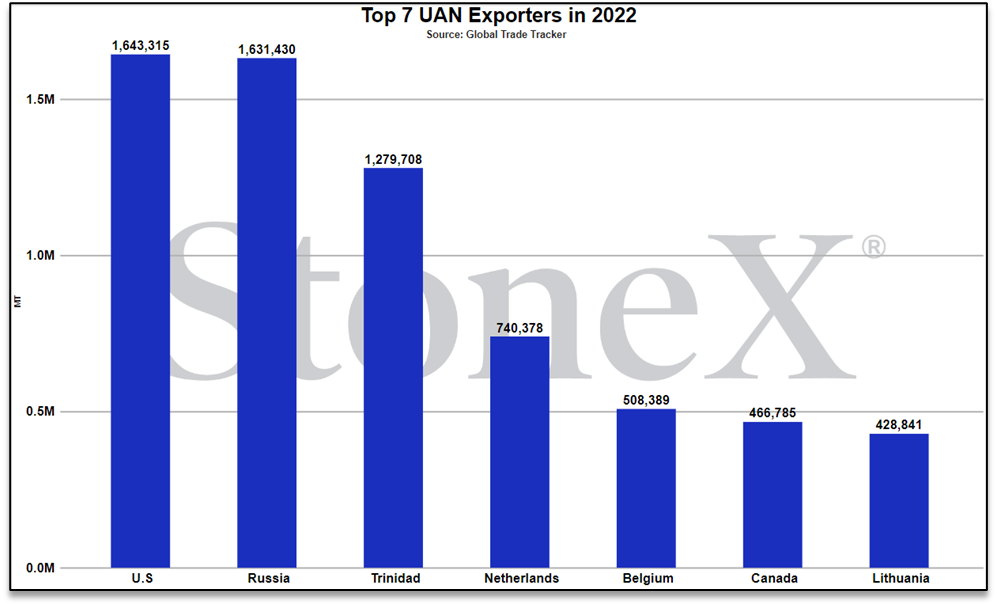
Number 1 global exporter in 2022
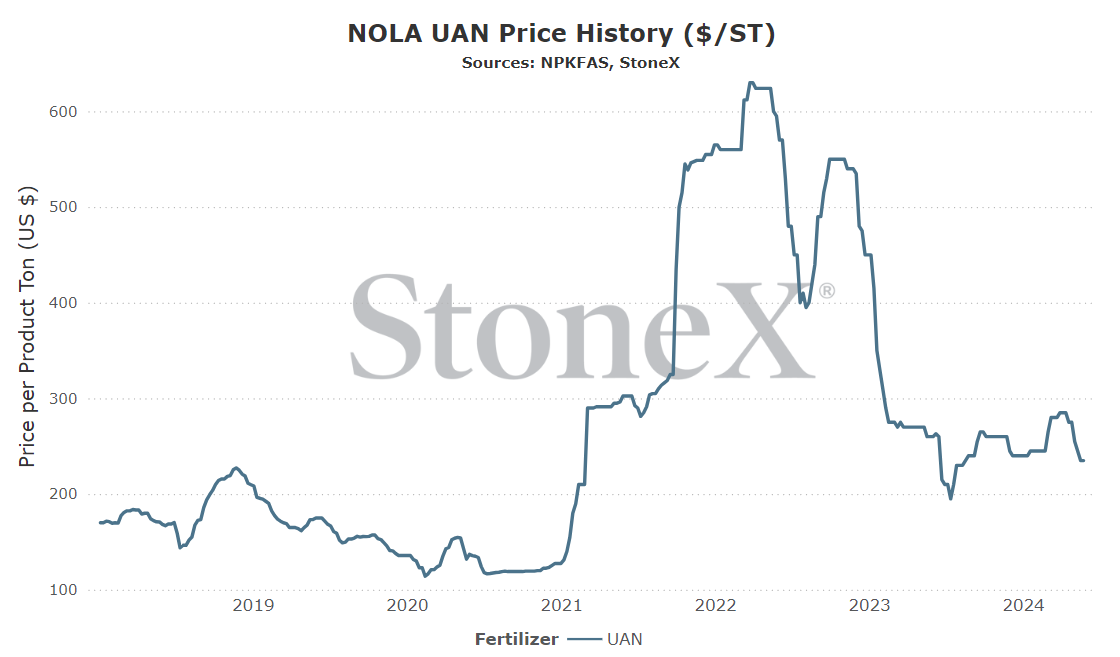
Price comparisons
Vs 30 days ago - -15% or approximately $40 lower
Vs 90 days ago - -4% or approximately $10 lower
Vs 6 months ago - -10% or approximately $25 lower
Vs 1 year ago - -10% or approximately $25 lower
Black Sea (Russia)
Number 2 global exporter in 2022
Price comparisons:
Vs 30 days ago - +8% or approximately $13 higher
Vs 90 days ago - +3% or approximately $5 higher
Vs 6 months ago - -12% or approximately $24 lower
Vs 1 year ago - +10% or approximately $15 higher
- Further European nitrogen plant stoppages – I really hope this does not happen but with Dutch TTF values creeping higher, we need to watch for it. If more European production goes offline, it is going to hurt the global UAN marketplace.
- U.S. starts to consider blocking Russia imports – again, this is another low likelihood situation but major enough to watch. I'm hoping this story does not gain any traction but if we start hearing more about it in reports/articles/D.C. discussions, we need to start getting nervous about prices moving higher.
- Australia government keeps Russian import restrictions in place - if the government were to drop the restriction on Russia, their UAN could start flowing very quickly, allowing Aussie farmers to enjoy their lower price ideas. Unfortunately, we have not seen/heard any sort of news that this is the case and as a result, prices are supported.
- Long, slow summer ahead – actually, for UAN, long summer/fall/winter is ahead! Basically, after this last push, there is a lot of calendar between today and next spring. Farmers are not in a great mood given that profitability is suffering vs the last few years. Retailers are going to be gun shy, knowing farmers will be skeptical. Lot more of the pressure will be on manufacturers to find a price that works to bring spring demand forward.
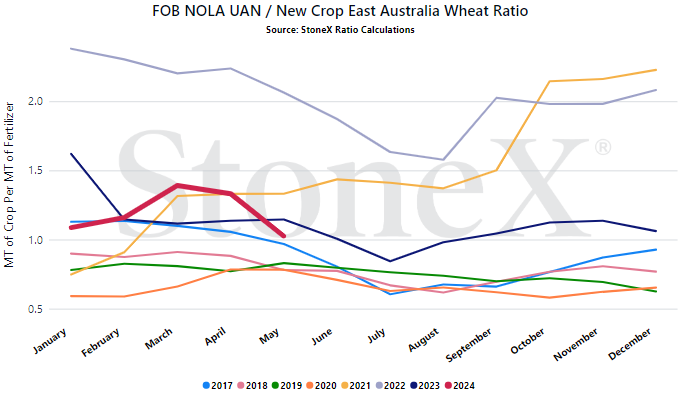
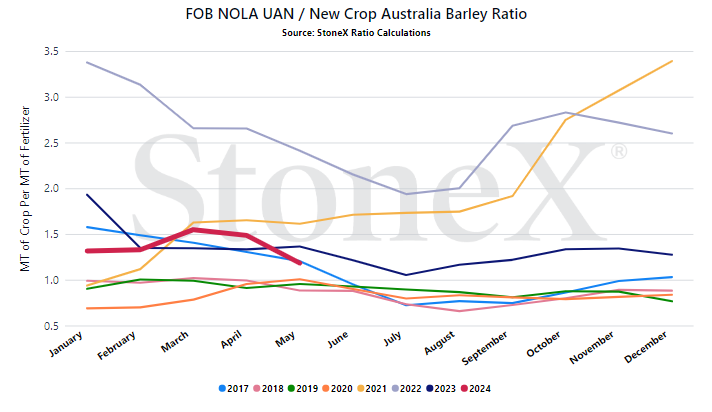
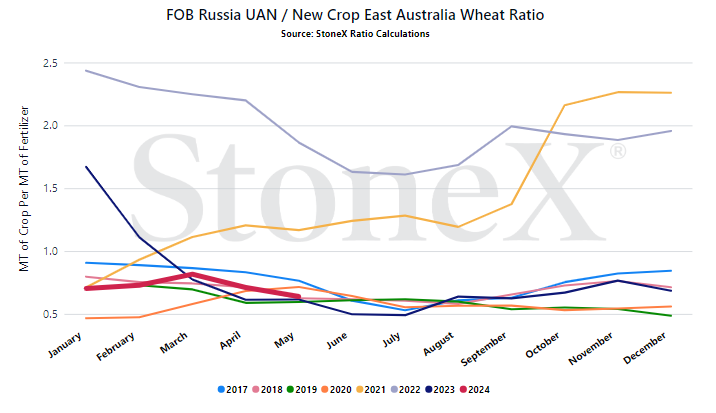
- UAN relatively high priced vs grains – similar to above, there just isn't much exciting about current UAN values. When compared against several of the grains (below), there is nothing screaming "buy me". It doesn't mean manufacturers are desperate to sell today...but that day could come sooner than we think.
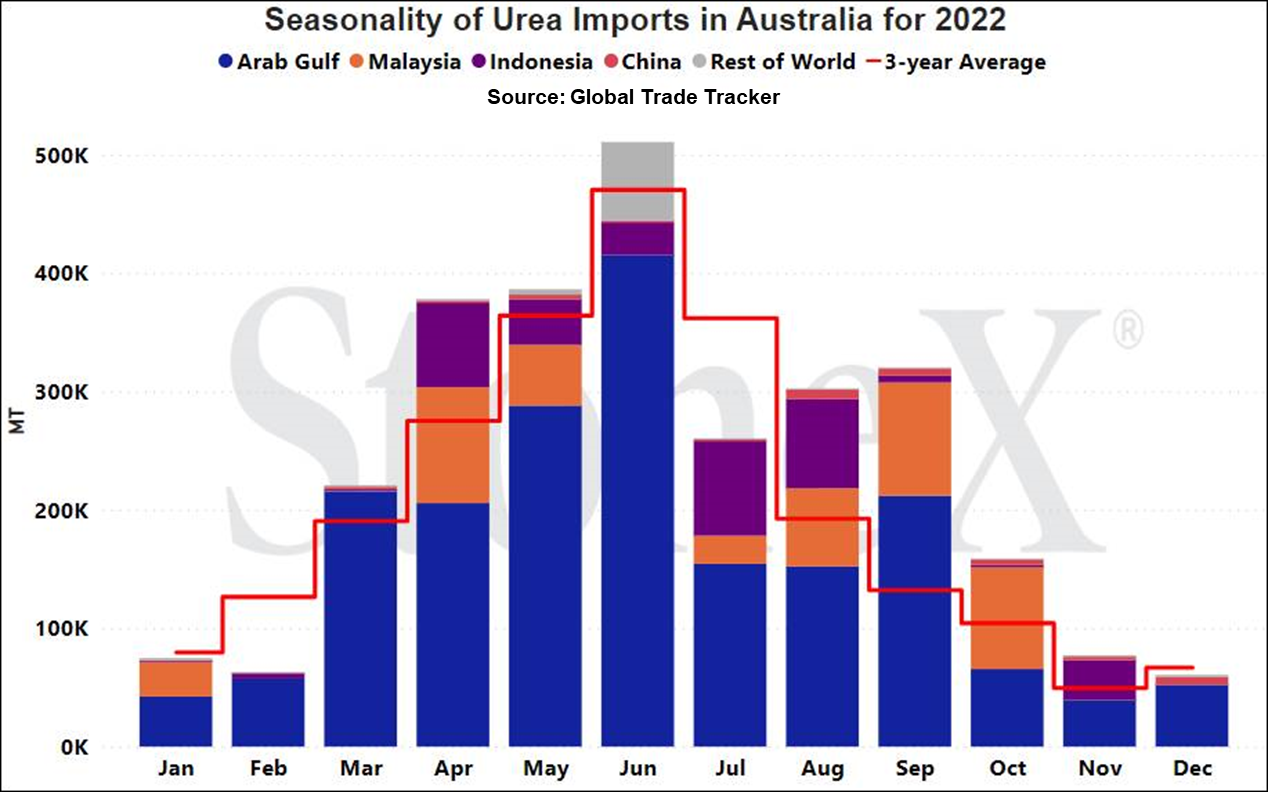
- If the Aussie government lifted Russian restrictions - these restrictions were originally put in place to punish Russia's actions against Ukraine. A lot of nations said that there were going to, but in the end to my knowledge, only Australia and Canada did it to fertilizers. Now, if the government were to revise these restrictions and do away with them, we would no longer be reliant on the U.S. Russia has basically been begging for another customer in the world to ship product to.
We believe that only looking at the flat price of either grains or fertilizer can be misleading:
-
Only selling grain can hurt you if fertilizer prices rise substantially
-
Only buying fertilizer can hurt you if grain prices fall
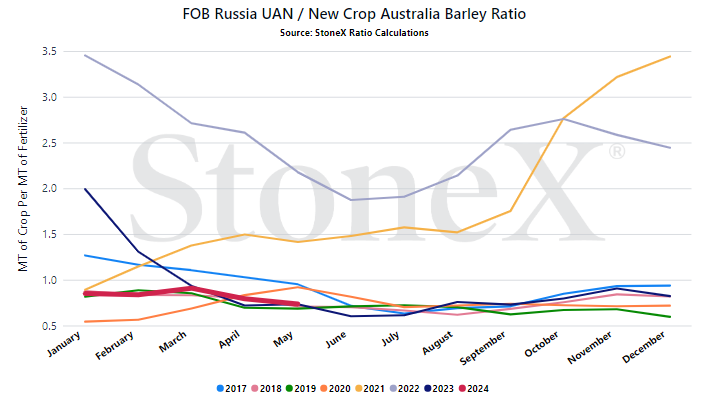
We look at the ratio "value" to get a better indication of where we are or how many bushels of X does it take to pay for 1 ton of fertilizer.
Would you rather:
-
Spend 100 bushels to pay for 1 ton of UAN
-
Spend 60 bushels to pay for 1 ton of UAN
When we compare the current ratio value against recent years, we start to see if we are high or low.
YOUR VALUES MAY LOOK DIFFERENT
This graph looks at the NOLA UAN price vs the flat grain price. There are no logistics on either product. Your location will look different due to fertilizer logistical costs, grain basis, etc.
- Attempts by the U.S. to block Russian UAN imports - following the conclusion of the U.S. duty case against Morocco/Russia phosphate imports, an attempt was made to put similar duties on Russian UAN imports. That attempt ultimately failed...but I do not think they have given up. In recent earnings calls, it was mentioned that purchasing Russian fertilizers was an indirect way of supporting the Russian war on Ukraine. I'm afraid this will be the new attempt to block those imports. If successful, expect UAN inventories to get much tighter and move to a much more common premium vs urea.
StoneX Ratio Calculation
The ratio calculation is derived from Bloomberg historical grains values as well as fertilizer values from StoneX, NPKFAS, and Argus.
The calculation is simply dividing the fertilizer price by each grain price.
All data was sourced from StoneX unless otherwise noted.