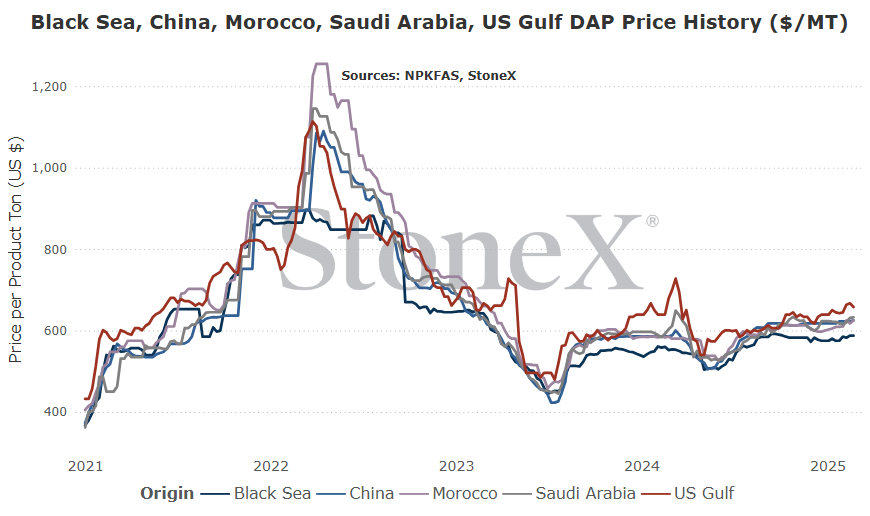
On the surface, not much has changed. Global supplies continue to be tighter than normal with Chinese export flows continuing lower than normal. Demand also hasn’t been drawn back as some have expected (put me in that camp). So, the S&D remains tight.
However, there is the emotional side to consider, and that emotion is quickly becoming one of fear. Fear of missing spring and carrying product into the late spring/summer/fall season. While there is still plenty of spring demand remaining, the calendar is getting awfully thin to be targeting that.
For the next month, I expect that values will remain flat. There is still plenty of demand out there and supplies are snug. However, then we must start considering what summer resets look like. Current prices are high which means there is plenty of downside price risk on top of heavy month to month carry costs. The timing could be a little hazy, but buyers could see some price reprieve in the next couple months.

Commentary
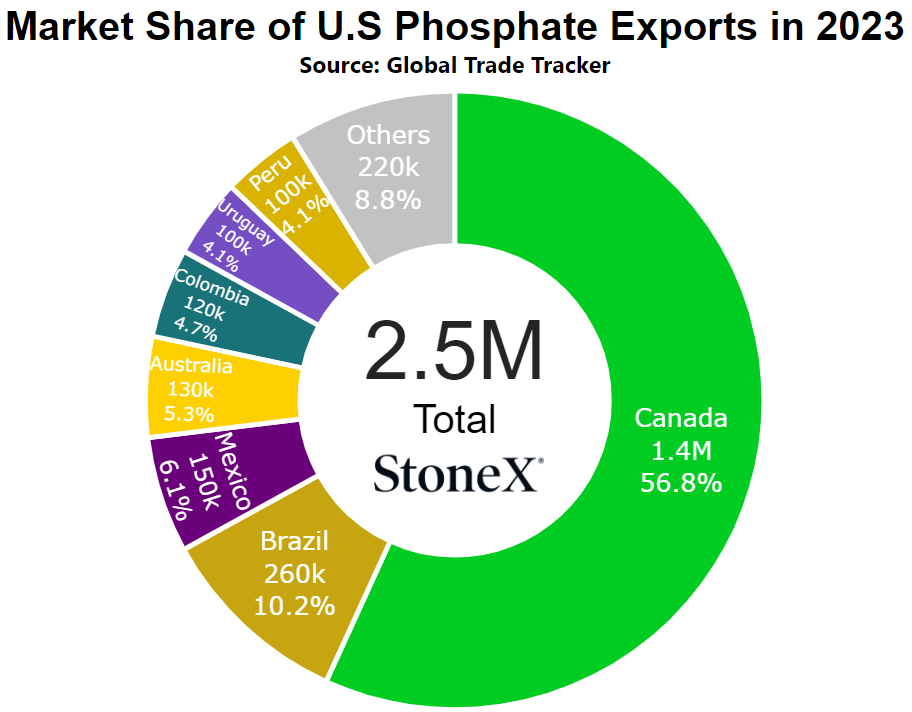
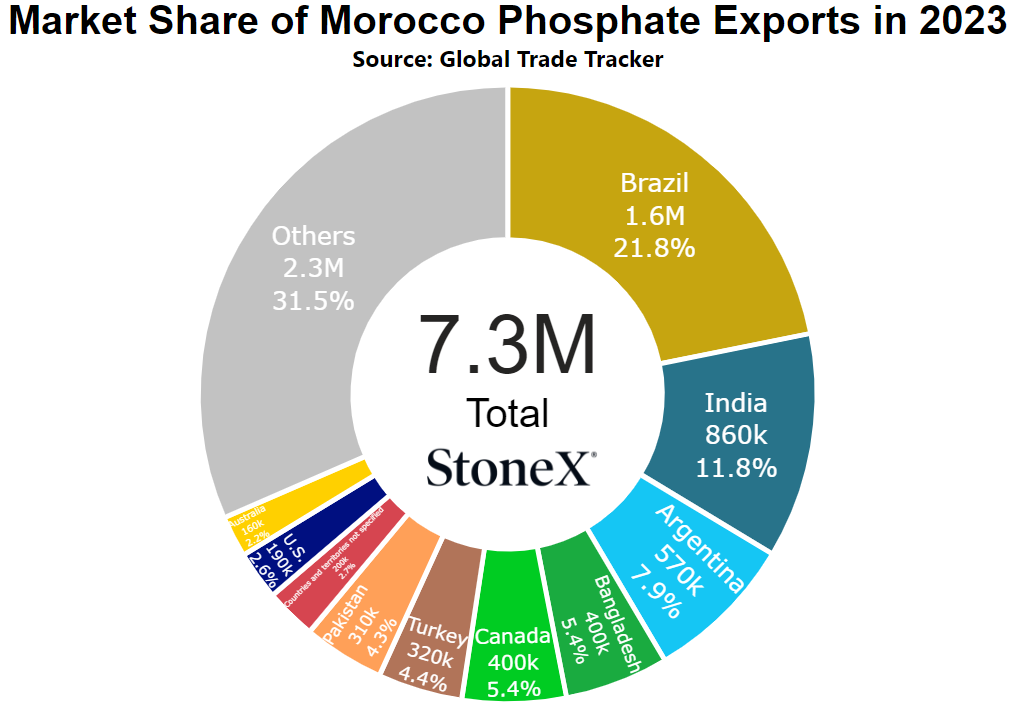
India agrees to 2.4M ton phosphate contract with Morocco
In a bit of a surprise move, the Indian government agreed to a 2.4M ton phosphate contract with Moroccan producer OCP with a shipment window thru the remainder of 2025.
For those that are new, it is important to understand how India's ag market operates. Unlike most of the world, Indian farmers see flat pricing of their inputs in the face of a volatile global market. In order to allow imports, the government subsidizes the price differential between global values and their farmer values. This is a massive cost to the government and creates a situation where if/when supplies run low, it is widely seen as the governments fault.
Since the summer of 2024, Indian phosphate stockpiles have struggled due to inadequate or late moves by the government in terms of their subsidies. Last summer, global values were falling as it appeared that Chinese exports were returning to normal. After years of massive subsidies, the government cut their programs further in an attempt to slow import purchases and hopefully save a few dollars. This worked...for a short time.
It wasn't long before the Chinese government reversed the markets belief. Exports began to slow, global demand began to pick up as a result, and global values started to rise once again. Rather than quickly get ahead of global price appreciation, the Indian government was slow to respond and importers spent much of the rest of the year struggling to obtain tonnage. The stalemate was finally broken during the Q3 period when government representatives traveled to Morocco, penned a half million ton purchase, and fixed the subsidy program. Unfortunately, it wasn't quick enough. Normally at the start of the new year, stockpiles are around a comfortable 2M ton number. At the start of 2025, it was widely believed that stockpiles were "only" 1.2M.
Rather than continue to struggle, India took the bold move of entering into a massive purchase agreement with OCP in Morocco. A total of 2.4M tons of phosphate was purchased to ship thru the remainder of 2025. Most of it is set to ship before Q3. 1.6M tons will be DAP. The remaining 800K tons will be triple super phosphate. More interesting is that the tons will be based on formula pricing. That has raised a few eyebrows across the industry.
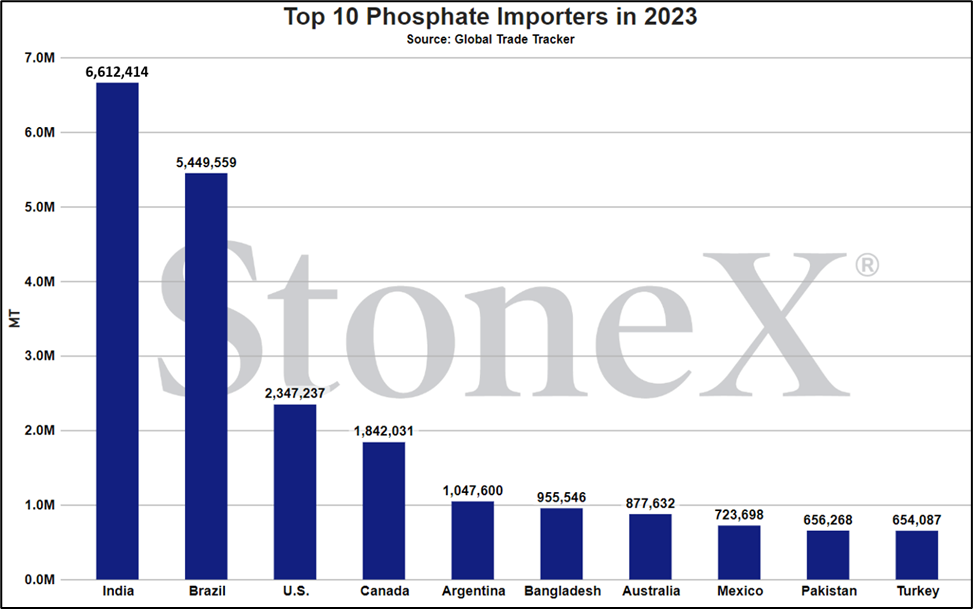
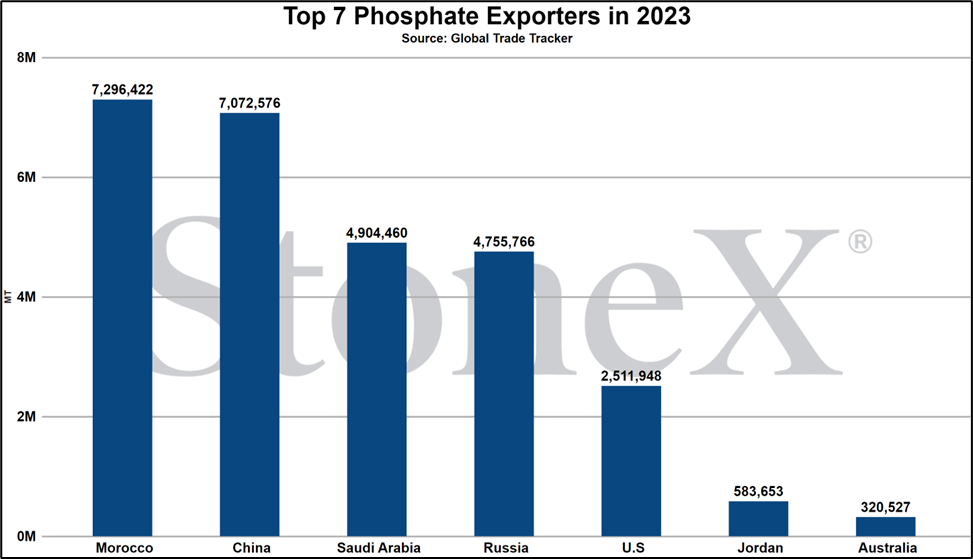
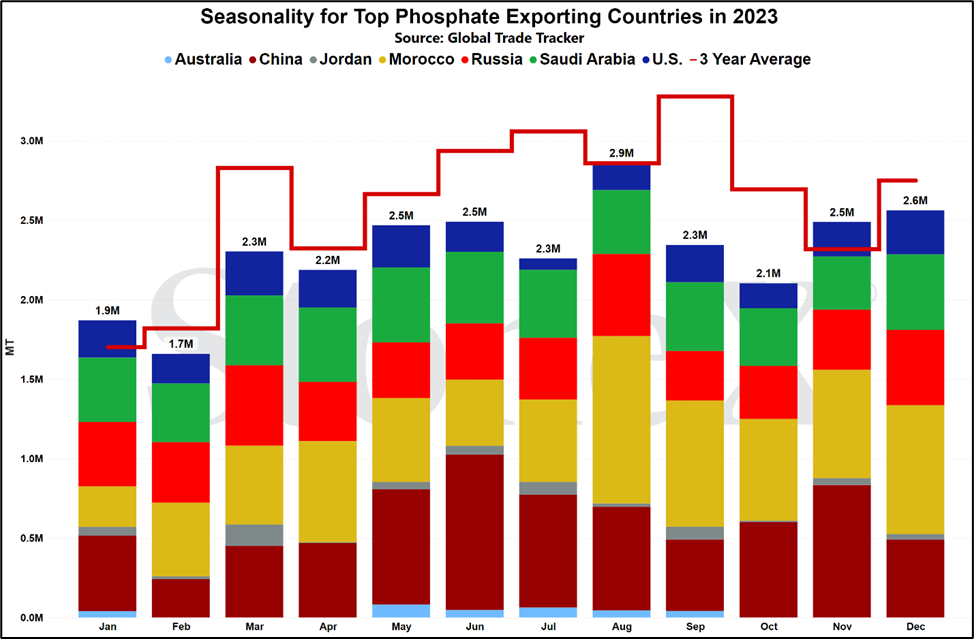
Global phosphate is a relatively small group of nations. 5 countries control approximately 85 - 90% of global production and exports. Phosphate acts and prices as a commodity. However, with so few major players, minor moves can have major impacts.
For Indian farmers, this should be seen as great news. It lessens the risk of inventories dropping to low levels. Given that they do not see global price volatility, all they should care about is availability.
For the rest of the world, this is 2.4M tons that are now secured. The demand has not changed. The supply has not changed. But it removes 2.4M tons of business from other buyers.
What does this mean for Aussie farmers?
The fact that India just secured 2.4M tons of phosphate does not change their overall demand. These are tons that the world expected it to buy. Rather than buying it on spot basis, it is buying it now on formula pricing.
The fact that Morocco just sold 2.4M tons of phosphate does not change their overall supply. These are tons they were planning to produce and now have a guaranteed home rather than having to sell to uncertain destinations.
This does absolutely nothing to change the global S&D.
However, it does change the view. Morocco is now MUCH more comfortable. They know where their tons are going. There is a significantly lower chance that they need to panic sell. On the flip side, India knows their tons are coming to them so they do not need to panic buy.
The biggest question on this is how it is interpreted by the rest of the market and whether any "games" are played as a result.
From an Australian farmers perspective, this doesn't do much...for now. Simply something to watch.
Ma'aden announces expansion of phosphate production capabilities
It isn't often that I get to give positive news in the phosphate markets so I'm going to jump at the chance when it happens!!!
It appears that Saudi Arabian based phosphate producer Ma'aden has taken major steps to begin expanding their phosphate production capabilities. This is huge news for a market controlled by so few countries.
Details are still coming out but here is what we have seen and heard:
- This expansion has long been aptly named "Phosphate 3" (you will never guess what the previous 2 were called!!)
- Estimated costs were pegged at around $6.5B back in 2016
- Believed it will add another 3M tons of finished phosphates on an annual basis
Obviously this will take time before construction is completed and the first new tons are produced. However, it helps to give the global market a bit of hope. Tight global supplies over the last few years as the result of Chinese exports being restricted have been the biggest story and cause of significantly higher values than what is considered "normal".
My bigger hope of this story is that it might cause other nations to consider doing something similar. Other places like Morocco are understood to have massive phosphate rock reserves. The phosphate rock is not the issue. It is merely the limitation of mining and production capabilities. These can be increased with investments.
Again, this likely is not a story that will help lower price ideas in the short term. It does provide a bit of light in an otherwise very dark tunnel.
What does this mean for Aussie farmers?
Finally, GOOD news!!!!
If Ma'aden proceeds with this expansion, this will add around 3M tons of exports to the global marketplace. Basically, that makes up the difference for what China is not exporting vs their historical norms.
More supply + unchanged demand = lower prices according to my Econ 101 class.
It will take time but this is finally good news in the phosphate space.
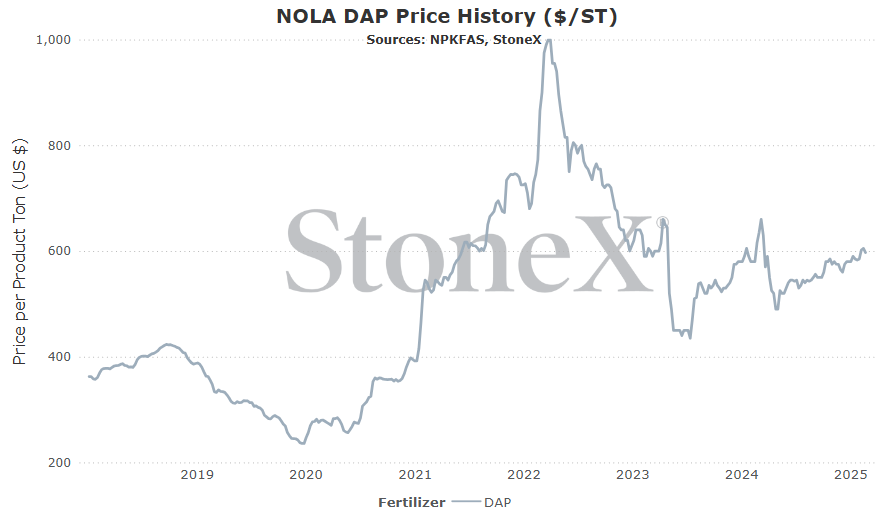
Price comparisons
Vs 30 days ago - 2% or approximately $14 higher
Vs 90 days ago -4% or approximately $22 higher
Vs 6 months ago - 10% or approximately $54 higher
Vs 1 year ago - -3% or approximately $18 lower
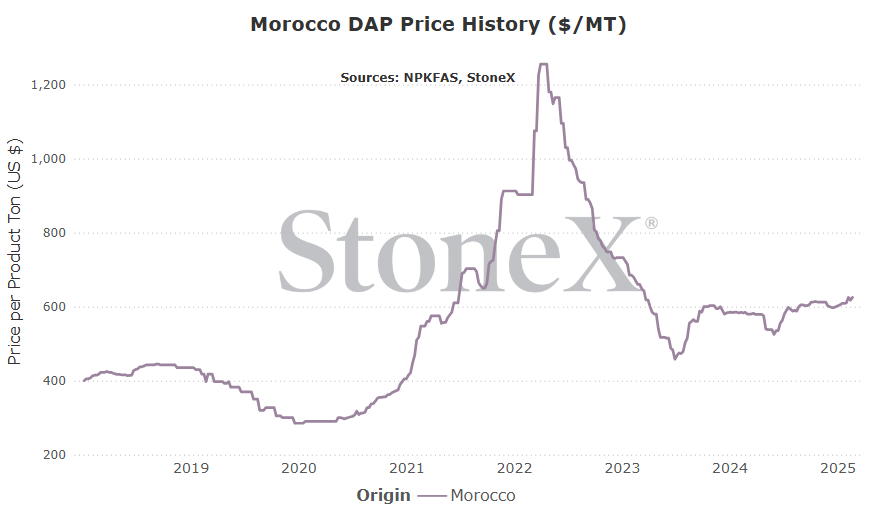
Morocco DAP price comparison
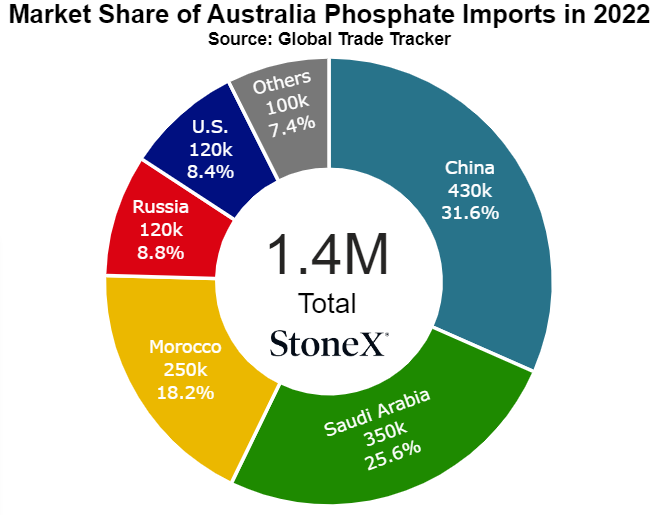
Number 1 global exporter in 2022
Price comparisons:
Vs 30 days ago - 3% or approximately $16 higher
Vs 90 days ago - 2% or approximately $13 higher
Vs 6 months ago - 6^ or approximately $38 higher
Vs 1 year ago - 7% or approximately $40 higher
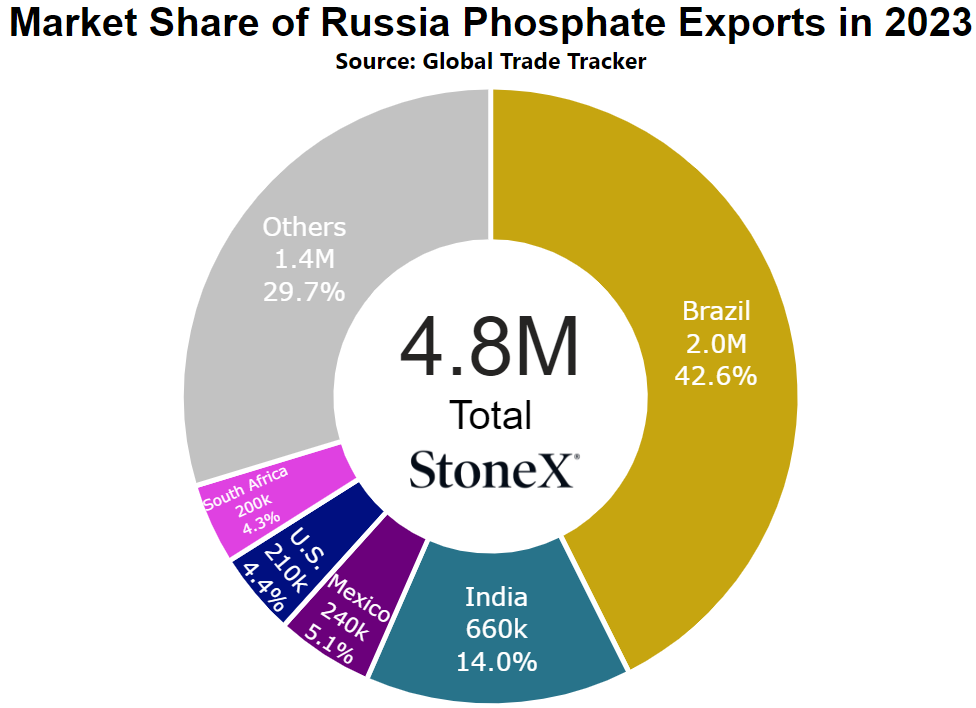
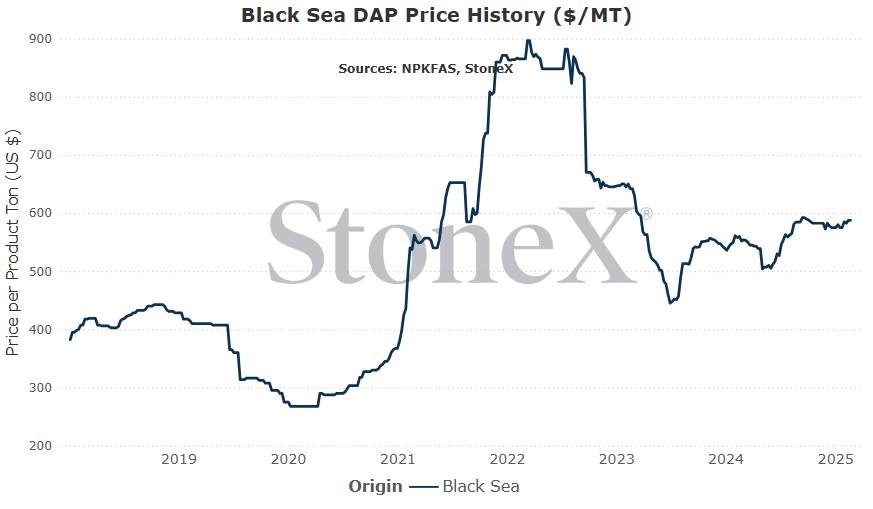
Black Sea DAP price comparison
Number 3 exporter of DAP/MAP in 2022
Price comparisons
Vs 30 days ago - 2% or approximately $13 higher
Vs 90 days ago - 1% or approximately $5 higher
Vs 6 months ago - 1% or approximately $7 higher
Vs 1 year ago - 7% or approximately $36 higher
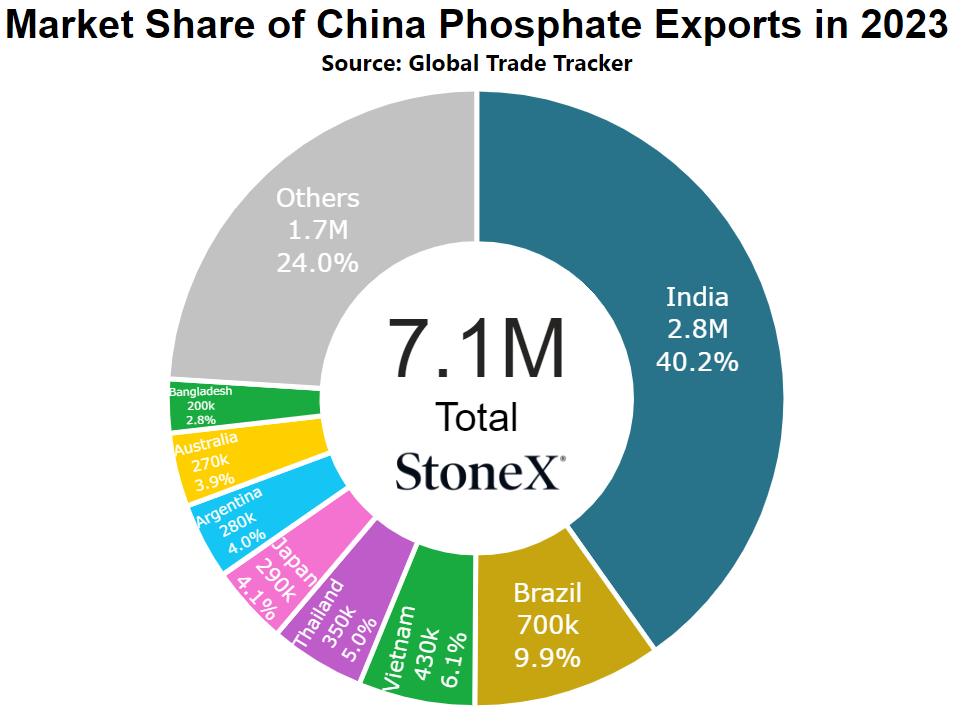
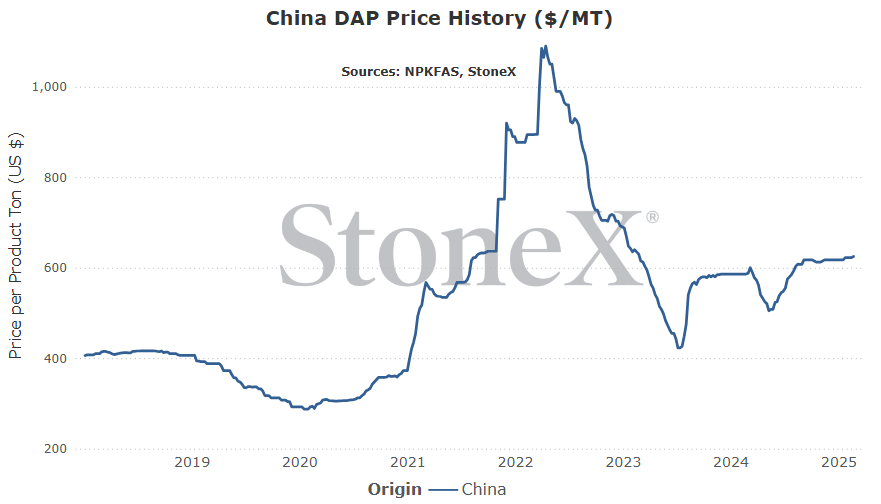
China DAP price comparison
Number 2 global exporter in 2022
Price comparisons
Vs 30 days ago - unchanged vs last month
Vs 90 days ago - 1% or approximately $8 higher
Vs 6 months ago - 3% or approximately $18 higher
Vs 1 year ago - 7% or approximately $39 higher
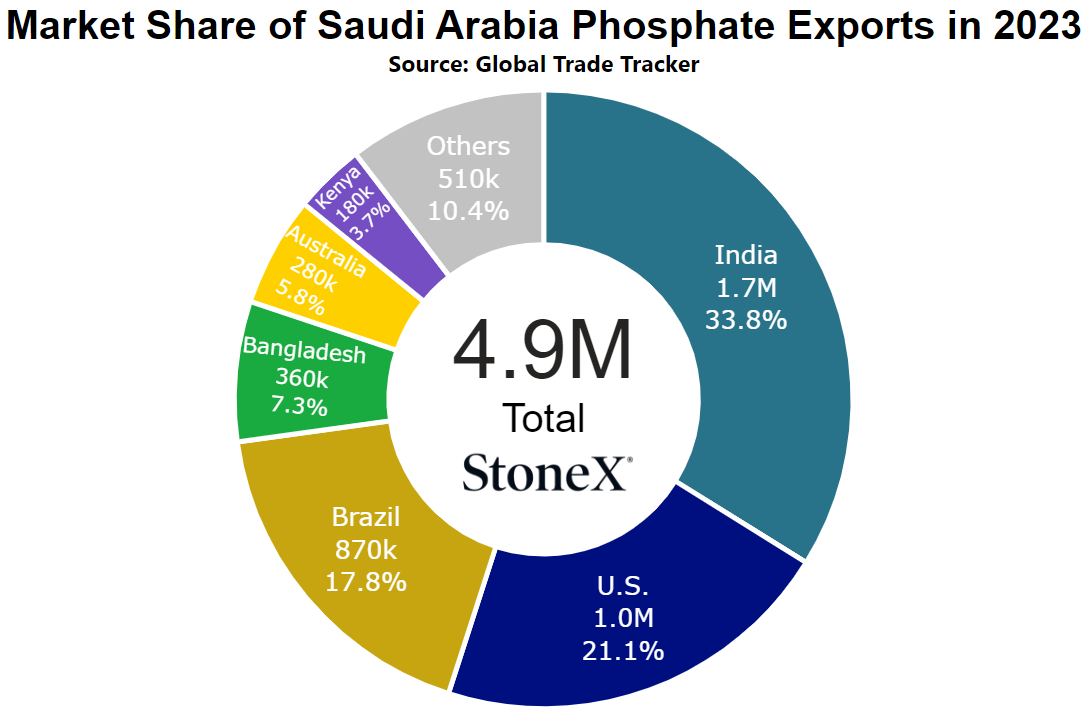
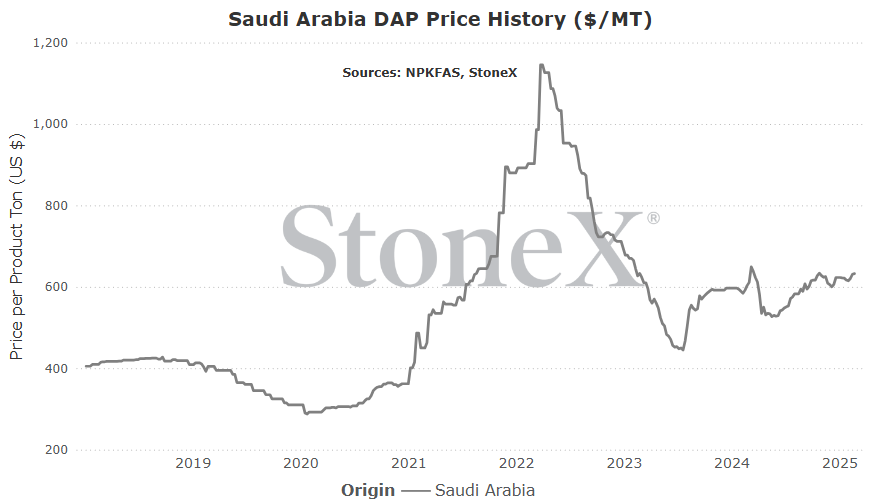
Saudi Arabia DAP price comparison
Number 4 global exporter in 2022
Price comparisons
Vs 30 days ago - 3% or approximately $16 higher
Vs 90 days ago - 1% or approximately $8 higher
Vs 6 months ago - 9% or approximately $50 higher
Vs 1 year ago - 5% or approximately $30 higher
- Chinese exports remain low – the world's historic largest phosphate exporter continues to pump the brakes on their flows, and the world is paying the price. As long as their exports remain slow, the global S&D remains snug and values elevated.
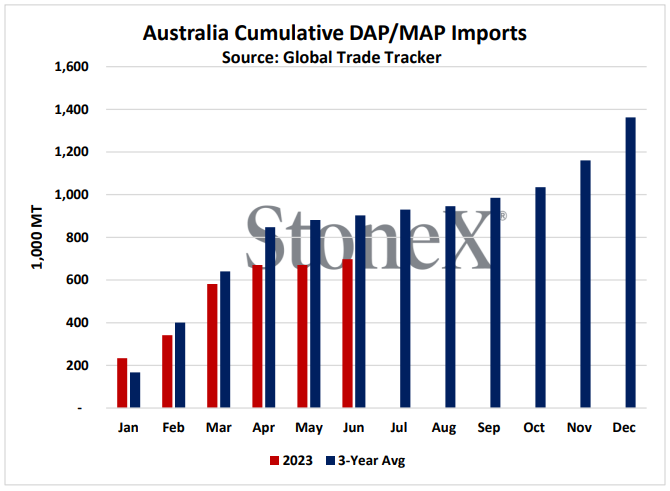
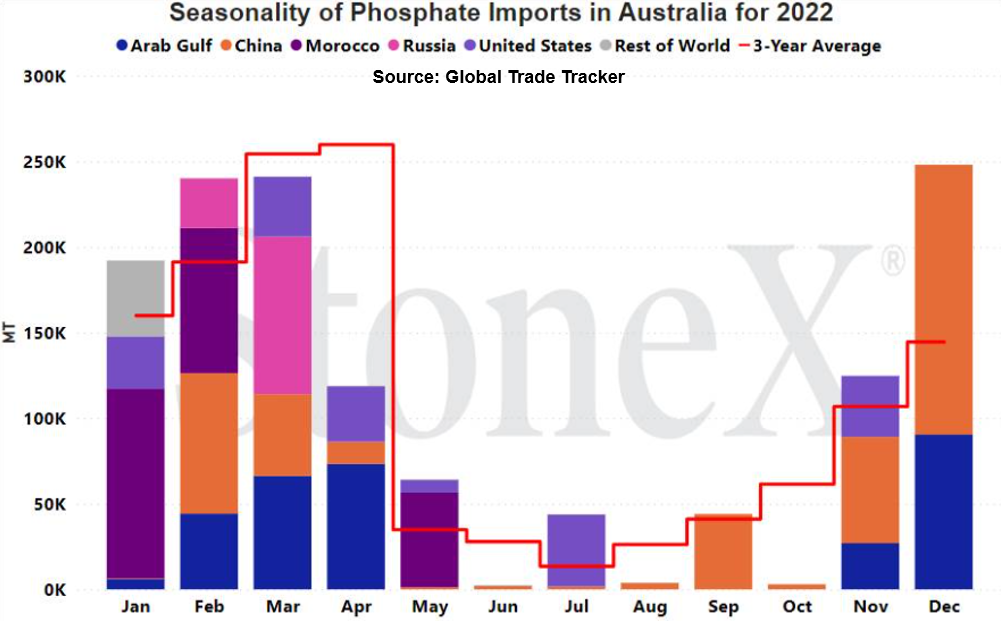
- Many Aussie imports likely already secured at higher prices – let's face it, when higher priced imports are already locked up, domestic values tend to be more sticky. That is where we are today. Global values never dipped so there was never a clear cut opportunity to lock stuff in.
- Nervous importers could lead to tighter supplies – in addition to the previous bullish point, we also need to consider how importers will have approached this season. Prices are high. You know it. They know it. There is a lot of price risk at these higher prices. That means a more conservative buyer thru the entire system. If importers have been conservative on their buying patterns and demand starts, we could quickly find supplies being MUCH more tight than normal. At least worth the conversation with your supplier.
- High phosphate values/low grain prices/poor farm economics cut rates – phosphate continues to stand out as the worst input in terms of price vs grains. It is so far overpriced that many continue to talk about cutting their rates to get a step closer to break even. There is a certain amount of danger in this approach as it can limit total yield potential but if enough farmers determine the risk is worth it, we could see enough demand destruction to weigh on price ideas.
- China could start exporting normally tomorrow – does it look likely that China will start exporting just before their spring season? Absolutely not. Allowing exports to resume would likely mean domestic Chinese phosphate values start to climb. That is completely against what their strategy has been (reduce exports, keep healthy stockpiles at home, lower domestic values). However, never say never with China. They could easily shock us and allow a full resumption.
- Fear of carryover – right now, the resounding conversation in the phosphate market is tight supplies which "should" mean higher prices. However, a person would be lying if they told you they didn't worry about holding onto a position for too long. Eventually, spring demand will give way to planting. The next time phosphate will be in demand will be for summer fill. Given how high priced phosphate currently is, it leaves a lot of downside price potential. That fear could mean we see long positions selling lower earlier than expected to get ahead of the rush.
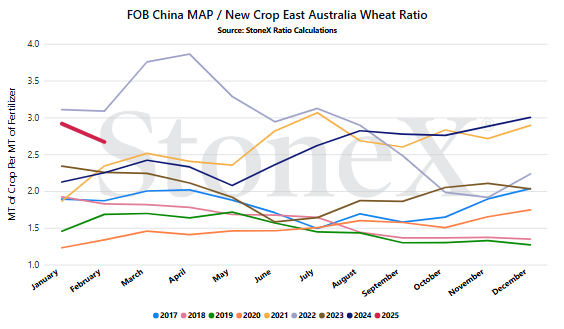
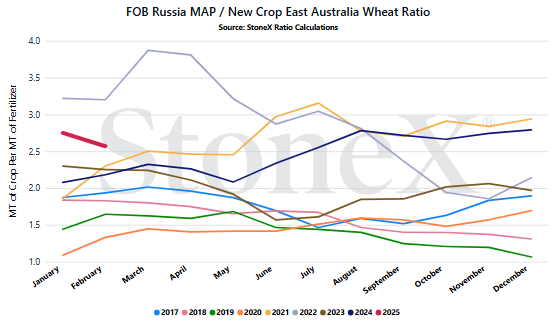
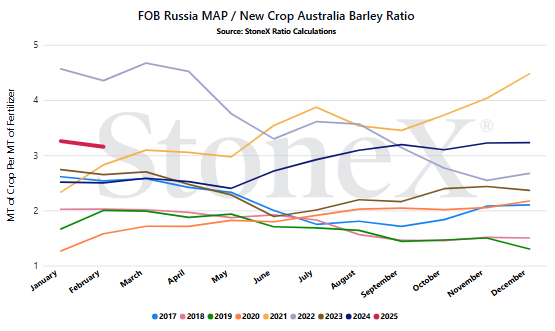
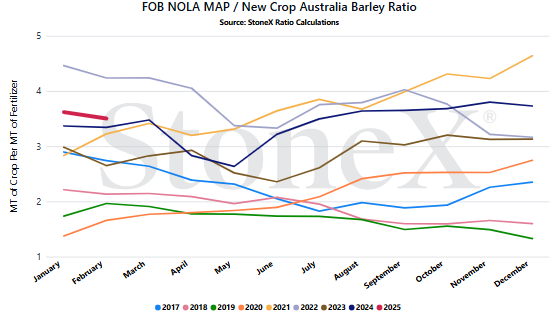
We believe that only looking at the flat price of either grains or fertilizer can be misleading:
-
Only selling grain can hurt you if fertilizer prices rise substantially
-
Only buying fertilizer can hurt you if grain prices fall
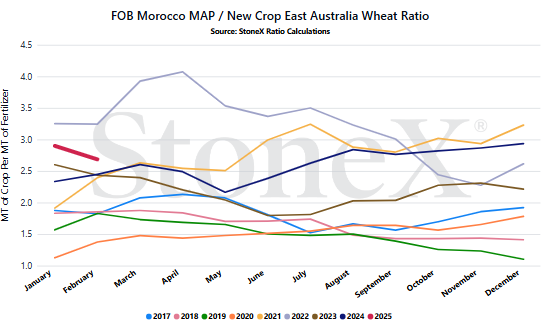
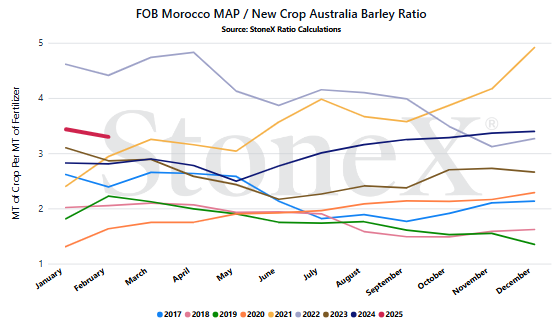
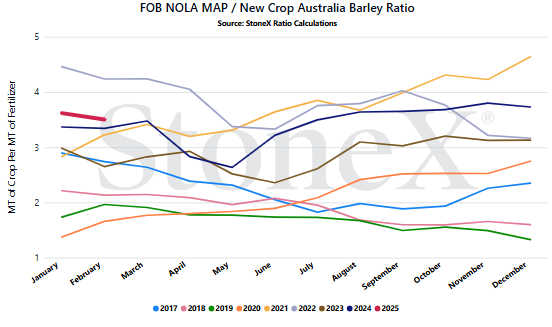
We look at the ratio "value" to get a better indication of where we are or how many bushels of X does it take to pay for 1 ton of fertilizer.
Would you rather:
-
Spend 4 ton of grain to pay for 1 ton of MAP
-
Spend 1.5 ton of grain to pay for 1 ton of MAP
When we compare the current ratio value against recent years, we start to see if we are high or low.
YOUR VALUES MAY LOOK DIFFERENT
- Chinese export programs - the biggest global exporter continues to put restrictions in place for phosphates. Normally, they export around 10M tons per year. 2024 saw them hit 6.6M, leaving a 3.4M ton hole in an export market that is much smaller than most believe. The Chinese spring season is looming which means there is little reason to believe they would loosen the program now. If they did, likely that domestic Chinese values would rise, going completely against the governments long strategy. However, it isn't guaranteed. Just as soon as we think we know what they are going to do, they will surprise us. Hence, China remains the biggest enigma in the phosphate market, and remains the biggest influencer on global values.
- How importers approach high price risk - global values have been high and continue to be high. The high price represents a lot of downside price risk, even though that doesn't look likely short term. The high price also causes end users (farmers) to drag their feet. Why wouldn't you? Prices are stupidly high so better to wait just in case something better comes along. All of this fear and risk could result in lower tonnages being secured. This is not a certainty, merely something that needs to be watched. It would not hurt to have conversations with your supplier.
StoneX Ratio Calculation
The ratio calculation is derived from Bloomberg historical grains values as well as fertilizer values from StoneX, NPKFAS, and Argus.
The calculation is simply dividing the fertilizer price by each grain price.
All data was sourced from StoneX unless otherwise noted.