Global
Demand should be slowing and down and major annual contracts with China and India are in the crosshairs. A very long summer period looms. Grain prices have struggled a bit from what has been considered "recently normal". There is very little pointing to any supply issues in the foreseeable future.
While we do not expect to see price levels fall triple digits, we do see weakness on the horizon. A well supplied market and uninterested buyers should put pressure on the sell side.
North America
With spring largely wrapped up, N.A. can take stock of where it is. On the one hand, there were very few reports of finding product this spring. After a huge fall and short winter, it was a surprise that potash stayed ahead. That should lead us to expect significantly lower values this summer. On the other hand, potash values have remained aggressive vs other fertilizers. That should mean it doesn't have to fall tremendously.
I am expecting to see potash values lower to entice buyers to step forward. However, the reset will be limited in nature given that potash manufacturers have done a great job of keeping potash attractively valued.
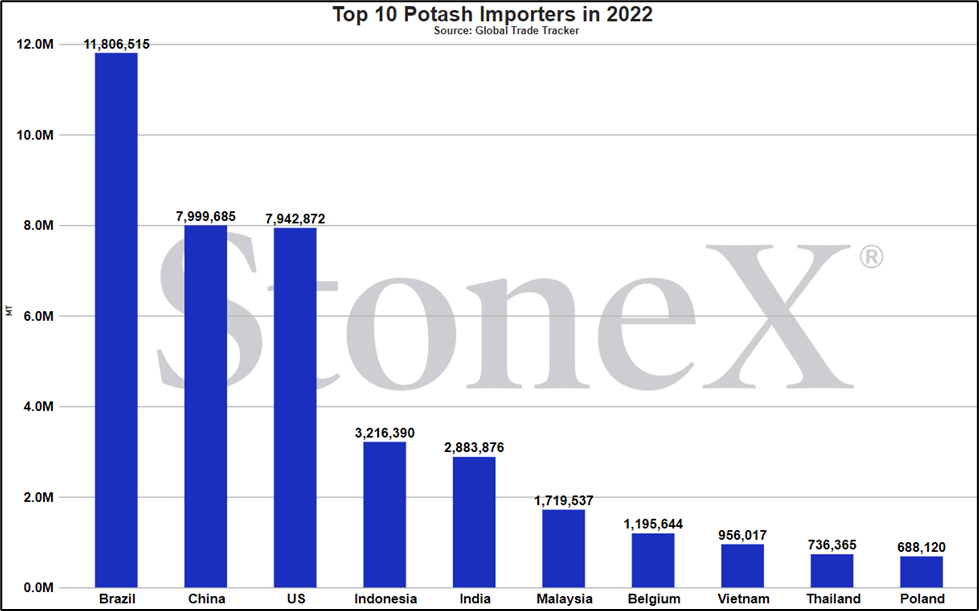
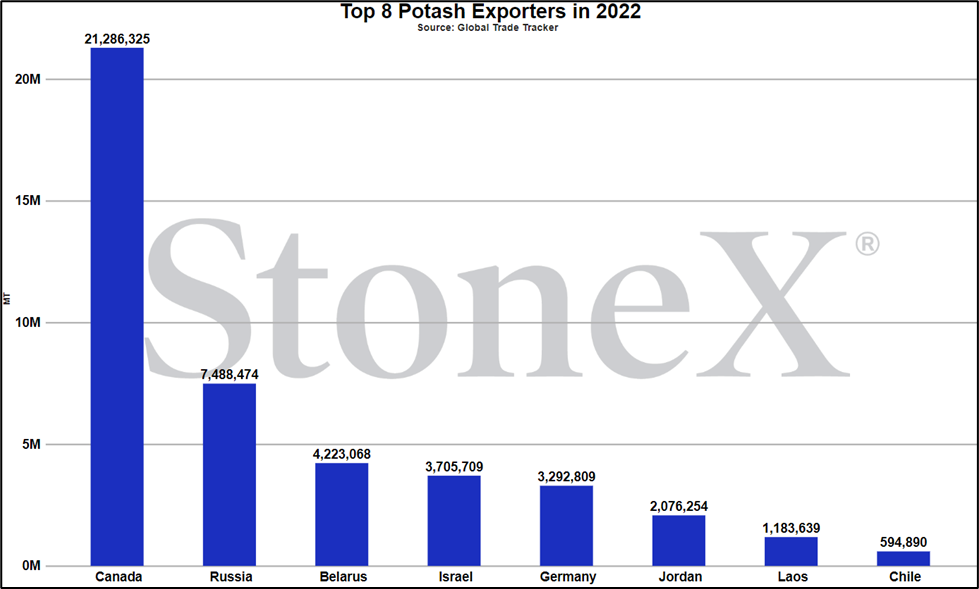
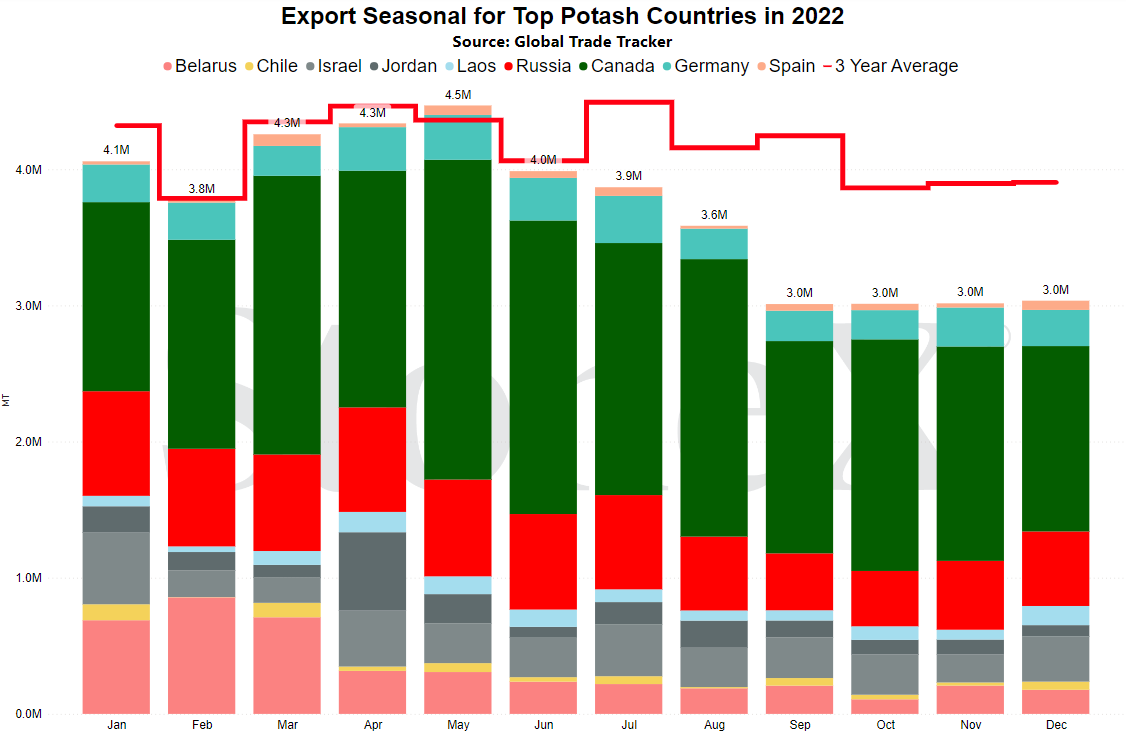
Chinese imports remain strong / global values remain flat
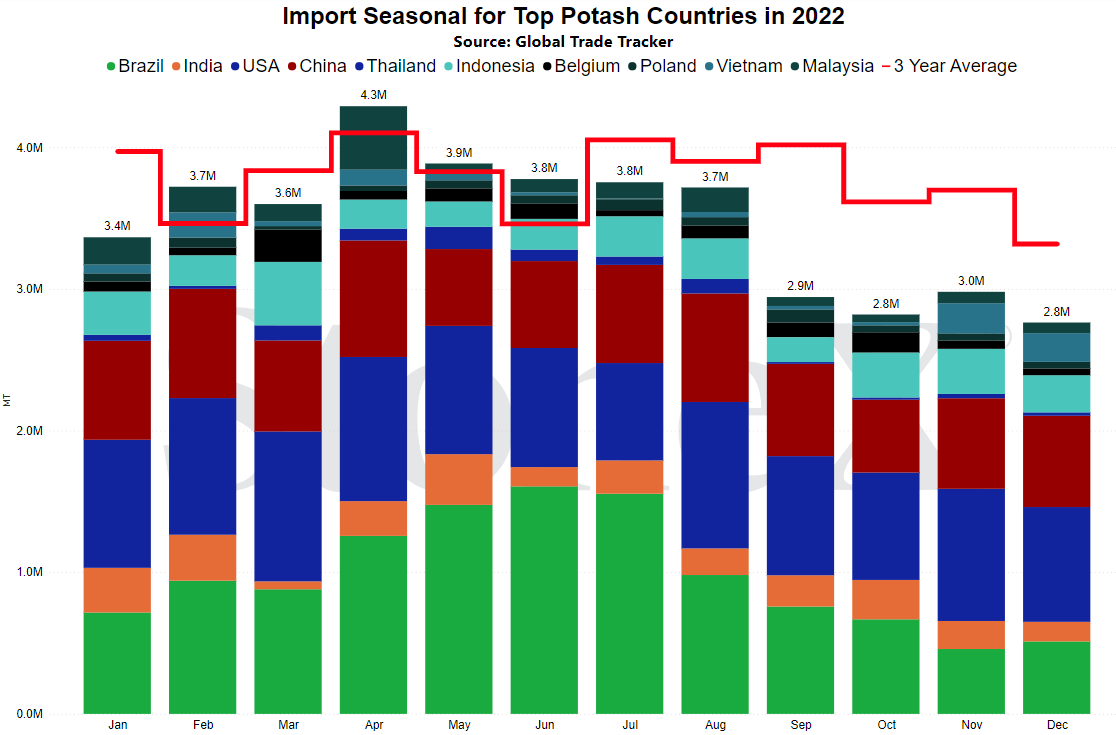
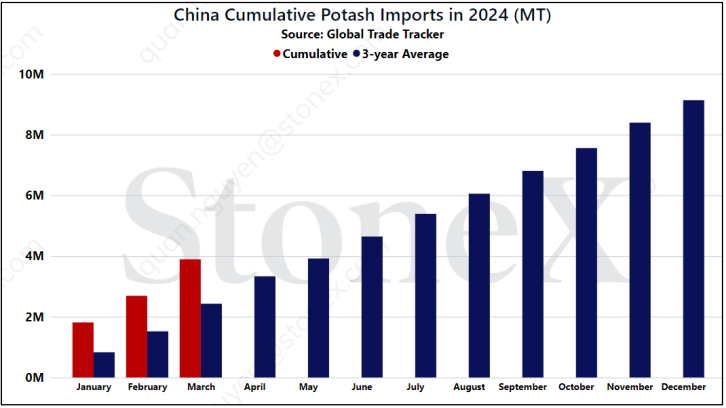
China, one of the world's larger buyers of potash, continues to be on a hot import streak with import values thru March showing them well ahead of the 3-year average.
It will be very interesting how China uses this hot import pace when it comes time to secure their annual contract. For those unaware, China locks into an annual contract for a very large amount of potash. This contract is typically agreed upon shortly after India sets the pace on their own annual contract.
For China, this should be a huge negotiation tool. They have been well ahead of the curve in terms of imports and domestic stockpiles should be in very good shape. That is a solid argument to use against manufacturers. We also continue to hear that China is still investing heavily in Laos potash manufacturing which if/when successful, should release China from being dependent on "western countries" and being more dependent on neighbors.
Ultimately, their failure or success in their contract will help set the tone for the rest of the world.
Lack of price movement leads to well/over supplied market outlook
It has been a very interesting fertilizer year for North American potash.
Last fall was a huge run that emptied the system. Farmers/retailers/distributors/manufacturers all reported little to no product left in bins. The season that largely ended in mid-December ended almost empty. That would be a feat to refill for the long summer. Winter made it that much more difficult. Then, winter was short. Many in the south started applying in early/mid-February meaning that the market only had 2 - 3 months to replace stockpiles, depending on where they resided. Then spring saw solid demand once again.
During all that time, values barely moved in some places. Inland average dropped substantially to help close the basis to NOLA, an event that didn't seem possible given how tight inventories were.
So if we just went thru a 3 season cycle of very, very tight inventories and values barely moved (and basis fell)...just how well/over supplied is this marketplace?
That is the question in front of us. Historically speaking, potash is typically the most well supplied fertilizer in the marketplace. That is a large reason why values move so slowly. It is just hard to get excited about. This continues to back our narrative that we will continue to see potash toeing the line between well supplied and oversupplied. Many new production projects were delayed or cancelled...but not all. Add to that China's investment in new Laos production which will raise supplies and remove demand.
This does not mean potash values are going to zero but it certainly does limit upside for the moment.
Summer expectations
We just went thru a fall/winter/spring of very tight inventories...yet values didn't budge.
That should mean that the upcoming long summer period will see values tank...right?
Not so fast.
Now, you are correct in thinking that values should see some weakness in the coming weeks/months. Buyers are in no rush to come forward to fill their bins for fall. Interest rates are high. Grain prices not fantastic like they have been. Farmer profitability is tough for 2024 and 2025. All of this should mean that manufacturers need to dangle a carrot in front of the market to get buyers stepping forward.
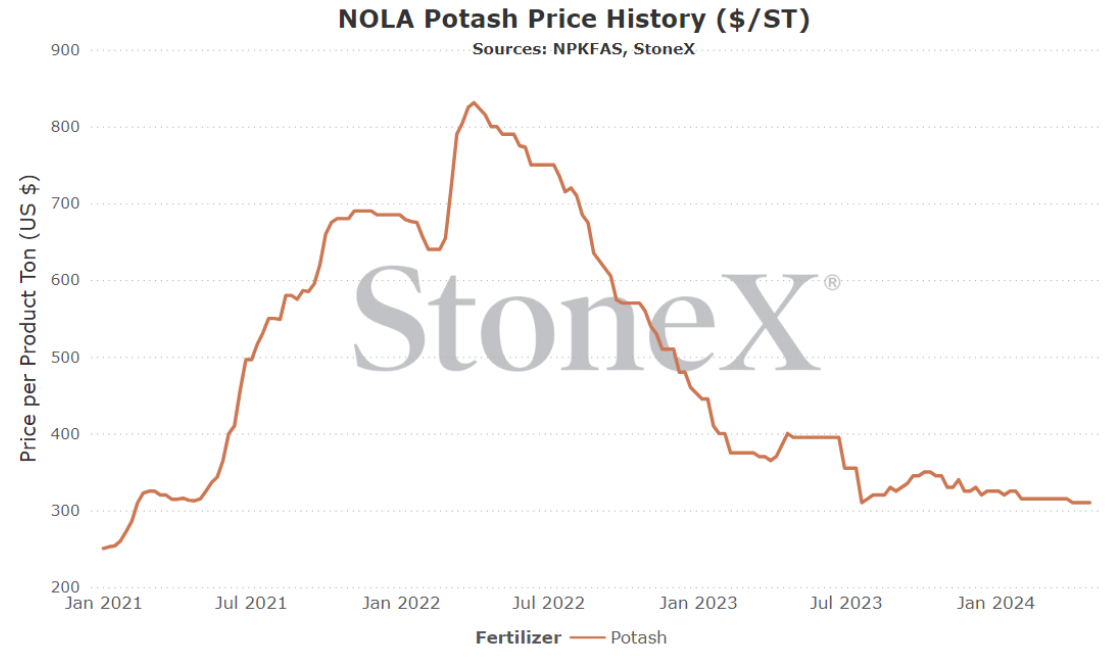
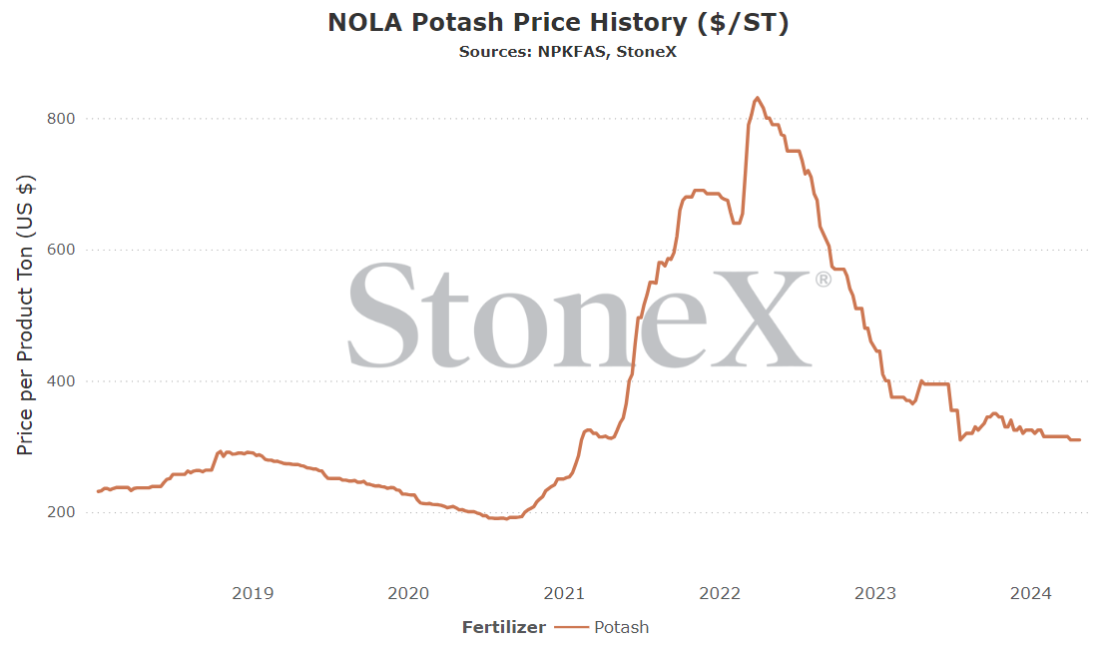
However, on the flip side, potash never got out of hand like the other fertilizers did. Take a look at the price graph below. Potash fell...and stayed down. It didn't try to take advantage of a tight marketplace. It stayed engaged to make sure demand was solid.
So what can we expect?
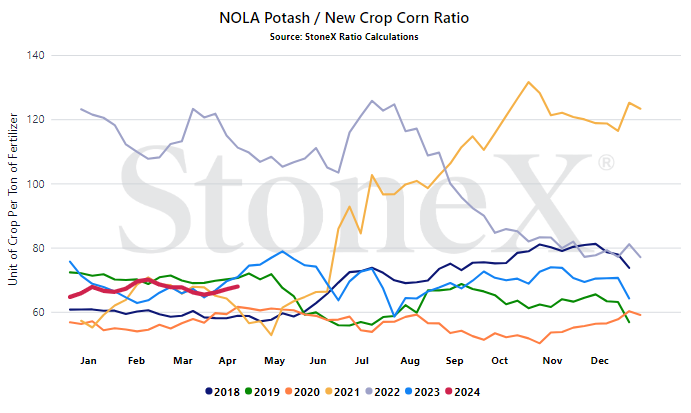
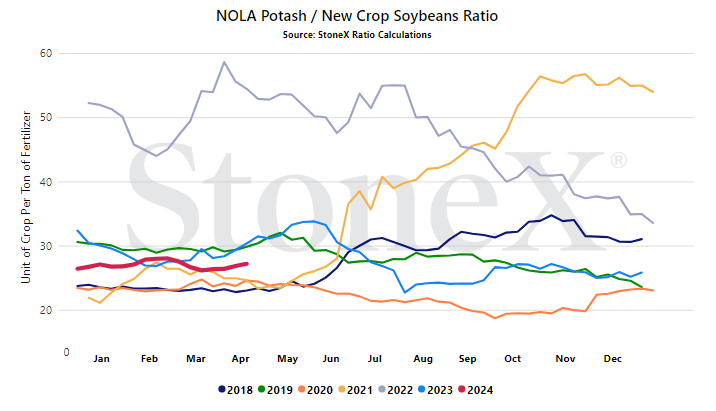
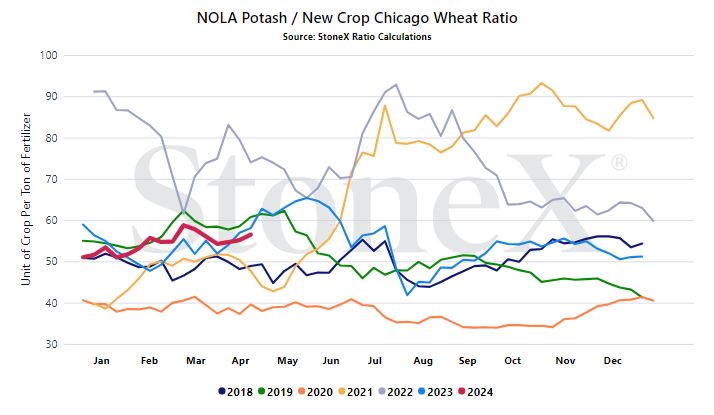
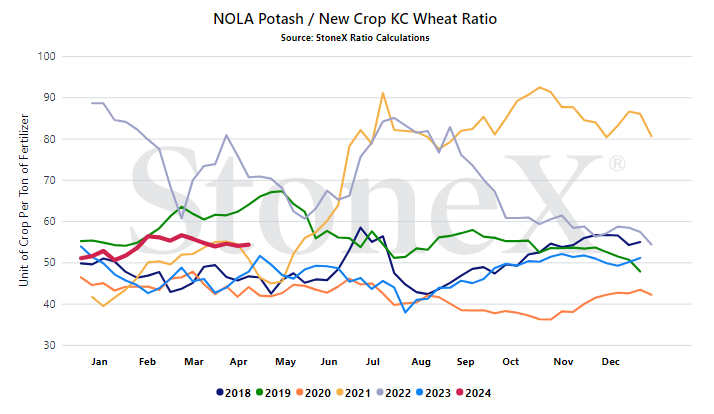
Personally, I am hoping that we can get the price down to where ratios against corn hit 55 - 60. If we use the low end 55 ratio against December 2025 corn, that gives us a reset price that is only $25 - $35 lower than where barge price ideas are today. Now, if corn values deteriorate, it is a new ballgame but this should put into perspective what potash has been able to accomplish. Typically, I am very hard on the manufacturing side. Given their margins, they can take it. But if I am going to dole out the negative, they deserve the positive.
All in all, I am seeing prices down from where they are today but I think it will be wrong to expect huge price corrections. Potash really never did us wrong.

NOLA/New Orleans Louisiana
Vs 30 days ago - -2% or approximately $5 lower
Vs 90 days ago - -5% or approximately $15 lower
Vs 6 months ago - -10% or approximately $35 lower
Vs 1 year ago - -22% or approximately $85 lower
U.S. Midwest Average (average of several points across the Midwest)
Vs 30 days ago - -23% or approximately $110 lower
Vs 90 days ago - -4% or approximately $16 lower
Vs 6 months ago - -9% or approximately $37 lower
Vs 1 year ago - -20% or approximately $95 lower
- Current inventories should be tight – North America just saw a solid fall/spring run that should end with very low inventories which means plenty of open space to fill. That usually works in the manufacturers favor as they have plenty of sales opportunities.
- Potash values never rallied like other fertilizers - I know some might be taken aback by that statement but potash has remained well priced. Other fertilizers rallied hard going into the spring season but potash remained mundane. If compared, potash could rally and still be more attractive than other inputs.
- Manufacturers can take a production curtailment approach – when demand refuses to step forward and prices start to see pressure, manufacturers can certainly take the step to either slow or stop production. We have already seen this at one location in Canada. On its own, it does not appear enough to buoy price ideas but if others follow...
- Uninspired demand will need convincing to step forward – farmers are not happy today. 2024 economics are not great. 2025 economics are not great. Interest rates are high. Land prices are high. Equipment prices are high. "I really want to rush out and spend money on fertilizer" isn't a thought most are having right now. Manufacturers likely will need to entice buyers to step forward. That is usually done with lower values.
- India/China should pressure market with annual contracts - this will become a focal point in the coming weeks/months. India should set the pace, negotiating their annual purchase. China should follow suite. Given the substantial volume each purchase and the outlook of the potash marketplace (very well supplied), it should lean on values.
- Global market continues to appear very well supplied – in addition to the above point, the outlook for the potash world is even better supplied. More production is coming in Canada. Russia should have more. China continues to invest in ramping up Laos. There is a lot of new supplies coming online...and demand isn't growing as fast.
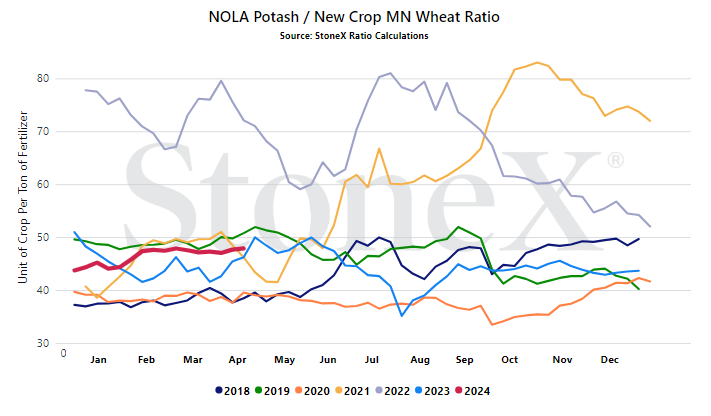
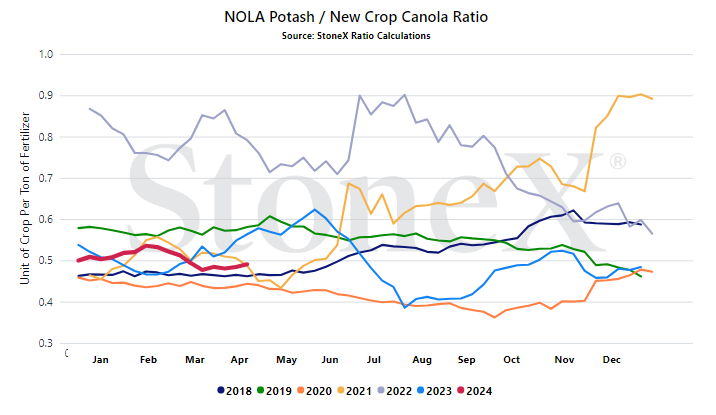
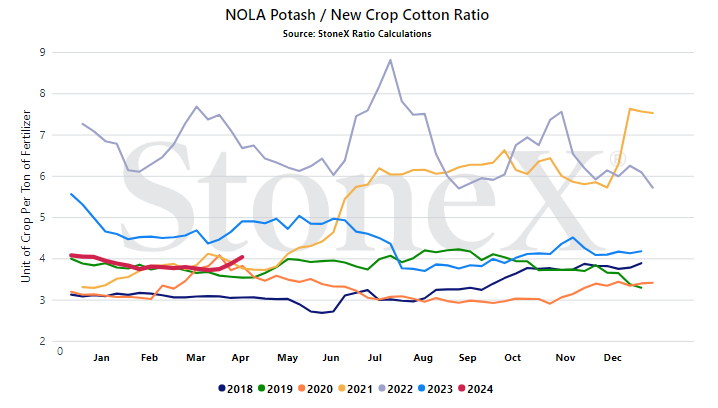
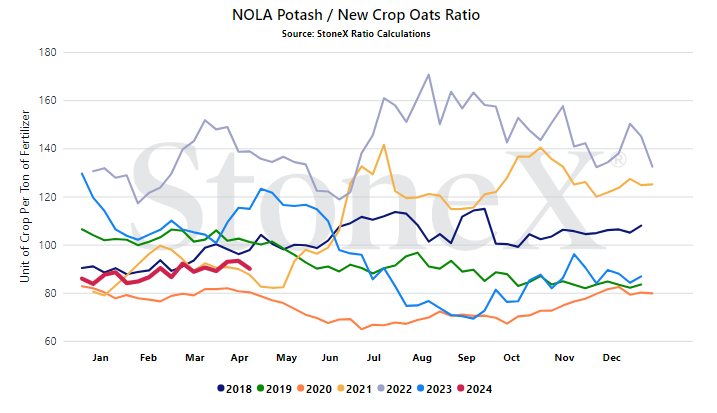
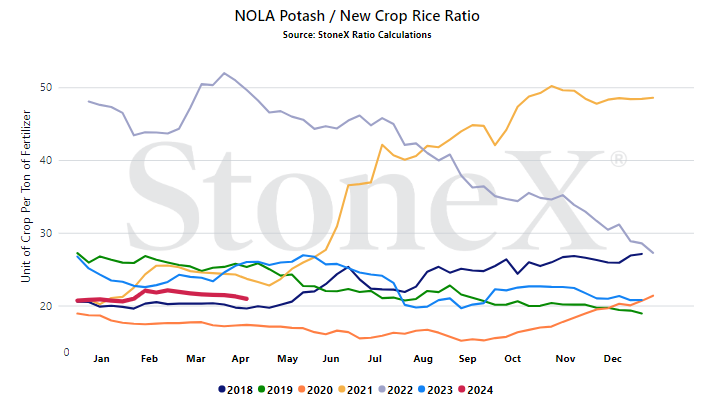
Where are the current potash/grain ratio values today
We believe that only looking at the flat price of either grains or fertilizer can be misleading:
-
Only selling grain can hurt you if fertilizer prices rise substantially
-
Only buying fertilizer can hurt you if grain prices fall
We look at the ratio "value" to get a better indication of where we are or how many bushels of X does it take to pay for 1 ton of fertilizer.
Would you rather:
-
Spend 120 bushels to pay for 1 ton of potash
-
Spend 60 bushels to pay for 1 ton of potash
When we compare the current ratio value against recent years, we start to see if we are high or low.
YOUR VALUES MAY LOOK DIFFERENT
This graph looks at the NOLA potash price vs the flat grain price. There are no logistics on either product. Your location will look different due to fertilizer logistical costs, grain basis, etc.
- Manufacturers AND buyers approach- I know that basically encompasses the entire market, but hear me out. From the manufacturing side, we need to watch production rates. With values likely to see some pressure, it isn't out of the question that manufacturers will fight back by curtailing production. If buyers do not want to step forward, then cut the supply side and force them. However, buyers are in no mood. The financial outlook for farmers isn't as great as it has been in recent years. There is no excitement to spend money on next years crops. It could set up as a fight to see who can outlast who...
- Grain values - I feel like grain markets are going to go a long way in helping set potash values. Today, potash values are not terrible vs grain pricing. That's why I keep thinking the downside is limited. However, if corn falls 50-cents (I really hope that doesn't happen), then potash no longer looks well priced.
StoneX Ratio Calculation
The ratio calculation is derived from Bloomberg historical grains values as well as fertilizer values from StoneX, NPKFAS, and Argus.
The calculation is simply dividing the fertilizer price by each grain price.
All data was sourced from StoneX unless otherwise noted.