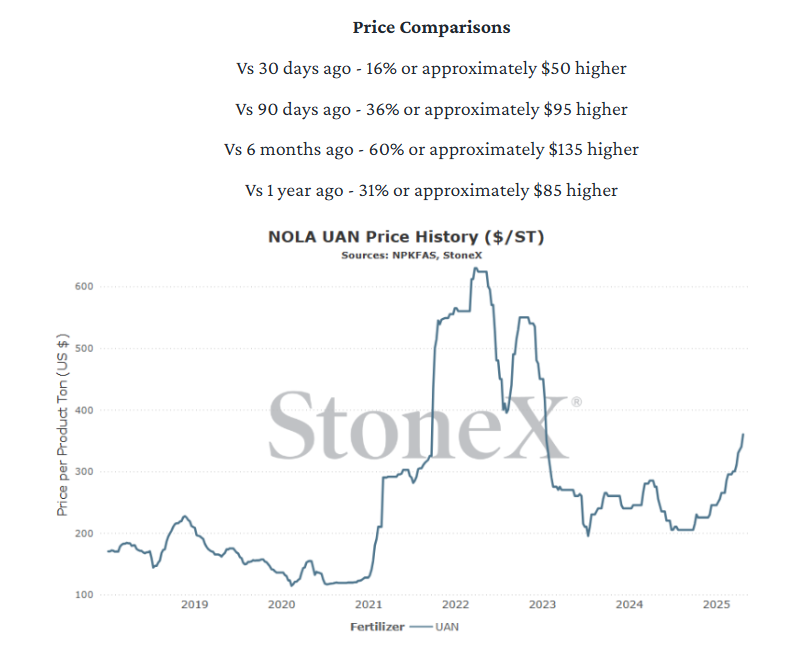
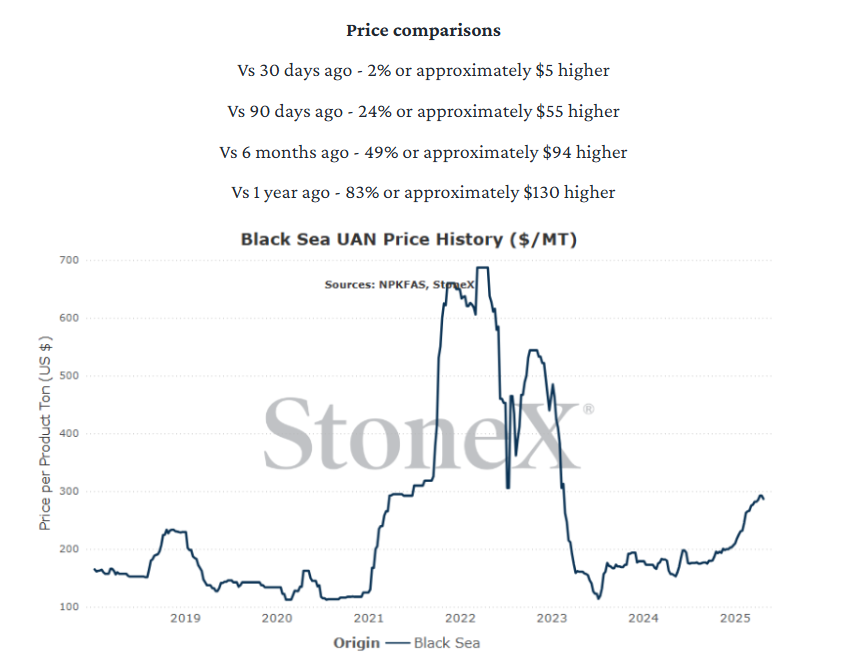
The intention of the below graphs are not to use to say "my price should be X based on this graph". These prices are derived from an FOB price point average. The intent is to show major global price movement trends. Your values will likely have significant basis difference (similar to your local grain price being different than the traded market price).
This graph is labeled as MT in USD currency.
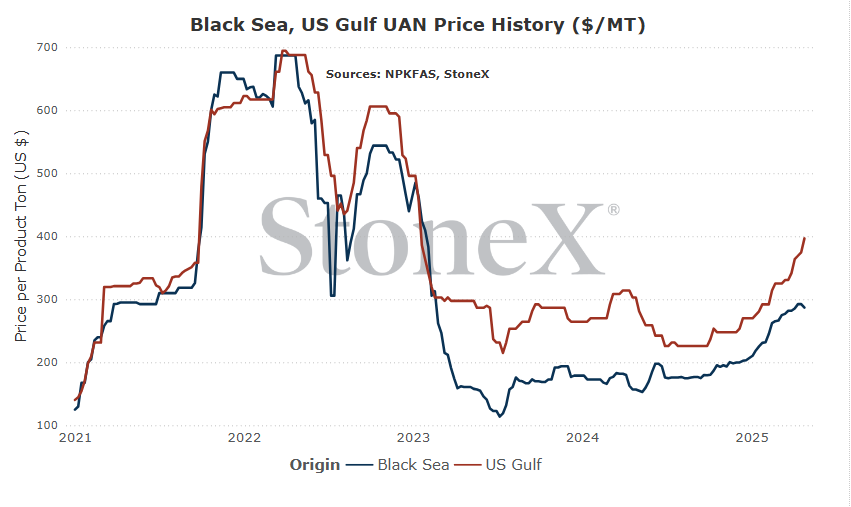
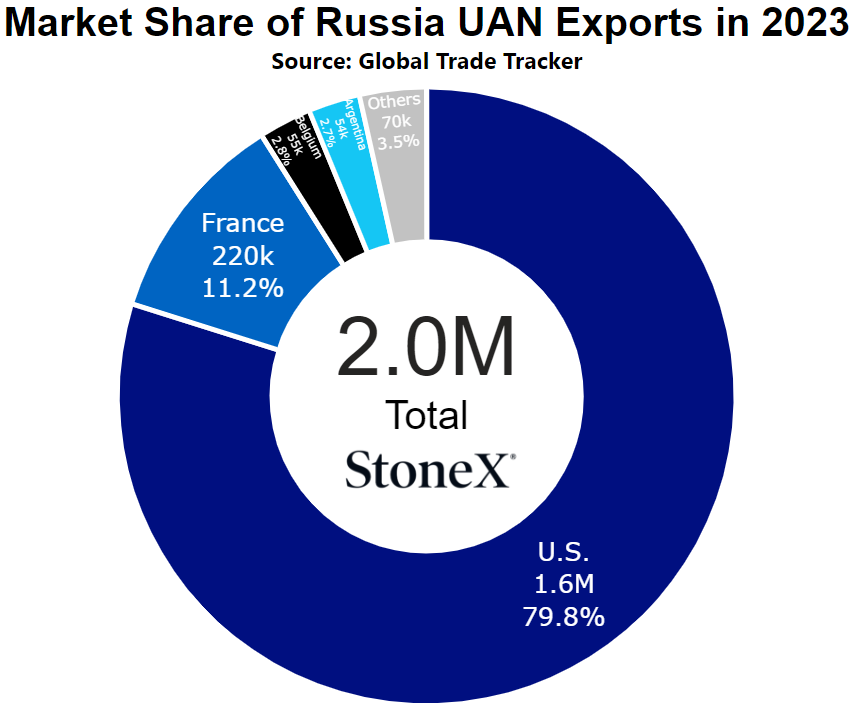
Global/Russian values have held onto last months NOLA UAN strength much better than I expected. By this point, I thought we would see their prices start to break apart but I think I was early in that call. There is still a lot of spring ahead for UAN applications which means still time to send supplies to meet that demand. Also helps that we continue to believe that Russia has slowed their UAN production rate in favor of urea. With so many UAN destinations refusing to business with Russian firms (Canada/Australia/Europe in general), cannot say I blame them.
As long as N.A. UAN values hold/push higher, it makes sense to believe that global/Russian value will do the same. Once we reach that point on the calendar where it is too late to get newly purchased vessels to arrive before spring end, that should be the downfall (assuming something major/bullish hasn't happened to urea).
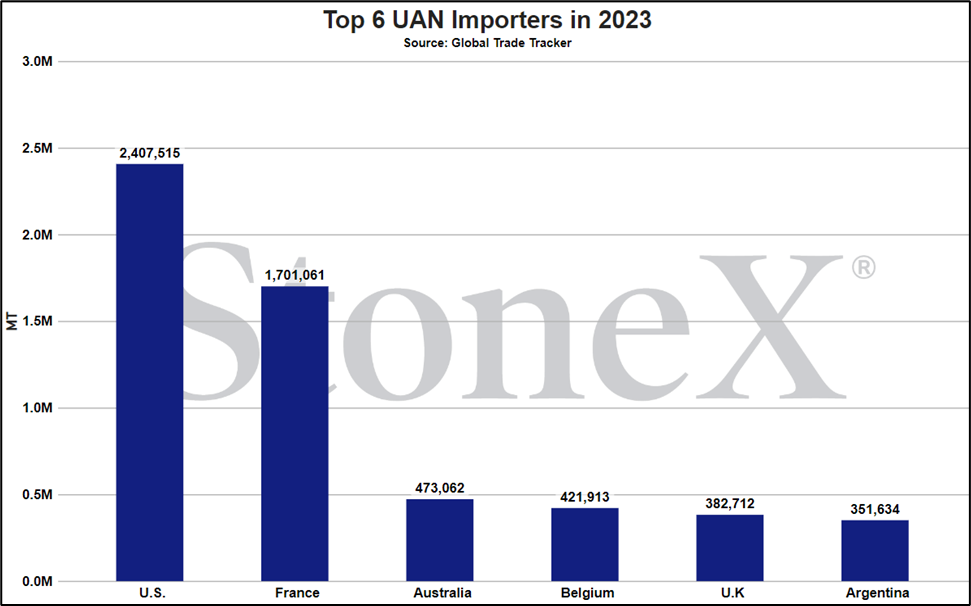
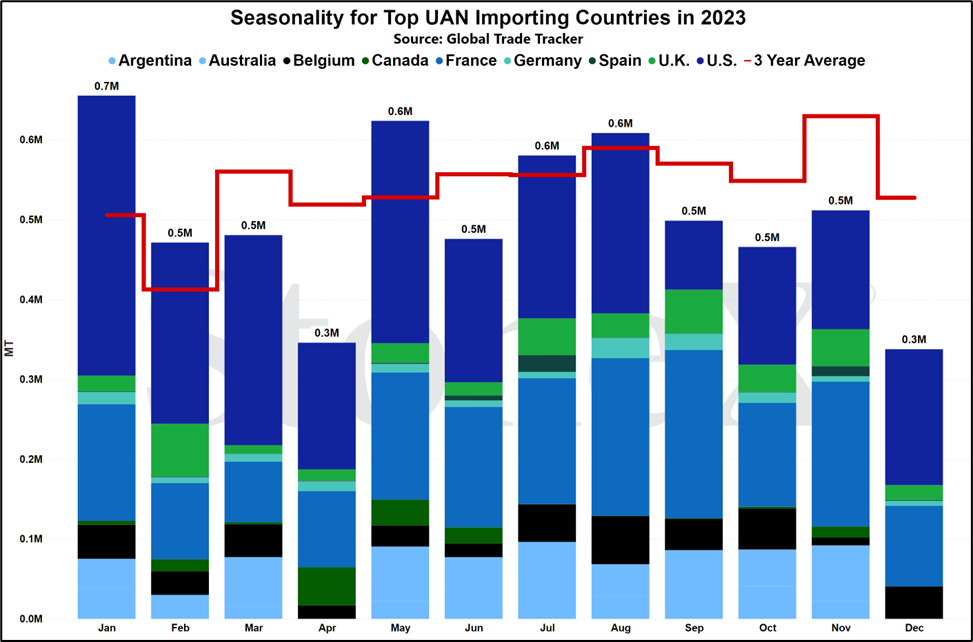
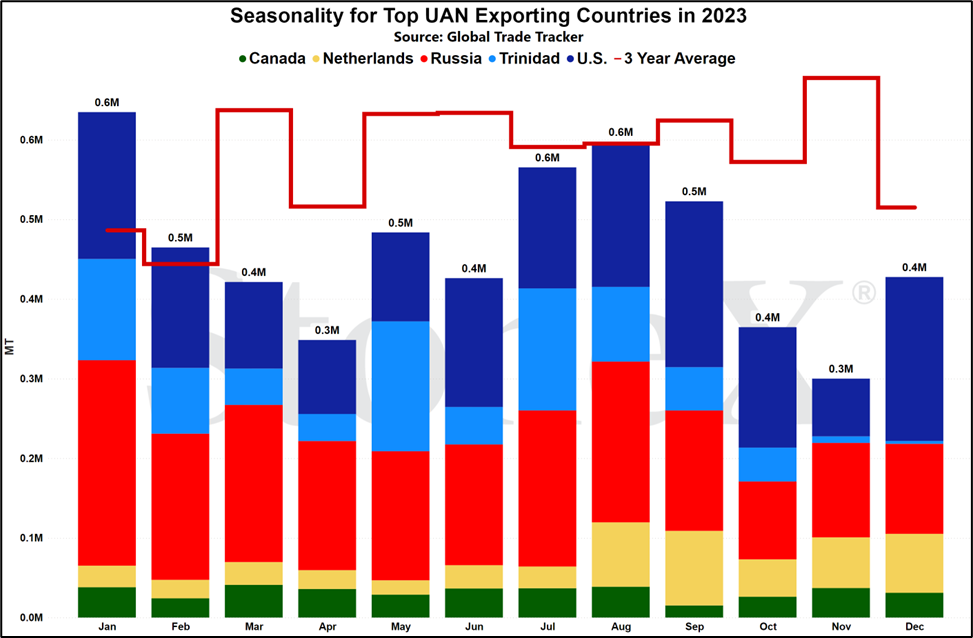
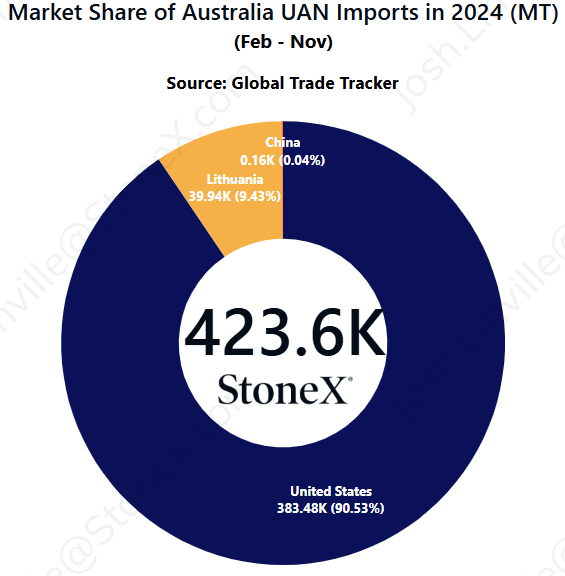
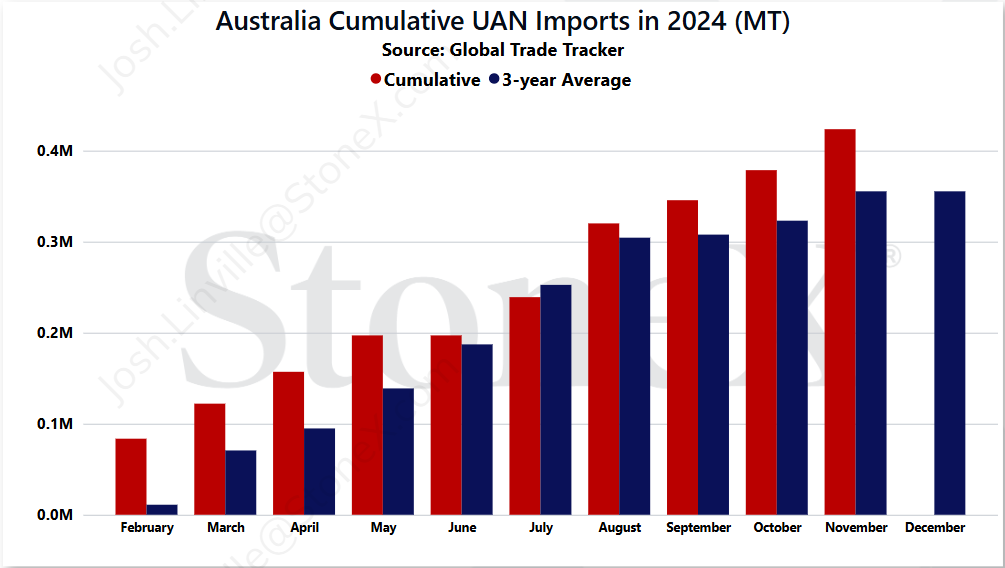
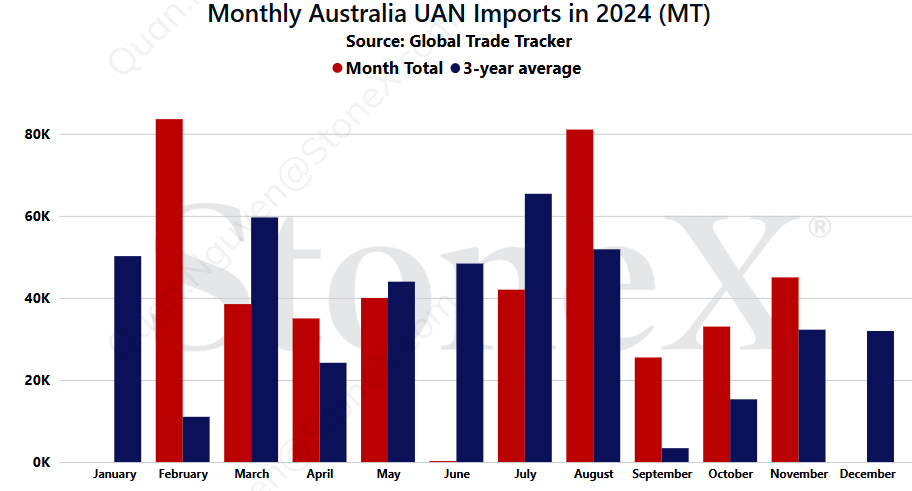
European production remains around 75% of normal
European nitrogen fertilizer production rates has been a story for several years now. Fortunately, since establishing a new recent "normal" rate of 75%, it hasn't fallen any further. Unfortunately, it also has not improved. Also unfortunately, there isn't a whole lot in the near term that has us thinking that will change without a massive shift in relations between European nations and Russia.
For a bit more detailed look back on the story, flip over to urea. I tried to give a quick background on the what/why/where/etc. of the story.
Here, we will shorten the story and just say that European production remains at an estimated 75% of normal production. When looking at that percentage over all the urea tons produced, we believe that results in 3 - 3.5M tons of urea production being lost (and increasing demand on the world as a result). UAN isn't nearly that high. We estimate an annual production loss of around 2M tons per year...but 2M tons on the UAN market is a very big deal as it means that European buyers have had to look elsewhere around the world to meet their needs. Given Trinidad production hiccups due to tight natural gas supplies (more on the next story) and Europe's unwillingness to buy Russian produced product, they have started to lean heavily on the U.S./N.A. markets which has played a big part in their current issue.
As mentioned before, it appears unlikely that this will change in the near future. Even when Dutch TTF (European natural gas markets) dipped as low as $7MMbtu, production rates did not improve. It appears that the 25% offline plants are waiting for more steady low input prices rather than short term blips. Today it appears that relations are not going to improve anytime soon and even if they did, the next step is to repair the Nordstream pipeline which was attacked deep underwater. Shocking, I am not a deep sea natural gas pipeline expert, but I'm going to make an educated guess that those repairs will take time.
So for now, Europe continues to struggle with production which raises their reliance on international tons...and ultimately helps boost the global price floor until they return...if they return.
What does this mean for Aussie farmers?
Trinidad production hiccups allow other manufacturers to fill in
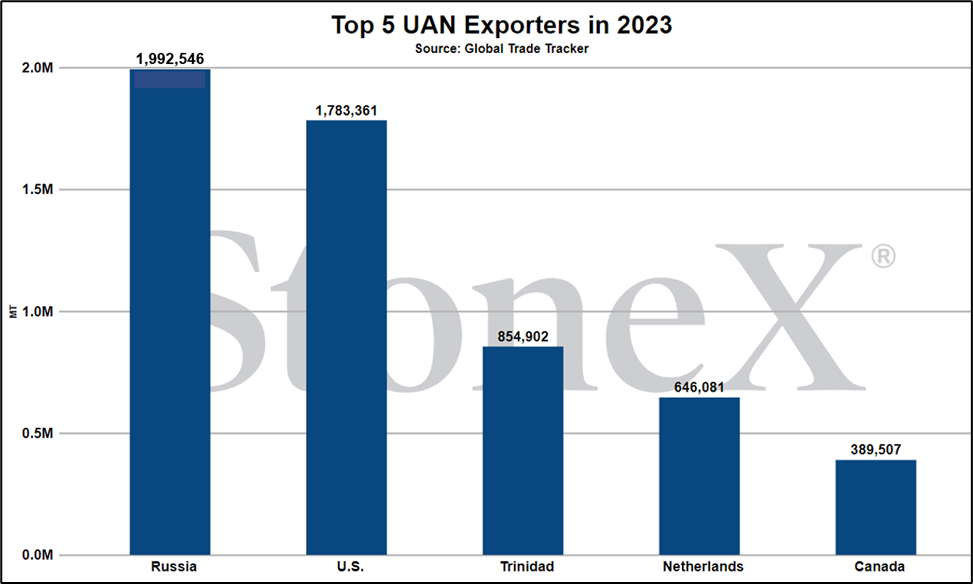
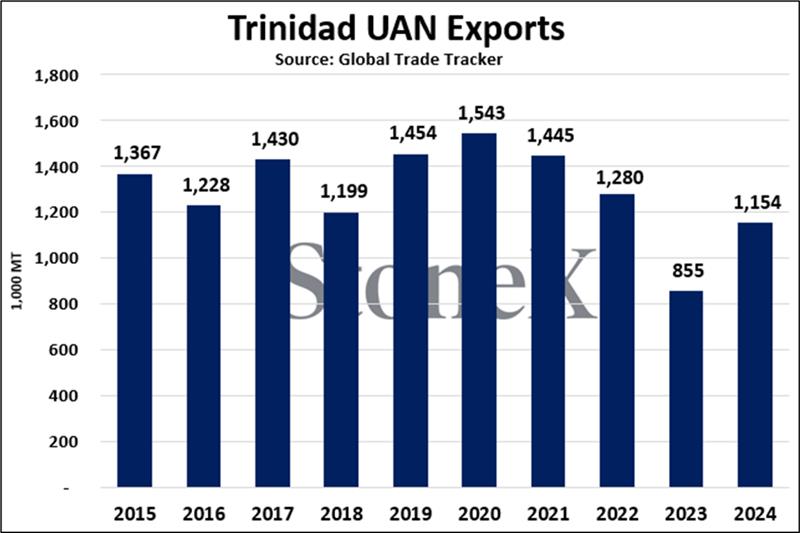
Trinidad, with its large natural gas supplies/reserves, has been a major manufacturer of UAN and NH3. Over the last few years, their exports of UAN have been:
- 2021 - 1.445M
- 2022 - 1.279M
- 2023 - 855K
- 2024 - 1.154M
Unfortunately, those robust gas supplies meant an incredible amount of industry moved in...and supplies have struggled to keep up. This has been recently been impacting production of NH3 and UAN with plants having to slow down to input speed.
Longer term, we are hoping this situation improves. Trinidad had approved the exploration and development of previously untouched waters. As development picks up, supplies of gas will increase and hopefully we see this UAN production hiccups start to become a thing of the past. From a pricing perspective, that would be a great situation. However, like everything in life, there will be road blocks. Current global tariff wars, nations relations may improve/deteriorate, etc. There is no certainty that development will happen. We just have to hope for the best!
Today, we have still not heard if Trinidad production has returned to full strength. Cannot say that we have even heard recent estimates. Obviously, this hurts the global UAN market. Less supplies and unchanged demand typically mean higher prices...
What does this mean for Aussie farmers?
Again, less global supplies means more competition for less available product.
- Trinidad production lowers their supplies
- Their normal buyers forced to look elsewhere
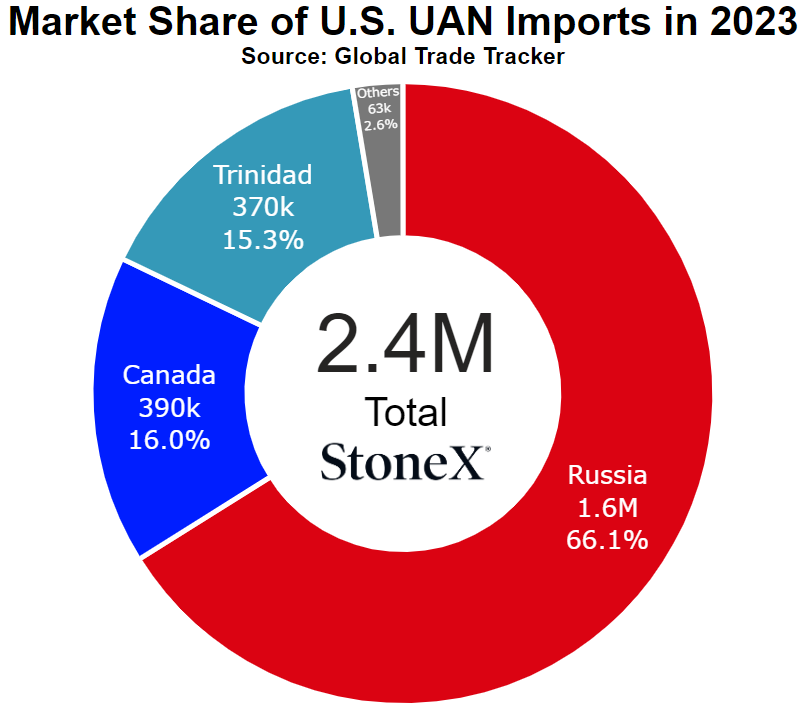
- The U.S. is found to be one of the few remaining suppliers available
- European demand rushes to the U.S., creates more competition
- U.S. exporters raise price ideas
Eventually, the dominos fall to Australia in the form of higher prices than normal.
N.A. UAN supplies incredibly tight for multitude of reasons
Well, it happened. It has been much worse than anticipated, but cannot say we didn't discuss the situation.
N.A. UAN has become more tightly supplied than at any period in my 23 years in the business. I've been asking those with more years of experience if they have seen anything. Resounding no's. Today, most conversations have folks saying that while a couple loads here and there might pop up, to find decent volumes to purchase, you have to wait until June. This has been the case for a few weeks already.
So how did we get here? It has been a lot of factors all coming together in a nightmare scenario:
- Fertilizer year beginning inventories were low - no big deal. Spring '24 was a solid season. Inventories got chewed up. Nothing shocking, just started us on the low side.
- Fall production hiccups - there were several plants that had production hiccups. Any single one of them were really no biggy. However, when you combined them, it turned into 200 - 300K tons lost (estimated).
- Late winter (severe cold) production hiccups - again, this wasn't nearly on the scale of a few winters back where dangerously cold temps reached Mexico that sent gas values screaming higher and production shutting off. Still, there were some reports of plants going offline for at least a few days. More tons lost.
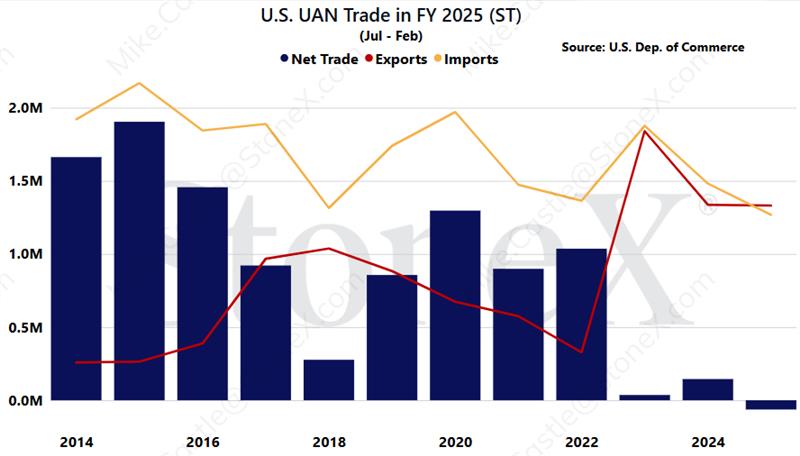
- Exports were big - this was not expected. Sure, U.S. traders/manufacturers have been sending UAN to Europe to backfill their offline production. That isn't new. Unfortunately, when Trinidad production has struggles and their production slows, it created an even larger export opportunity.
- Imports were low - when looking at this fertilizer year, imports have not been booming. N.A. buyers were not jumping up and down to secure spring needs. Why would they? The price never felt "right". Grain prices have stunk. That position had importers squeamish.
- Spring demand grew on bigger corn acres - many people think that adding a million acres of corn to the mix is a massive nitrogen deal. If that demand is split between NH3/Urea/UAN, it really isn't. It certainly raises demand, but not hundreds of thousands of tons each. Still, we started 2025 at 92M acre forecasts, currently reside in the mid-94M range, the USDA last reported 95.3M and many in the market think 96+M is in the cards. All in all, bigger demand is still bigger demand.
- Wide open spring + just in time demand - this spring feels like it has been moving at a break neck pace. Around here in Kansas City region, we have had some moisture but nothing to push us out of the fields for more than a day or so. Lot of areas have been going hard which means demand coming all at once. To make it worse, it sounds like many farmers opted to wait until the last moment to buy their stuff. Now, just in time demand is meeting just in time logistics.
That's a long list. Crazy thing, if we reversed the clocks and removed just a couple of those factors, we are likely not where we are now. Many people in Ag do not understand the work that goes into making sure product is in place and ready to go for spring. Many people in Ag do not know how close to "failure" the market gets every season.
Unfortunately, this is the year every factor happened.
Now, we are seeing some things happen that should help a bit. Some are reporting that new buyers that want UAN are finding out how tight it is and are opting for urea as their N source. Others are reporting that buyers are seeing urea at a more steep discount than normal and opting for it. A few are saying that some see the tight supply situation and have decided to switch back to beans.
All of these will help alleviate the current stress, but unfortunately I do not think it fixes it. It will not stay this way forever, but may stick around much longer than we are used to...
What does this mean for Aussie farmers?
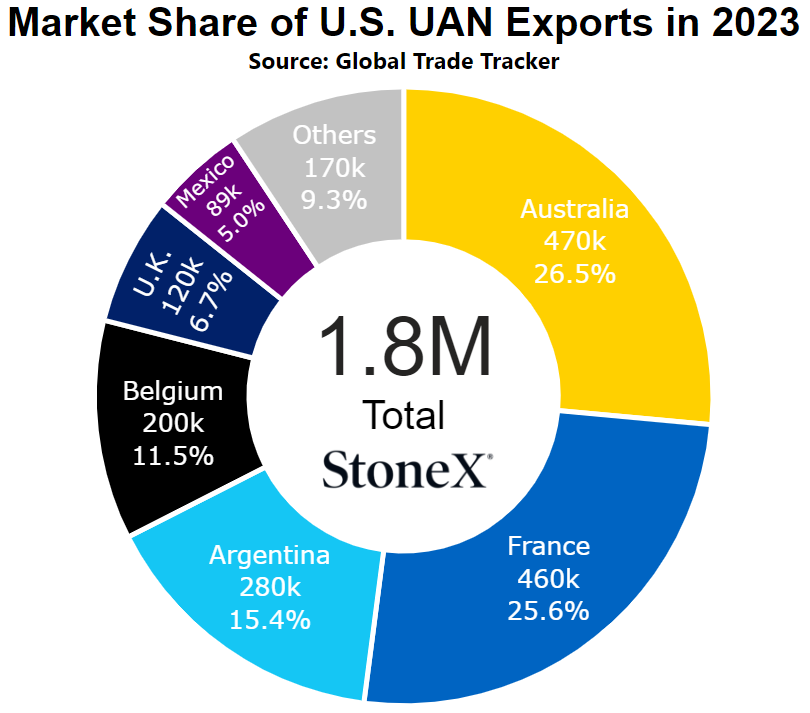
Unless Australian UAN netbacks are amazingly higher priced than current N.A. options, why would the U.S. export anything?
They are already awash in demand with very little supply to offer. It is to the point that when a few tons pop up, pricing only gets discussed after guarantees of availability. Real tonnage isn't available to ship until June.
The market there knows the situation. It also knows that if it is seen exporting product during this situation, heads may roll. While that hasn't stopped anyone in the past, it should make some nervous.
This just makes it harder for Australia to find UAN short term.
NOLA/New Orleans, Louisiana
Number 2 global importer in 2022
Number 1 global exporter in 2022
Black Sea (Russia)
Number 2 global exporter in 2022
- Further Trinidad production issues – the longer Trinidad struggles with production, the more tons of UAN that could be produced are lost. The more tons of production that are lost, the less tons available to global buyers. The less tons available, the higher the global price floor. Trinidad is a big cog in the global UAN machine. When they suffer, we all suffer.
- N.A. buyers continue to care more about availability than price (copying from U.S. version given Australia's reliance on U.S. supplies) – I would say this is actually happening today. When discussing a need for UAN to ship nearby, rarely is price discussed. The question is "can you actually find it and when can it be here". That mentality, while absolutely right given today's circumstance, is dangerous for prices. If I am back to being a trader and I have 20 truckloads to sell, I'm not selling 20 truckloads at one. I'm selling 2 - 3. If they say yes without blinking, the next 2 - 3 are offered higher. So on and so forth. It is a sellers delight out there if they have tons.
- Urea starts getting tight/higher priced (copying from U.S. version given Australia's reliance on U.S. supplies) – unfortunately, I would say this is also happening today. Starting to hear more folks say that urea is getting harder to find. Part of it is just typical spring stuff. You have to wait longer in the heat of battle. However, demand is also rising. Several people have said that farmers/retailers have been switching from UAN to urea. Some due to availability. Some due to price differentials (urea is cheaper). That is also something we have discussed. As urea gets tighter, it starts to shift that demand back to UAN.
- Trinidad production returns to normal soon – while we haven't seen/heard anything about this happening, we are watching. Once they come back, and I think it is more about when than if, that will help remove a bullish factor from the list. Once removed, it adds to the global supply pot and helps to lower price ideas...eventually.
- Too much demand switches away from UAN in N.A. (copying from U.S. version given Australia's reliance on U.S. supplies) – right now, I do not think we have hit this point. Yes, some demand has been switching away from UAN and back to urea. It just isn't enough to make a difference given the current UAN supply situation. I also struggle to believe it happens because we are already seeing urea supplies get tight. That will further restrict demand switching. Still, if urea can keep up and demand switches away from UAN, it could hit a break point where UAN needs to buy demand back in the form of lower prices.
- Focus moves away from current tightness and to selling off June/July inventories (copying from U.S. version given Australia's reliance on U.S. supplies) – spring demand doesn't last forever. Eventually, the height of spring demand/stress/etc. gives way to the hot and quiet months of summer. Imagine what will happen when things slow down. The market will finally have time to take stock of all that has happened...and suddenly might not be so confident in their outlook. If nerves start to take hold, you could see a sell off. With inventories so tight, doesn't look like this could happen for a while but it is something to monitor.
We believe that only looking at the flat price of either grains or fertilizer can be misleading:
-
Only selling grain can hurt you if fertilizer prices rise substantially
-
Only buying fertilizer can hurt you if grain prices fall
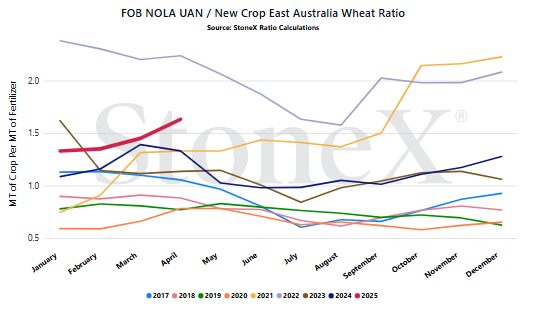
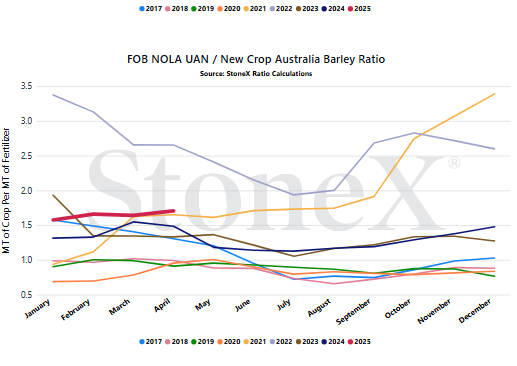
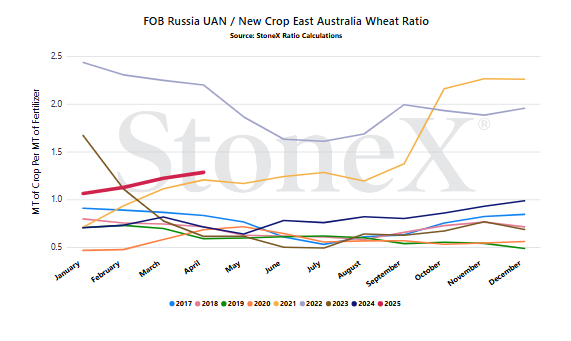
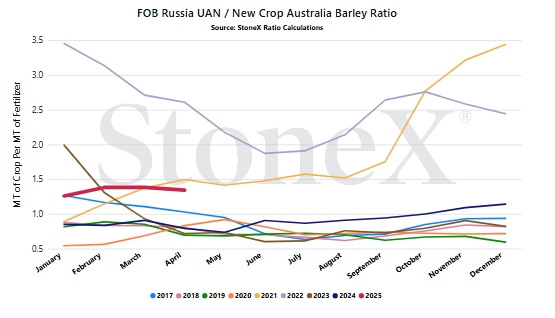
We look at the ratio "value" to get a better indication of where we are or how many bushels of X does it take to pay for 1 ton of fertilizer.
Would you rather:
-
Spend 100 bushels to pay for 1 ton of UAN
-
Spend 60 bushels to pay for 1 ton of UAN
When we compare the current ratio value against recent years, we start to see if we are high or low.
YOUR VALUES MAY LOOK DIFFERENT
This graph looks at the NOLA UAN price vs the flat grain price. There are no logistics on either product. Your location will look different due to fertilizer logistical costs, grain basis, etc.
- Trinidad production - having Trinidad production slow due to insufficient gas flows hurts the world, plain and simple. They are major force in the export marketplace. UAN isn't exactly full of global exporters so options are limited. I'm continuing to hold out for news that they are back, but afraid at this point it would be more of a summer help than spring.
- N.A. supply situation - right now, it is extremely hard/impossible for N.A. retailers/farmers to find nearby ship UAN. It does not look like this will correct itself in the near term with many continuing to state they are sold out into June. That will make it very difficult for buyers like Australia to find tons to ship in until that situation rectifies itself.
StoneX Ratio Calculation
The ratio calculation is derived from Bloomberg historical grains values as well as fertilizer values from StoneX, NPKFAS, and Argus.
The calculation is simply dividing the fertilizer price by each grain price.
All data was sourced from StoneX unless otherwise noted.