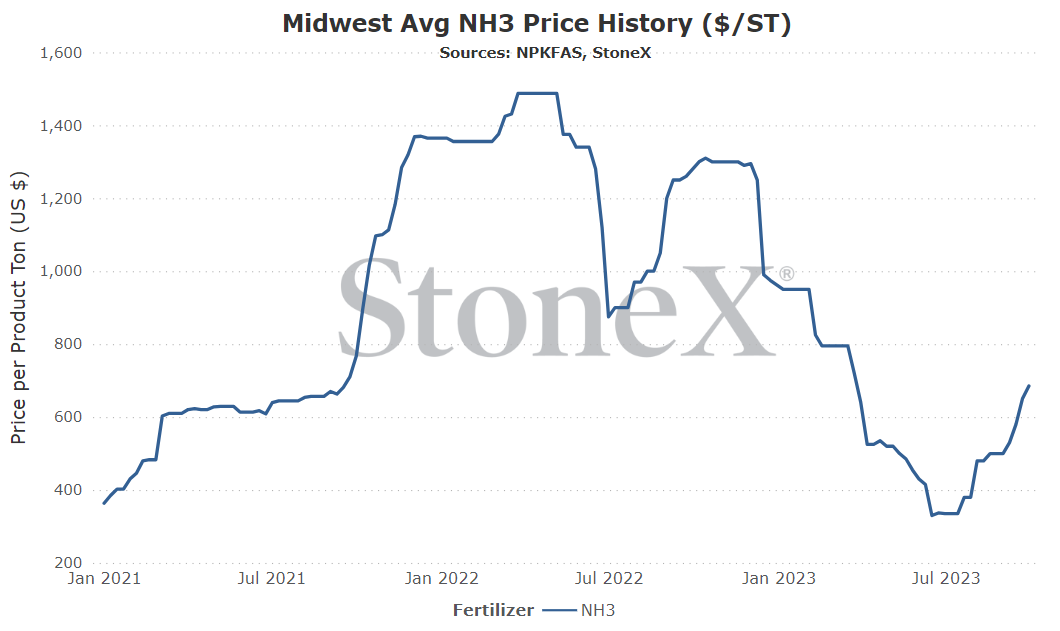
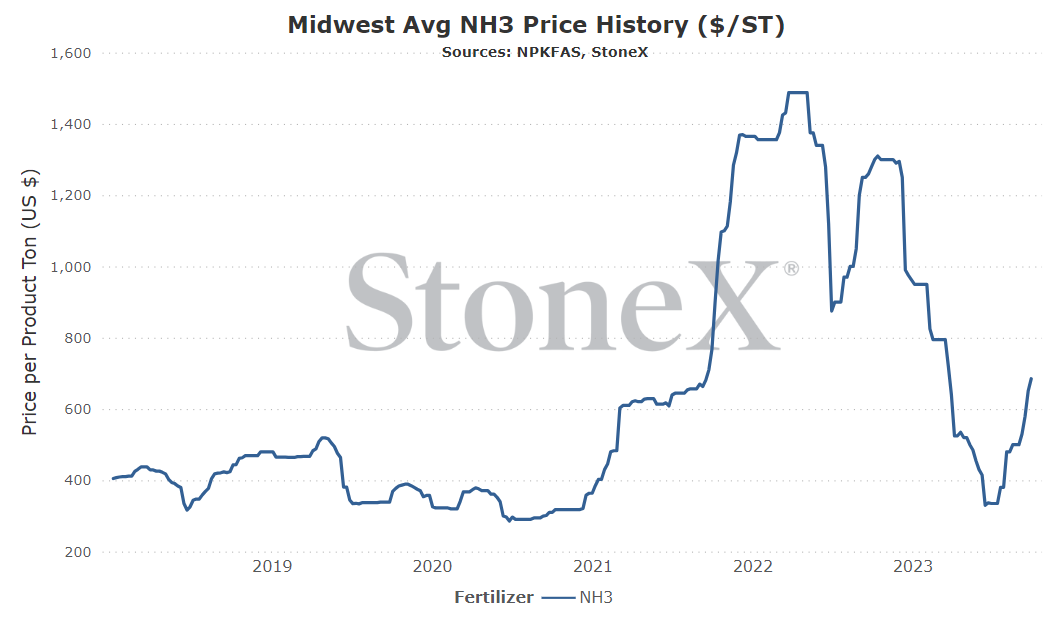
The first graph is the AVERAGE of the entire Midwest U.S. region. That means your local value WILL be different than what the graph reflects. Please do not take this into your retailer and say "why isn't my price the same as here". That is comparing apples to oranges. You might be on the cheaper or more expensive side of this graph. This doesn't take into account logistics/storage/interest/insurance/shrink/etc.
This graph looks at the price from a short ton and USD currency POV.
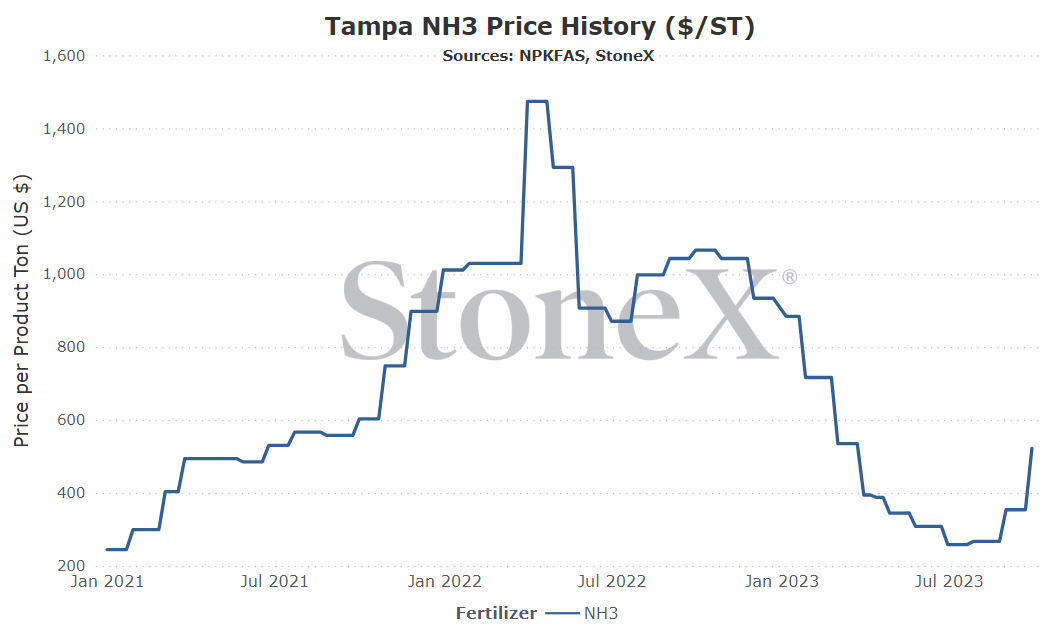
This second graph looks at the price set for Tampa NH3. This value does not have a high correlation to Midwest values. It is a talking point used when prices are rallying...yet somehow gets skipped on the way down. This price is more an indication of the global price. This price is set by two parties (purchaser - phosphate producer in Florida / seller - international producer providing NH3 to FL phosphate production).
This graph CAN be used as an indication of global market price direction/trends. This graph SHOULD NOT be used to determine a Midwest value. Tonnage is listed in short ton and currency in USD.
The current market is hot. No way around that.
We have seen multiple production issues at multiple production areas (Trinidad/Europe/Saudi Arabia). That has made a market that is STILL without its largest exporter (Russia), extremely tightly supplied. As long as supply is tighter than demand, prices should remain supported.
However, how long will this situation last? Russia is working to build export infrastructure. Europe is showing signs of production recovery. Saudi Arabia will get itself fixed. Trinidad...well, we will see. On the demand side, I cannot shake the fear that recessions are about to dominate the news cycles which will hurt. As supply issues fix themselves, current prices start to feel a little overbaked.
Long story short - would not be surprised at all to see short term prices elevated but longer term, the S&D will correct and prices should correct lower. When exactly is that going to happen? I'm going to need more zero's on the left side of the decimal point before I know that!!!
North America
The outlook for fall ag application demand remains really good. All signs point to our running the system out of product as we move into December/January. This is a HUGE negotiation win for manufacturers. Continued global strength will only help to back the bullish narrative. However, the one thing that is making me nervous is that prices have climbed substantially and are starting to feel high. If demand approaching the market in November see's these types of values, it could push demand away.
Longer term, we are still watching for demand destruction from the industrial sector as well as global values correcting.
Long story short - we feel VERY confident that values will hold/push higher into fall, winter/spring should see continued support but it gets murky past that. A poor run due to mother nature would disrupt the entire outlook.
I've thought about this section a lot in the last month and I've decided I'm going to discontinue it.
I swear I'm not being lazy!!! My issue is that this decision can vary so widely.
-
What crops are you growing?
-
Where are you located?
-
What programs are you using?
-
Are you just looking for the fertilizer low or are you selling grain as well?
-
Are you at a higher weather risk for growing next season?
-
What is your local basis (what makes your area values unique)?
That just touches the number of questions which differentiate each and every person who subscribes to this. What makes sense for one may not make sense to the next.
At the end of the day, it is NOT my place to tell ANYONE what to do/not do for their operation. I'm here to provide background/information/insight into the markets but you make your own decisions. You have to answer to your bank/suppliers/etc.
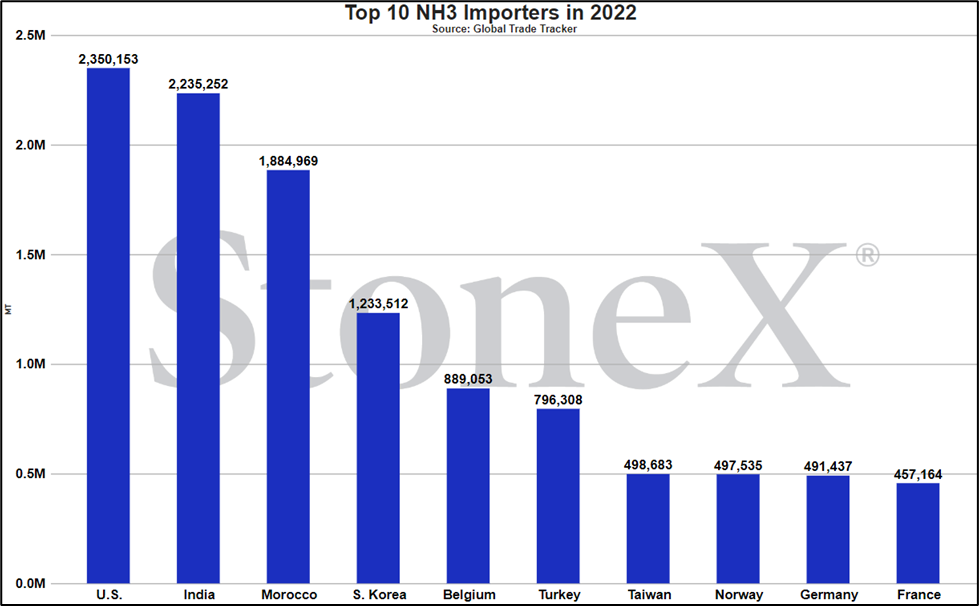
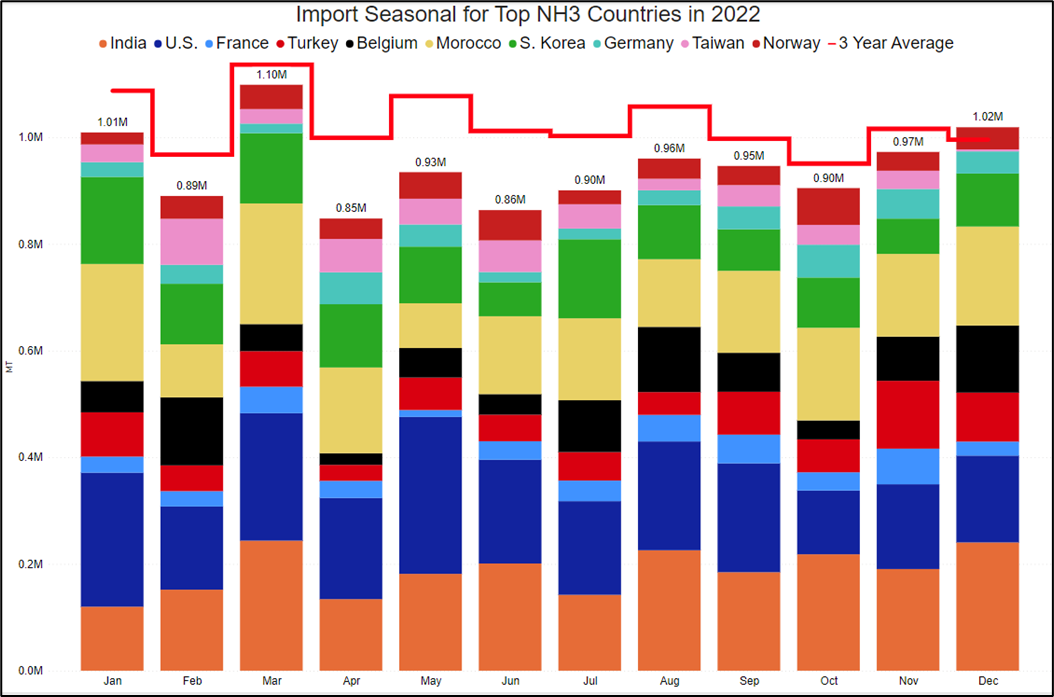
It always amazes me just how quickly a market can change.
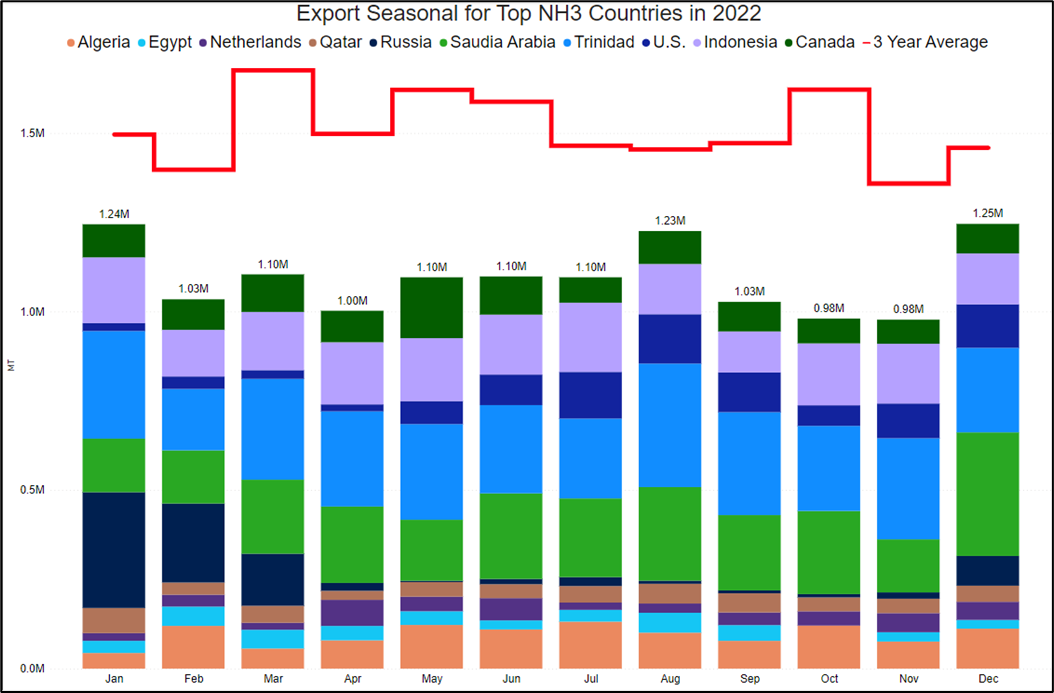
As the global NH3 market moved into the summer, supplies were more than sufficient vs demand. Production was doing well. Demand had backed off. NH3 values were dropping.
Then the issues started.
Trinidad NH3 production has seen more issues than previously expected.
Saudi Arabia, generally an area that has little to no issues, has seen production take hits and supplies become tight.
Europe remains in the news as production continues at less than 100% of normal due to high input costs.
None of those take into account normally scheduled nitrogen plant shut downs for repairs.
So a global market that saw values completely fall out of bed (Tampa starting 2023 at near $1,000MT and falling to sub $300MT by July) is now regaining its foothold.
Get used to volatility, it isn't going anywhere anytime soon...
Russian exports remain non-existent
For the sake of saving everyone reading time, the last couple months of newsletter go deeper into the story of why Russian NH3 exports have ceased to exist. A very long story short:
-
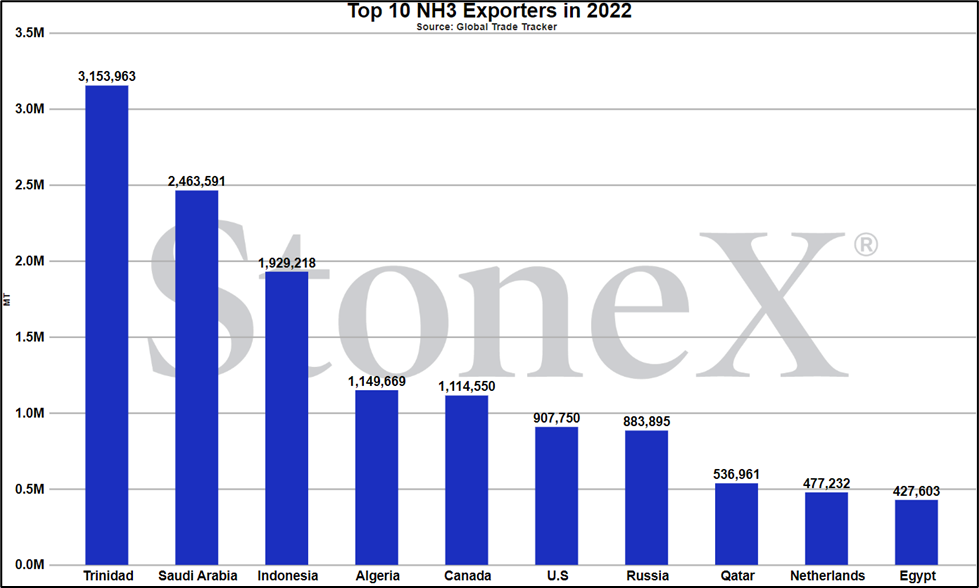
Russia WAS world's largest NH3 exporter
-
They exported by shipping thru a pipeline...that runs thru Ukraine and out to sea by Ukraine port
-
...then Russia invades Ukraine...
-
Fighting, lack of electricity for pipeline pumps, damage to pipe itself blows any chance of shipments resuming
That brings us to today...where nothing has changed.
Russian NH3 exports continue to be near 0 due to the fact that they cannot access the global marketplace.
There continue to be rumors/discussions that the Russian are building infrastructure to carry their product to newly developed deep sea ports which reside within Russian territory. Eventually, these projects will be completed and Russia exports resume toward normal once again...the question is when and that is a hard question to answer.
Suffice to say, we continue to believe that Russia will be absent from the NH3 market at least thru remainder of 2023...and at least partly in 2024.
However, when their exports resume (whenever that is), a lot of product will become available very quickly.
Tampa NH3 prices rally further on continued demand/tight supplies
Well, the fun for international NH3 buyers was fun while it lasted.
The "cheap" NH3 values now seem to be a thing of the past as demand continues at a solid pace and production issues at several key points around the globe have grown into the current situation.
As is typically the case, Tampa NH3 market is a solid indicator of global price direction and the price set for October was bullish to say the least.
In September, the value was agreed upon at $390 and that September price was a solid price increase vs August.
However, October took it to a new level with the price being set at $575 for a large $185 increase.
This will have ramifications on multiple markets:
-
Global nitrogen production plants will see input costs grow.
-
Industrial NH3 demand will see their inputs higher.
-
Florida/global phosphate production costs grow as a result.
There are signs that the higher trend could slow:
-
Recession fears continue to linger (at least for me)
-
Some production issues will get resolved
Today, the trend is higher and will continue to support growing values at points around the world.
My personal recession fears continue to grow, casting doubt on NH3 industrial demand
Let me start this section by pointing out that I am not an economic guru. I struggle with fertilizer more days than I like to admit!!!
That said, there is a growing list of reasons to be nervous of an upcoming recession.
Bankruptcies continue to grow. Mortgage rates are rising, making it harder for folks to purchase and pay for homes. Inflation continues to be a part of life. People are continuing to spend money like they did coming out of Covid (when everyone had to sit at home and save).
While it may not happen, it seems like the chance of a looming recession is growing...so why do we care from an NH3 POV?
For at least N.A., the demand for NH3 from an Ag direct application side is about the same as the demand from the industrial side. What happens in a recession? The economy slows down. What happens when an economy slows down? Production slows. If production slows, industrial demand for NH3 drops...and those tons are left looking for homes...in the ag sector.
Again, I am far from an economic expert. I'll leave that to folks smarter than I. However, we have to remember that Ag is far from bullet proof. If we start seeing more signs of a recession coming, expect it to have an effect on NH3...eventually.
N.A. Midwest average values double from summer fill low's
This is a bit like comparing apples to oranges, so bear with me.
When looking at the Midwest Average, the price of NH3 has doubled since its low.
When summer fill programs (not fall shipment programs which truly set the market) were announced, the average sat around $330. Manufacturers had seen a somewhat disappointing spring NH3 application run which left more product in the system moving into the summer months. Effectively, they dropped the price to make it a no brainer for buyers to step forward and fill their tanks.
There is a list of reasons that NH3 values have been bullish since setting that low but the net result is that the Midwest average fall shipment value is approximately $650. Not only has it doubled from the low's, the outlook price remains firm as international values continue to climb, overall N demand remains high, urea and UAN values remain high and current NH3/grain ratios still make sense.
This highlights the fact that while the excessively high prices might be behind us, price volatility is still very much a part of our lives.
N.A. fall NH3 outlook remains extremely strong
There are multiple reasons/perspectives that we are using to justify this point:
-
Overall nitrogen outlook remains strong with our forecasting 92M acres of corn in 2024 (vs 88M acres of beans). It is yet another year of 90+M acres and with it, the substantial overall N demand that comes with it.
-
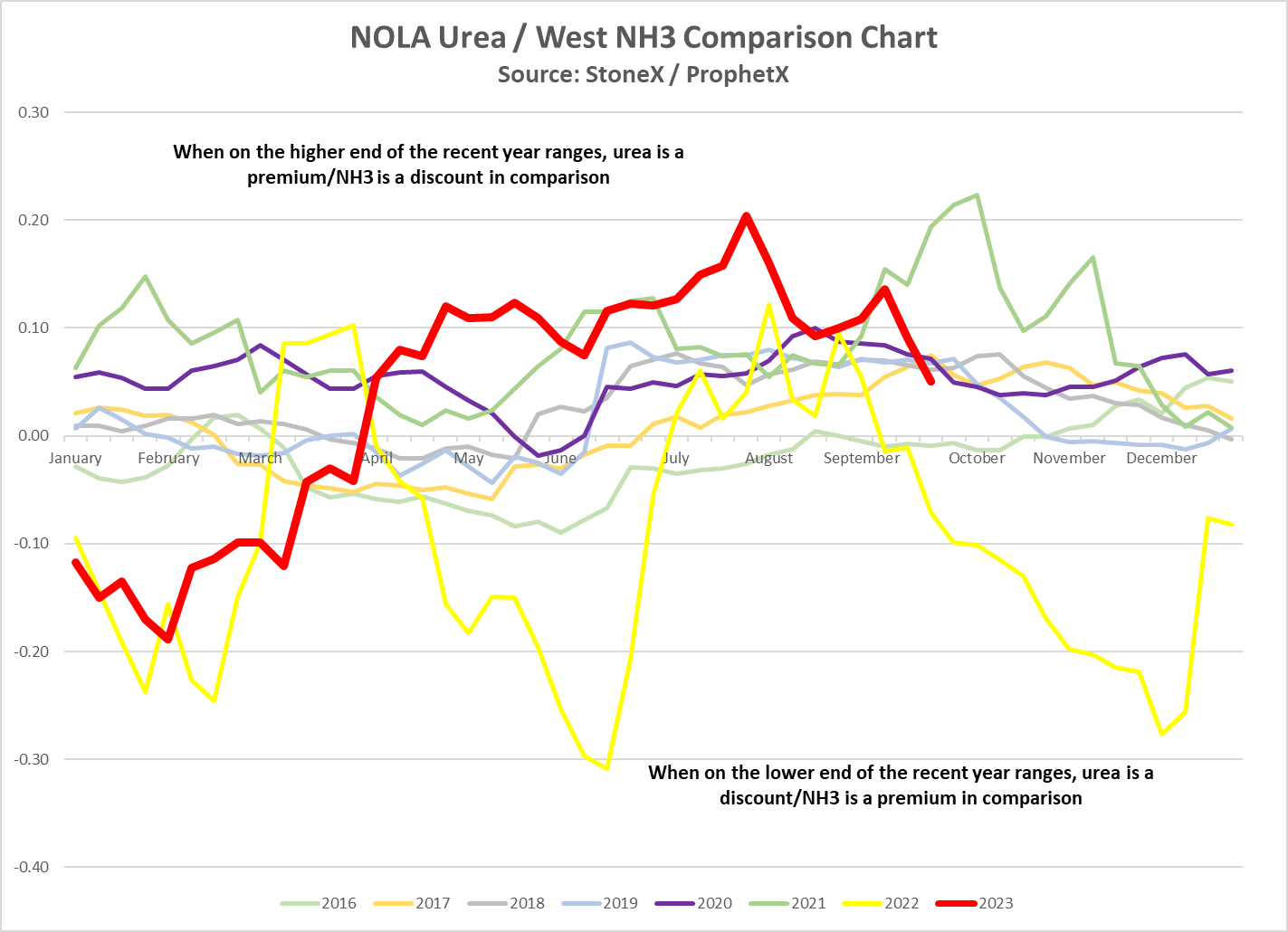
NH3 still looks well valued vs corn pricing. While the ratio is higher than the low's set this summer, when compared to recent years, the current value is still on the lower end of the range and should indicate that farmers will not shy away.
-
Harvest looks to be on-time to early this fall. The crops saw more stress than previously expected which seems to have sped up a lot of the acres. Today, there is no reason to believe that harvest will be delayed. The earlier it is done, the more time for farmers to pull out the toolbars.
-
NH3 still looks decent vs urea. While it isn't the huge discount that it was, it is still mostly in line (normal) with current urea market values.
-
NH3 still looks ok vs UAN. This one is starting to edge toward UAN being a better deal, but the current spread still has it in recent year ranges.
We have taken all of these points and put together a fall ag demand application forecast of 2.15M. Last fall, we had forecasted 2.0M so this is an improvement as we get within weeks of starting.
However, please note that all of the above pales in comparison to weather. NH3 could be free to the farmgate, but it wouldn't make a bit of difference if it froze early or stayed wet all the way thru fall season. Mother nature ultimately gets the first and last say on what we do and do not get done from an Ag perspective.
U.S. Midwest Wholesale price average
Vs 30 days ago - +30% or approximately $150 higher
Vs 90 days ago - +93% or approximately $313 higher
Vs 6 months ago - -10% or approximately $70 lower
Vs 1 year ago - -48% or approximately $610 lower
U.S. Southern Plains price average
Vs 30 days ago - +46% or approximately $166 higher
Vs 90 days ago - +86% or approximately $244 higher
Vs 6 months ago - -5% or approximately $30 lower
Vs 1 year ago - -50% or approximately $536 lower
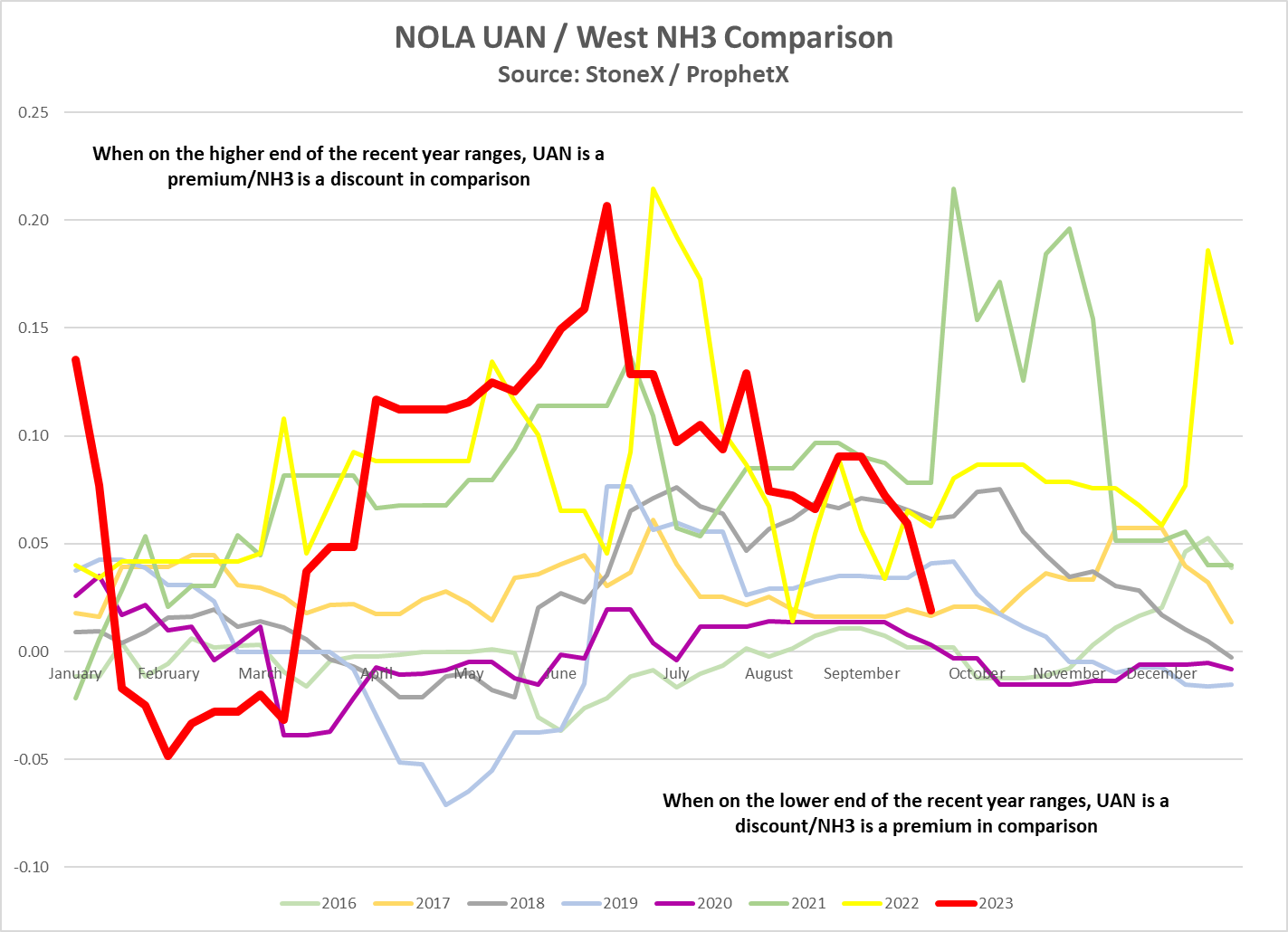
- Global production issues have added up - Trinidad, Saudi Arabia, and Europe. All 3 areas have seen decent production issues of NH3 that have resulted in global supplies being tighter than previously expected. While the end appears in sight for Saudi Arabia and Trinidad, the same cannot be said for Europe. All in all, less supply is available today.
- World's larges exporter, Russia, still cannot find a way to export today - the chances of getting the country you are actively and illegally invading to allow you to ship your NH3 thru its country and out to the world thru its ports are pretty thin. Today, the world continues to operate without its largest exporter.
- N.A. NH3 values still point to a solid fall application period - since the summer fill low's, the Midwest NH3 average has doubled in price...but still remains the most economical source of N for farmers. Harvest looks like it will be on time, if not early. Everything is adding up still to a very solid fall application run which will deplete inventories thru the Midwest.
- Work continues in Russia to resume exports thru its own ports - when you are the world's largest exporter, you might be down for a while but you are never down forever. You find a way, and that is exactly what we continue to hear. Rumors are that work is still being done to build infrastructure to bypass the Ukrainian pipeline in lieu of rail to new deep sea ports residing in Russia. Once this work is complete, Russian NH3 exports can return. Today, it seems it is a matter of when, not if.
- Production issues should resolve themselves - ok, maybe not for Europe unless natural gas values plummet or global nitrogen values continue to rocket higher. However, Trinidad and Saudi Arabia should see their production issues resolved and production resumed. The return adds more supply to the marketplace.
- Recession fears persist - I am not an economic genius...but there are plenty of things that I see today that worry me going forward. Growing bankruptcies. High mortgage rates (not what a lot of you dealt with in the 80's, you know what I mean!!!). Insane inflation (even if certain parties do not want to admit it is happening). If these things push global economies into a recession, then manufacturing "should" slow. If manufacturing slows, industrial demand for NH3 drops. If industrial demand for NH3 drops, they push those tons into the ag sector. Welcome to a decently oversupplied marketplace.
- Only selling grain can hurt you if fertilizer prices rise substantially;
- Only buying fertilizer can hurt you if grain prices fall.
- Spend 150 bushels to pay for 1 ton of potash
- Spend 100 bushels to pay for 1 ton of NH3
- Very quickly, we start to see if we are high/level/low vs previous years.
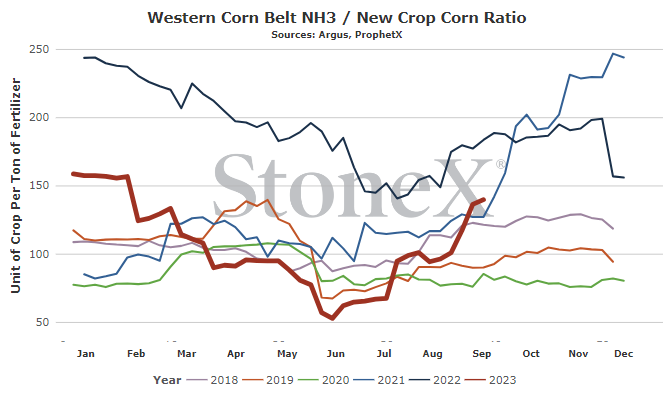
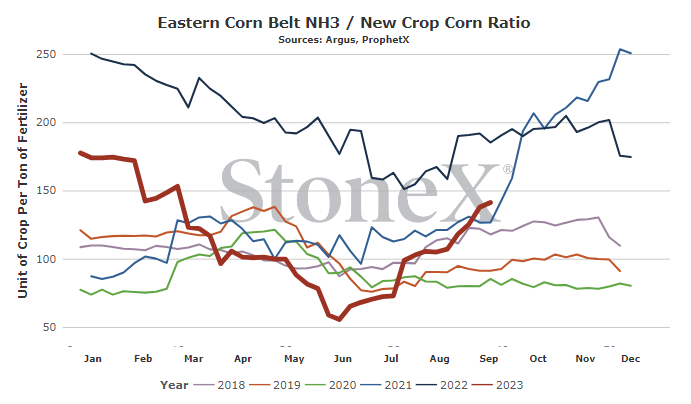
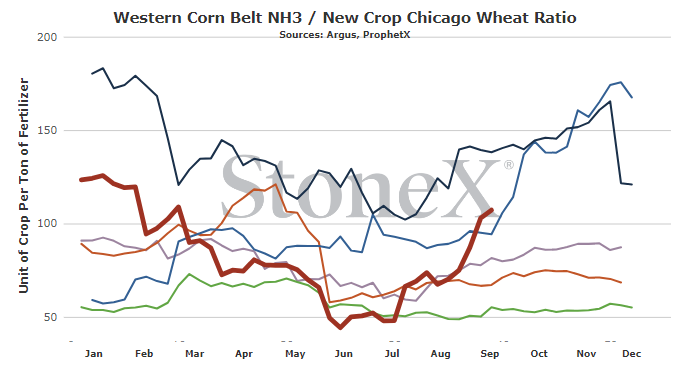
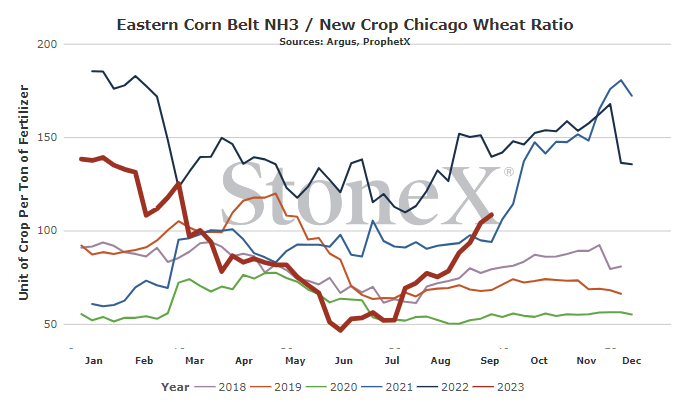
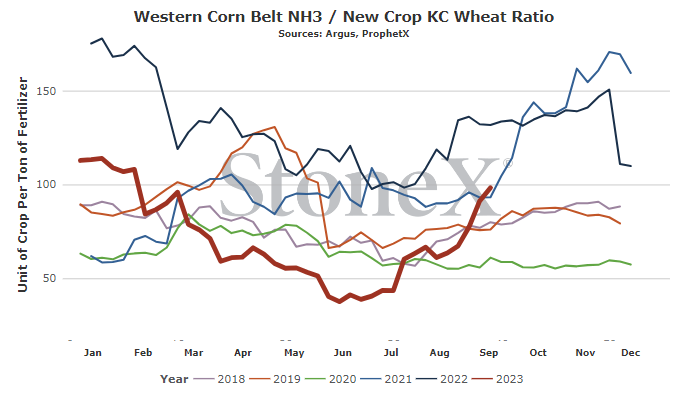
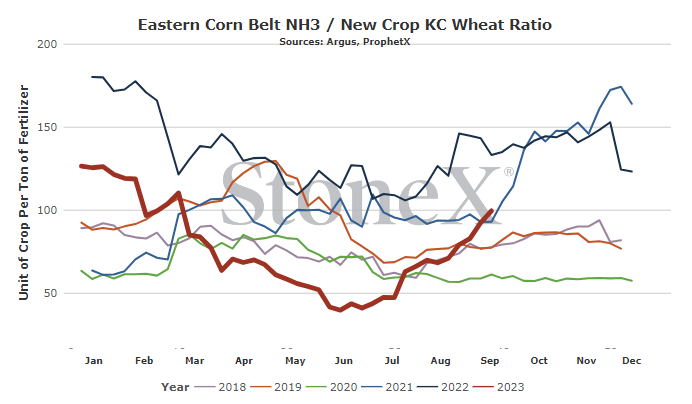
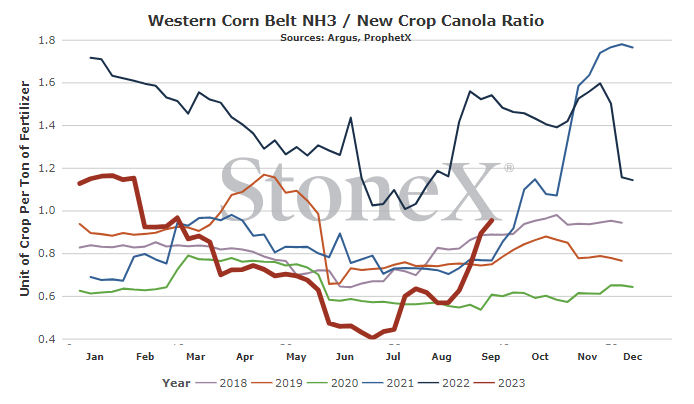
- Global production rates - there have been some hiccups in the global NH3 market that has caused supplies to tighten much more than they should be right now. Middle East production took a hit. Trinidad has had some issues. Europe continues to struggle with lower production due to high natural gas costs. Russian exports remain near zero due to the ongoing invasion of Ukraine. All of these are combining to keep values firm...but how long will they all last?
- Global economies (i.e. possible NH3 demand destruction) - let's start with this: I am no economist expert. I'm not trying to be. That said, I'm still very worried about a lot of major economies around the world. We continue to hear reports of the Chinese economy being in a major stress period. Heck, here in the U.S., bankruptcies continue to rise as people are struggling to pay their bills (but somehow still have the funds for a new vehicle/vacation/etc.). If, big IF, this turns into reality, we need to be very nervous regarding the NH3 market. If we roll into a recession, then the economy slows down. If the economy slows down, manufacturing typically slows down. If manufacturing slows down, then demand for NH3 falls. If industrial demand falls, guess where those supplies end up...that's right. They start flooding the ag market.
- N.A. demand reaction to continued rising price ideas - this is not my saying the ratios to grains are high. In fact, the opposite. Many of the comparisons/ratios are still sitting at very solid values today, even with NH3 values up. But the ratio approach is a unique perspective that most of the market is not utilizing. Most of the market still seems to be looking at the flat price of NH3 to figure out if it is good or bad. For those comparing directly to this time last year, today's values are fantastic. However, Midwest values have doubled from their summer low and could have some demand reeling. Overall, we continue to expect a huge fall application run but prices have rallied enough that we should start watching.
All data was sourced from StoneX unless otherwise noted.
This material should be construed as market commentary, merely observing economic, political and/or market conditions, and not intended to refer to any particular trading strategy, promotional element or quality of service provided by the FCM Division of StoneX Financial Inc. (“SFI”), StoneX Financial (Canada) Inc. (“SFFC”) or StoneX Markets LLC (“SXM”). SFI, SFFC and SXM are not responsible for any redistribution of this material by third parties, or any trading decisions taken by persons not intended to view this material. Information contained herein was obtained from sources believed to be reliable, but is not guaranteed as to its accuracy. Contact designated personnel from SFI, SFFC or SXM for specific trading advice to meet your trading preferences. These materials represent the opinions and viewpoints of the author, and do not necessarily reflect the viewpoints and trading strategies employed by SFI, SFFC or SXM. The FCM Division of StoneX Financial Inc., a subsidiary of StoneX Group Inc., is a member of the National Futures Association (“NFA”) and registered with the U.S. Commodity Futures Trading Commission (“CFTC”) as a futures commission merchant and commodity trading advisor. StoneX Financial (Canada) Inc. is currently registered as a Futures Commission Merchant or equivalent in all provinces of Canada and is a member of the Investment Industry Regulatory Organization of Canada.