Global
Short term (remainder of 2023), it looks like potash values will continue to be flat to supported. Major global buyers have been aggressive in their buying patterns which has helped to tighten global supplies much more than they have been. We have also seen potash manufacturers taking steps to reduce production rates to help balance the S&D.
The result is that the shorter term market doesn't appear to have tremendous downside/could have decent upside.
However, longer term (2024 and beyond), we still view potash as a well to over supplied marketplace. With major global buyers being aggressive today on purchases/imports, it could result in a situation where they disappear again, setting the market into a bearish slide. Also, many of the production expansion plans were paused...for now. Pause does not mean permanently cancelled. They could just as easily decide one day to proceed and push potash into an even more well supplied marketplace.
Long story short - it looks like prices should stay flat to higher thru the remainder of this year but will lean bearish longer term.
North America
I am flat to bullish on my short term outlook for global potash. That means I should be the same for N.A. I am, but a bit more and it has more to do with logistics.
The demand outlook continues to look good for N.A. potash this fall. We emptied the system last fall. Historically, the current price of potash isn't bad (it has done a lot of work to reduce value). The price of potash vs grain values is pretty good. We are also seeing river shipment issues which will put more pressure on rail shipments which is what potash depends upon.
While I continue to believe we will see better/lower values in the future, I do not think we see them this fall and question if we will see them next spring (especially if we empty the system again this fall).
I've thought about this section a lot in the last month and I've decided I'm going to discontinue it.
I swear I'm not being lazy!!! My issue is that this decision can vary so widely.
- What crops are you growing?
- Where are you located?
- What programs are you using?
- Are you just looking for the fertilizer low or are you selling grain as well?
- Are you at a higher weather risk for growing next season?
- What is your local basis (what makes your area values unique)?
That just touches the number of questions which differentiate each and every person who subscribes to this. What makes sense for one may not make sense to the next.
At the end of the day, it is NOT my place to tell ANYONE what to do/not do for their operation. I'm here to provide background/information/insight into the markets but you make your own decisions. You have to answer to your bank/suppliers/etc.
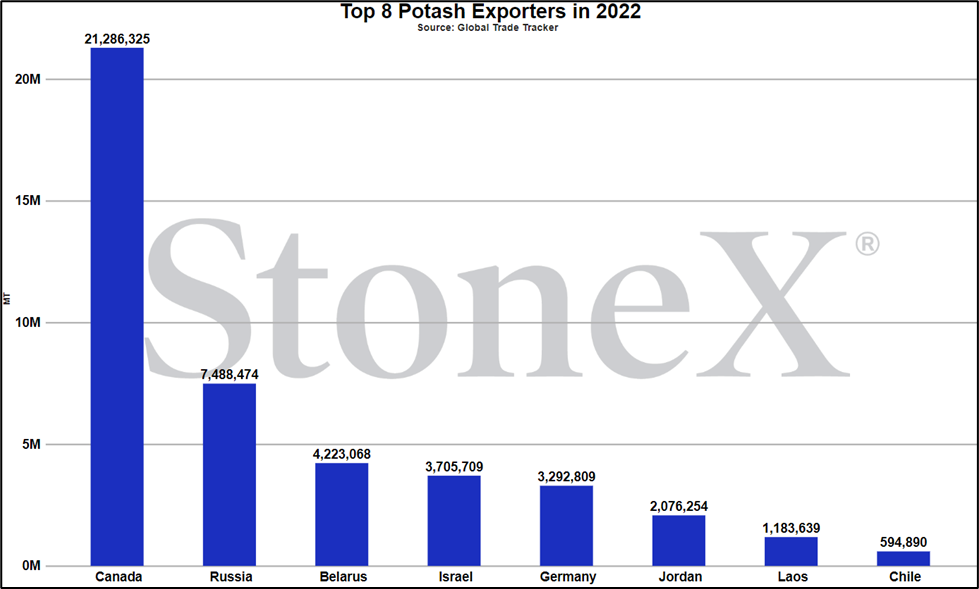
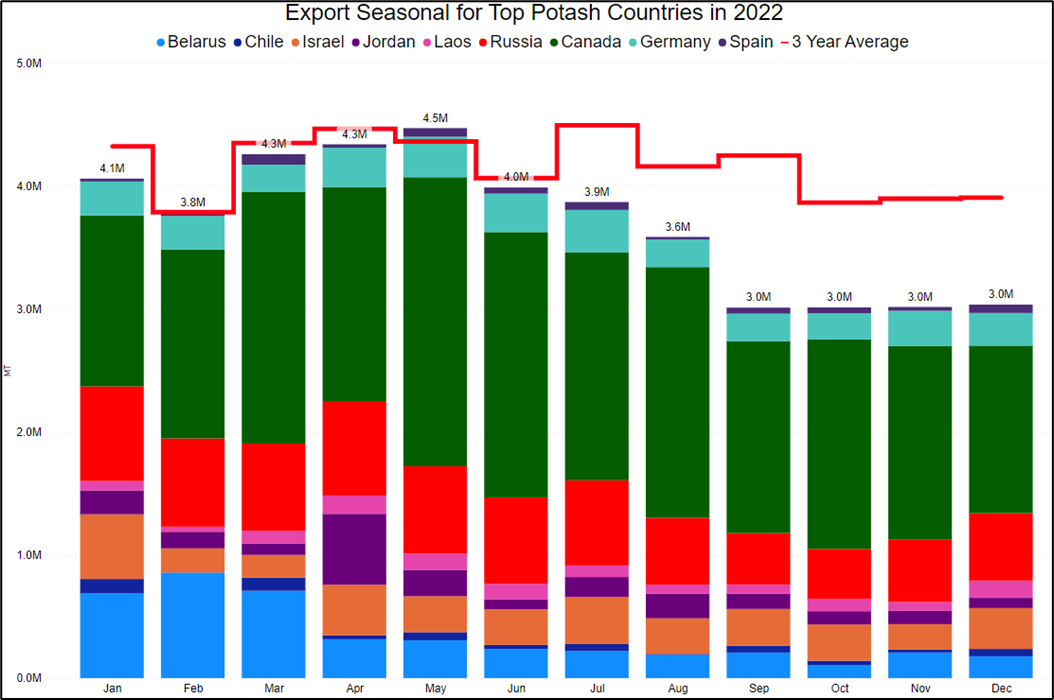
Seriously, this is the recap for what has happened in the last month.
I thought for a week of potash stories I could hit on.
I hit friends in the industry to see if I was missing anything.
I trolled internal to see if they saw something I didn't.
Nothing. Nada. Nil.
...but that is normal for potash. It isn't nearly as exciting as what the nitrogen and phosphate markets are. Potash is a slow and methodical marketplace (most times). Price trends can take months, and sometimes over a year, to complete themselves.
The only thing to really talk about is the lack of increased/new production...though the story is still that these plans have either been put on the shelf to be considered in the future or completely abandoned. At this point, it seems that the logistics of potash are more important than the potash market itself.
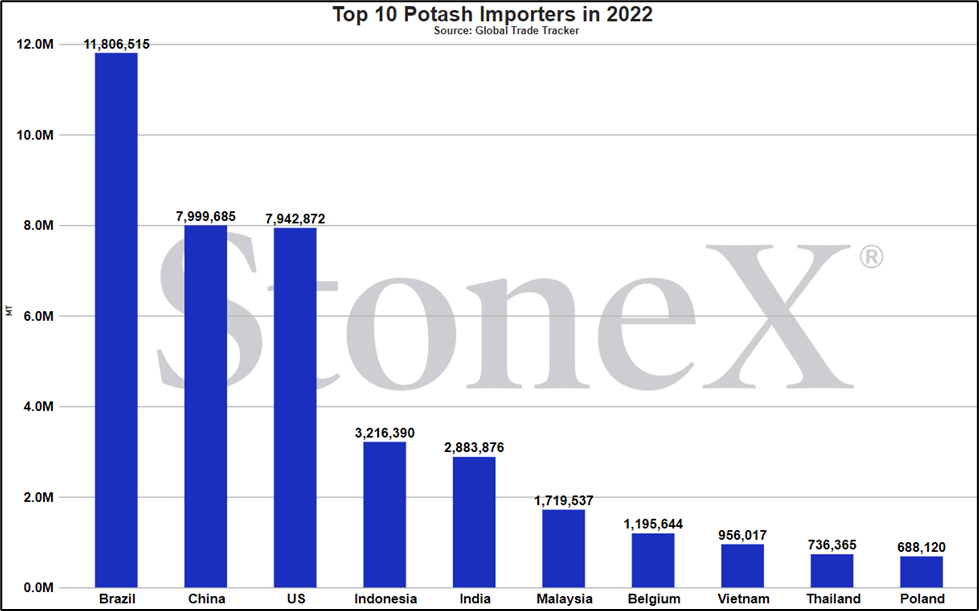
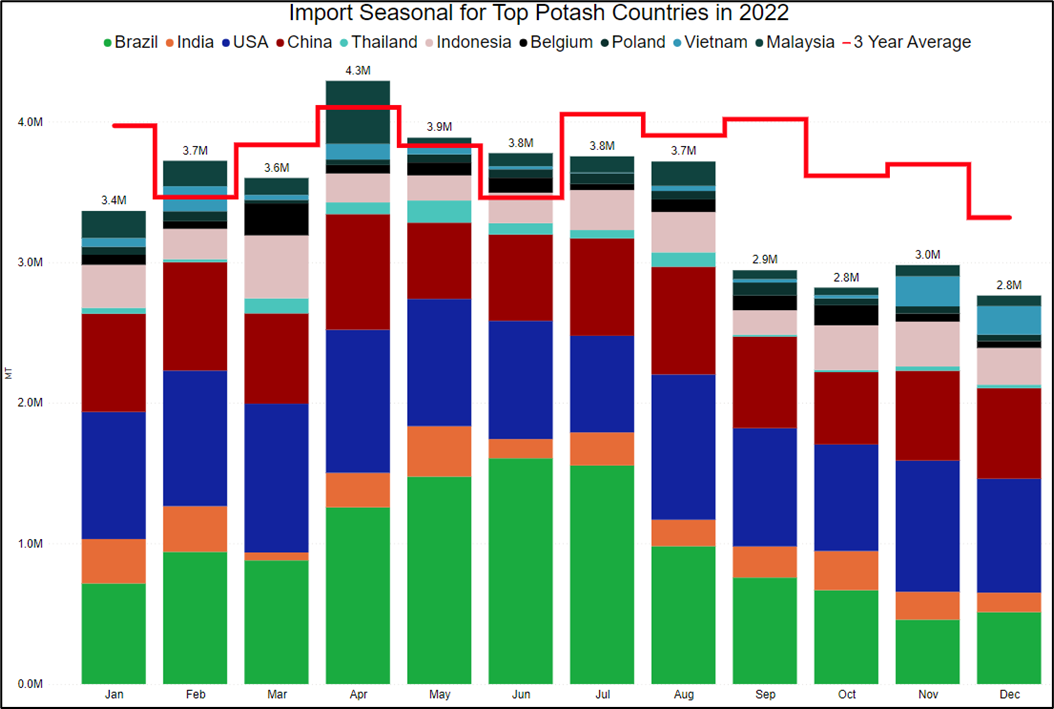
North America still refilling warehouses in anticipation of large fall application demand
Speaking of logistics of potash being more important than potash itself...
Obviously we have spent the summer discussing just how tight inventories were at the end of last spring. Given the fact that prices flat lined thru spring and then jumped near the end of spring was a great indication that inventories got very low.
Today, efforts to refill the system before the start of fall application continue. Everything on the surface appears to be going well as potash is much more reliant on rail and truck than its counterparts which utilize river systems more. However, we also need to be weary of rail as many in the industry discuss worsening service. While it isn't as big an issue out of season, once we get into season, small delivery delays can have huge impacts to an operation.
All this to say is to enjoy the quiet, but be weary the risk. If one plans on a fall application of potash, have that conversation sooner than later.
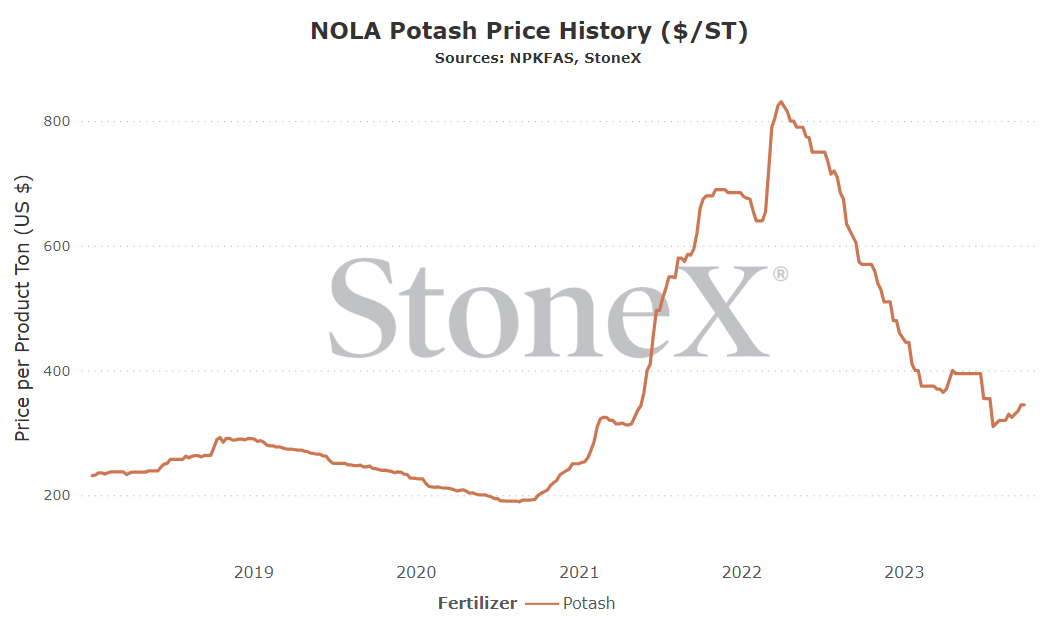
NOLA/New Orleans Louisiana
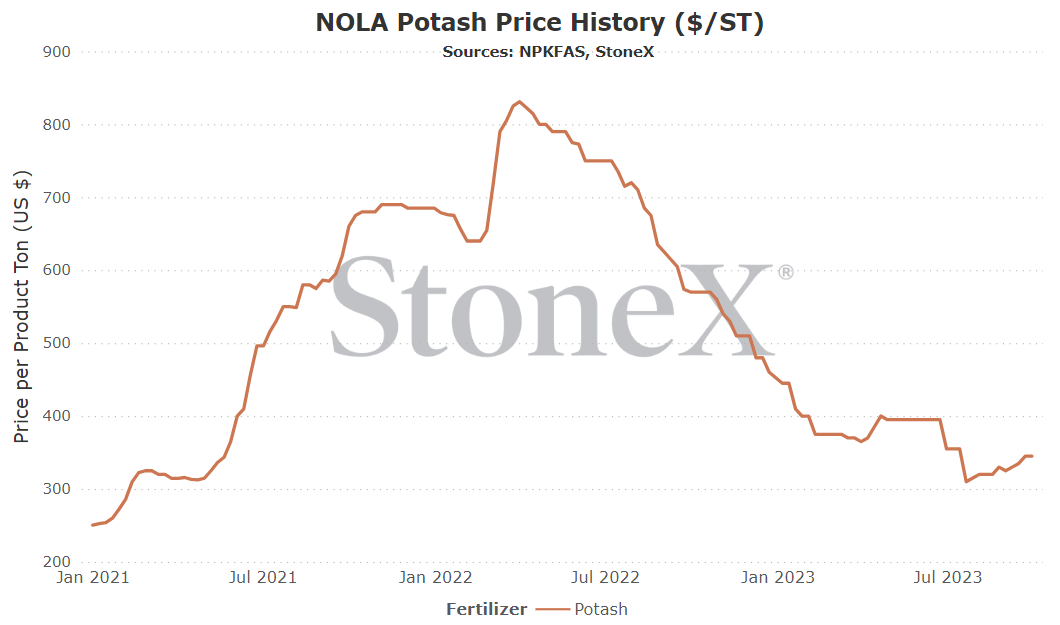
Vs 30 days ago - +6% or approximately $20 higher
Vs 90 days ago - -3% or approximately $10 lower
Vs 6 months ago - -5% or approximately $20 lower
Vs 1 year ago - -39% or approximately $225 lower
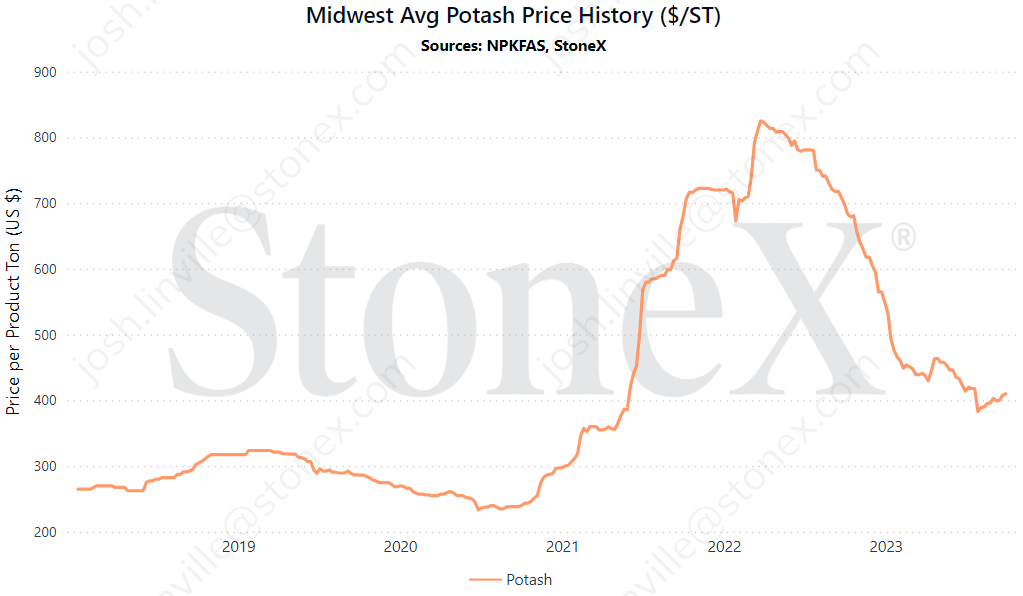
U.S. Midwest Average (average of several points across the Midwest)
Vs 30 days ago - +2% or approximately $8 higher
Vs 90 days ago - -1% or approximately $4 lower
Vs 6 months ago - -6% or approximately $28 lower
Vs 1 year ago - -42% or approximately $298 lower
- Current N.A. potash values point to solid coming demand – N.A. potash values continue to look very attractive as we near the fall application season. Yes, they could always be higher but they are solid vs grain values, solid vs recent historical values, etc. Assuming mother nature plays nice, we should be geared up for a solid fall season.
- Many global new mine/expanded production plans delayed or cancelled - when potash values were at their high's in April 2022, new and expanded production of potash was being announced everywhere. Now, with values much closer to "normal", those plans are being delayed at best and cancelled at worst. The lack of new production could spin potash into a tight supplied market...eventually.
- Still lingering concerns on Russia – this isn't anything specific. More just a note that Russia is a huge exporter of potash to the world market and their participation in this invasion of Ukraine continues to haunt the global fertilizer market. We do not expect their exports to cease. However, chalk this up to "low probability / high impact" scenario.
- High price of N.A. phosphate may impact potash demand this fall – at least for N.A., a lot of farmers view phosphate and potash as a package deal. Potash values currently look very good...phosphate values not so much. While I still lean toward the situation where potash demand pulls phosphate demand forward, it wouldn't take much of the markets shifting to change that view. If phosphate is viewed as just too high to justify, it could hurt potash.
- Global supplies still "feel" adequate – while there is an argument to be made that some areas are still struggling to get resupplied before application begins, the whole of the global market still feels decently supplied. Enough so that if the looming fall season turns out to be a bust, we could conceivably see values under pressure rather quickly.
- Belarus CONTINUES to find its way to the global market - Belarus is the potash wild card. As a top 3 exporter before their support of Russia in invading Ukraine, the loss of their tonnage quickly tightened the global S&D. Now, reports of their tonnage finding homes around the world, rather than just neighboring countries, means they are finding their way and creating a more well supplied global market. More well supplied typically means a softer market.
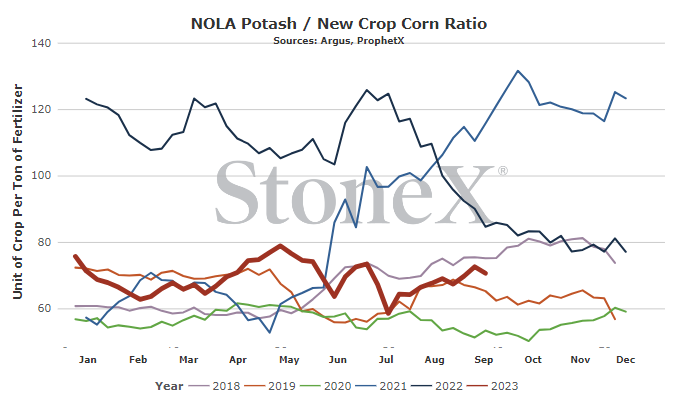
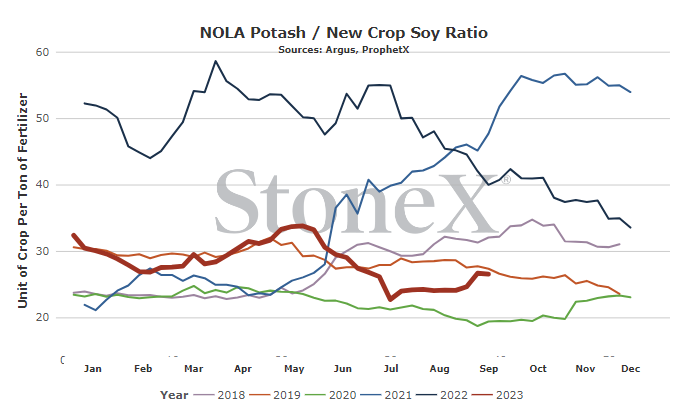
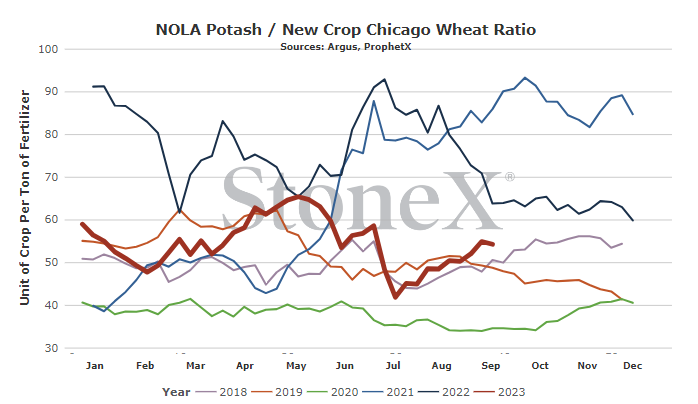
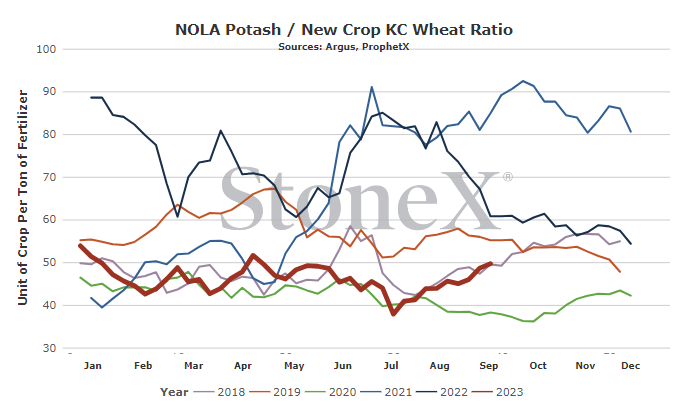
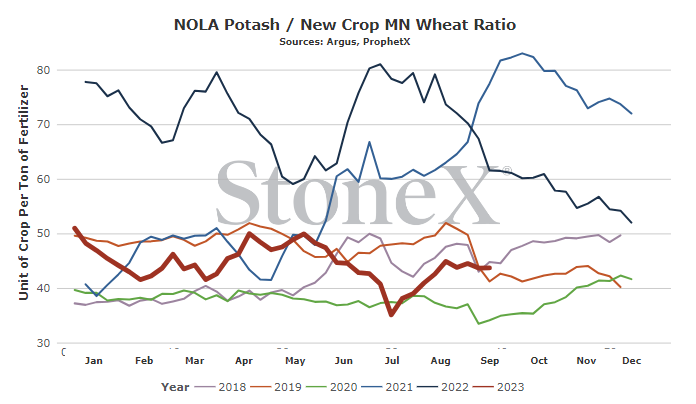
We believe that only looking at the flat price of either grains or fertilizer can be misleading:
-
Only selling grain can hurt you if fertilizer prices rise substantially
-
Only buying fertilizer can hurt you if grain prices fall
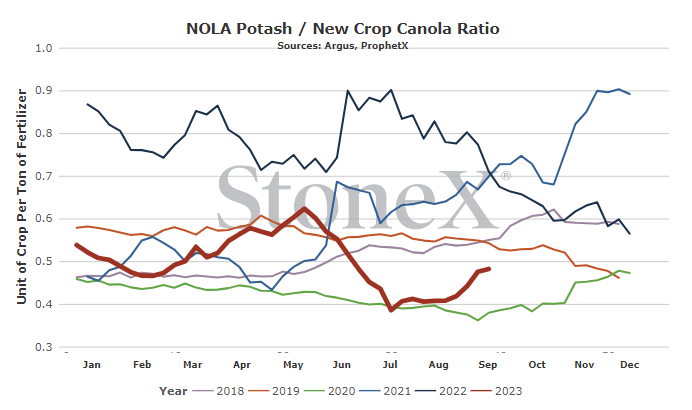
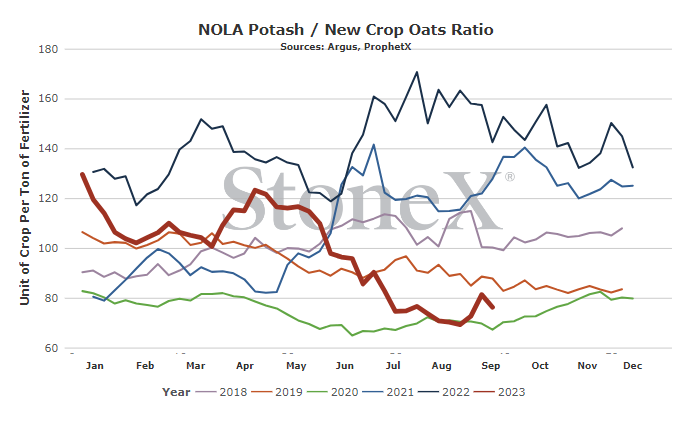
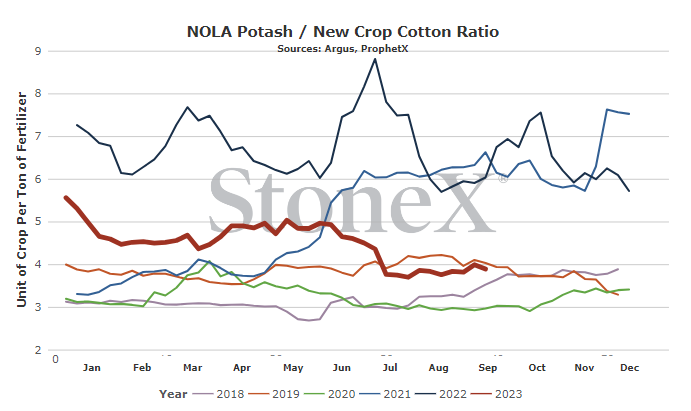
We look at the ratio "value" to get a better indication of where we are or how many bushels of X does it take to pay for 1 ton of fertilizer.
Would you rather:
-
Spend 120 bushels to pay for 1 ton of potash
-
Spend 60 bushels to pay for 1 ton of potash
When we compare the current ratio value against recent years, we start to see if we are high or low.
YOUR VALUES WILL LOOK DIFFERENT
This graph looks at the NOLA potash price vs the flat grain price. There are no logistics on either product. Your location will look different due to fertilizer logistical costs, grain basis, etc.
- Regional N.A. inventory availability - for the most part, potash has not seen tremendous price movement at major price points whether it be mines/import locations/etc. The market has been boring. However, N.A. is still reeling from the huge spring which dropped inland inventories to very low levels. This is not to say that there will not be enough in place during fall season to go around. It just means the chances of tight/insufficient supplies is higher than normal. All this to say that logistics are even more important this fall than normal and is a MAJOR reason we continue to push farmers to chat with their retailers sooner than later for fall needs.
- New production...or lack of - when potash values were hundreds of dollars higher and the outlook remained firm, everyone wanted to either expand their operation or get into the business. Big reason why high prices cure high prices. Now, with values much more manageable (i.e. lower), new mines have been cancelled and expanded production at existing mines delayed. Going forward, if potash values rise substantially again, these plans can be dusted off rather quickly and put into action. Should act as a cap on values under most circumstances.
- Potash still looks like a solid value today - while we would all like to see the price of inputs lower, regardless of where they are priced, it is hard to say that potash is currently overvalued against most grains. While it isn't true for every grain, most are seeing very low ratios today. Between the solid ratio and the low flat price vs a year ago, fall demand should be solid.
All data was sourced from StoneX unless otherwise noted.
This material should be construed as market commentary, merely observing economic, political and/or market conditions, and not intended to refer to any particular trading strategy, promotional element or quality of service provided by the FCM Division of StoneX Financial Inc. (“SFI”), StoneX Financial (Canada) Inc. (“SFFC”) or StoneX Markets LLC (“SXM”). SFI, SFFC and SXM are not responsible for any redistribution of this material by third parties, or any trading decisions taken by persons not intended to view this material. Information contained herein was obtained from sources believed to be reliable, but is not guaranteed as to its accuracy. Contact designated personnel from SFI, SFFC or SXM for specific trading advice to meet your trading preferences. These materials represent the opinions and viewpoints of the author, and do not necessarily reflect the viewpoints and trading strategies employed by SFI, SFFC or SXM. The FCM Division of StoneX Financial Inc., a subsidiary of StoneX Group Inc., is a member of the National Futures Association (“NFA”) and registered with the U.S. Commodity Futures Trading Commission (“CFTC”) as a futures commission merchant and commodity trading advisor. StoneX Financial (Canada) Inc. is currently registered as a Futures Commission Merchant or equivalent in all provinces of Canada and is a member of the Investment Industry Regulatory Organization of Canada.