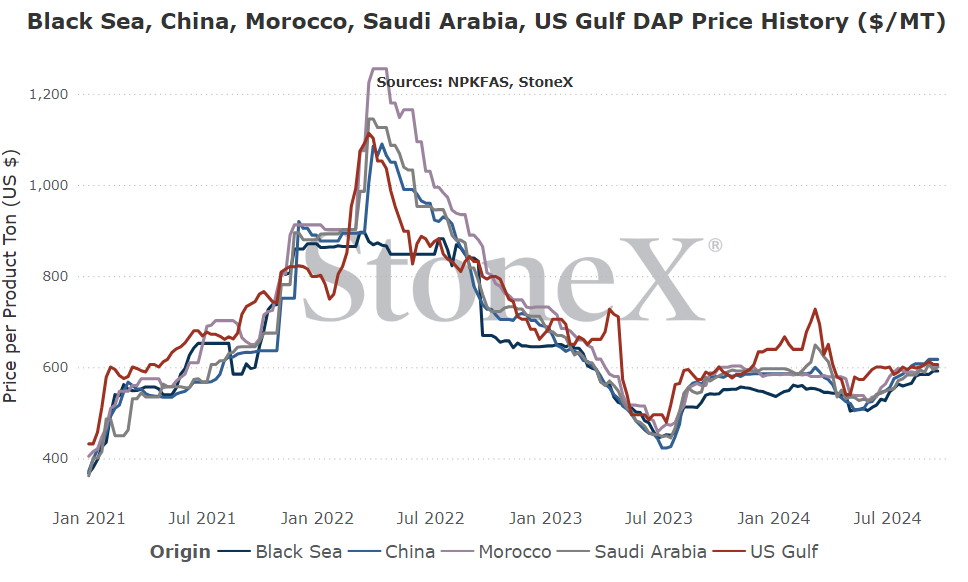
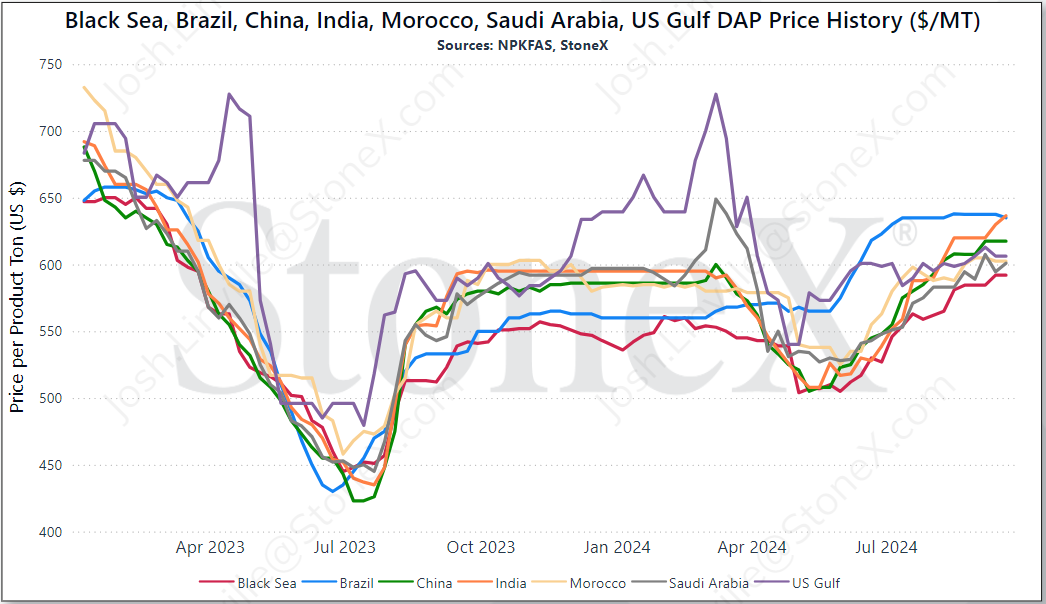
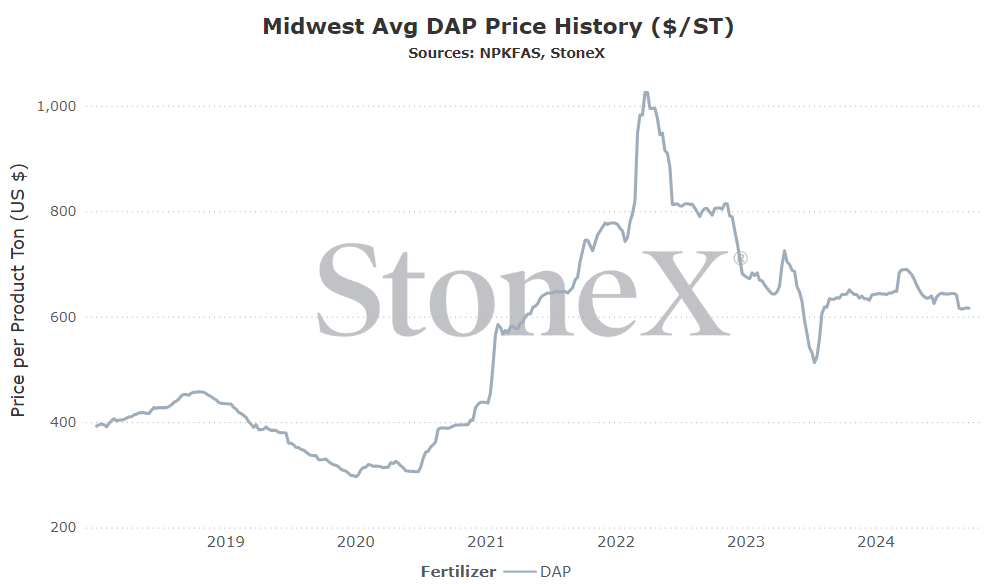
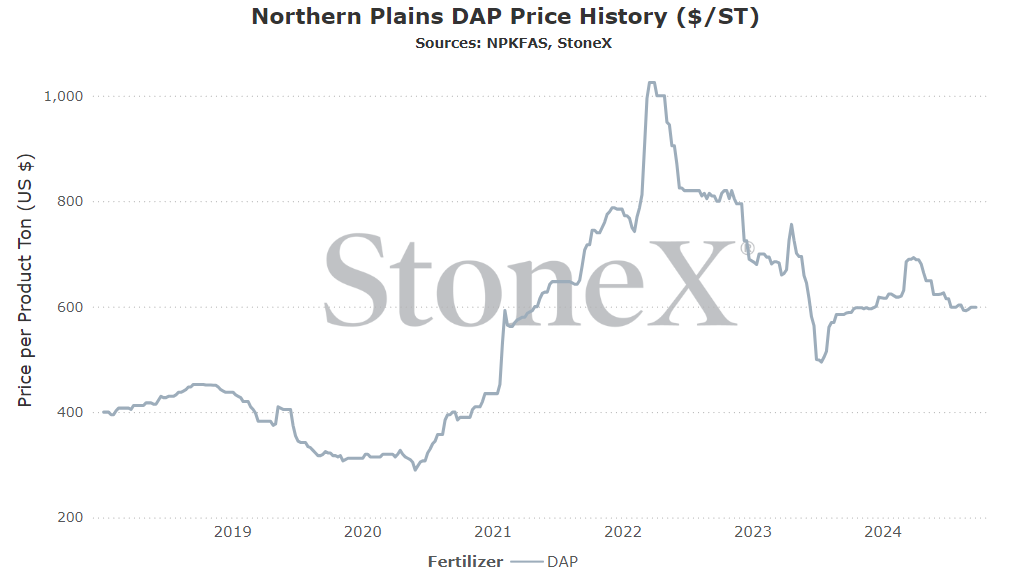
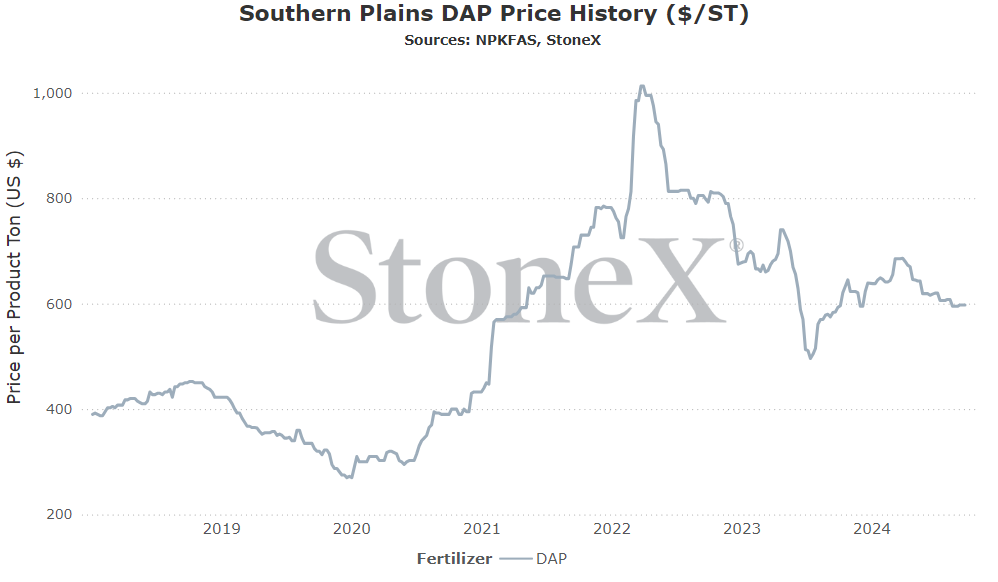
I will say this now and will say it going forward to eternity: these are the flat price graphs for each individual location. Your price where you are is going to be different. There are logistics. There is the cost of storage/interest/insurance/etc. These graphs should not be taken as "it shows the price at $700, why isn't my price $700". These graphs should be used to give an appreciation for price movements.
All values are in metric tons and USD currency.
Global
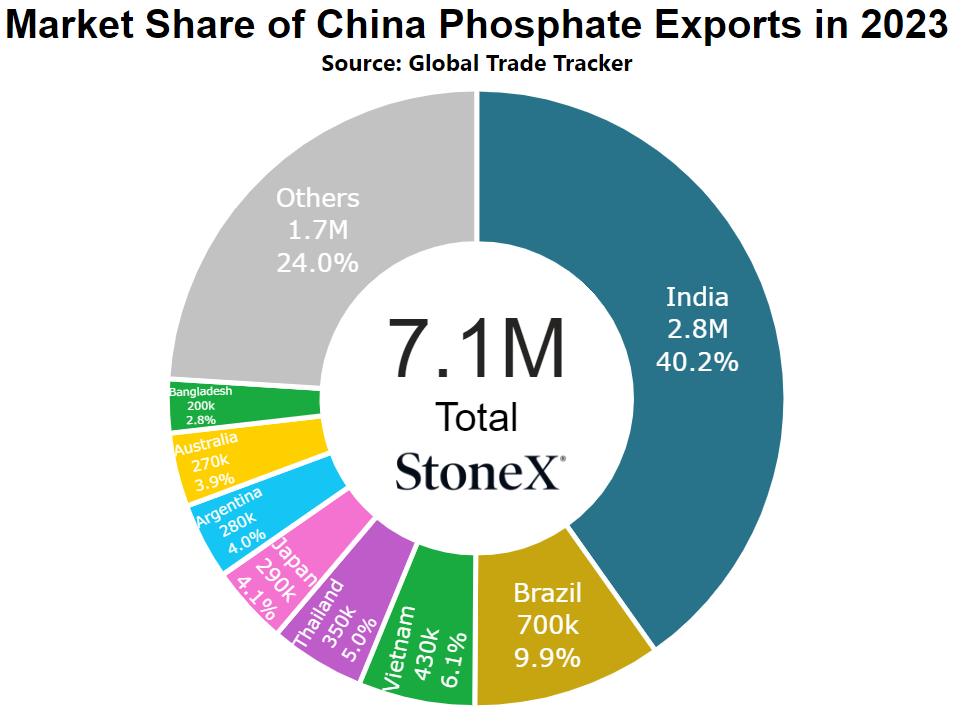
China has historically been the leading global exporter...and they continue to be behind on export rates.
India has historically been the leading global importer...and they need to rebuild stockpiles.
That is not a good combination...
As long as China scales back on exports and India plays catch up on stockpiles, it is really hard for me to see global values falling. I do firmly believe that farmers that are seeing global replacement values (i.e. not subsidized by the government) will look to cut back but I am afraid that will not be enough to offset this situation.
This makes me continue to believe that global values stay flat to higher. I would love to be wrong and everyone get a chance to lock in significantly lower values...but I do not see it today.
North America
I think that summarizes what farmers across North America are thinking!!!
I continue to hear that farmers are going to reduce their phosphate application rate, they are going to skip their application rate, fall farmers are going to drag their feet until spring, etc. Frankly speaking, I believe every single one...but I'm not sure it will make enough difference to offset the global issues.
Right now, NOLA DAP isn't the world's highest price. Brazil, India, and even Chinese DAP values are higher than NOLA (MAP is a different story). In fact, it isn't that much higher than even Saudi Arabian and Moroccan values. If this continues (and of course things CAN change) and we see demand down big in the fall, we could see NOLA values fall but it would be more likely that exports would rise. That would tighten our S&D and bring us back into range.
I understand folks who are wanting to take a pass on phosphate in hopes of greener pastures, but I do not see that short term. I continue to think global values will stay supported and given our price vs the world, we should see our values stay supported.
Remember, don't shoot the messenger!!!!
As expected, India fixes subsidy rate and buying spree ensues
Given India's place as the largest global phosphate buyer (not consumer but buyer), it makes sense that we watch their activities very closely as it can shift global sentiment.
That is what we have spent so much time discussing them the last few months. For a bit of backstory:
Back in later 2021, we saw Indian farmers erupt. Stockpiles of DAP had dwindled down to the low 1M ton range across the country. While that may seem a huge number of tons available, for a country the size of India, it was very low. As a result, upheaval began. Farmers rioted. There were reports of retail locations being ransacked. It was an ugly look. Fortunately, the government was able to start rebuilding stockpiles to comfortable levels and the angst went away.
While India is not yet back to those times, they have been getting closer than they need to and most of it was due to the government not "fixing" their subsidy rate.
For those unaware, Indian farmers do not see global replacement values. Their phosphate values remain steady. Obviously, importing companies are not going to purchase product at a loss so the government steps in with a subsidy rate that helps offset the difference. If you remember earlier this year, global phosphate values were falling on what appeared to be improving Chinese supplies and waning demand. The Indian government started to cut their subsidy rate. No doubt in hopes of influencing global values further down in order to save a little money. This worked for a short time...until Chinese exports started to slow again. That is where the issue began.
The government was slow to increase their subsidy rate, so importers had their hands tied. Imports slowed to a stop/crawl and demand started to reduce the available supplies. Remember how the late 2021 riots started because stockpiles dropped to the low 1M ton range? The lowest forecasted stockpile I have seen was 1.5M. Fortunately, in the last month, the government finally start to take steps to alleviate the issue.
A team was sent to Morocco to secure a block of tons. While they were unsuccessful in lowering price ideas, they were able to lock up 500K of DAP (and a couple hundred thousand ton of TSP). Then, the subsidy rate was improved and buying began.
That brings us to today. Put yourself in the shoes of a global phosphate manufacturer. You continue to see China (world's largest DAP/MAP exporter historically) scaling back on their export flows. That tightens global supplies. At the same time, you see the world's largest buyer low on inventories and backed into a corner. What do you do? Do you keep prices flat or even consider lowering them?
I wouldn't...
What we have seen is that with every reported sale or every couple reported sales, the price they pay goes up a little. Originally, they were paying $630 CFR. Then that value jumped to $637 CFR. Then it jumped to $642 CFR with rumors/reports that traders are buying DAP destined for India at prices near $640. India has been doing a solid job of securing tonnages, but they have a long ways to go. Normally in the summer, they would have approximately 4M tons sitting around...far cry from the 1.5M forecasted.
While I am very glad to see imports resuming to India as it means farmers there have access to product sorely needed to raise their crops. Unfortunately, it means that the price bar continues to rise. How long this buying spree continues is anyone's guess.
What does this mean for farmers?
Higher price ideas. That is unfortunately what it means.
If the world's largest buyer continues to be willing to pay higher prices to build their stockpiles and the worlds largest exporter in China continues threaten lower export rates, it is a sellers paradise. While it cannot last forever, it can last for a while.
Chinese exports continue to lag, reducing global supplies
On the above story, I talk about how we need to track the world's largest buyer of phosphate as they can influence the global markets. Just as important is the historically largest exporter of DAP/MAP in China.
For a bit of backstory for the new crowd, the last several years have seen a tremendous amount of price volatility. Early 2022 was the worst of it. Grain prices were high, causing demand to front run and support price ideas. Then Russia's invasion of Ukraine sent fear thru global phosphate markets that the world would stop the export flows. Given how important Russia is on the global phosphate state, prices rallied to near record high's.
That is when the Chinese government took notice.
While the world was rallying price ideas, China was seeing its own phosphate price skyrocket. With fears of Russia being removed from the world, a sudden fear emerged in China that exports could explode to backfill the lack of Russia, leaving Chinese farmers with little to no product. That didn't sit well with communist China. We suddenly saw the government step in to protect its farmers. Exports started to be restricted with the strategy being "if we restrict exports, it ensures domestic supplies and helps to lower our farmers price". Unfortunately for the rest of the world, it worked.
Since then, global values have come off their high's and inventories feel much better than they did at the peak...but the Chinese government continues to play a part in restricting exports. Why?
With most things China, we never truly know but I have a working theory.
We have seen reports/rumors/etc. that the Chinese government is taking steps to make themselves much more self sufficient than they have been in the past. This includes wanting to raise more domestic grains which could mean domestic demand is even higher than it has been. On the other side of the theory, the government figured out the power they have as an exporter. By reducing outflows, it forces more tons to stay at home and forces values to stay a discount to the world. That benefits their farmers significantly.
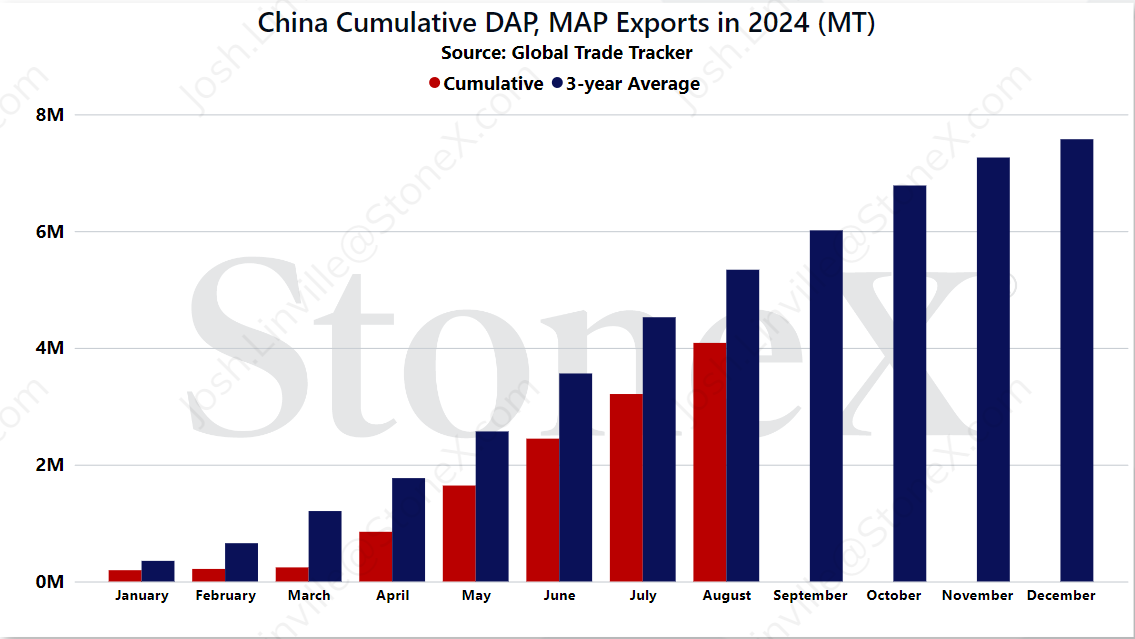
That brings us to today. Thru August, Chinese DAP/MAP exports sit at only 4.1M tons. Their 3-year average thru August would normally put them around 5.3 - 5.4M tons. A 1+M ton shortfall obviously hurts but that is only part of the story. In recent history (prior to the 2022 situation), China would export something closer to 9 - 10M tons for the year so when you look at the graph below, remember that the last dark blue line should be another 1.5 - 2M ton higher than what it shows...
So a very long story short is that the world's largest exporter continues to restrict flows to benefit their own farmers...and the globe continues to pay the price.
What does this mean for farmers?
If the world's largest exporter is removing what we believe will be millions of tons from the world stage at the same time the world's largest buyer is trying to rebuild stockpiles, this is why I continue to think prices should be higher even with big application rate cuts.
Listen, I do not want prices higher. I do not like this story I am telling. That said, I sit down, I put my emotion/desires/etc. to the side, and I report on what the market and the numbers are telling me. It does not mean I will be 100% correct 100% of the time. No one is and frankly, I would be in a much higher paying job if I was!!!
Remember that regardless of where you are reading this from, these global issues affect you and your operation. China scaling back on exports affects you. India ramping up purchases affects you. You are part of the world market whether you like it or not so you need to watch/respect it.
OK, rant/soap box moment over!!!
U.S. Moroccan counter vailing duty drama ends with no change
I can tell I got a lot better jump on starting the newsletters this month. I'm spending a lot more time on backstories than normal!!!!
For those new, the U.S. imposed counter vailing duties on both Moroccan and Russian phosphate imports during the spring of 2021. Mosaic had filed a request during the summer of 2020. I'm going to say this and it might get a few folks angry with me but when they made the request, it made sense.
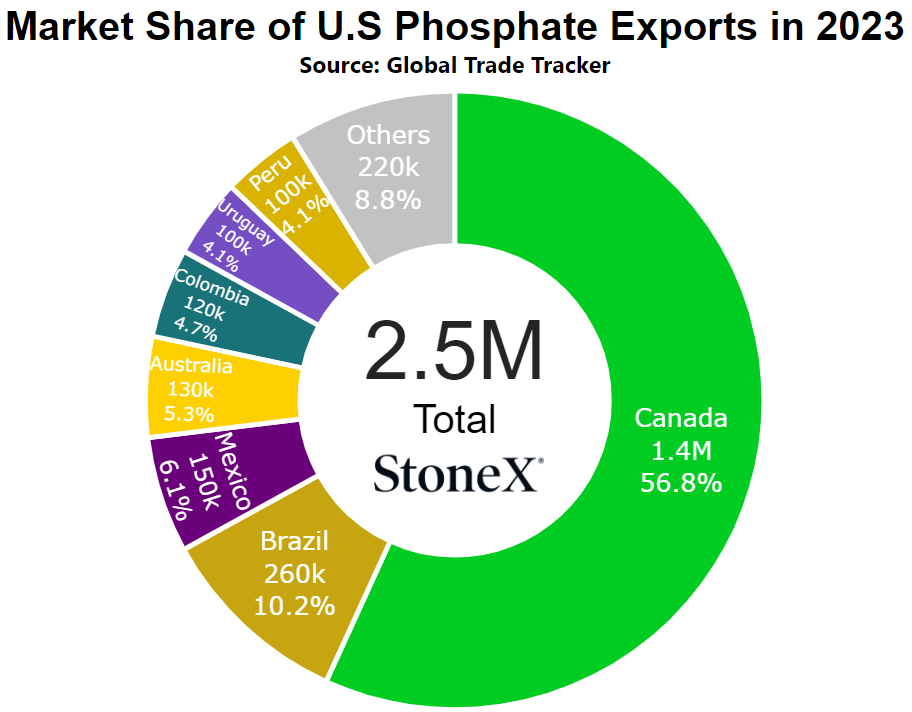
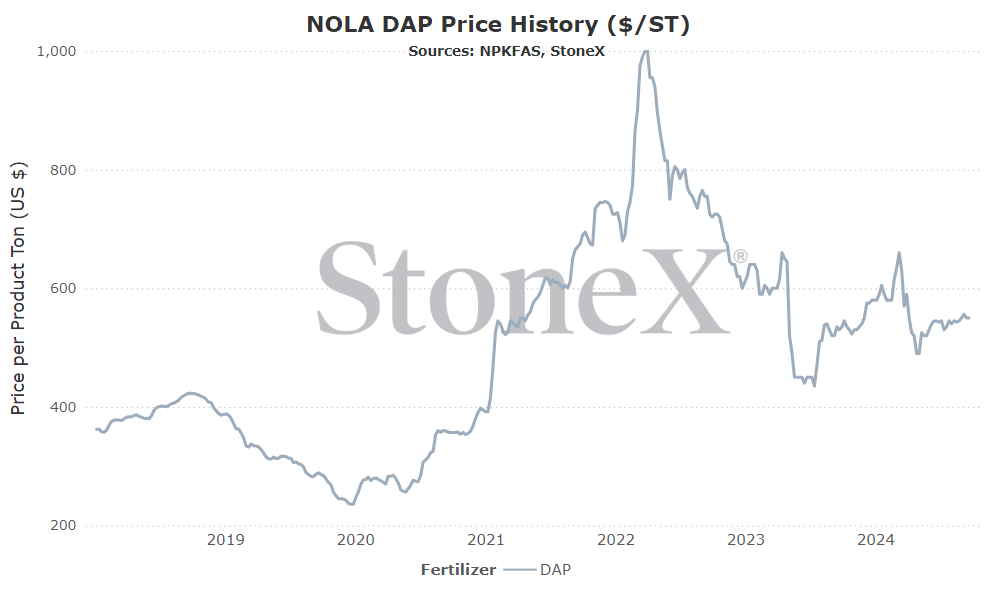
At that time, phosphate was extremely cheap. At it's highest price in early 2022, NOLA barges of DAP jumped to $1,000. In the summer of 2020, that cost was $250. As a result, Mosaic was having to curtail production because they were losing money. They simply could not compete with the imports...and there was an element of the imports not being on level footing. A common discussion point around Moroccan production is that they simply dump their production tailings into the ocean whereas Mosaic is legally required to maintain their tailings pile (not cheap) as well as reclaim the land that has been mined (again, not cheap). On the Russian side, many point to phosphate manufacturers being able to get inputs at much less than market value due to "relationships". Both put U.S. manufacturers at a distinct disadvantage and as a result, duties were put into place.
Since then, things have changed...significantly. As mentioned before, values quadrupled and even today are slightly higher than those high's that were set. Suddenly, margins are no longer an issue and there has continued to be an uproar from farmers and retailers alike. Inventories have been snug as domestic production has struggled to keep up with demand (one of the promises made during the request was that domestic demand can be met with domestic supply). With inventories tight and prices extremely high, the prevailing call has been to cancel the tariff's and allow free trade to resume.
In the last month, there was hope that we could see a step toward that.
Mosaic made the decision to abandon a 3rd administrative review and given the lack of insight on how these processes work, theories were all over the place. Many immediately hoped/thought that this was Mosaic's way of creating a path to Morocco imports resuming. While it wouldn't solve all of N.A. farmers woes, it would help to crater the DAP/MAP differential which has ballooned in recent seasons while also providing more supply/competition. It was, at the very least, some sense of improvement.
Unfortunately, we do not believe that to be the case.
Since the rates have been set, we have seen imports from Morocco and Russia come to an abrupt stop. From their vantage point, why pay a penalty to sell into the U.S. if they can sell their product to the rest of the world? Mosaic knows this and also knows that reviews require time/money/stress/bad PR/etc. If the rates are already doing what they were intended to do, why try to push them higher?
So for all the excitement and all the hope that had built, most of it is now practically gone. The U.S. continues forward with 3 of the 5 largest exporting nations in the world effectively blocked from supplying tons (China had duties in place under the Trump administration). Inventories remain snug and MAP remains a much larger premium than normal.
Now for the story that needs told but may not be that well received...NOLA/N.A. values are not crazy high vs the world.
...pause for effect and for people to stop yelling and throwing things...
Below is a price chart that compares most of the world's largest buyers/sellers. Historically speaking, NOLA values have always been in line to a slight discount vs the world. This was due to strong production rates and export influence in the world. However, that global influence has waned over the years, drawing the price more toward the middle. Then, since the start of the duties, we started seeing NOLA a significant world premium for longer periods of time as we struggled with supplies.
Today, NOLA DAP values are very much in line with global values. India, Brazil, and even China all 3 boast a higher fob DAP price than current for NOLA. If we had seen the Moroccan rate dropped, I will admit that we would see better supplies available, would see MAP values come more in line with DAP (NOLA MAP absolutely world's highest today), and we could see a little emotional price weakness as the market came to terms with the news. However, fundamentally speaking, unless global values fell we likely wouldn't see a lot of weakness in DAP. If NOLA values dropped substantially, we would see exports start sending ships by the day.
Now, I am not saying that current values are good or anything of that sort. They are high. That is why the next section focuses solely on the high price of phosphate. What I am saying is that N.A. values are in line with the rest of the world. We are a part of the global market and tend to follow its direction. Doesn't mean we have to like...
What does this mean for farmers?
Unfortunately, it tells me there isn't a lot of better prices coming short term.
India, world's largest buyer, is playing catch up on stockpiles.
China, world's largest seller, is restricting exports in favor of their own farmers.
That and the fact that NOLA is basically priced where it should be in relation to the world tells me that there isn't a lot of downward hope. Is it possible? Of course. Anything is...it just doesn't look promising today.
Florida/NOLA/Gulf hurricanes impact phosphate production/transportation
Gulf coast states have had to be on their toes in recent months as hurricanes have been the major storyline.
First, it was Hurricane Francine that took a shot at the NOLA region. If memory serves me correct (I could google it but I am also lazy!!), it came ashore as a Category 2. While it was certainly something that needed to be watched, that part of the world is used to storms of that size. Buildings and infrastructure is designed to withstand it and at the end, the impact to the fertilizer markets/manufacturing facilities was minimal.
Today, we are watching Hurricane Helene. This is a monster and the last I read is forecast to come ashore as a VERY dangerous Category 4 with storm surge 20' high. For a little while, there was a chance that this storm could slam into Tampa which raised our concerns for phosphate. There are a lot of tailing piles in the area and there is always the worry that the dikes could fail. Then there is the impact to actual production of phosphate and the logistics around it. I say this from a strict phosphate perspective, it fortunately looks like it is going to aim a little north of Tampa. While there is still some concern of storm surge to the area, most of the damage looks like it will be north.
However, there will still be impacts and given that we are in October, they are felt. Operations and logistics need to shut down as the storm passes to give workers time to be home with loved ones. Then, once the storm passes, workers must take time to go thru the plants to make sure there are no damages. While any impact should only last several days, those are several days we need given our proximity to the fall run and given the tight inventory situation for N.A. phosphate.
I am writing this piece on Sept. 26 so by the time we publish, the storm will have passed and we should know the extent of impact. I'll make sure to write a small piece in the body of the e-mail discussing anything that happened. For now, we watch.
What does this mean for farmers?
It "could" mean a large impact to remaining phosphate supplies for the fall...or it could mean nothing. It all depends on what path the storm takes and what damage it causes. The N.A. phosphate inventory situation is already tight. That has been a common theme all year. That, combined with the fact that we are only 30 days from application, means that any hiccup to supply will be felt. Likely in the form of higher prices. Hopefully this becomes a non-event...but this is why we watch.
Phosphate remains high priced vs...everything
Yeah...phosphate prices are high.
While most other fertilizer saw their values tumble to a third of the high's set in early 2022, phosphate dipped to half and has been building back since. Farmers, already struggling with poor farm economics due to low grain values, have been singling out phosphate as one of their first cuts if necessary. Now, a lot of that can be put on emotion and there is nothing wrong with that. There are going to be a lot of farmers who are happy if their harvest pays the bills. There could be a lot that are not that fortunate. Farming has gone back to being a rough living so it is easy to be upset/frustrated/etc.
However, as explained in the above pieces, this is not just a one area of the world situation. We are seeing global values remain high with a very tight S&D looking to continue supporting values.
Based on memory, I believe the highest NOLA DAP barge trade that I saw was very near $1,000. Today, it has been in the mid-$550's and with global support looks to climb near term. Historically speaking, it is high.
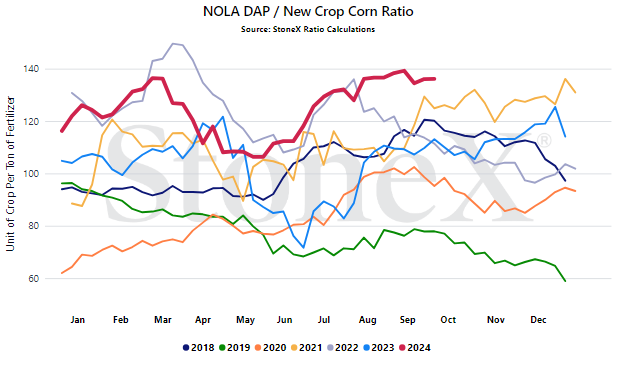
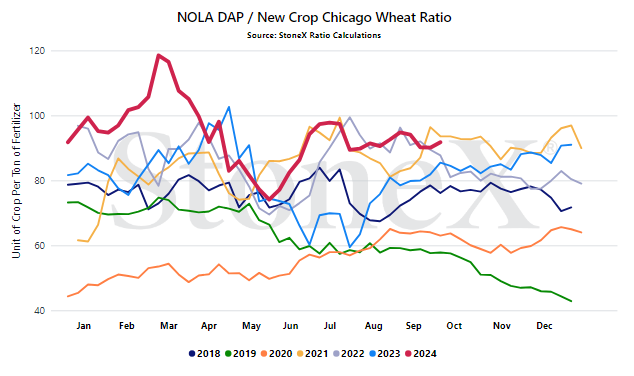
But how does it compare to grain values? At the end of the day, if grain values are high then the value between the two must be decent. Therein lies the problem. Grain prices suck. December 2024 corn currently sits at $4.13/bushel. With NOLA DAP in the mid-$550's, that puts the ratio in the 134 - 135 range. A quick glance at the historical DAP/Corn ratio chart below shows that this is easily on the highest end of values. What that means is that you are paying significantly more bushels to pay for the exact same ton of DAP. I'll save you the MAP chart...it's worse.
By a lot of the POV's that I use, each one says that phosphate is overpriced today...but that does not mean it is coming down. Ultimately, the world still has several issues and prices have been holding on. Given what is happening in China/India, I'm afraid they can get worse.
Now for my soapbox time:
Make rational phosphate decisions.
Notice I didn't tell you what to do or not to do? Just make rational decisions.
It is very easy today to make angry decisions. Those rarely work. However possible, try to set those emotions to the side when making your farm marketing decisions. Can you reduce/cut your phosphate application rate without hurting overall yield potential? OK, then that might be the way to go. Can you wait until spring in hopes a clearer picture emerges? I'm not sure it will but if you can, that might be the way to go.
My job IS NOT to tell anyone what to do. I simply ask that whatever you ultimately decide to do, you do that from a grounded place. It is already hard enough out there this year. No need to make it harder.

NOLA/New Orleans, Louisiana DAP price comparison
Number 5 global exporter in 2022
Price comparisons
Vs 30 days ago - 1% or approximately $5 higher
Vs 90 days ago - 1% or approximately $5 higher
Vs 6 months ago - -7% or approximately $40 lower
Vs 1 year ago - 4% or approximately $20 higher
U.S. Midwest Average (using multiple points across Midwest) price comparison
Vs 30 days ago - unchanged vs last month
Vs 90 days ago - unchanged vs 3-month's earlier
Vs 6 months ago - -5% or approximately $30 lower
Vs 1 year ago - 6% or approximately $34 higher
U.S. Northern Plains Average price comparison
Vs 30 days ago - 1% or approximately $6 higher
Vs 90 days ago - -4% or approximately $28 lower
Vs 6 months ago - -14% or approximately $94 lower
Vs 1 year ago - 2% or approximately $11 higher
U.S. Southern Plains Average price comparison
Vs 30 days ago - unchanged vs last month
Vs 90 days ago - -3% or approximately $20 lower
Vs 6 months ago - -13% or approximately $89 lower
Vs 1 year ago - 2% or approximately $14 higher
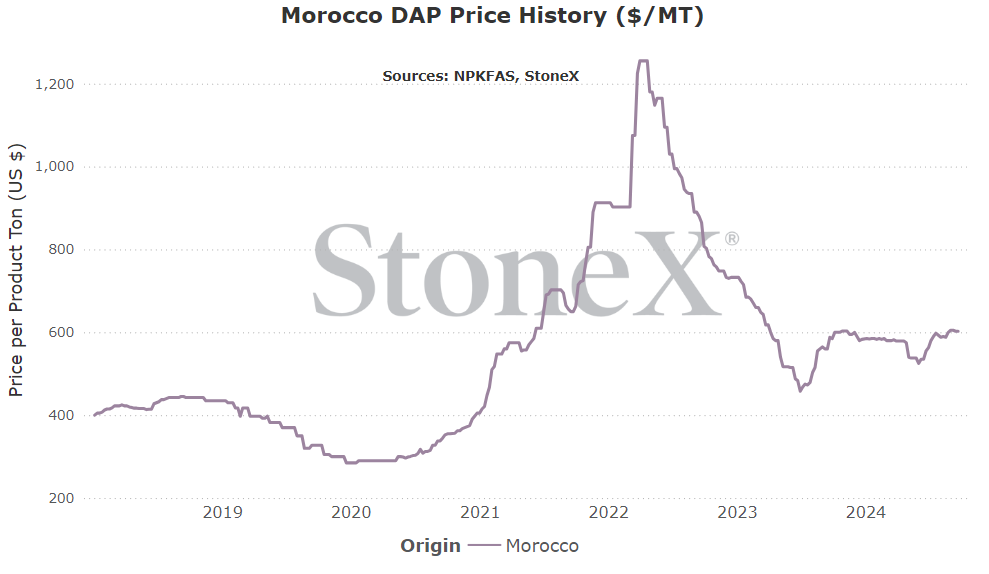
Morocco DAP price comparison
Number 1 global exporter in 2022
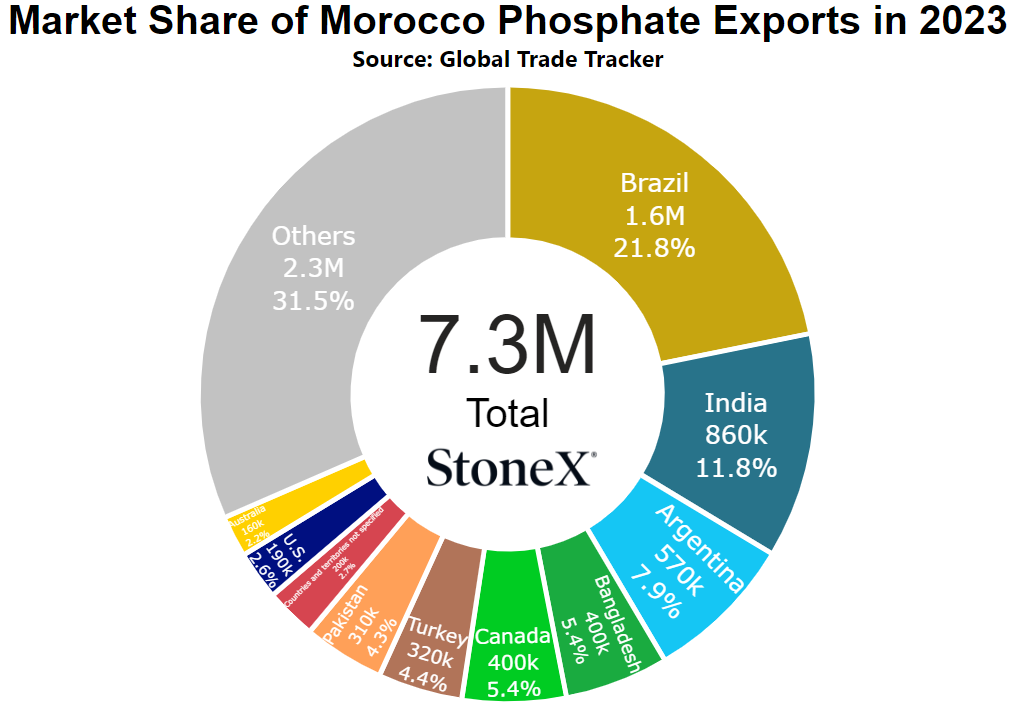
Price comparisons:
Vs 30 days ago - unchanged vs last month
Vs 90 days ago - 9% or approximately $48 higher
Vs 6 months ago - 4% or approximately $24 higher
Vs 1 year ago - 3% or approximately $15 higher
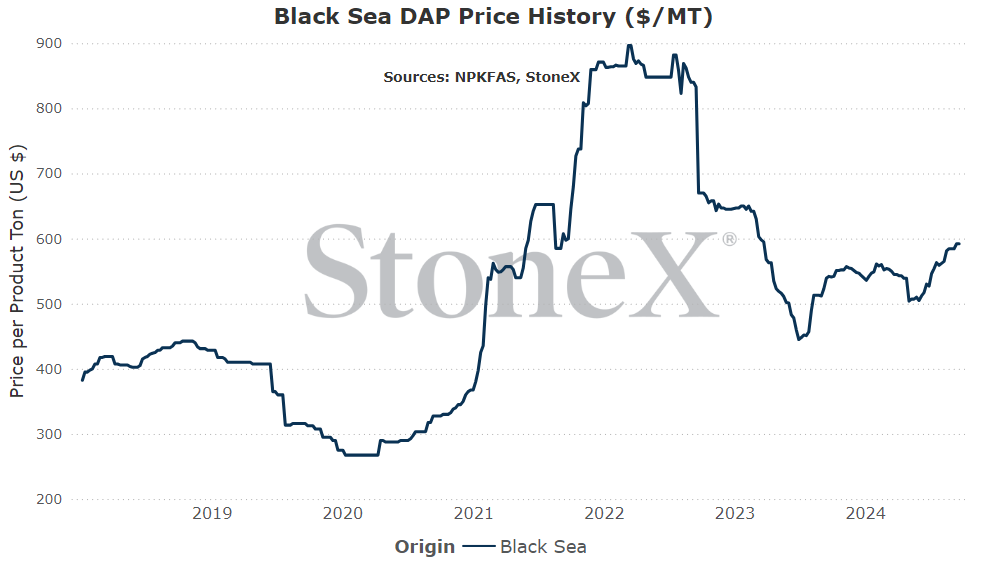
Black Sea DAP price comparison
Number 3 exporter of DAP/MAP in 2022
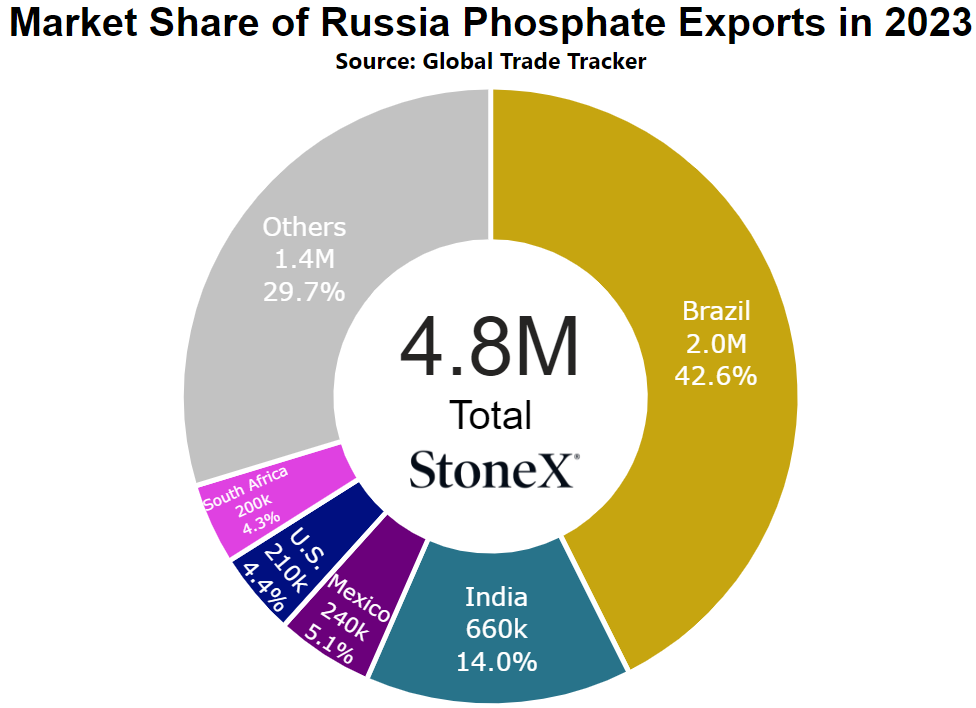
Price comparisons:
Vs 30 days ago - 1% or approximately $8 higher
Vs 90 days ago - 12% or approximately $62 higher
Vs 6 months ago - 9% or approximately $48 higher
Vs 1 year ago - 9% or approximately $50 higher
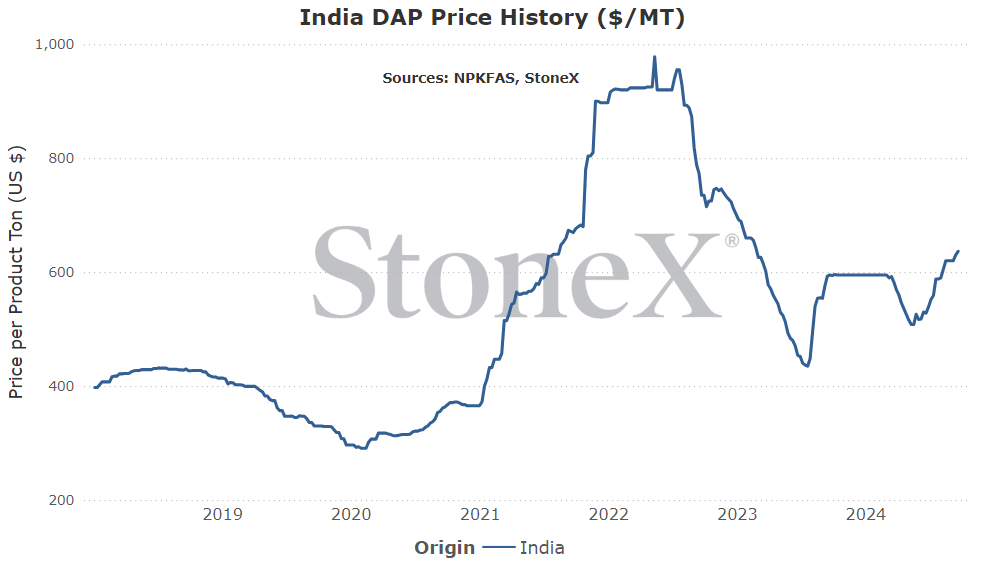
India DAP price comparison
Number 1 global importer in 2022
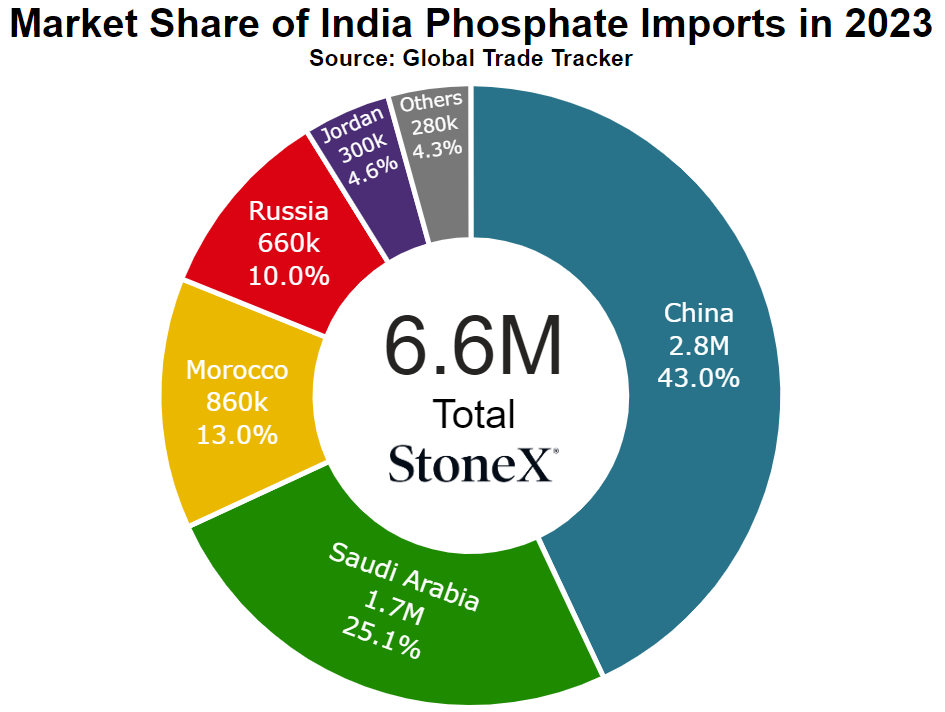
Price comparisons:
Vs 30 days ago - 3% or approximately $17 higher
Vs 90 days ago - 21% or approximately $109 higher
Vs 6 months ago - 12% or approximately $68 higher
Vs 1 year ago - 7% or approximately $42 higher
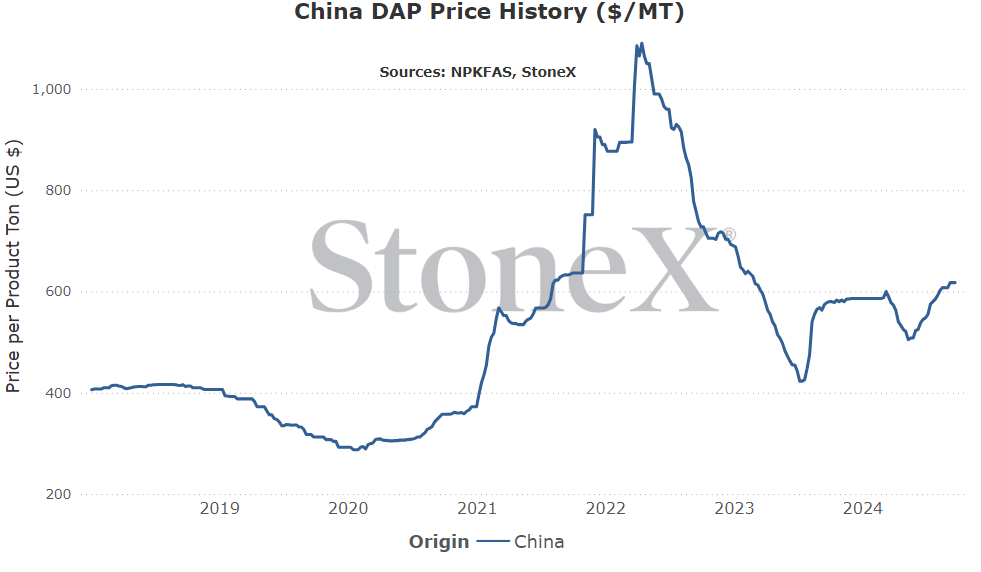
China DAP price comparison
Number 2 global exporter in 2022
Price comparisons:
Vs 30 days ago - 2% or approximately $10 higher
Vs 90 days ago - 13% or approximately $73 higher
Vs 6 months ago - 8% or approximately $45 higher
Vs 1 year ago - 7% or approximately $40 higher
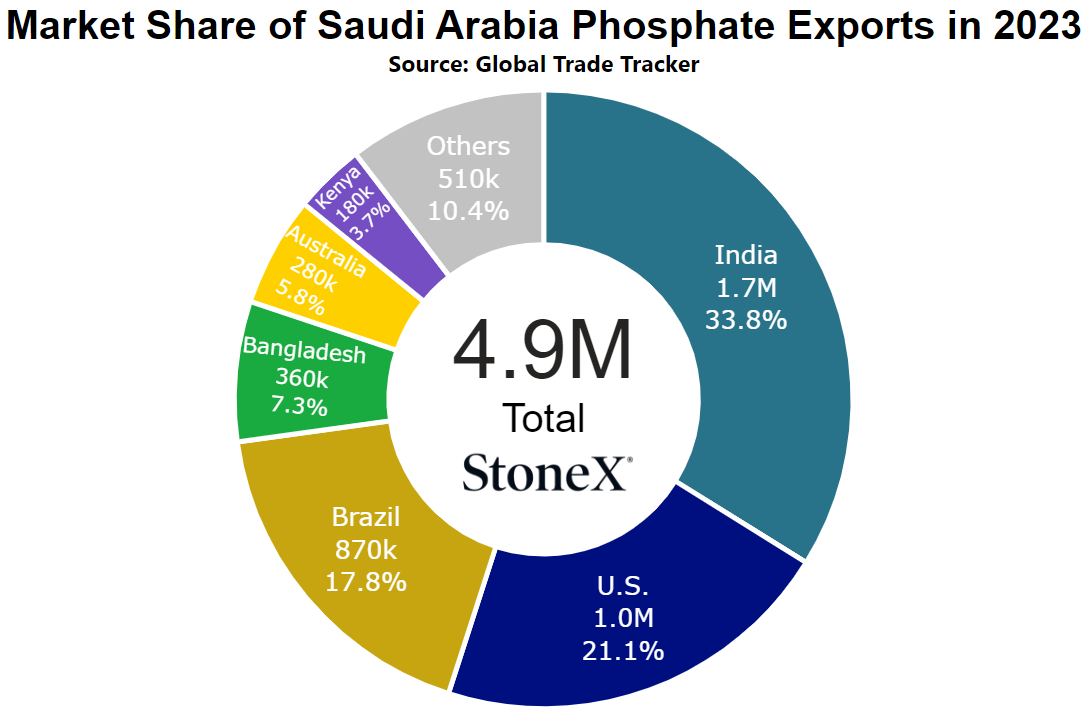
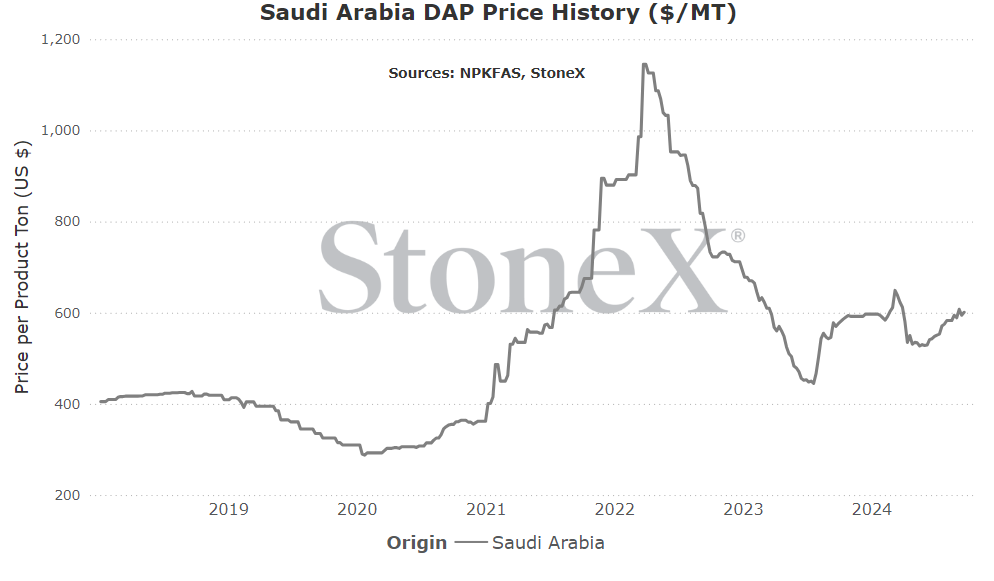
Saudi Arabia DAP price comparison
Number 4 global exporter in 2022
Price comparisons:
Vs 30 days ago - 1% or approximately $7 higher
Vs 90 days ago - 11% or approximately $59 higher
Vs 6 months ago - -2% or approximately $11 lower
Vs 1 year ago - 5% or approximately $31 higher
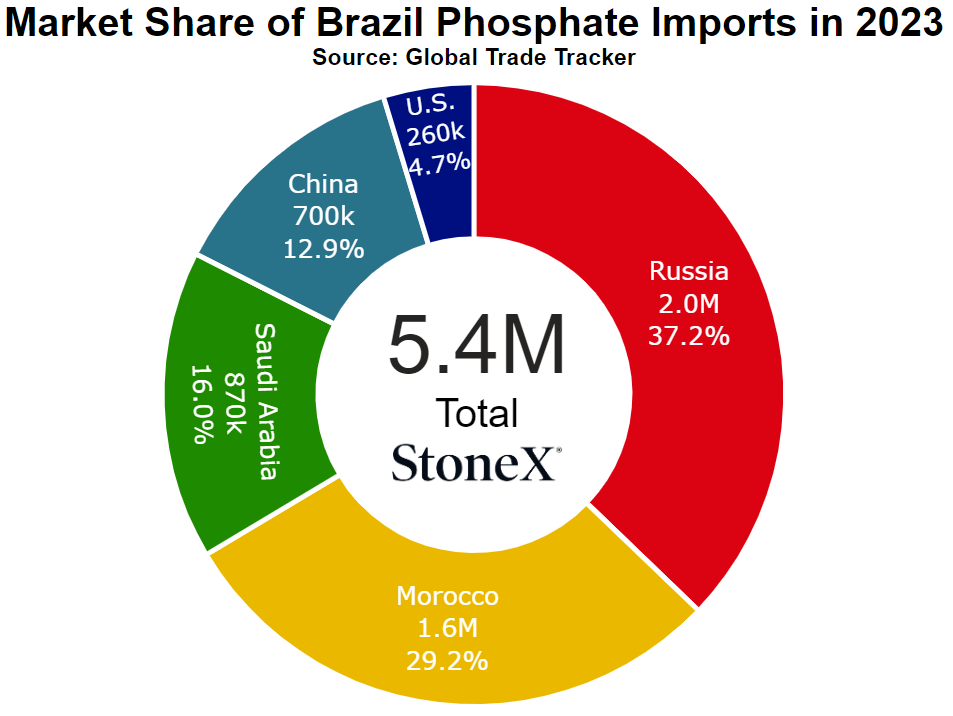
Brazil DAP price comparison
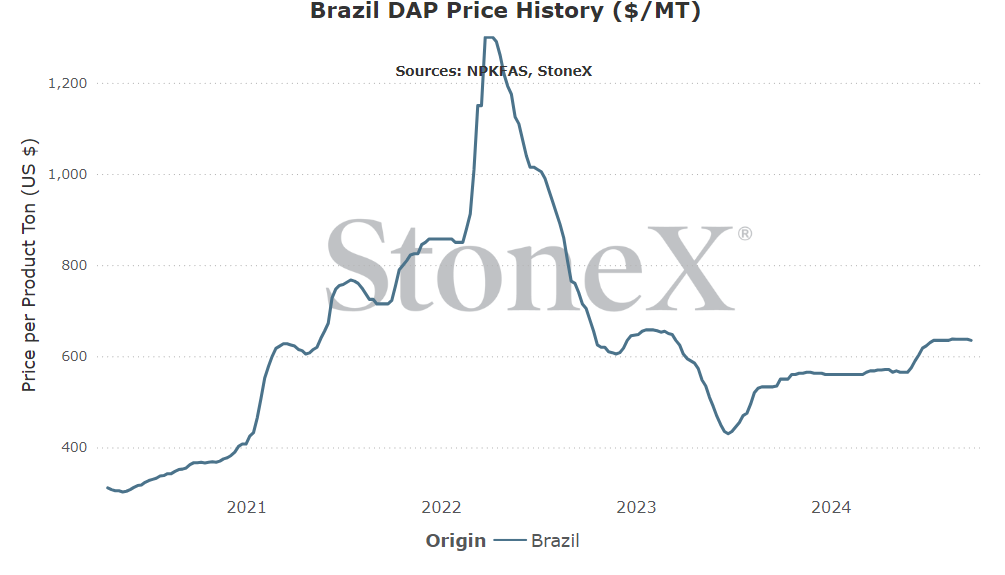
Number 2 global importer in 2022
Price comparisons
Vs 30 days ago - unchanged vs last month
Vs 90 days ago - 3% or approximately $18 higher
Vs 6 months ago - 11% or approximately $65 higher
Vs 1 year ago - 19% or approximately $100 higher
- Chinese exports continue behind normal trends...and could get worse in Q4 – you cannot talk global phosphate market without talking about China. They are historically the world's largest exporter...which means when they start cutting back, the world needs to take notice. Unfortunately, that continues to be a story. Not only is China behind at this point in the calendar, there are signs that they could pull back even further in Q4. The more this happens, the worse it hurts the global S&D.
- India continues to play catchup on stockpiles – I sure wish this was a factor that we had listed in past editions that had not come true. Unfortunately, we have had to chalk this one up in the "win" column...sure doesn't feel like a win. The Indian phosphate subsidy rate was finally fixed, allowing importers to start rebuilding stockpiles. Originally, they had been purchasing $630 CFR, then $637, then $642, now reports of $647 being done...and they have a lot more to buy. As their price goes up, so to do manufacturer price ideas for the rest of the world.
- Farmers relent and apply normal amounts – before harvest, it is easy to make claims such as "I am not going to put a pound of phosphate on the ground". There is still plenty of time before the fall rush. Frankly, given how out of balance/high priced phosphate is, I wouldn't blame a single farmer who followed thru on those claims. That said, harvest is now rolling and a lot of pre-harvest ideas make way for typical approaches. If we see farmers as a whole make a 180 and decide to roll with normal application programs, that should create a surge in demand that would support price ideas.
- Return to normal for Chinese exports – am I a believer that this will happen? Absolutely not. Would it be naïve of me to think that China couldn't do a complete 180 and start exporting at ridiculously high rates again? Absolutely. Never say never when it comes to China. We do not know what they are going to do and when they are going to do it. All outside signs are that they will scale back on exports hard in Q4 but we could see them change their minds. It has happened before and that would cause values to fall globally.
- Farmers hold true to their approach and demand is much lower – up above, I talked about how we wouldn't be surprised to see farmers return to normal phosphate application rates/timelines. In the same breath, I wouldn't be surprised to see a decent degree of application rate reductions or delays to spring. I think this will be especially true outside the corn belt where the economics are a lot tighter. Why do you think all those country songs talk about hard living on red dirt roads?!!!
- U.S. CVD's are eliminated (more MAP than DAP) – again, chalk this up in the "not very likely but still needs to be watched" category. Recently, Mosaic had decided to pull out of an administrative review of the counter vailing duty again Morocco. There was elation among some in the market who thought/hoped it paved a way to Morocco's return. We quickly saw MAP prices slide as they expected Morocco would send waves of MAP vessels to the U.S. Unfortunately, it does not sound like that will be the case but it highlights what would happen "if" it did.
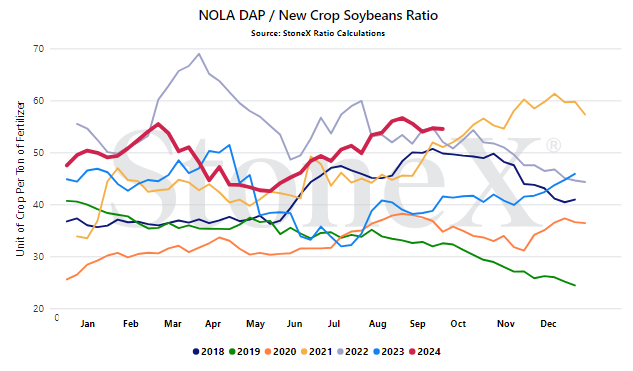
We believe that only looking at the flat price of either grains or fertilizer can be misleading:
-
Only selling grain can hurt you if fertilizer prices rise substantially
-
Only buying fertilizer can hurt you if grain prices fall
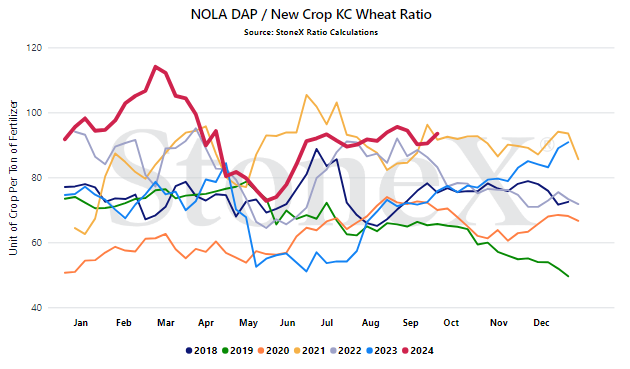
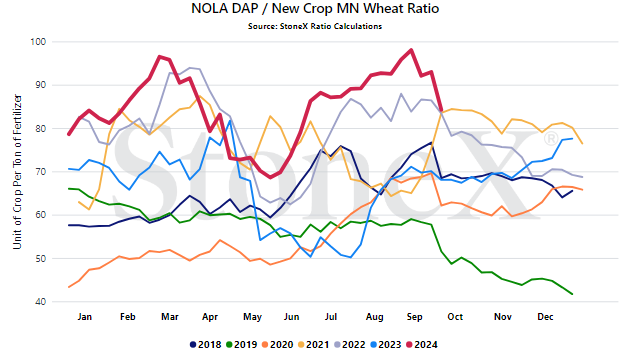
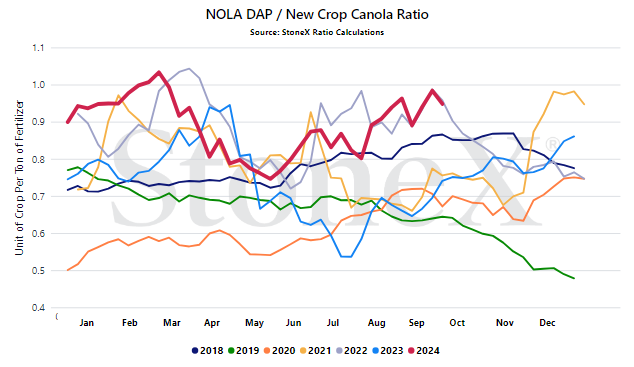
We look at the ratio "value" to get a better indication of where we are or how many bushels of X does it take to pay for 1 ton of fertilizer.
Would you rather:
-
Spend 150 bushels to pay for 1 ton of DAP
-
Spend 80 bushels to pay for 1 ton of DAP
When we compare the current ratio value against recent years, we start to see if we are high or low.
YOUR VALUES MAY LOOK DIFFERENT
This graph looks at the NOLA DAP price vs the flat grain price. There are no logistics on either product. Your location will look different due to fertilizer logistical costs, grain basis, etc.
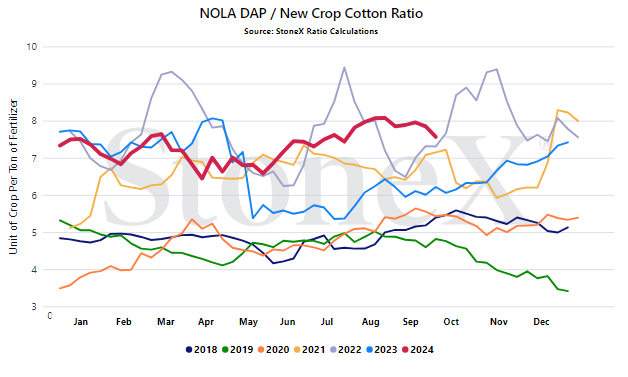
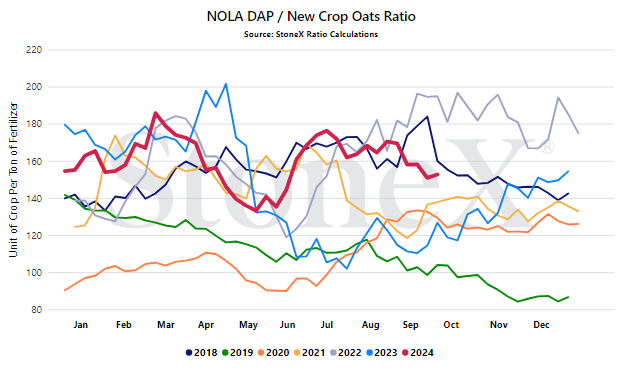
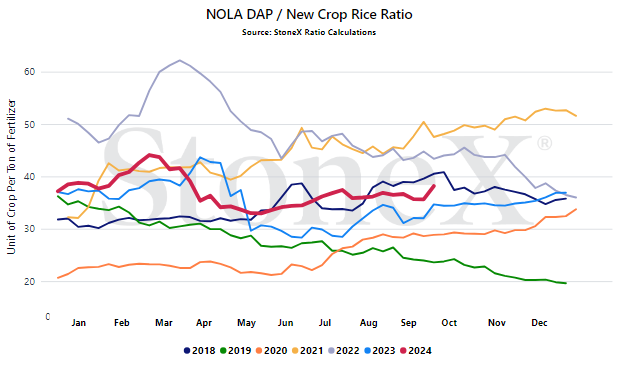
- Chinese export flows - how do you have a bigger focal point when the world's historically largest DAP/MAP exporter continues to dampen export flows...with fears that it gets worse in Q4? China is not playing a "normal" part these last couple years and unfortunately, it is getting worse. Now, they could easily turn a 180 and start hammering out exports. It's China, one never really knows. We all just make educated guesses and then ignore those guesses when wrong and brag when right. What they do or do not have global implications. Ignore at your own risk.
- How India continues to build their stockpiles - if the world's largest exporter is the number one focal point, then number 2 has to be the biggest buyer in the world. Indian DAP stockpiles have fallen to "dangerous" levels (estimated 1.5M or so). As a result, the government has "fixed" their subsidy rate so importers can import product to rebuild those stockpiles. Now, look at this as a manufacturer/seller. The world's largest exporter, China, is scaling back and reducing supplies and at the same time, the world's largest buyer in India needs to rebuild. What do you do? You take prices higher with each sale and that sets the bar for the rest of the world.
- Farmers reaction to high phosphate values/poor farm economics - globally, my story/POV is that tight supplies and large demand are going to continue to support price ideas. However, that does not mean that farmers are going to just roll over. There are still a lot of farmers whose intention it is to fight high prices with lower demand. Lower application rates. Skip application rates where possible. Delay application from the fall to the spring. All are reactions to poor farm economics/high phosphate values and could help keep a lid on pricing. Ultimately, I think the world price direction prevails but shorter term, farmers can have their say.
- How a perceived large crop removes phosphate from the soil - as mentioned above, farmers are fighting back the best way they know how: by not buying. However, how long can this last? There seems to be a massive crop coming off which means a lot of nutrient removal. That includes phosphate. It is very easy to claim reductions of phosphate rates when in the summer. It is fully another when in the fall and soil tests are screaming for rebuilding levels. I am not saying this absolutely happens, but we could be surprised by the demand that comes...
StoneX Ratio Calculation
The ratio calculation is derived from Bloomberg historical grains values as well as fertilizer values from StoneX, NPKFAS, and Argus.
The calculation is simply dividing the fertilizer price by each grain price.
All data was sourced from StoneX unless otherwise noted.