StoneX logo

OPEC+ and its Quota Hike: The State of Play

By: Harry Altham, Energy Analyst, Market Analysis EMEA & Asia

OPEC+ and its Quota Hike: The State of Play
 
Harry Altham
Energy Analyst, EMEA & Asia

Brent has moved $1 higher despite API data showing a 1.85M bbl rise in oil inventories; data which was compounded by rises in both gasoline (+1.82M bbl) and distillate (+3.38M bbl) inventories. Yesterday, oil’s inverse relationship to the U.S. dollar led moves across the energy complex, although there was notable strength observed in NYM Heating Oil versus RBOB Gasoline, as exports of diesel to Europe reached 1.12M bbd in the first week of June – the highest since Vortexa started tracking shipping records in 2015. United States refinery utilisation is approaching five-year highs, according to the EIA; this threatens further tightness in oil product markets as the peak summer consumption season continues, and hurricane season approaches. Meanwhile, the U.K. is considering recommencing the Cambo Oil Field project, which had been blocked on environmental grounds in December. 

OPEC+'s increased output mandate fails to deter benchmark strength
Despite OPEC+ increasing its monthly production quota to 650k bbd, banks are continuing to revise price forecasts upwards. In the last two days, Morgan Stanley set a Brent forecast at $140 for Q3, and Goldman predicted that price to rise to $150 during Q4. Morgan Stanley goes as far to say that prices will rise until such a moment that demand erosion kicks in. Indian refiners, for their part, believe this process has already begun domestically; such an effect in developed nations is the moment Morgan Stanley sees as being critical to reversing the present bull market. With spot Brent above $120, we can safely determine that OPEC+’s intervention has not allayed price concerns since the production hike was announced last week. Moreover, the proportion of money managers that were long versus short rose across all major benchmarks last week except for RBOB (whose net long fell by just 0.15% of total fund open interest), indicating that markets became more bullish in their outlook. 
Why are banks and markets in no mood to react to OPEC+’s announcement?
Firstly, the near-term demand outlook appears unlikely to provide much respite. We are now in the peak summer driving season, in which the IEA estimates an average 9.2M bbd of gasoline to be consumed in the U.S. alone – 500k bbd more than consumption in Q1. The IEA believes demand will remain robust across most developed economies throughout the summer, with demand destruction expected to come into play in Q4 2022 and become a major consideration next year. In addition, China’s 50 largest cities are all out of lockdown for the first time in almost four months as COVID cases fell to just 156pd (seven-day average basis) in the nation of 1.4Bn people. Total oil demand fell by 1.2M bbd from March through April – much of which can be expected to return by the end of July (assuming COVID cases remain under control). 
image 39972
Source: Reuters, S&P Platts, StoneX
image 39973
Source: OPEC


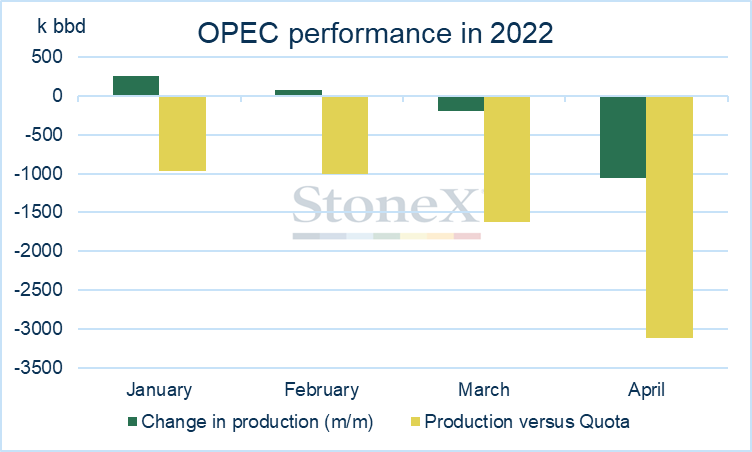
Can OPEC’s production keep pace with that? 650k bbd would, in theory, far-outpace the IEA’s May Report estimated rise of 1.8M bbd in consumption for 2022. However, OPEC+’s production is actually down by 910k bbd now versus December 2021 – which means global production needs to rise by 2.7M bbd by the end of this year to keep pace with that rise in demand (this ignores the supply/demand balance trailing from 2021). As OPEC+ produces around 45% of the world’s oil, OPEC+ would need to produce around 1.7M bbd more oil by the end of the year (we assume here that OPEC+ is required to recover its existing 910k bbd shortfall). 
RUSSIA A MAJOR OBSTACLE, BUT NOT THE ONLY ONE
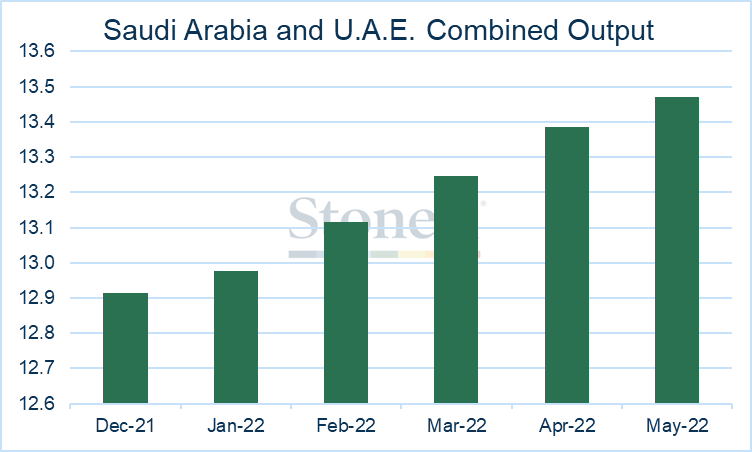
A major inhibiting factor is the 900k bbd fall in Russian production due to the fallout from the war in Ukraine (and subsequent fall in demand for Russian oil). Russia’s production is expected to fall by another 1M bbd by the end of 2023 (IEA & Russian estimates); proportionally, this would suggest its output will fall by 330k bbd this year – which leaves the remainder of OPEC+ to pump a further 2M bbd. But, with limited spare capacity (Nigeria, Angola et al), political troubles (Libya, South Sudan, Sudan et al), frequent facility outages (Kazakhstan) and sanctions (Iran, Venezuela), markets are not optimistic that this is achievable. The four key Gulf States – Kuwait, Iraq, U.A.E. and Saudi Arabia – had 2.6M bbd spare capacity back in March; a 2M bbd rise in output will push OPEC’s spare capacity close to its limits. Furthermore, save for a change of policy by Saudi Crown Prince Mohammed bin Salman (he meets President Biden this month), it is unlikely that the Gulf producers will pump more than their apportioned quotas. 

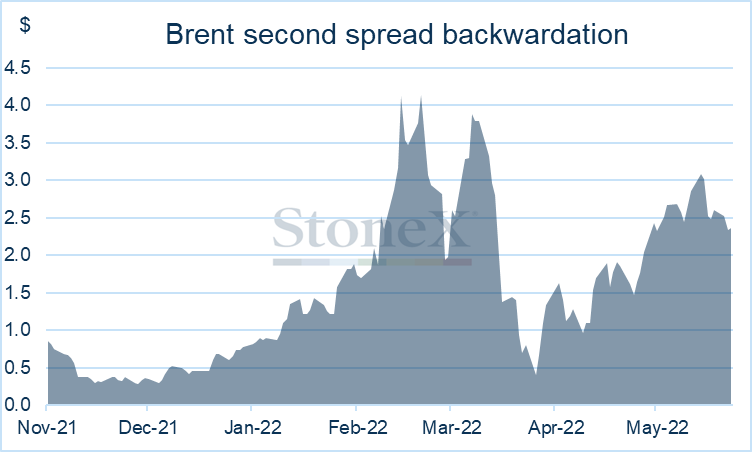
It therefore looks unlikely that OPEC+’s output will keep pace with the rise in demand in 2022. The possible consequences of this include a steepening of the backwardation in oil futures; the 2nd Brent spread, which currently trades at $2.35, could sustain levels above $3.25. Such a level has only ever been breached in March 2022, amid evaporating liquidity and a flight-to-front-month as Western nations scrambled to procure oil in the wake of the Russian invasion of Ukraine. We concur with bullish flat-price assessments by Goldman’s and Morgan Stanley moving towards the end of this year. However, another major outbreak of COVID in China poses a substantial challenge to achieving price levels above $140 as the Government continues to pursue a zero-tolerance approach that has the potential to heavily impact oil demand in the second half of 2022.  

image 39980
Source: Bloomberg, StoneX


  • Energy

This material should be construed as market commentary and represents the opinions and viewpoints of the author, and does not reflect tailored advice associated with any specific account.


The views are current only through the date stated and are subject to change at any time based upon market or other conditions, and StoneX Group Inc. (“SGI”) disclaims any responsibility to update such views. Actual results, performance, or achievements may differ materially from those expressed or implied. Information is based on data gathered from what we believe are reliable sources. Past performance does not guarantee future results.


The StoneX Group Inc. group of companies provides financial services worldwide through its subsidiaries, including physical commodities, securities, exchange-traded and over-the-counter derivatives, risk management, global payments and foreign exchange products in accordance with applicable law in the jurisdictions where services are provided.


References to certain OTC products or swaps are made on behalf of StoneX Markets, LLC (SXM), a member of the National Futures Association (NFA) and provisionally registered with the U.S. Commodity Futures Trading Commission (CFTC) as a swap dealer. SXM’s products are designed only for individuals or firms who qualify under CFTC rules as an ‘Eligible Contract Participant’ and who have been accepted as customers of SXM.


StoneX Financial Inc. (SFI) is a member of FINRA/NFA/SIPC and registered with the MSRB. SFI is registered with the U.S. Securities and Exchange Commission (SEC) as a Broker-Dealer and with the CFTC as a Futures Commission Merchant and Commodity Trading Advisor. StoneX Financial (Canada) Inc. (SFCI) is registered in Canada and is a member of CIRO and CIPF. References to certain securities trading are made on behalf of the BD Division of SFI and are intended only for an audience of institutional clients as defined by FINRA Rule 4512(c). References to certain exchange-traded futures and options are made on behalf of the FCM Division of SFI. Wealth Management is offered through SA Stone Wealth Management Inc., member FINRA/SIPC, and SA Stone Investment Advisors Inc., an SEC-registered investment advisor, both wholly owned subsidiaries of SGI.

R.J. O’Brien & Associates, LLC (RJO) is registered with the CFTC as a Futures Commission Merchant and is a member of NFA.


StoneX Financial Ltd (SFL) is registered in England and Wales, company no. 5616586. SFL is authorized and regulated by the Financial Conduct Authority (FCA) (registration number FRN:446717) to provide services to professional and eligible customers including: arrangement, execution and, where required, clearing derivative transactions in exchange traded futures and options. SFL is also authorized to engage in the arrangement and execution of transactions in certain OTC products, certain securities trading, precious metals trading and payment services to eligible customers. SFL is authorized and regulated by the FCA under the Payment Services Regulations 2017 for the provision of payment services. SFL is a category 1 ring-dealing member of the London Metal Exchange. In addition SFL also engages in other physically delivered commodities business and other general business activities which are unregulated and not required to be authorized by the FCA.


This communication is issued in the European Economic Area by StoneX Financial Europe GmbH (SFEG). StoneX is the trade name used by STONEX GROUP INC. and all its associated entities and subsidiaries. StoneX Financial Europe GmbH (“SFEG”) is a securities trading firm registered in Germany under Company No. HRB 80844.


StoneX APAC Pte. Ltd. (“SAP”) (Co. Reg. No 200616676W) is regulated as a Dealer (PS20190001002) under the Precious Stones and Precious Metals (Prevention of Money Laundering and Terrorism Financing) Act 2019 for purposes of anti-money laundering and countering the financing of terrorism. SAP is an “Approved International Trading Company” authorized to act as a “Spot Commodity Broker” under the Commodity Trading Act.


StoneX Financial Pte Ltd (Co. Reg. No 201130598R) (“SFP”) is regulated by the Monetary Authority of Singapore and is a Capital Markets Service Licence holder (for dealing in capital market products), an Exempt Financial Adviser (for advising on investment products and issuing or promulgating analyses/ reports on investment products) and a Major Payment Institution (for domestic and cross-border money transfer services).


SFP may distribute analysis/report produced by its respective foreign affiliates within the StoneX Group of companies pursuant to an arrangement under Regulation 32C of the Financial Advisers Regulations Recipients should contact SFP at (65) 6309 1000 for any matters arising from, or in connection with, this webinar.


StoneX APAC Pte. Ltd. (“SAP”) (Co. Reg. No 200616676W) is regulated as a Dealer (PS20190001002) under the Precious Stones and Precious Metals (Prevention of Money Laundering and Terrorism Financing) Act 2019 for purposes of anti-money laundering and countering the financing of terrorism.


StoneX Financial (HK) Limited (CE No.: BCQ152) (“SHK”) is regulated by the Hong Kong Securities and Futures Commission for Dealing in Securities and Dealing in Futures Contracts.


StoneX Financial Pty Ltd (ACN 141 774 727) holds an Australian Financial Service License (AFSL: 345646) for Dealing in Securities, Exchange-Traded Derivatives Contracts, OTC Derivatives Contracts and Foreign Exchange Contracts, and is regulated by the Australian Securities and Investments Commission.


StoneX Securities Co., Ltd. (“SSJ”) (Co. Reg. No 010401047199) is regulated by the Japanese Financial Services Agency as a Type-I Financial Instruments Business Operator (Kanto Local Finance Bureau (FIBO)No.291’), is a member of the Financial Futures Association of Japan for dealing and broking FX and FX Option transactions, and is a member of the Japan Securities Dealers Association for dealing and broking stock indices and option transactions.


Trading swaps and over-the-counter derivatives, exchange-traded derivatives and options and securities involves substantial risk and is not suitable for all investors. Past performance of any futures or option is not indicative of future success. Indicators are not a trading system and are not published as a specific trade recommendation. The information herein is not a recommendation to trade nor investment research or an offer to buy or sell any derivative or security. It does not take into account your particular investment objectives, financial situation or needs and does not create a binding obligation on any of the StoneX group of companies to enter into any transaction with you. You are advised to perform an independent investigation of any transaction to determine whether any transaction is suitable for you. No part of this material may be copied, photocopied or duplicated in any form by any means or redistributed without the prior written consent of StoneX Group Inc.


The report/analysis herein is not directed to, or intended for distribution to or use by, any person or entity who is a citizen or resident of or located in any locality, state, country or other jurisdiction where such distribution, publication, availability or use would be contrary to law or regulation.


© 2026 StoneX Group Inc. All Rights Reserved.

Satellite view of Earth at night showing illuminated cities across Asia and the Middle East

Discover more insights

Our subscribers have access to comprehensive market analysis from StoneX spanning commodities, equities, currencies and more.

Related articles for Energy

WTI and Brent Crude Are Now Reading the Strait of Hormuz Differently

WTI and Brent crude are moving to different beats as a possible U.S. Iran deal reshapes the oil market. The two benchmarks are pricing Strait of Hormuz risk in their own ways, and the gap between them says a lot about where crude goes next.

Editorial Team
Editorial Team
  • Energy

Perspective: Morning Commentary for August 7

August 7 – The U.S. economy unexpectedly lost 23k jobs in July, dramatically below market expectations of an 80k increase and marking the worst Non-Farm Payrolls print since February. Furthermore, May and June were both revised sharply downward, with combined revisions showing 103k fewer jobs than previously reported. Outside of the healthcare sector, which added 22k jobs in July, the losses were very broad-based. Government payrolls saw the largest decline, shedding 53k jobs in July, the largest seen since October 2025, while June was revised down to show a loss of 10k jobs as well. The private sector at least saw growth, adding 30k jobs in July, now matching the month prior after it was revised down from the 49k initially reported, and substantially missing forecasts of 78k jobs being added. This is a sharp reversal in course from the largely better than expected U.S. labor data seen earlier this week.

Mike Castle
Mike Castle
  • Grains & Oilseeds
  • Energy
  • Dairy
  • Renewable Fuels
  • Cocoa
  • Coffee
  • Cotton
  • Sugar
  • Meats & Livestock
  • Forest Products

Diesel Supply Faces Three Fresh Risks Before the Winter Heating Season

The oil market keeps watching the Strait of Hormuz, but the tighter pressure on fuel is building in refining. With a large share of global capacity offline and unplanned outages carrying no repair timeline, diesel supply faces three fresh risks before winter.

Editorial Team
Editorial Team
  • Energy
StoneX: We open markets

Our market expertise, advanced platforms, global reach, culture of full transparency and commitment to our clients’ success all set us apart in the financial marketplace.

Reach

With access to 40+ derivatives exchanges, 180+ foreign exchange markets, nearly every global securities marketplace and numerous bi-lateral liquidity venues, StoneX’s digital network and deep relationships can take clients anywhere they want to go.

Transparency

As a publicly traded company meeting the highest standards of regulatory compliance in the markets we serve, our financials and record of accomplishment are matters of public record. StoneX’s commitment to “doing the right thing over the easy thing” sets us apart in the industry and helps us build respect, client trust and new partnerships.

Expertise

From our proprietary Market Intelligence platform, to “boots on the ground” expertise from award-winning traders and professionals, we connect our clients directly to actionable insights they can use to make more informed decisions and achieve their goals in the global markets.