April 14 - Stocks are modestly higher at midday after starting the day strong as traders try to marry President Trump's tariff carve-out for electronics with his comments that seem to indicate that everything will eventually face tariffs as he strives to bring production of that sector to the United States. The VIX fell to just above 30 at one point this morning, before firming again as stocks slipped to now trade near 33. The dollar index is trading near 99.6 as it trades just above Friday's three-year lows. Yields on 10-year Treasuries are trading 4.41%, while yields on 2-year Treasuries are trading near 3.87%. Crude oil prices slipped back into negative territory as stocks lost their upward momentum, but then recovered as stocks began to recover. Meanwhile the grain and oilseed sector is weaker, led by wheat with rains forecast for dry areas of the Plains.
The dollar resumed its decline versus other world currencies today, although it remained above Friday's three-year low at this hour. The weaker dollar provides fresh tailwinds for the broader commodity sector, which benefits from the weaker currency via stronger exports - at least that's the theory. The move appears to be part of a global investment restructuring after a period when global investors had been sending the bulk of their money to the States, requiring conversion into dollars to participate in our markets. The U.S. share of the MSCI World stock market index had soared to 73% recently, up from 48% in 2010. We last saw a major reallocation after the U.S. share soared to 60% ahead of the tech bubble burst in 2000. Positive interest rates for Japan and renewed hope for Europe's economy if the Ukraine war ends create a different dynamic for the markets currently, although all of this is subject to change depending on the eventual outcome of President Trump's tariff regime.
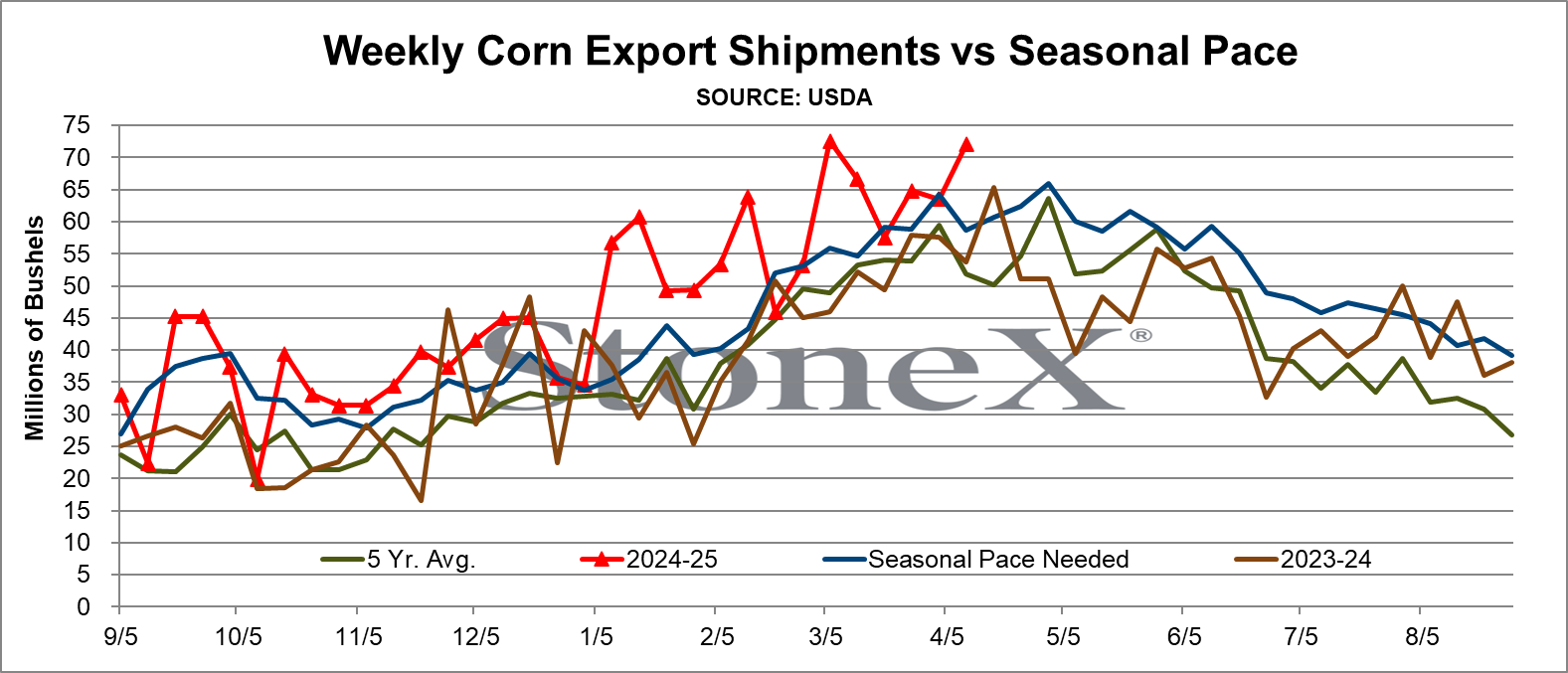
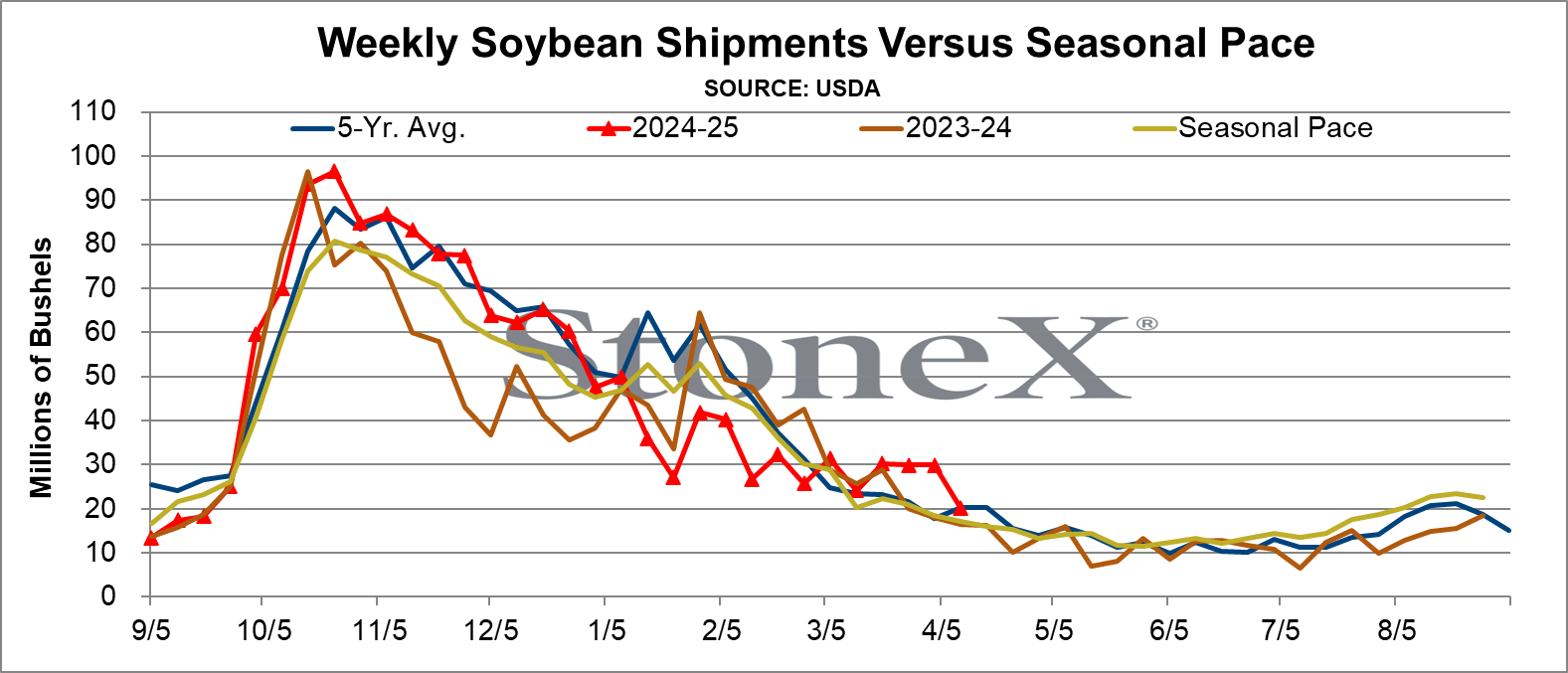
USDA inspected 72.0 million bushels of corn for export shipment in the week ending April 10, as shown below, which was among the largest weekly shipment totals of the past five years. It also inspected 20.1 million bushels of soybeans for shipment, along with 22.2 million bushels of wheat, and 0.9 million bushels of grain sorghum. Of the above, we saw 5 million bushels of soybeans get shipped to China; likely purchased by state-buyer Sinograin for its reserve. Marketing year to date corn export inspections total 1.477 billion bushels, up 345 million bushels or 30% from the previous year's pace. USDA raised its corn export target by 100 million to 2.550 billion bushels on April 10. But last week's shipments push year-to-date inspections 176 million bushels above the seasonal pace needed to hit USDA's target for the year. Marketing year-to-date soybean export inspections total 1.547 billion bushels, up 150 million or 11% from the previous year's pace, and up 98 million from the seasonal pace needed to hit USDA's target for the year.
Argentina is the world's largest exporter of soybean oil and soybean meal, but it also exports whole soybeans when it has the spare capacity to do so. China is one of the primary buyers when Argentina sells. China doesn't allow Brazilian soybeans into its reserve, believing that they don't store as well, but it does purchase Argentine and U.S. soybeans for the reserve. I wrote this morning about the IMF assistance package offered to Argentina over the weekend. President Milei took advantage of the package to offer some export tax relief to farmers, encouraging them to sell in a way that would increase the availability of dollars available. President Milei encouraged farmers today to take advantage of the program to sell their crops as they harvest them currently, stating that the tax would be back by June. This is expected to increase the availability of Argentine corn and soybeans to the world market in the weeks ahead.