April 22 - Wall Street threw a temper tantrum on Monday as it protested comments emerging from the White House that it was considering firing Federal Reserve Chair Jerome Powell. I have not been a fan of the Federal Reserve's actions over the past 20 years, believing that it has lost touch with Main Street, but that's still better than monetary policy dictated by whoever happens to be in the Oval Office at the time. That would tend to drive policy for what's best for the four-year election cycle rather than the longer-term good of the U.S. economy. President Trump may think that he's intimidating Powell into lowering rates, but his threats may actually solidify the 12 voting members to do the opposite. Firing Powell would also put the next nominee into a most difficult situation, with that individual needing to repeatedly try to prove their independence. I certainly would not want to be in that position, and many good candidates would likely feel the same way.
Nonetheless, the tantrum appears to be over as quickly as it started as investors focus on a plethora of earnings reports that thus far look pretty good. Everything could flip again with the next headline, but for now stocks are rebounding impressively. The VIX is easing back to trade near the psychological 30 level, while the dollar index firms to trade near 98.5. Yields on 10-year Treasuries are trading near 4.39%, while yields on 2-year Treasuries are trading near 3.79%. Crude oil prices are more than 2% higher as they follow the optimism of the stock market higher today, while the grain and oilseed markets are quietly mixed. Soybeans saw modest gains at midday, with soymeal doing the same. Meanwhile, soyoil prices reversed early gains to trade modestly lower in profit taking after prices began to approach multi-month highs. Soyoil prices continue to find support from trade rumors that the Environment Protection Agency "may" release favorable biomass diesel mandates as early as this week, but gains were limited by the fact that current prices are rationing both domestic and export demand.
Twelve percent of the U.S. corn crop was planted as of Sunday, up from 4% the previous year, and up from the five-year average for the date of 11%. Soybean planting progress as of Sunday stood at 8%, up from 2% the previous week, up from 7% in the same week last year, and ahead of the five-year average for the week of 5%. Rapid planting progress was seen in many areas of the central and western Midwest over the past week, thanks to a relatively open weather pattern, while some delays were seen in the eastern Midwest. a wet pattern is expected to dramatically slow fieldwork in the central and western Midwest over the next week to 10 days, while a drier pattern allows fields to dry and fieldwork to resume in eastern areas. The outlook into week #2 suggests and overall drier pattern for the Midwest that extends into the 16- to 30-day time period as well. That should allow for active planting in good soil moisture for most areas of the Midwest beyond the near-term rains, which would be a pretty ideal situation if it occurs.
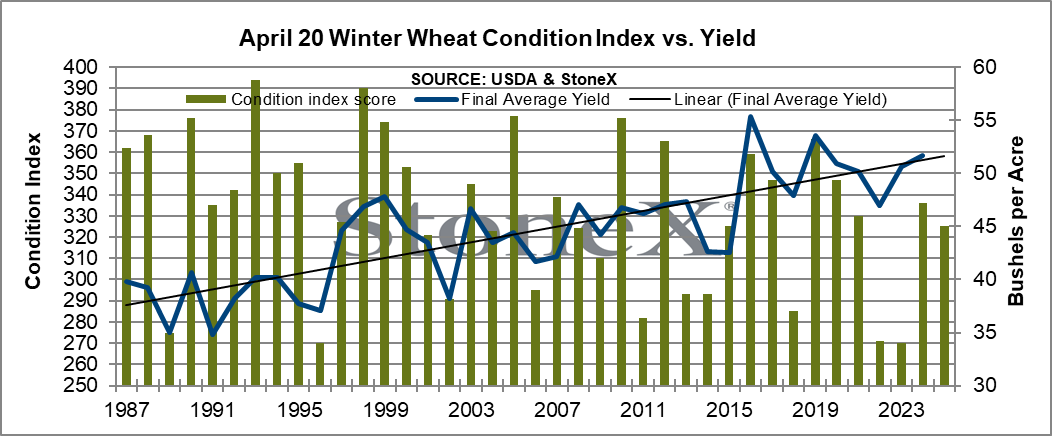
USDA reports that 45% of the U.S. winter wheat crop is rated Good to Excellent, down 2 points on the week, and down 5 points on the year. The agency reports that 21% of the crop is rated Poor to Very Poor, which is also up 2 points on the week. Adding in the 34% of the crop that remains in the Fair category allows us to calculate an overall condition index score of 325, as shown below. That's down from 329 the previous week, down from an index of 336 a year ago, but it's still above the 10-year average for the week of 319. You can also see from the graphic below that the correlation between the condition index score in mid-April and final yields is not strong. Both above- and below-trend yields are still possible, as growing conditions in the weeks ahead have a major impact in determining yield.