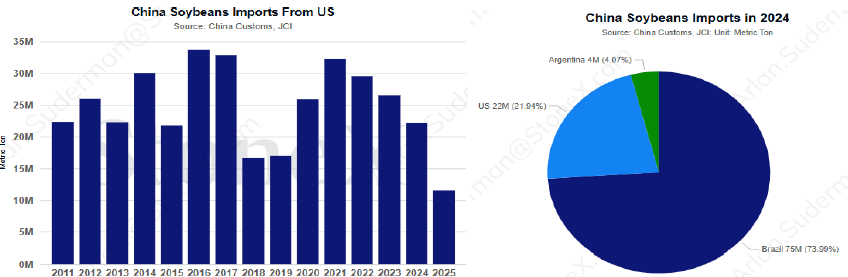
April 25 - Stocks are mixed as we head into the weekend when the headlines will continue to flow. The VIX is testing the April 3rd low just below 25 at midday, while the dollar index is trading near 99.5. Yields on 10-year Treasuries are trading near 4.26%, while yields on 2-year Treasuries are trading near 3.77%. Crude oil prices, along with the grain and oilseeds, have been quietly trading mixed. Soyoil prices turned lower as traders fear they may not hear the rumored EPA biomass diesel decision today, turning the focus back to exports. The left graphic below shows U.S. calendar year soybean sales to China. Note the dip in 2018 & 2019, which is a combination of the previous trade war, and the fact that nearly two-thirds of China's hogs had died in the African Swine Fever epidemic. This was followed by a brief resurgence of purchases required in the Phase One trade deal. Regardless, Chinese purchases of U.S. soybeans are trending lower from the 2016 high as China leans toward cheaper sources in Brazil, as shown on the right graphic.
The White House says that it is close to a trade deal with India. We've previously heard this regarding other countries as well. Maybe it is true, but sustaining momentum means that the White House needs to start producing solid trade deals with major trading partners - and do so soon. This morning's consumer sentiment index provided evidence that the president is losing the consumer, which increases the risks of a recession going forward. The question then will be, will the consumer / voter / Congress remain patient to allow President Trump's strategy play out if we go into a recession. Historically, recessions happen every 6.5 years, but we haven't had one in more than 15 years if you don't count the pandemic, and people are beginning to assume that recessions are rare.
But the focus now appears to be shifting away from the 90 - 100 countries seeking negotiated trade agreements to the big prize of a trade deal with China. President Trump teased the media with comments that he could possibly wrap up a trade deal with China within three to four weeks. I'm quite skeptical of that, but he's setting those expectations. The bottom line though is that the markets currently interpret this, combined with other headlines out of both China and the White House that I summarized in my Morning Commentary, as evidence of a slow thawing of relations between the two major superpowers. There likely are talks occurring at some level, but those are likely the talks that thaw things out enough for the actual negotiations to take place, and I believe that we are still some distance from an actual agreement with China. In fact, the more that President Trump builds expectations, the more President Xi may have incentive to make sure that doesn't happen.
The consumer sentiment index, produced by the University of Michigan, fell to 52.2 for April, up from 50.8 mid-month, but down from 57.0 in March, and down from 77.2 a year ago. It was the fourth consecutive decline for the index. The current conditions index dropped to 59.8 in April, down from 63.8 the previous month, and down from 79.0 the previous year. The index of consumer expectations fell to 47.3 this month, down from 52.6 in March, and down from 76.0 a year ago. The expectations index is down 32% since January, marking its steepest three-month percentage decline since the 1990 recession. The decline was particularly strong this month for middle-income families, but expectations worsened for "vast swaths of the population across age, education, income, and political affiliation." The biggest concerns cited were regarding the tariffs and possible inflation. Labor market expectations are bleak, and consumers expect weaker income growth for themselves in the year ahead, which is expected to reduce spending in the months ahead. Year-ahead inflation expectations jumped to 6.5% in April, up from 5.0% in March, and the highest reading since 1981. Those inflation expectations ebbed somewhat after the April 9 "pause" in the tariffs, but they remain substantially elevated relative to March. Long-run inflation expectations rose to 4.4% this month, up from 4.1% in March.