April 29 - Stocks are cautiously mixed to higher at midday as traders assess President Trump's first 100 days in office. They're encouraged by earnings reports that lean toward beating expectations, as well as ongoing reports that the White House is "close" to reaching trade agreements with some key trading partners. The Trump Administration also provided greater clarity this morning on auto tariffs, that give support for the U.S. auto industry, while protecting relationships established with Canada and Mexico under the USMCA trade agreement. The VIX is trading near 24.5 at midday, which is its lowest level since April 2nd when the reciprocal tariffs were announced as Wall Street adjusts to the new world in which we now live. The dollar index is trading near 99.1, which is just above three-year lows that were posted last week. Yields on 10-year Treasuries are trading near at three-week lows near 4.17%, while yields on 2-year Treasuries are trading near 3.65%. The broader commodity sector is generally under pressure today, with crude oil prices trading just above $60 per barrel on demand concerns, while the grain and oilseed markets are mostly lower as well.
The consumer confidence index fell to 86.0 for April, down from 93.9 in March. The Present Situation index dropped a mere 0.9 points to 133.5, while the Expectations Index dropped 12.5 points to just 54.4, which is its lowest level since October 2011. The survey cutoff date was April 21st. This suggests that consumers are scared about what the future might hold, amid the constant news headlines of tariffs and inflation, but they're not so worried about their present situation. That suggests that perhaps those future fears might ease if the White House were to start seeing a series of tariff-lowering trade agreements soon, but that will remain a big "IF" until it actually happens.
Traders in the soybean complex gave up on hopes of seeing an imminent announcement from the U.S. Environmental Protection Agency on the biomass diesel production mandate, which then allowed them to focus on declining demand as South American supplies hit the global market, as well as the rapid planting pace that favors good yields for the U.S. crop. That same sentiment weighed on corn prices as well, although demand for corn remains seasonally strong. Momentum trading Algos added sell orders that amplified the move lower. Wheat prices continue to come under pressure as drought in the Southern Plains appears to be being replaced by a wet pattern that favors good yields, and just in time for the critical reproductive phase for the crop. That Southern Plains wetness has also created a surge in demand for a limited supply of feeder cattle, leading that market to hit new highs today, with live cattle futures following the product market higher.
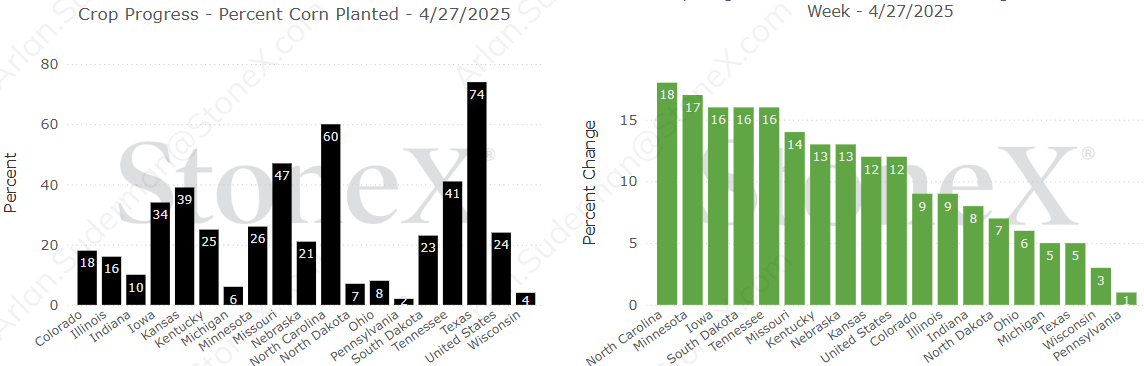
USDA reports that 24% of the U.S. corn crop is planted as of April 27, up from 12% the previous week, and up from the five-year average for the week of 22%. The greatest progress was seen in North Carolina, where 18% of the crop was planted during the week, while just 1% of Pennsylvania was planted during the week, as shown below. Some areas will again see slow progress this week as rains fall, but the Midwest largely dries out beyond this week, which is expected to support rapid planting progress. USDA reports that 18% of the U.S. soybean crop was planted as of April 27, up from 8% the previous week, and up from the five-year average for the week of 12%. Nineteen percent of the Mississippi crop was planted last week, while just 2% of North Dakota was planted during the week. It should be noted that we continue to see an emphasis on planting soybeans ahead of corn in some key production states, which is a trend seen in recent years to boost soybean yields. Soybean planting progress in Iowa was at 25% as of Sunday, while it was at 22% for Illinois, up from the five-year average for those states of 13% and 20% respectively. Corn planting in Iowa and Illinois on Sunday was listed at 34% and 16%, versus the five-year average for the week of 28% and 26% respectively. So, Iowa corn planting is still above average, but soybean planting is much further above average. Soybean planting in Illinois is well above the average pace, while corn planting trails the historical pace.