April 8 - We continue to see solid gains in the equities today, although the major indices have backed off their session highs somewhat. The major stock indices are still posting gains of 1 - 1.5% on the day, but fear levels remain high amid the uncertainty of the current tariff situation. The VIX spiked above 60 yesterday, while it has largely traded between 36 and 44 today, trading near 44 at midday. We need to see that drop back below the 30 level to increase investor confidence to fully participate in the commodity markets. The dollar index is trading near 103.3 at midday. Yields on 10-year Treasuries are trading near 4.20%, while yields on 2-year Treasuries are trading near 3.79%. Both are well off their lows posted over the previous two sessions, getting closer to levels seen early last week before the tariffs were announced. Crude oil prices are consolidating around the $61 per barrel level, which is roughly near the cost of production for some of our shale oil fields. The grains are mixed, with the soy complex mostly higher at midday. Soybeans experienced a recovery rally today, after seeing the largest losses in the tariff selloff.
The White House continues to keep the phone line open so that China can call. China has thus far been the only country to defy President Trump's threat to escalate tariffs if any country placed retaliatory tariffs on the States. China placed a 34% retaliatory tariff on U.S. goods, while keeping Hong Kong as a free port where semi conductors and other products could still enter the country free of the new tariffs. President Trump made good on his threat yesterday by stating he would add another 50% to last week's announced tariffs tomorrow if China failed to remove its retaliatory tariffs before then. He also stated that he would cut off all negotiations regarding the tariffs if China failed to do so. Reuters reports that the new 104% tariff went into effect at Noon EDT today, but we can't confirm that. Regardless, the tariff was already high enough to stop trade. China's response so far is that it will not back down from a fight. Roughly 70 other countries responded to Trump's tariffs by asking if they could negotiate their tariffs lower, but China has thus far stood strong to defend its pre-existing tariffs and non-tariff restrictions, believing them to be essential to its survival.
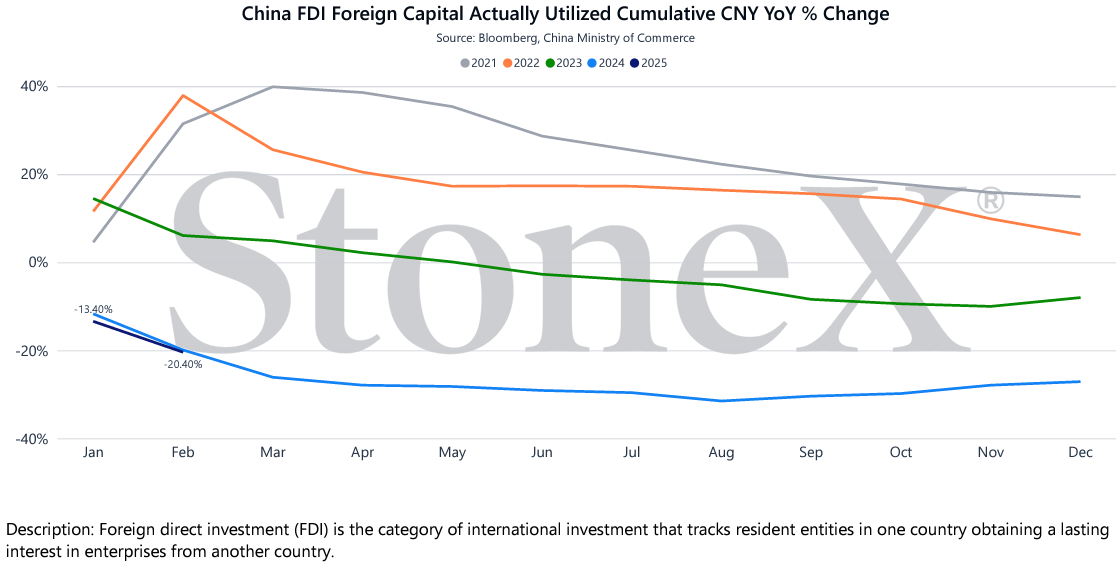
That says a lot about what has funded the growth of China's economy over the past 25 years. The Trump tariffs could essentially bring a halt to the flow of $430 billion in consumer goods that flow to the United States each year that are essential to China's economy. The current trade war also threatens to further reduce the foreign direct investment (FDI) money that flows into China each year to fund its growth. This trade war has made many foreign investors less comfortable investing in China's economy. The flow of foreign capital into China's economy had already been in decline, resulting in slowing China's economy down. The graphic below shows that FDI into China's economy was down by 20.4% year-on-year in February (the latest data available), after being down by a similar amount the previous year. Consumer confidence remains just above record low levels in China as well, reducing domestic demand for products except for those that are subsidized by the government. China continues to mount up debt to subsidize the economy, while also now pumping money into the stock market so that it looks good. Escalating the tariff situation rather than negotiating down tariffs and restrictions is costing China deeply, and Trump knows it. But now he has to give his friend Xi Jinping an escape route that allows him to save face in the negotiations IF they happen.