April 9 - Stocks quickly recovered from overnight losses to trade into positive territory today, despite the tariff headlines that remain largely negative yet at this point. The major stock indices are chopping around with modest gains for the day currently, with the VIX again easing back to trade near 49, down from its session high near 58, and down from Monday's high above 60. The dollar index is trading near 102.3 at midday. Yields on 10-year Treasuries are trading near 4.46%, in what has been a very volatile session, while yields on 2-year Treasuries are trading near 3.78%. Note the significant rally in Treasury yields today, particularly for the longer-end of the yield curve. Crude oil prices remain roughly 4% lower at midday, although that's well off their session lows.
Meanwhile, the grain and oilseed sector continues to be resilient in the face of the turmoil, with prices generally mixed to higher. I still contend that it will be difficult to sustain a rally when the VIX is above 30, but the fact that these markets remain resilient amid the negativity of much of the rest of the market complex should be noted. Even so, a lot of margin calls are going out during this tariff-induced volatility, so no market is immune to liquidation if needed to make those margin calls. The cattle market is one of those markets with the most speculative length, leaving it susceptible as well, along with Chinese demand loss.
My broader observations from the markets are that the major stock indices have held above their recent lows, despite another barrage of negative headlines. My next observation is that Treasury yields continue to rocket higher, suggesting that this is a symptom of something bigger occurring. There's a lot of speculation about what that might be. No, I do not believe it is a reflection of Chinese manipulation, but I do believe that it may have something to do with our growing debt, easing panic in the market reducing safe-haven buying, carry trade unwinds, and liquidating Treasuries to make margin calls, in some combination. Finally, one has to be impressed with the resiliency of the grain and oilseed markets and how well they are holding.
Japan and South Korea have both begun the process of negotiating lower tariffs with the Trump Administration. We know that Israel and Argentina were also quick to get on the top of the list as well. A new trade deal with Japan, or even South Korea could go a long way toward calming market fears if the Trump Administration can do so relatively quickly. Meanwhile, both Europe and Canada are responding to President Trump's tariffs on steel and aluminum. The EU's retaliatory tariffs thus far cover an estimated $28 billion in U.S. goods, which is just a fraction of the $370 billion in U.S. exports to the EU last year. That's because the EU desired to respond in a way that would still leave the door open for negotiations. Canada says that it has the same interest, although it is election season there, and talking tough against Trump has become a popular thing to do, which doesn't do much to smooth things over with Trump.
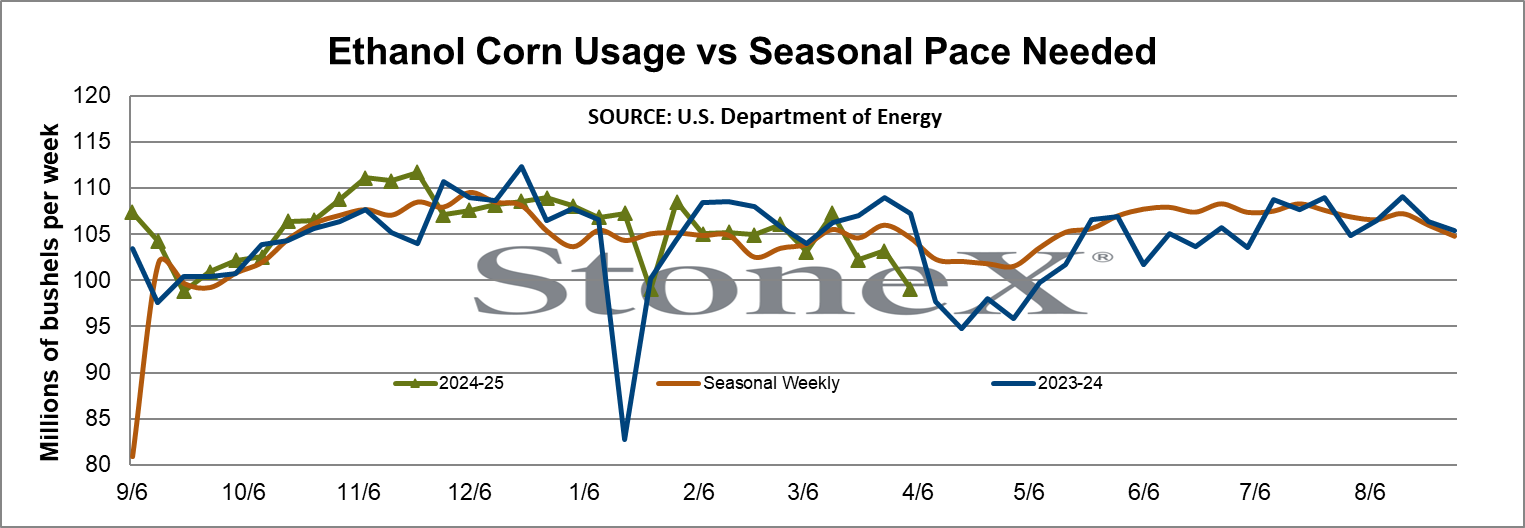
U.S. commercial crude oil inventories (excluding the Strategic Petroleum Reserve), increased by 2.6 million to 442.3 million barrels in the week ending April 4, leaving them still 5% below levels typically seen in early April. Gasoline stocks fell by 1.6 million barrels, putting them right at the five-year average for the week. Distillate stocks dropped by 3.5 million barrels, placing them 9% below seasonal levels for early April. Ethanol stocks rose to 27.0 million barrels in the week ending April 4, up from 26.6 million the previous week, and up from 26.2 million barrels in the same week last year. Ethanol production dropped to 1,021K barrels per day during the week, down from 1,063K bpd the previous week, and down from 1,056K bpd the previous year. The production of ethanol utilized an estimated 99.1 million bushels of corn last week, down from 103.2 million bushels the previous week, and down from 107.3 million bushels the previous year. Marketing year to date estimated corn use for ethanol totals 3.262 billion bushels, down 5 million bushels from the previous year's pace, but still 34 million bushels above the seasonal pace needed to hit USDA's target for the year.