August 16 - Stocks were mixed in choppy trade this morning, as traders anticipate this afternoon's release of the minutes of the July Federal Open Market Committee meeting. A report showing U.S. industrial production much stronger than expected in July had little impact on stocks. The VIX is trading near 16 at midday, while the dollar index is trading near 103.2. Yields on 10-year Treasuries are trading near 4.23%, while yields on 2-year Treasuries are trading near 4.95%. Crude oil prices are also quietly mixed today, while the grain and oilseed markets are notably higher on resumed tensions in the Black Sea and on a hotter drier Midwest forecast for the last half of August.
U.S. commercial crude oil inventories (excluding the Strategic Petroleum Reserve) fell by 6.0 million to 439.7 million barrels in the week ending August 11, putting stocks roughly 1% below the five-year average for the week. Gasoline stocks dropped by 0.3 million barrels, leaving them 6% below seasonal levels. Distillate stocks rose by 0.3 million barrels, but they remain 16% below levels typically seen at this time of year. Ethanol stocks rose to a 15-week high 23.4 million barrels in the week ending August 11, up from 22.9 million barrels the previous week, but matching levels posted in the same week last year. Ethanol production rose to 1,069K barrels per day during the week, up from 1,023K the previous week, and up from 983K bpd the previous year. The production of ethanol utilized an estimated 105.6 million bushels of corn last week, up from 101.1 million the previous week, and up from 97.0 million the previous year. Year-to-date corn use totals 4.908 billion bushels, suggesting that we will fall short of USDA's target by 15 million bushels if we sustain the current production pace.
It will be hot and dry across much of the Midwest the next two weeks, putting crops under stress as the corn crop finishes grain fill and soybeans try to set those final pods. The annual Pro Farmer Midwest crop tour is scheduled to take place next week in the middle of that weather story, providing us our first significant look at this year's crops. I believe the input from this year's tour will be particularly valuable. I've seen an increase in anecdotal reports this year of small corn ears and / or a lot of tip back or else poor pollination. The first of those reports came from early planted corn in eastern Nebraska, which didn't surprise me at all considering the intensity of their drought in June. But I've been surprised at how many other areas of the Midwest have had similar reports. I never know how much to make of these anecdotal reports, since farmers with high yield potential rarely talk about it. But next week's tour should give us a good idea of whether these problems are rather isolated incidents that make good social media fodder, or if they are more widespread with more significant implications for the national yield potential.
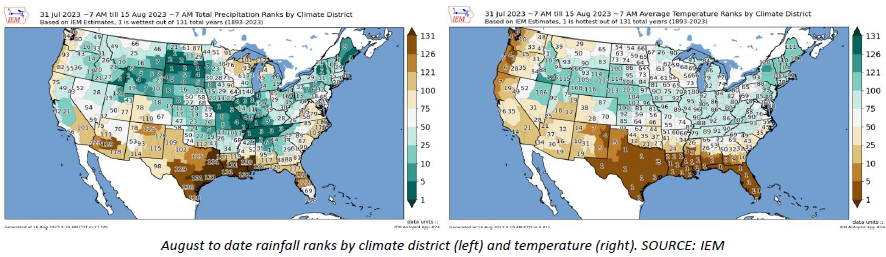
My primary concern this summer has been the soybean crop, and not just because it has the tightest balance sheet. As a former agronomist who walked hundred of fields, I strongly believed in the common belief that soybeans are made in August. But I found in my research that most of the other soybean crops in past years that were stressed in June to a similar degree to this year ended up with below-trend yields. As such, I've been watching this crop closely, noticing that it was slow to respond to improving weather conditions in July. Its ratings popped impressively last week, reflecting favorable rainfall and temperature patterns for the first half of August, as shown below, but how will that translate into pod set and fill? I would expect the favorable past couple of weeks would be good for new pods to set, but again I'm hearing reports of a lack of blooms on plants, which would make it difficult to add new pods. Here again, I'm looking forward to next week's tour for indications of whether these issues are widespread, or isolated incidents. What we do know is that the last half of August will likely look much different than the first half illustrated below.