August 19 - U.S. stocks resumed their upward trek today ahead of this week's Jackson Hole, Wyoming Economic Symposium, sponsored by the Kansas City Federal Reserve. Traders remain optimistic that the Fed will give it a series of rate cuts starting next month, although they have dialed back a bit the scope of those cuts in recent days amid better economic data. The VIX is trading below 15 at midday, while the dollar index is trading at its lowest level since early January near 102.0. Yields on 10-year Treasuries are trading near 3.86%, while yields on 2-year Treasuries are trading near 4.05%. Crude oil prices are 2% lower at midday. Wheat prices are quietly mixed, while corn and soybean prices are rallying off recent multi-year lows after Friday's lows held on the charts, and the Midwest crop tour failed thus far to provide any fresh fodder for the bears. Momentum and chart-trading algos added to the strength, although the market currently lacks a fundamental reason to sustain a rally.
The Pro Farmer Midwest Crop Tour kicked off in two places today - southeast South Dakota and central Ohio. Neither place was expected to have spectacular yields, and that's largely proven to be the case. Southeast South Dakota in particular saw its wettest June on record, followed by one of its drier Julys on record. Both ends of the crop tour have found nice crops, but with a problem here and there. The market had priced in expectations of a very big crop, which it may still find as it crosses the rest of the Midwest. But thus far today, tour participants haven't impressed the markets with anything bigger than what has already been priced in, contributing to some short covering and end user buying that then triggered more chart related buying after the Friday lows held. Prices tested and probed above Friday's highs in both corn and soybean futures, but there hasn't been enough buying interest to sustain such a move at this point amid those lingering expectations that this year's big crops are getting bigger. The tour will likely see its worst corn today, although it may get into a few problem areas on Thursday as it wraps up in northern Iowa and southern Minnesota. But most of the interest will be on what they'll see over the next couple of days. It should be noted that Pro Farmer's official yield estimate released on Friday has only been higher than USDA's August estimate twice in the past 12 years, so doing so this year would make a statement if it occurs.
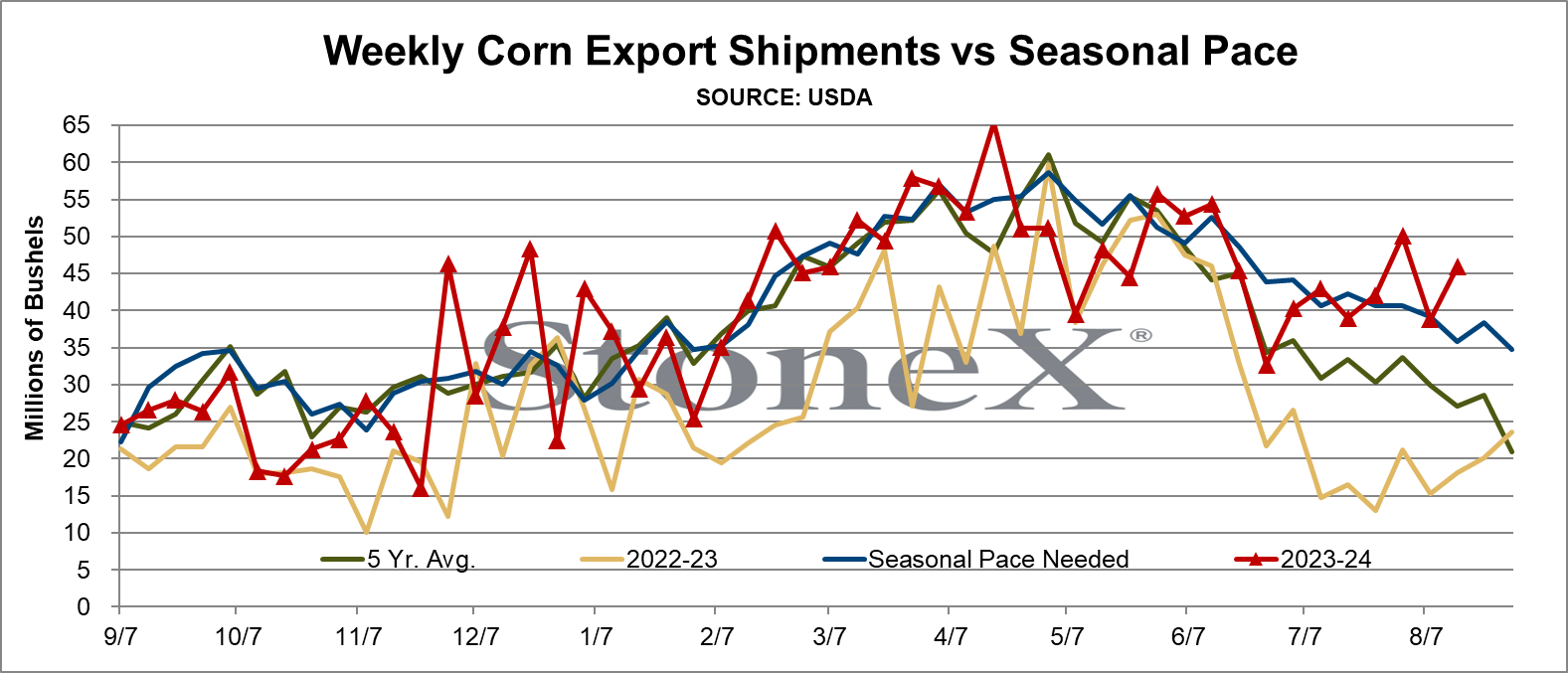
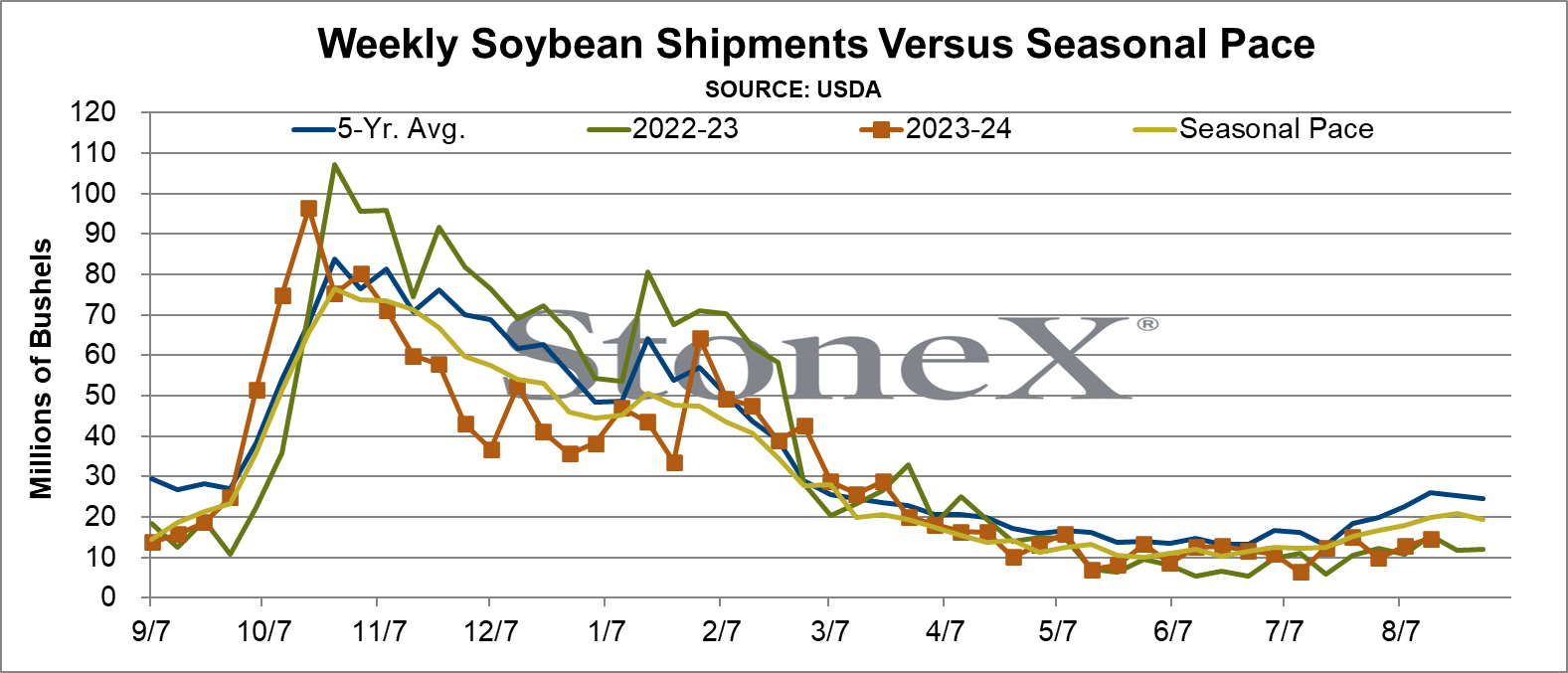
USDA inspected 45.9 million bushels of corn in the week ending August 15, as shown below, along with 14.6 million bushels of soybeans, 12.8 million bushels of wheat and 4.2 million bushels of grain sorghum. Nearly all of the grain sorghum inspected during the week was destined for China, along with 2.1 million bushels of soybeans, but just very minor amounts of corn and wheat went to China last week. Marketing year to date corn export inspections total 1.972 billion bushels with just 16 days left in the marketing year, up from 1.424 billion bushels at this point last year. This year's total falls short of the seasonal pace needed to hit USDA's target by 41 million bushels, which is better than the 51 million bushel deficit last week. It should be noted that not all corn that gets exported is inspected. Our trade agreement with Canada and Mexico allows grain to move without inspection, so there's always some that does. That shows up then in the Census Bureau data, which is delayed by a month or two. It's possible that those uninspected shipments will be larger than normal late season due to the abnormally large amount of corn purchased by Mexico relative to normal this year. As such, that may allow final export shipments to hit USDA's target by the end of the month. Marketing year to date soybean export inspections total just 1.609 billion bushels, down from 1.894 billion at this point last year. That's still 6 million bushels above the seasonal pace needed to hit USDA's target, but that number continues to drop each week. It's actually possible that final soybean shipments will come in below USDA's target.