August 23 - The dollar fell sharply from nearly 11-week highs posted earlier in the session when data showed U.S. business activity approaching stagnation in August, as the greenback followed Treasury yields lower. That sparked a rally in the tech sector, although gains in stocks remained capped by the economic realities reflected in the data. The VIX slipped to a one-week low near 16 at midday, with the dollar trading near 103.4. Yields on 10-year Treasuries are trading near 4.22%, which is down nearly 15 basis points from yesterday's high, while yields on 2-year Treasuries are trading near 4.96%. Crude oil prices are modestly lower in active trade, while grain and oilseed prices are solidly higher. The Pro Farmer Midwest Crop Tour continues to find fields with good yield potential in Iowa and Illinois, but they're also seeing an increased frequency of problem fields with lower yield potential to the point that one can make a case for USDA's corn and soybean yields to slip lower. The sharp break in the dollar today also adds support for the grain and oilseed markets. The break in the dollar also helped crude oil recover from sharp losses earlier in the session.
China is currently booking soybeans for shipments in October and beyond. It's believed that they have booked 80% of what they need for October, with another 2 million metric tons of purchases still likely - possibly happening this week. U.S. soybeans are essentially priced equal - shipped to China - for October and November loading, with Brazil perhaps having a slight price advantage currently. But Brazil still gets the edge due to two factors - geopolitical tensions between China and the United States and delays on the Panama Canal. The average wait time for ship desiring to pass through the Panama Canal is between 10 and 11 days currently, up from 6 to 7 days last month. The wait time exceeds 17 days for cargo vessels and liquified petroleum gas carriers, while being almost 13 days for tankers. The wait has been more than 20 days at times for some cargoes. The draft currently allowed through the canal is 44 feet, reducing the amount of cargo that a ship can carry, which also adds to costs and to delays. As such, a growing number of ships are choosing to avoid the canal by choosing alternative routes around the southern end of South America or passing through the Suez Canal to the east. These options all add time and costs that currently scare Chinese buyers at a time when Brazil still has unusually high supplies for this time of year. It's currently estimated that the Brazilian farmer still has 36 mmt of soybeans available to sell, which should keep Brazil involved in the export market for quite some time yet.
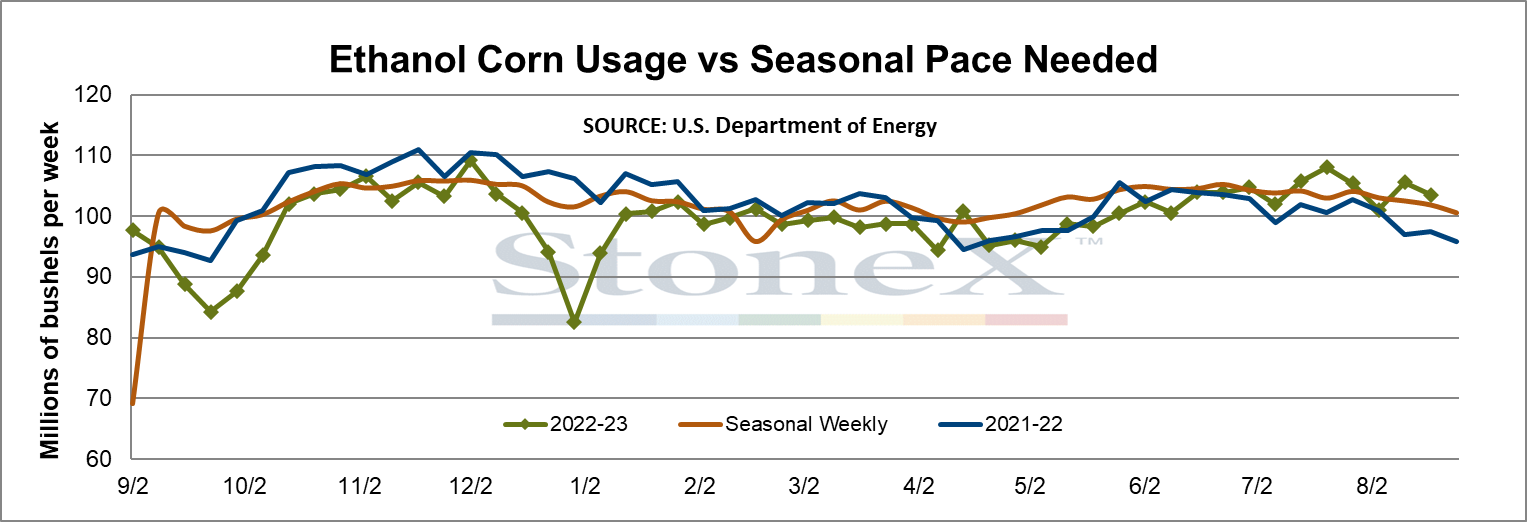
U.S. commercial crude oil inventories (excluding the Strategic Petroleum Reserve) fell by another 6.1 million to 433.5 million barrels in the week ending August 18, putting them about 2% below levels typically seen in mid-August. Gasoline stocks rose by 1.5 million barrels, moving them to 5% below the five-year average for the week. Distillate stocks increased by 0.9 million barrels, leaving them 16% below levels typically seen in mid-August. Ethanol stocks slipped to 22.8 million barrels in the week ending August 18, down from 23.4 million the previous week, and down from 23.8 million barrels in the same week last year. Ethanol production fell to 1,048K barrels per day during the week, down from 1,069K bpd the previous week, but up from 987K bpd the previous year. The production of ethanol utilized an estimated 103.5 million bushels of corn in the week ending August 18, down from 105.6 million the previous week, but up from 97.4 million in the same week last year. The current production pace suggests that we will likely fall short of USDA's current target of 5.225 billion bushels of corn for ethanol production, by perhaps 10 to 15 million bushels at the current usage pace, with the marketing year ending on August 31.