August 28 – Jitters surrounding upcoming Nvidia earnings after the close today have stocks lower at mid-day, while the VIX has risen through the morning to trade near the 16.7 level. The dollar is up on the day, touching its highest level of the week above 101 before falling back down to trade near 100.8 at the time of writing. Treasuries have traded both sides of unchanged today, with 10-year yields currently around 3.83% and 2-year yields around 3.86%. Crude oil is down again today on global demand concerns, including in the U.S. following this morning’s DOE report, though a loss of Libyan exports and ongoing tensions in the Middle East prevent it from falling too far as the nearby WTI contract trades near the $74.70 level. The ags are mostly lower, save for the wheat complex trying to add to yesterday’s gains on the back of a slight miss on Canadian wheat production from this morning’s Statistics Canada report as well as some reductions to supply from the EU.
Average 30-year mortgage rates fell for the fourth consecutive week, reaching their lowest level since April 2023 at 6.44% for the week ending 8/23. Obviously, this is still very elevated relative to most of the 2010’s and 2020’s but is down solidly from the peak of 7.9% reached back in October 2023. This has led to an uptick in mortgage applications in August, with today’s data showing a 0.5% week-on-week rebound after an ugly headline drop last week that was truly more of a result of the sharp uptick seen in the week ending 8/9. Mortgage refinance applications fell 0.1% week-on-week, though they’ve also seen an uptick throughout August. Yesterday’s data showed some signs of U.S. home prices potentially cooling, due in large part to existing home inventories rising to a nearly four-year high. Could this be a sign of homeowners currently locked into extremely low mortgage rates that have been interested in changing houses but unwilling to sell finally feeling more comfortable with these new rates after seeing their home’s value rise considerably in recent years? With expectations for rates to continue falling, we would expect to see demand from buyers rise in step. However, another interesting aspect will be seeing if the expected drop in rates also brings forward more supply from current homeowners changing and/or upgrading houses.
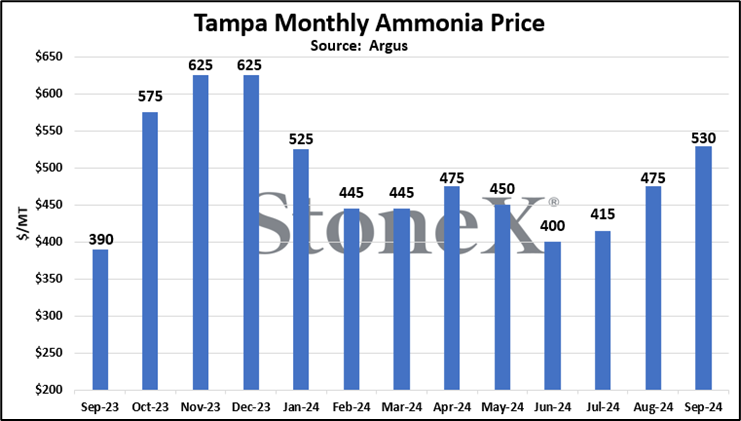
U.S. ammonia values continue to rise, with September Tampa ammonia being announced at $530/MT yesterday, a $55/MT month-on-month increase. This is up 32.5% from the recent low seen in June and 36% higher than the same month last year, though still considerably lower than the extreme highs seen back in 2022. With grain values continuing to erode on heavy fundamentals, this is worsening fertilizer affordability ahead of the upcoming fall application season. Unfortunately for the farmer, ammonia fundamentals certainly support this move higher, with demand for U.S. exports remaining hot due to the ongoing absence of the world’s former top supplier, Russia, as their new Taman export terminal continues to be delayed, and other major supplier Trinidad & Tobago still playing catch-up after months of limited production this summer due to recurring gas supply issues.
U.S. crude oil stocks fell less than expected for the week ending 8/23 according to this morning’s DOE report, falling only 846K vs. trade expectations of a 2.52 Mb reduction. This was driven by a 1% uptick in refinery utilization, with the 93.3% rate marking a six-week high, as well as a nearly 400K barrel reduction in weekly exports. However, the opposite was true on the gasoline side, with stocks falling sharper than expectations at 2.2 Mb, driven in part by a 1.6% week-on-week decline in production. Distillate stocks saw a 280K barrel build, defying expectations of a 780K draw. Another noteworthy takeaway from this morning’s report was a 2.5% week-on-week decline in U.S. ethanol production to 1.071M barrels per day, coming in below the low-end analyst estimate of 1.08M.