

August 31 - Stocks firmed today on this morning's inflation data, although gains are thus far held in check while traders wait for tomorrow's monthly jobs report. Nonetheless, the VIX is trading at a one-month low below 14 today, while the dollar index is firming to trade near 103.7. Yields on 10-year Treasuries are trading near 4.09%, while yields on 2-year Treasuries are trading near 4.88% in relatively quiet trade. Crude oil prices are nearly 2% higher as they trade at their highest level in nearly three weeks on ideas that OPEC+ will extend production cuts at a time when supplies are tightening. Grain and oilseed prices are mixed in quiet trading today. The markets will be closed on Monday for the Labor Day holiday, with trading starting to take on a bit of a holiday feel ahead of the weekend. Even so, we're seeing some follow-through weakness in soybeans today, while corn prices bounce near areas of chart support. Chicago wheat did the same, while the hard wheat markets remain weak on poor demand as Russia continues to dump wheat on the world market at a record pace, although some short-covering on Black Sea risk ahead of a three-day holiday weekend could support prices here.
The Chicago purchasing managers index rose to 48.7 for August, up from 42.8 in July, and above analyst expectations of 44.6. A number below 50 still indicates month-on-month contraction, although today's number suggests some improvement. The PMI has reflected contraction each month over the past year, although today's number is the highest of the past year, raising hopes that it is a sign that a recovery is coming.
China waited until nighttime to engage more stimulus for its economy - primarily in the property sector. It lowered the amount required to buy a first home to a 20% down payment, down from 30% previously. The down payment for a second home must now be just 30%, down from 50% previously. The move increases risks for the system down the road, but authorities hope that it will spur buying interest near-term to reverse a property sector that's in deep trouble, as I outlined earlier in this morning's commentary. Authorities need to see a resurgence of demand for property in China to avoid potential significant credit problems for the country toward the end of the year. The overnight markets responded positively in China, reacting to what they felt was an over-due response from the government, while the yuan surged in value versus the dollar in initial trading following the announcement.
The debate again this year revolves around the size of this year's national corn and soybean crops. It's been a year of extremes in the Midwest, with the weather pattern flipping back and forth between periods of extreme heat and mild temperatures. There have been periods of heavy rains with high winds and hail, but also extended dry periods. The core of the Midwest was drier than normal over the past three months, although timeliness of rains can also be a factor for carrying crops through. The graphic below shows this year's rainfall events to date for Des Moines, Iowa, as well as the year-to-date rainfall for this key production area. Year-to-date rainfall for Des Moines is down by more than a third, with most of that deficit coming this summer - especially the past couple of weeks during a period of extreme heat. That speeds maturity of the crop, which reduces seed size, and therefore yield. That is true for both corn and soybeans. Corn can afford to lose yield, considering the weakness of demand. Soybeans has less margin for error. My yield model is at 50.9 currently for the U.S. crop, which matches USDA's August estimate. Our StoneX official estimate will come from our customer survey that we will conduct next week on Wednesday the 6th. My sense is that we're probably just below 50, but we'll see what our customers say next week.
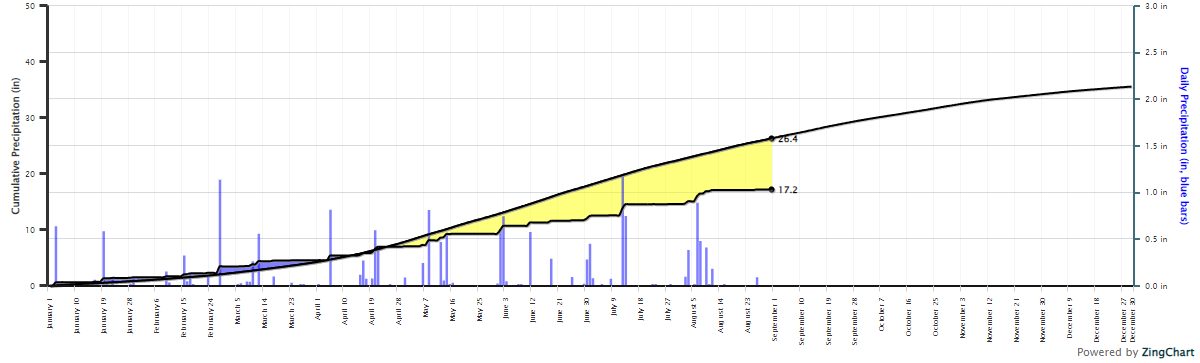
Year-to-date rainfall for Des Moines, Iowa reflects summer shortfall. SOURCE: Nutrien Solutions



