August 8 - The major stock indices traded 1 - 2% higher at midday, although they remained below yesterday's session highs thus far. Fears of recession were eased somewhat by this morning's report on weekly jobless benefit claims, although this market still has work to do before confidence will be restored following the recent rout. The Bank of Japan still indicates an interest in raising its benchmark rate again, although it has pledged not to do so when the markets lack stability. Treasury yields are continuing to push higher again following a poor auction on Wednesday, which is also providing support for the dollar. The VIX is trading near 26 at this hour, as stocks rally, while the dollar index is trading near 103.3. Yields on 10-year Treasuries are trading near 4.00%, while yields on 2-year Treasuries are trading near 4.05%. Crude oil prices continue to rebound, trading 1% higher at this hour, on escalating geopolitical risks as recession fears ease. However, the grain and oilseed markets are mostly posting modest losses at midday. Traders are beginning to position for Monday's monthly USDA WASDE crop report amid expectations that it will reinforce expectations for big corn, soybean, and wheat crops this year that boost ending stocks amid soft demand fears. The protein sector reflects those weak demand fears as well, with both cattle and hog futures under pressure.
How big is this year's corn crop? That hasn't been determined yet. Our StoneX customer survey on August 1 revealed expectations of a 182.3 bushel per acre national average crop, which is above this year's USDA trend yield of 181.0 bushels per acre. But where do we go from here? August is a critical month for grain fill in the crop. Agronomists will tell you that temperature is actually more influential than rainfall in shaping the grain fill period, although obviously some moisture is necessary. But seasonally mild temperatures reduce moisture needs for the crop, while slowing maturity, which then lengthens the grain fill period to create deeper / larger kernels. Larger kernels translate into higher yields. The opposite is true as well. A hot August speeds the maturing process, resulting in smaller kernels, and therefore lower yields.
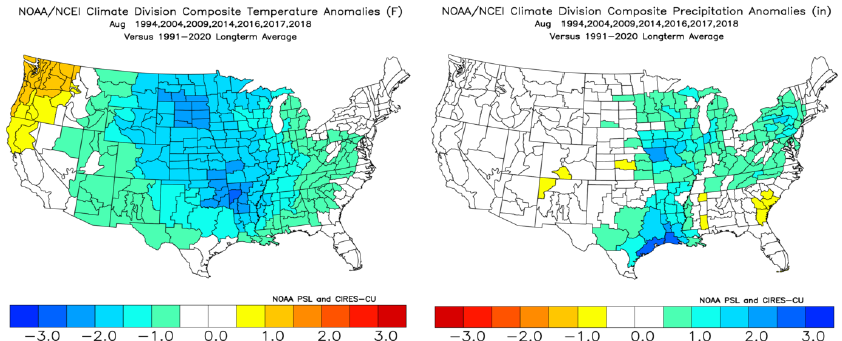
My morning commentary looked at years in the past three decades that had above trend yields, averaged the percent above trend, and then applied that average to this year's trend to give us an idea of what's possible. I'm going a little deeper here, only looking at those years that saw the final national average yield 5% or more above trend. That list of years includes 1994, 2004, 2009, 2014, 2016, and 2017. The left graphic below shows the average August temperature deviation from normal for a composite of those years, with Midwest readings generally 1° to 2°F below average. The right graphic shows rainfall for the composite years, with most of the Midwest seeing 0.5 to 1.5" more rain than normal. Forecasters disagree on what the rest of August holds, but Commodity Weather Group currently leans toward normal to below normal temperatures for the Midwest over the next 15 days, and normal to above normal rainfall. That doesn't mean that August will end up looking like the below maps, but it does suggest that we have more upside yield risk than downside yield risk currently. By the way, the above mentioned years saw national average yields average 7.6% above trend, which if applied to this year's trend that would be 194.7 bushels per acre. By no means am I now predicting a crop that big, but I do think that it is important to understand what the potential is for the crop if August continues to come in milder than normal for the Midwest. Looking at those same years, the soybean crops averaged just over 6% above trend, which would put this year's crop just over 55.1 bushels per acre.