December 1 - Stocks have turned positive at mid-day following remarks from Fed Chair Jerome Powell this morning. Powell tried to quell the market's anticipation for upcoming rate hikes by saying that it would be "premature" to conclude that the FOMC is ready to do so, but also said current rates are slowing the economy as expected and noted that "the data will tell us if we need to do more." Coinciding with this, U.S. manufacturing data came in worse than expected this morning and is thus supporting the doves' case for optimism today. The VIX has fallen through the morning to trade down near the 12.6 level, reflecting the sense of calm on Wall Street. The dollar has reversed course from this morning, now in the red on the day and trading near the 103.2 level at the time of writing. Treasuries have done the same, with 10-year yields now down on the day near the 4.25% level and 2-year yields hovering around 4.58%. Crude oil is up slightly on the day while the ags are largely mixed.
The U.S. manufacturing sector continued to show weakness in November, with Manufacturing PMI's from both ISM and S&P coming in below forecasted levels and showing continued contraction on their respective releases this morning. ISM's November Manufacturing PMI came in at 46.7, remaining unchanged from the month prior despite expectations of an improvement to a 47.6 reading. This is now the 13th consecutive month spent in contractionary territory for the index, the worst such streak seen in the U.S. for over 20 years. S&P Global's Manufacturing PMI came in at 49.4 in November, moving back into contractionary territory after sitting right at 50 in October and marking the worst reading since August. Both indexes also showed a softening in employment in the sector, adding more intrigue to upcoming U.S. labor data next week.
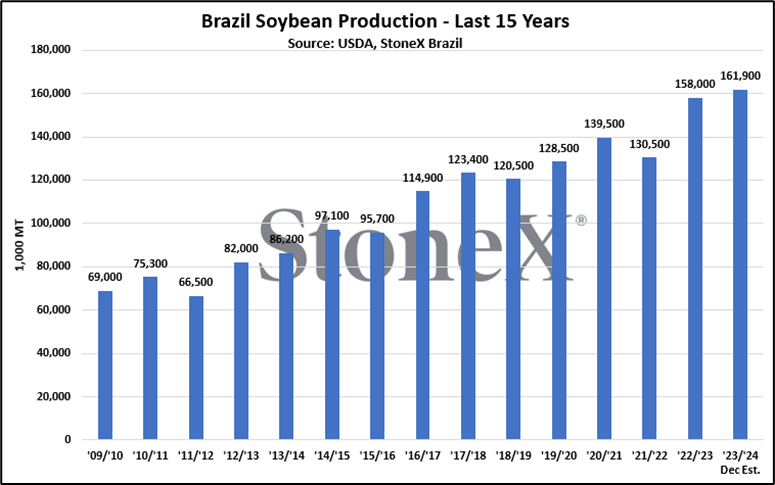
StoneX Brazil released their updated production estimates this morning, showing reductions in the size of Brazil's soybean and corn crops. Brazil's soybean crop was pegged at 161.9 MMT, a drop of 3.1 MMT from their November estimate of 165 MMT and now falling below USDA's most recent guess of 163 MMT. Their estimate for Brazil's 1st and 2nd corn crops were reduced by 0.35 MMT and 1.66 MMT, respectively. Assuming a 3rd corn crop unchanged from the year prior, this would put total Brazilian corn production at 126.02 MMT, a roughly 2 MMT decrease from the month prior and coming in nearly 3 MMT below USDA's current 129 MMT. For those following Brazilian weather over the last few months, the cuts shouldn't come as much of a surprise, as the ongoing heat and dryness in key growing areas of the country has delayed plantings and put immature soybeans under stress.
The drop in soybean production was mostly driven by reduced yield, while the drops in corn production were mostly driven by smaller Safrinha (2nd crop) plantings due to the late soybean crop. Soybean yields were dropped by 1.9%, now falling slightly below last year's yield, while soy plantings were down by only 0.1%. The biggest reduction in soybean production was in Mato Grosso, the country's top-producing corn and soybean state in the all important Center-West region. Soybean acreage in Mato Grosso was reduced very slightly, but yields were dropped by 5% due to the poor growing conditions to start the year. On the corn side, 1st crop yields were actually increased slightly due to improved production in the country's wet south, though not by enough to offset the impact of reduced plantings in the dry north. 2nd crop corn yields were dropped very slightly while a 1.3% drop in overall plantings were led by cuts in Goias and Mato Grosso.
Despite the reduction, this would still be a record soybean crop for Brazil, surpassing last year's fresh record of 158 MMT. StoneX Brazil is the fourth entity in the last week to 10 days calling for record or near-record soybean production from Brazil this year, keeping a lid on the bullishness of this reduction. There is still plenty of risk ahead, with December shaping up to be a critical month for soybean development and influencing subsequent corn plantings, so look for the market to continue keeping a close eye on ever-changing Brazilian forecasts.