December 18 - The overnight theme carried through much of the morning, with stocks and many of the commodities bouncing following yesterday's weakness. The VIX managed to slip lower toward the 15 level by midday, while the dollar index firmed to trade near 107.1. Yields on 10-year Treasuries are trading near 4.40% ahead of this afternoon's release of the updated Federal Reserve monetary policy, while yields on 2-year Treasuries are trading near 4.23%. Crude oil prices are more than 1% higher, on the cusp of testing both the 100-day moving average and the late November highs, while the grain and oilseed markets are mixed.
Wheat prices firmed on a private firms estimate of 2025 Russian wheat production of 78.7 million metric tons, although most private estimates are in the 80 - 83 mmt level. The reports that we've seen from the ground there suggest that the crop was planted on lower acreage due to this fall's drought and poor returns, but it still has good recovery potential if the winter is not too harsh and if the rains return in the spring. Keep in mind that roughly 40% of Russian production comes from spring wheat production, which is a part of that estimate. Regardless, it looks to be another smaller crop again next year, with those estimates still having some downside risk to them.
Brazil's real again fell versus the dollar today, reflecting problems in the Brazilian economy. A weakening real stimulates farmer sales until it doesn't. Farmers sell their soybeans in dollars based off the Chicago board price, which is converted into reais. A weaker real versus the dollar means that they get more reais for each bushel of soybeans due to the weakening currency exchange rate. Yet, it can shut off sales if farmers fear that the currency will drop significantly lower. Regardless, it increases the price advantage on the export market for Brazilian soybeans. They already had a price advantage, even before this month's further weakening of the real, meaning that Brazilian soybeans are nearly always cheaper than U.S. soybeans sold to China if / when they are available to the market - meaning if farmers have soybeans to sell. This simply reinforces the advantage, while also stimulating buyers to extend their coverage even further if they feel that the real may be putting in a bottom of some type. Offsetting this is the fact that the weaker real increases costs for inputs that farmers must import into Brazil, including fertilizer and chemical. The net effect is still to encourage production at the expense of the American farmer. This comes at a time when U.S. domestic demand is in question due to a lack of guidance from the government on what subsidy levels for liquid biofuels will be in 2025. January soybeans broke through chart support at the October lows this morning, leaving them vulnerable to a test of the August lows, with November '25 soybeans falling to new contract lows. The collapsing soybean market provided headwinds for corn, with the new-crop soybean / corn price ratio dropping to 2.22, with plenty more downside risk to that ratio in the weeks and months ahead.
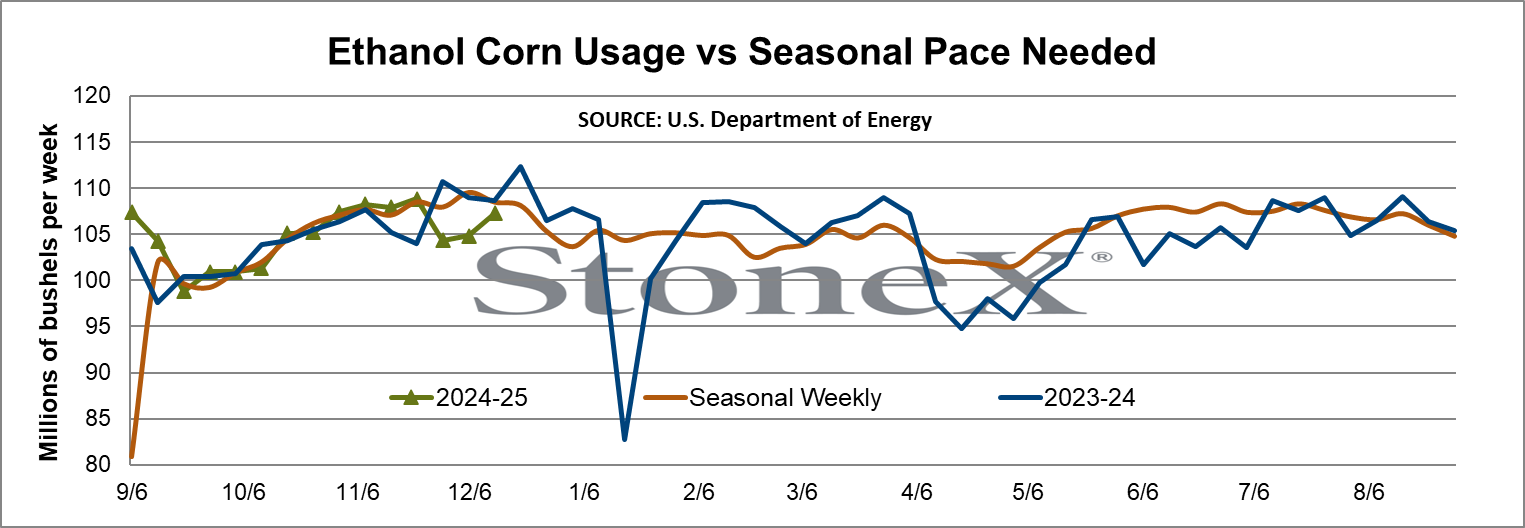
U.S. commercial crude oil stocks (excluding the Strategic Petroleum Reserve) fell 0.9 million to 421.0 million barrels in the week ending December 13, leaving them 6% below levels typically seen in mid-December. Gasoline stocks rose 2.3 million barrels, putting them 3% below the five-year average for the week. Distillate stocks dropped by 3.2 million barrels, putting them 7% below seasonal levels. Ethanol stocks were unchanged during the week at 22.6 million barrels, which was down slightly from the 22.9 million barrels seen at this time last year. Ethanol production rose to 1,103 barrels per day last week, up from 1,078K bpd the previous week, and up from 1,071K bpd in the same week last year. Estimated corn use for ethanol production last week totaled 107.3 million bushels, up from 104.8 million the previous week, but down from 108.7 million the previous year. Marketing year to date estimated corn use for ethanol totals 1.558 billion bushels, down 24 million or 1.5% from the previous year's pace, but just above the seasonal pace needed to hit USDA's recently increased target for the year.