December 2 – Stocks are mixed at mid-day, with the Nasdaq pushing higher while the Dow Jones falls and the S&P 500 is caught in the middle, while the VIX remains muted as it hovers below the 13.7 level. The U.S. Dollar is starting the week off on a strong note following better-than-expected U.S. economic data readings this morning, pushing back above the 106.6 level after ending last week in the red. Treasuries have traded both sides of unchanged this morning, with 10-year yields falling back narrowly into the red at the time of writing just above 4.18% while 2-year yields remain in positive territory above 4.19%. Crude oil is up slightly on the day with fresh geopolitical escalations in the Middle East, this time in Syria, helping build in some risk premium as the nearby WTI contract trades around $68.30/barrel. The ags are mixed, with the soy complex pushing lower while corn & wheat move a bit higher, and the livestock complex trades mixed.
U.S. manufacturing data came in stronger than expected this morning, with the S&P Global Manufacturing PMI rising to a final November reading of 49.7, up from the preliminary 48.8 and marking the strongest reading since June, though remaining in contractionary territory for the fifth consecutive month. Similarly, ISM’s November Manufacturing PMI rose to 48.4 from 46.5 in October, beating analyst estimates of a slighter rise to 47.5 and also marking the best reading for the index since June. New orders showed improvement on both, with optimism for the year ahead showing marked improvement as well. One of the most relevant takeaways given the current economic climate was the much-improved employment picture, with ISM’s Employment subindex rising much sharper than expected to a 48.1 reading from the 44.4 seen in October and again marking the highest level since June. The market will get plenty more labor data to focus on this week, with the October JOLTs report due to be released tomorrow, ADP Employment Change on Wednesday, Jobless Claims on Thursday, and Non-Farm Payrolls on Friday.
Construction spending also came in hotter than expected, showing a 0.4% month-on-month rise in October, up from 0.1% rise in September and doubling expectations of a slighter improvement to a 0.2% increase. This was the strongest monthly gain in construction spending in the U.S. since April. The strength was driven by a 0.7% month-on-month rise in private spending offsetting a 0.5% decline in public spending. The strength in private spending was due to strong 1.5% growth in the residential segment, while non-residential spending was down 0.3%.
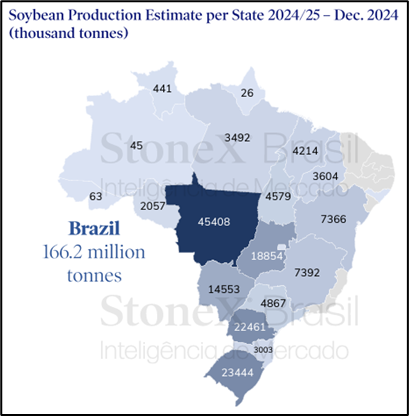
StoneX Brazil maintained their 166.2 MMT soybean crop estimate on their December update released this morning. This would mark a new all-time record if realized but remains on the low-end of the range, nearly 3 MMT below USDA’s most recent 169 MMT estimate and well below some recent private estimates that have crept into the low 170’s. The StoneX Brazil team pegged the country’s soybean planting at 92.4% complete on Friday’s update, now a full 10% ahead of last year at this time and sitting at the fastest pace seen in five years as conditions have shifted to ideal following the slow start. With neighboring Argentina’s soybean crop also going in the ground ahead of schedule and getting off to a solid start, global soy supply is continuing to look heavier, weighing on prospects for U.S. export demand, especially given the newfound strength in the dollar.
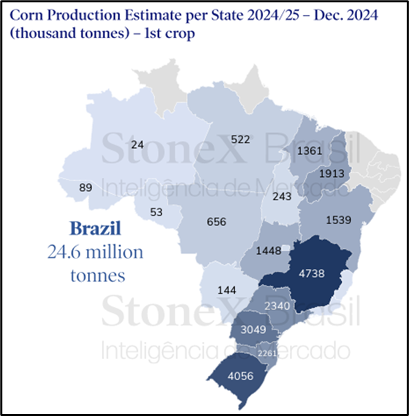
Meanwhile, first crop corn production was lowered by a slight 0.247 MMT to 24.638 MMT, with the second crop left alone and third crop estimated even with last year, implying a potential total 2024/25 corn production of 128.5 MMT. Unlike the soybean side, this would be higher than USDA’s most recent 127 MMT estimate. The small drop in first crop corn production was entirely driven by a 5.7% month-on-month drop in yields in Rio Grande do Sul due to a recent shift to drier weather. StoneX Brazil pegged the country’s first corn crop at 74.9% planted on Friday, ahead of the 72.5% seen at this time last year but still trailing the previous 5-year average at this time by 8.6%, mainly due to delays in the northernmost growing regions.