December 3 – The Nasdaq is clinging to small gains at mid-day after pushing to fresh record highs earlier in the session, while the S&P 500 pushes lower after making its own record high yesterday, and the Dow Jones adds to yesterday's losses after posting its own high on Friday. Meanwhile, the VIX remains muted again as it hovers around the 13.4 level. The dollar is down on the day, wiping out part of yesterday’s gains and providing some help to the broader commodity sector. Treasuries are mixed, with 10-year yields pushing slightly higher to 4.22% while 2-year yields fall to 4.17%. Crude oil is up on the day from a combination of OPEC+ being expected to delay scheduled production increases when they meet Thursday as well as an increase in geopolitical risks following the news of the U.S. sanctioning 35 entities and vessels for their role in aiding illicit Iranian oil exports, as well as ongoing escalations in Syria. The ags are mostly higher on the day, save for corn which has fallen back into the red after starting the day in the green.
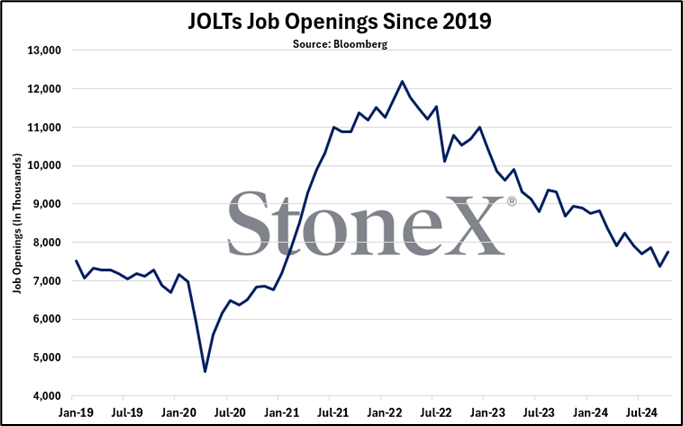
Today’s JOLTs report showed U.S. job openings increase to 7.744M in October, up sharply from September’s downwardly revised 7.372M and well above market expectations of a slighter rise to 7.48M. The biggest increase in openings was seen in professional and business services (+209K), followed by accommodation and food services (+162K), and information (+87K), while federal government openings were down by 26K. Regionally speaking, the South saw the biggest rise (+486K) though this was likely skewed by hurricanes this fall, while the West saw an increase of 133K but the Northeast and Midwest saw declines of 195K and 52K, respectively. Interestingly, October’s job quits rose to a five-month high of 3.326M while September was revised higher to 3.098M, potentially a reflection of employees feeling more confident in their ability to find a new position elsewhere. The biggest quits were seen in accommodation and food services (+90K) and private education and health services (+47K), while declines were seen in retail trade (-26K), finance and insurance (-19K), and government (-2K). Overall, this morning’s data shows a strong U.S. labor market, though the FOMC will get plenty more jobs data to digest this week ahead of their next meeting on December 17-18.
Economic optimism in the U.S. reached its highest level since August 2021 this month according to this morning’s RCM/TIPP Economic Optimism Index. December’s reading rose by 0.8 points to now sit at 54.0, the second month in optimistic (above 50) territory after spending 38 consecutive months in pessimistic territory. The sharp jump has been in response to last month’s election, with the Confidence in Federal Economic Policies showing the biggest month-on-month improvement on today’s report. The Six-Month Economic Outlook and Personal Financial Outlook subindexes both saw slight month-on-month declines from November, but it should be noted that these both saw a major surge in November and remain well above where they spent the last three-plus years.
Trade tensions between the U.S. and China continue to heat up with China today announcing a formal ban on the export of gallium, germanium, and antimony to the U.S. in response to yesterday’s fresh crackdown by the U.S. on China’s semiconductor industry. The new measures announced by the U.S. yesterday target a list of 140 entities and aim to place controls on China’s ability to access chipmaking equipment, software, and high bandwidth memory chips. We’ve already seen a major reduction in the export of the materials targeted today from China to the U.S. due to previous curbs, so today’s announcement from China appears to be largely performative. However, some Chinese industry associations today released a statement that buying U.S. chips is “no longer safe,” and buyers should shift their purchases to domestically produced Chinese products. This could impact chip giants like Nvidia and others who, despite restrictions already in place, have been able to continue selling certain products into the Chinese market. With President elect Trump set to take office next month, we should expect to continue seeing a ramp-up in protectionist rhetoric between the world’s two largest economies, with the market having to adapt and react accordingly.