December 9 - Stocks quietly slipped lower this morning ahead of key inflation data to be released later this week and ahead of next week's meeting of Federal Reserve policymakers. The market continues to price in expectations of a 25-basis-point rate cut at next week's meeting, with two more cuts expected by June, but there's growing evidence that the Fed is split on future rate policy. The VIX is slowly creeping upward toward 14 at midday, although that's still a relatively low level, while the dollar index consolidates near 106.0. Yields on 10-year Treasuries are trading near 4.19%, while yields on 2-year Treasuries are trading near 4.12%. Crude oil prices are roughly 2% higher at midday after bouncing off chart support near $67 overnight, while the grain and oilseed market is mixed to higher as well. Value-buying at these low price levels continues to support corn, wheat and soymeal, while soybean prices erased early gains as selling emerged ahead of the big Brazilian harvest that will gain momentum over the big Brazilian harvest that is just a few weeks away.
China's domestic corn users are looking for alternative sources, according to a number of anecdotal reports recently heard inside of China. China just completed a big harvest, but numerous reports of quality issues have end users concerned. As such, they're looking to buy from China's reserves of imported corn. Last week's regularly scheduled auction offered nearly 21 million bushels of imported corn for sales from China's reserves, of which nearly 83% was purchased. That's up from 57% of the previous week's offered total being purchased. Anecdotal reports suggest that toxins are a problem in the domestic crop. It's difficult to separate truth from rumor in China, but the cash market seems to suggest that there are issues. China prefers to buy cheaper corn from Ukraine and Brazil, but neither of those sources have much corn available currently, IF it would start looking.
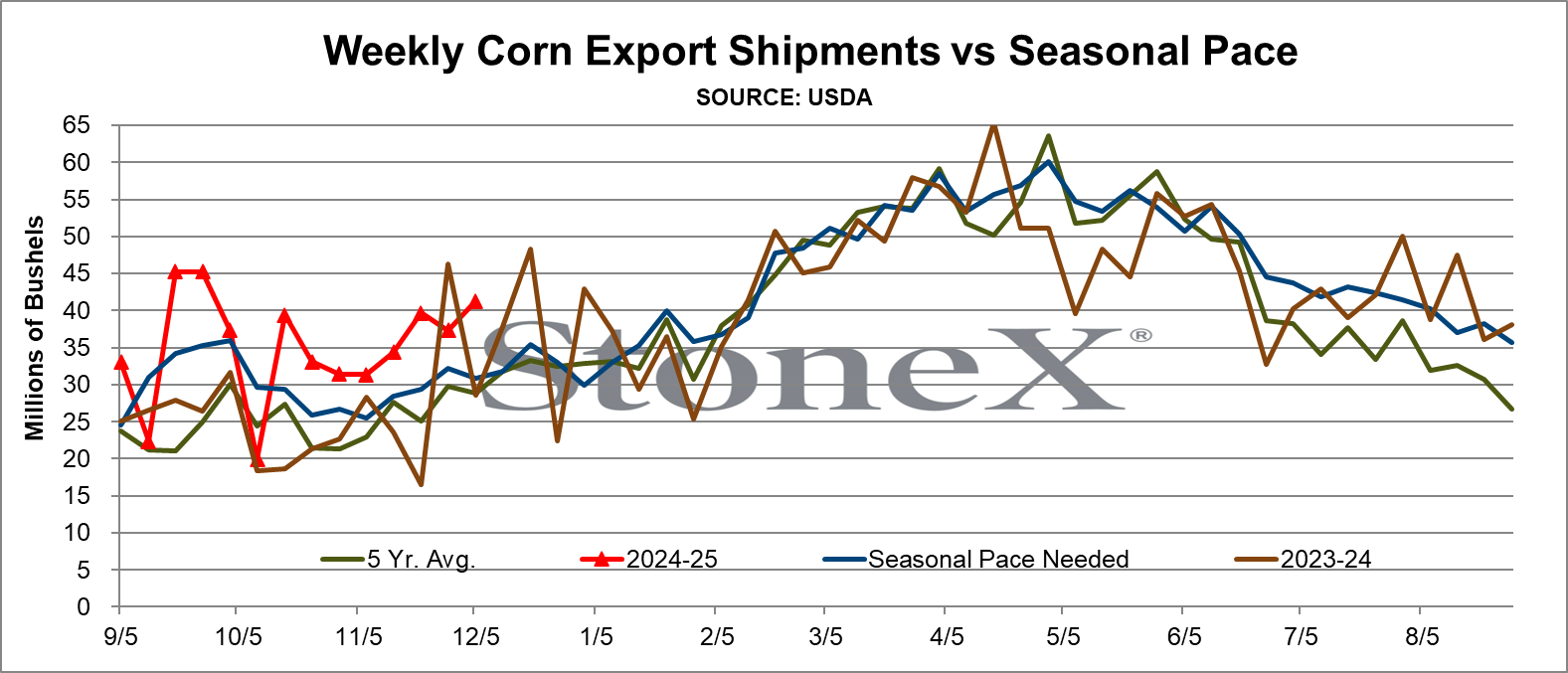
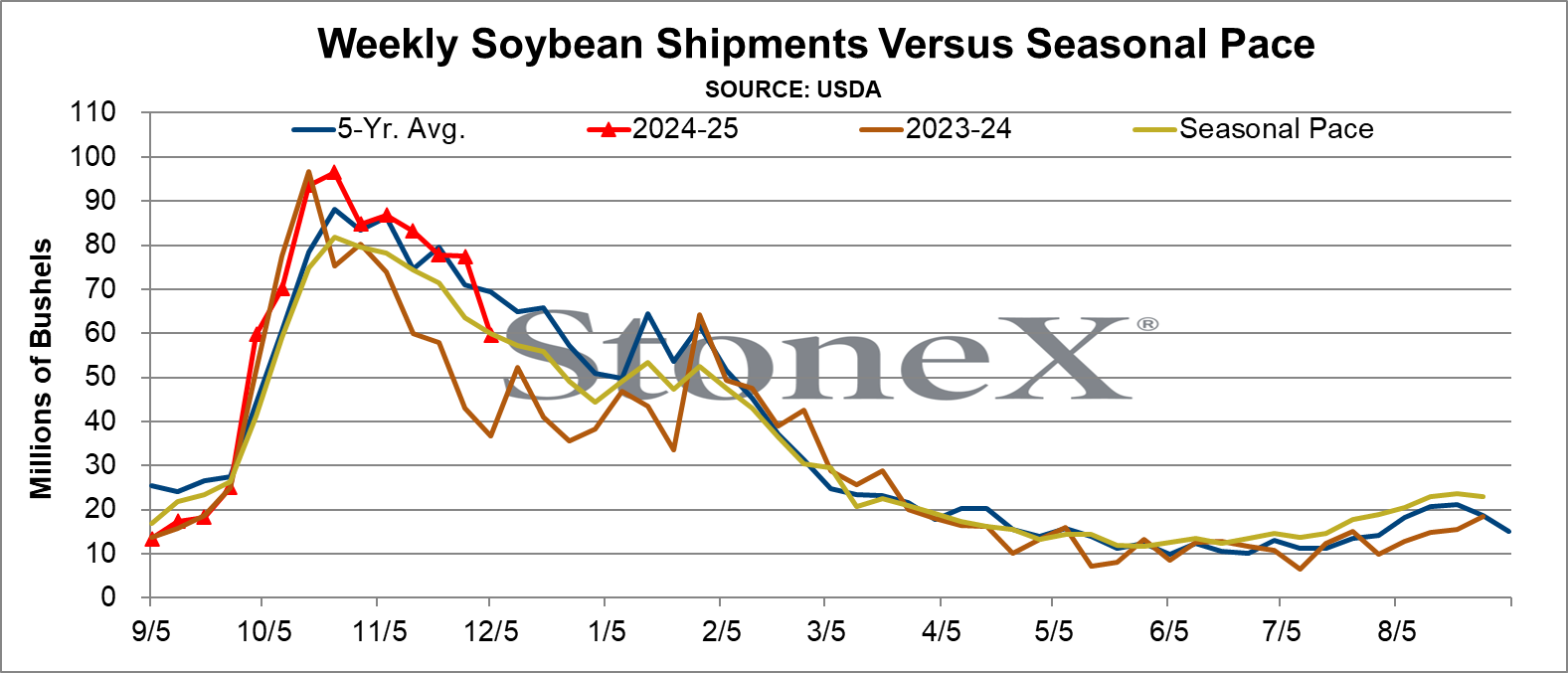
USDA inspected 41.3 million bushels of corn for export shipment in the week ending December 5, as shown below, along with 59.6 million bushels of soybeans, 8.3 million bushels of wheat, and 2.9 million bushels of grain sorghum. The portion of the above that was inspected specifically for shipment to China included 31.1 million bushels of soybeans and 2.9 million bushels of grain sorghum. Export inspections for wheat and for grain sorghum are basically in line with what we would expect on a seasonal basis to stay on pace to hit USDA's target for the year. However, grain sorghum commitments on the books lag the seasonal pace needed to hit USDA's target by more than 50 million bushels, so something is going to need to give.
Marketing year to date corn export inspections to all destinations total 478 million bushels, up 116 million bushels or 32% from the previous year's pace, and 59 million bushels above the seasonal pace needed to hit USDA's target. U.S. corn has been the cheapest option for many buyers, depending on freight, sending them our way to get their needs filled. That will likely be the case for several more months until southern hemisphere supplies become available, most notably in Argentina. Marketing year to date soybean export inspections to all destinations total 861 million bushels, up 135 million bushels or 19% from the previous year's pace and 88 million bushels above the seasonal pace needed to hit USDA's target after China essentially emptied Brazil's shelves earlier this year. My concern has been, what will happen once Brazilian new-crop supplies start becoming available next month? Those new-crop supplies are priced well below U.S. supplies currently due to the sheer size of the anticipated crop, as well as Brazil's currency exchange advantage. The one thing that might extend our export season would be if excessively wet weather would delay harvest in Brazil, or perhaps delay ship loading.