February 21 - Stocks are under pressure going into the weekend following more evidence being released this morning of sinking consumer sentiment. Yet, the VIX continues to trade near 16, while the dollar index trades near 106.6. Yields on 10-year Treasuries are trading near 4.44%, while yields on 2-year Treasuries are trading near 4.24%. Crude oil prices are 2% lower as they gravitate back toward that $70 per barrel area, while the grain and oilseed markets are mixed. Wheat prices found support on yesterday's price break, partially from spread trading with corn, while soybeans and corn both encountered selling. South American weather is currently moving in the right direction to favor production, and corn prices found fresh selling from their inability to hold above $5.
The consumer sentiment index slipped to 64.7 in February, down from 71.7 the previous month, and down from 76.9 a year ago. The index of current conditions fell to 65.7, down from 75.1 in January, and down from 79.4 a year ago. The index of consumer expectations dropped to 64.0 in February, down from 69.5 the previous month, and down from 75.2 the previous year. The decline in this month's sentiment index was unanimous across all age, income and wealth groups. All five index components deteriorated this month, led by a 19% drop in buying conditions for durable goods. Tariff headlines appear to be the culprit in the deteriorating sentiment. The outlook fell the most for Democrats and Independents, while it was largely unchanged for Republicans. A similar trend was seen for inflation expectations. The overall year-ahead inflation expectations reading rose a full percentage point to 4.3%, which was the highest reading since November 2023.
The Purchasing Managers Composite Index for February fell to 50.4, down from 52.7 previously. A number above 50 indicates month-on-month contraction, whereas a number above 50 indicates growth. The manufacturing index rose to 51.6, beating expectations of 51.3, and up from 51.2 previously. However, the service sector index fell to 49.7, down from expectations of 53.0, and down from 52.9 previously. It was the first contraction in the service sector in two years. Other data had existing home sales dropping to an annualized rate of 4.08 million units in January, down from expectations of 4.16 million, and down 4.9% from the previous month. Existing home sales remain up 4.8% year-on-year. However, the housing industry is again struggling amid rising consumer uncertainty.
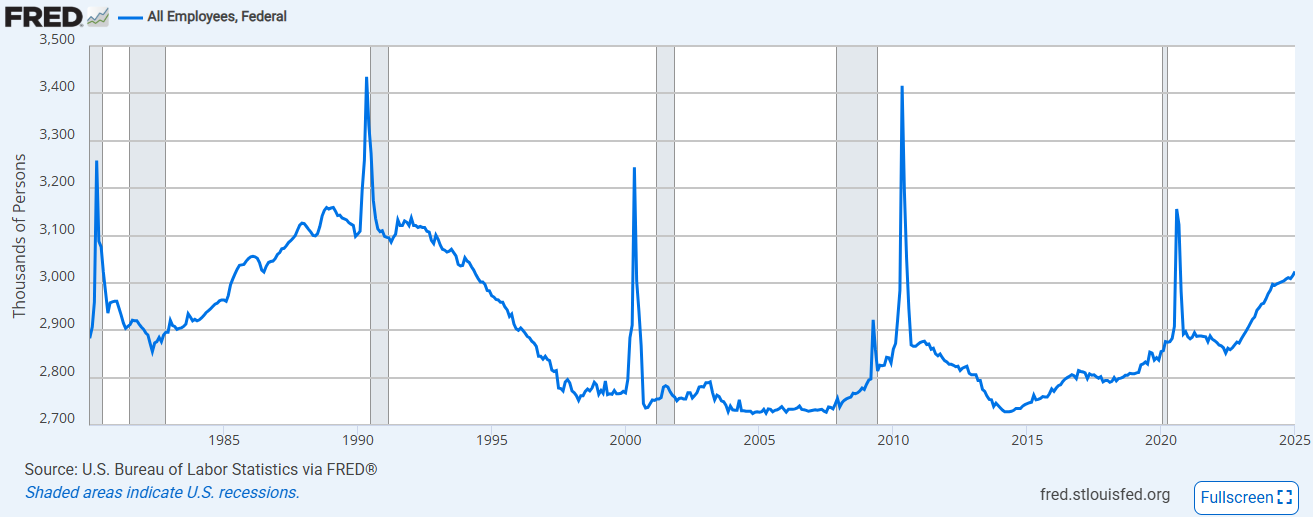
The St. Louis Federal Reserve reports that 3.024 million people were employed by the federal government in January, as shown in the graphic below. That graphic shows the history of federal employment over the past 45 years. Note the spikes in numbers every 10 years when the government hires census workers, although those are short-term employees. Removing census hires, current federal employment is the highest in 30 years, accelerating rapidly over the past 30 months or so. That said, federal employment trended notably higher during the Regan and Bush, Sr. Administrations, and then trended notably lower during the reforms of the 1990s. The key now will be how the labor market absorbs displaced federal workers amid the current round of layoffs. President Trump needs a strong economy to do that, which is one reason that he may be talking about sending taxpayers a portion of the savings being found by the Department of Government Efficiency, with the $5,000 figure being thrown around as a "refund" check. That would be expected to stimulate the economy, creating jobs and income for displaced workers. Whether the Trump plan will work or not is still up for debate, but cuts are being made. Trump's next challenge will be the above decline in consumer sentiment, and perhaps a $5,000 check would help that sentiment. Yet, it would take time to get Congressional approval for such a check, leaving the economy at risk of further consumer sentiment erosion.