February 21 - The tech sector led stocks lower this morning ahead of this afternoon's earnings report from Nvidia. The VIX is trading above 15 at midday, while the dollar index is trading near 104.0 in relatively quiet trade. Yields on 10-year Treasuries are trading near 4.29%, while yields on 2-year Treasuries are trading near 4.63%. Crude oil prices are modestly higher at midday, trading near their session highs, while the grain and oilseed sector is mostly lower. Gradually escalating geopolitical risks in the Middle East continue to support an upward trend in crude oil prices, despite forecasts for soft demand. Meanwhile, the funds continue to emphasize commodity deflation by maintaining large short positions in the grain and oilseed sector. Short-covering rallies periodically support prices, but those rallies are quickly sold amid ample global supplies. In fact, the spot corn contract posted a fresh three-year low today. Geopolitical risks remain for the grain and oilseed sector in both the Black Sea and the Red Sea, but the market is growing increasingly desensitized to that risk at this point. The protein sector was mixed at midday, with lean hogs lower while the cattle complex was modestly higher.
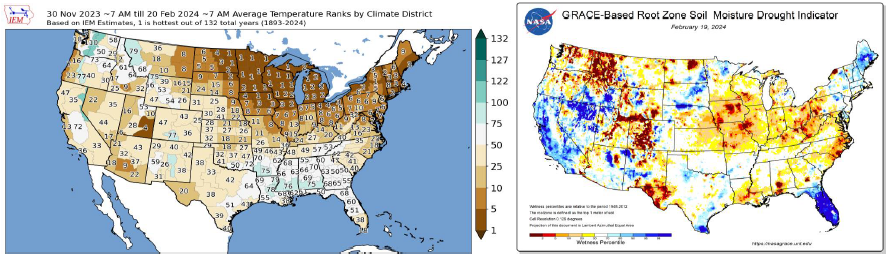
It's been a very typical U.S. El Nino winter, even though last summer was anything but typical for an El Nino growing season. The graphic on the left below shows temperature ranks by climate district versus the past 132 years of data. Note that much of the northern and western Midwest has thus far experienced its "warmest" winter (since December 1) on record. That doesn't mean that there hasn't been periods of cold, but overall, temperatures have averaged well above normal for the period. That's what we'd typically expect for an El Nino winter, along with modestly below normal readings in the South. Meanwhile, soil moisture continues to be lacking across much of the Midwest, although we've seen some significant improvement. We'll need to see a wet spring across much of the Midwest to continue to recharge the soil profile ahead of the summer growing season, but that is also what we would typically expect in an El Nino spring. Forecast models are leaning wet through the spring for much of the Midwest. We don't currently expect a repeat of the problems that we saw in 2019, but forecasters do see good opportunities to recharge soil moisture levels with above normal precipitation through much of the season, with periodic breaks to allow for fieldwork.
It's a different story in South America, where we're currently in the middle of Argentina's growing season. Argentina has thus far seen periods of active rainfall followed by periods of heat and dryness. Some private analysts are drawing down their production estimates for Argentina, while official estimates remain elevated. Argentina has a very long three month planting season that spreads out the production cycle over a greater amount of time, reducing loss risks from a single weather event. Further north in Brazil, better than a third of the soybean crop is harvested, with a third of the winter corn (safrinha) crop planted. The same is true for roughly two-thirds of the Mato Grosso soybean and corn crops. Both are on a normal pace toward completion. We're generally dry where we need to be harvesting, and wet where we need moisture for the winter corn. The concern is for March and April, when the corn crop will be developing. Forecast models are leaning dry for the last half of March and April. That doesn't necessarily mean that we'll have a short corn crop, but it increases the risks of such. The question then will be, will Argentina and Brazil combined see a short enough corn crop to justify higher U.S. prices that would ration demand? So far, we don't see any evidence of such, but that is what we'll be monitoring. A 2.1 billion bushel U.S. carryout gives some wiggle room. Argentina and Brazil combined are currently expected to produce 179 mmt of corn, up from 172 mmt the previous year. Corn acreage will likely be modestly lower in both Ukraine and the United States - the other major export sources in the world - so we'll need to monitor South American weather for the possibility of more significant losses south of the equator.