February 26 - Wall Street moved cautiously higher this morning, gaining momentum from movement in Congress to get tax cuts and deregulation through significant hurdles, even though they have not yet received final approval. Yet, the caution also comes from some anxiety ahead of this afternoon's earnings report from heavy weight Nvidia. The VIX is trading near 18 at midday, while the dollar index is trading near 106.3. Yields on 10-year Treasuries are trading near 4.29%, while yields on 2-year Treasuries are trading near 4.12%. Crude oil prices modestly lower as they consolidate near recent sharp losses, while the grain and oilseed sector is mostly in the red as well.
The commodity sector continues to face headwinds created by nervousness about the U.S. and global economies in a Trump tariffs world. Fund managers fear that President Trump's tariff threats will invoke trade wars that increase inflationary pressures, while slowing economic growth, and therefore slowing demand for commodities. Ironically, it was those same inflation fears that helped elevate the grain and oilseed sector that had been underperforming relative to the rest of the commodity world the past two years, but now traders worry about whether the demand will be there to fundamentally support prices at current levels. As such, we've seen a significant retracement in recent days. Wheat prices are breaking through initial areas of chart support, while corn and soybean prices are holding thus far.
The grain and oilseed markets are increasingly looking ahead to USDA's annual Agricultural Outlook Forum that will take place over the next two days - Thursday and Friday. USDA will release a lot of data during the conference - some of it relevant, but much of it not. The most relevant number that we can expect it to release will be its yield projections for this coming year. Obviously, this year's growing season weather pattern will determine the final yield, but the corn and soybean yields published this week are expected to be what USDA uses to build its balance sheets through the July WASDE crop report for the 2025-26 marketing year. There will also be a lot of fanfare around USDA's published planted acreage estimates that come out this week. Those are for discussion only. They do not come from input from the producers or the industry in general. Those are acreage estimates that purely come from economic modeling. USDA's May WASDE report - the first to contain balance sheets for the 2025-26 marketing year, will include planted acreage based on the agency's survey of producer planting intentions that will take place next week. Those numbers will be released on March 31st. The next focus will be on USDA's projections of demand use. The trade will try to infer from those numbers what the Trump Administration's stance will be on carbon intensity scores for soybean oil used as a feedstock for the production of biomass diesel fuel, but I believe that it would be a mistake to read too much into those numbers at this date. I'm not sure the Trump Administration has had much time to focus on that issue yet.
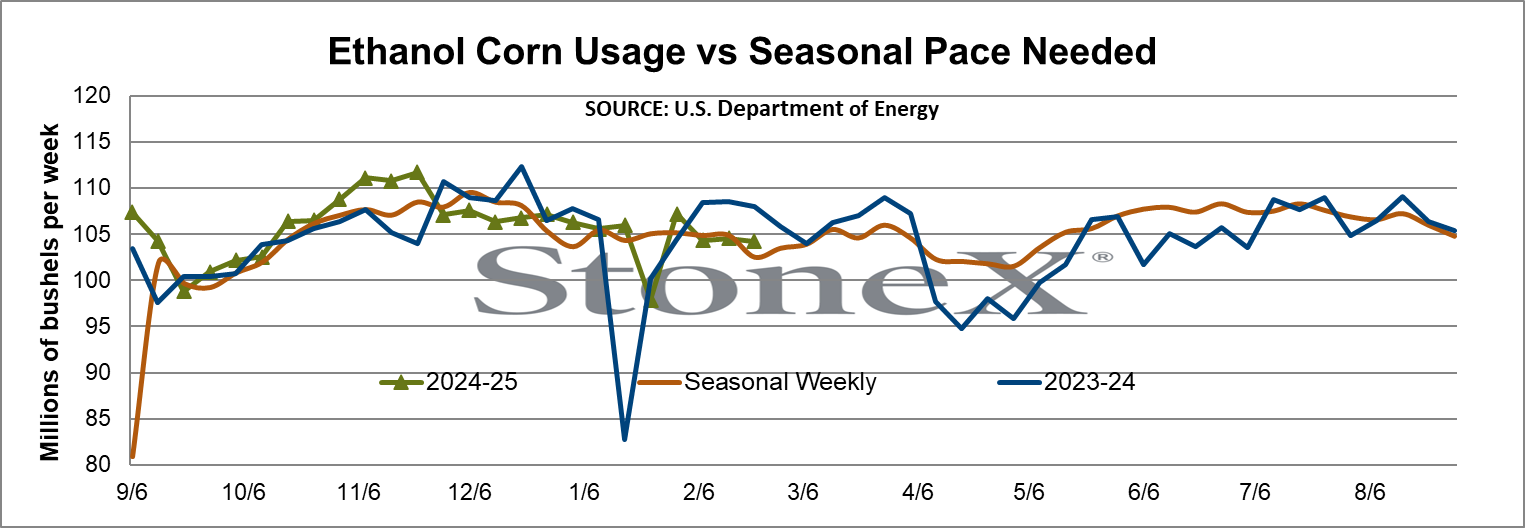
Commercial crude oil supplies (excluding the Strategic Petroleum Reserve) fell by 2.3 million barrels in the week ending February 21 to 430.2 million barrels. That puts them roughly 4% below the levels typically seen in this week of the year. Gasoline stocks rose by 0.4 million barrels, leaving them slightly below the five-year average for the week. Distillate stocks increased by 3.9 million barrels, but they are still 8% below seasonal levels. Ethanol stocks rose to a nearly five-year high just below record levels at 27.6 million barrels, up from 26.2 million barrels the previous week, and above the 26.0 million barrels posted in the same week last year. Ethanol production slipped to 1,081K barrels per day last week, down slightly from 1,084K bpd the previous week, but up from 1,078K bpd the previous year. The production of ethanol utilized an estimated 104.2 million bushels of corn in the week ending February 21, down from 104.5 million the previous week, but down from 107.9 million bushels in the same week last year. Estimated marketing year to date corn use for ethanol totals 2.627 billion bushels, matching the previous year's pace, but exceeding the seasonal pace needed to hit USDA's target by 26 million bushels.