January 13 - Stocks erased early losses this morning, as the Dow pushed into decent gains, while the Nasdaq remained in negative territory following the announcement of new technology export restrictions, and ahead of this week's key inflation data. The VIX dropped back below 20 at midday, while the dollar index continued to trade near 109.9. Yields on 10-year Treasuries are trading near 4.78%, while yields on 2-year Treasuries are trading near 4.39%. Crude oil prices are 3% higher at fresh five-month highs as the market prices in new sanction enforcement on Russia and Iran, while the grain and oilseed markets are mostly higher as well.
Much of the buying in the grain and oilseed sector is follow-through buying from Friday's bullishly construed USDA reports that saw last year's U.S. corn and soybean yields dramatically cut. Soybeans are seeing the strongest gains once again today, not because they have the strongest fundamentals, but because that's where the big short positions are at risk as the charts begin to turn. Short covering supports wheat prices as they follow, while managed money adds to its length in corn, where the fundamentals are a bit better. Strong export inspections for corn underline the solid fundamentals for that market, with the margin for error essentially removed from the balance sheet by USDA on Friday.
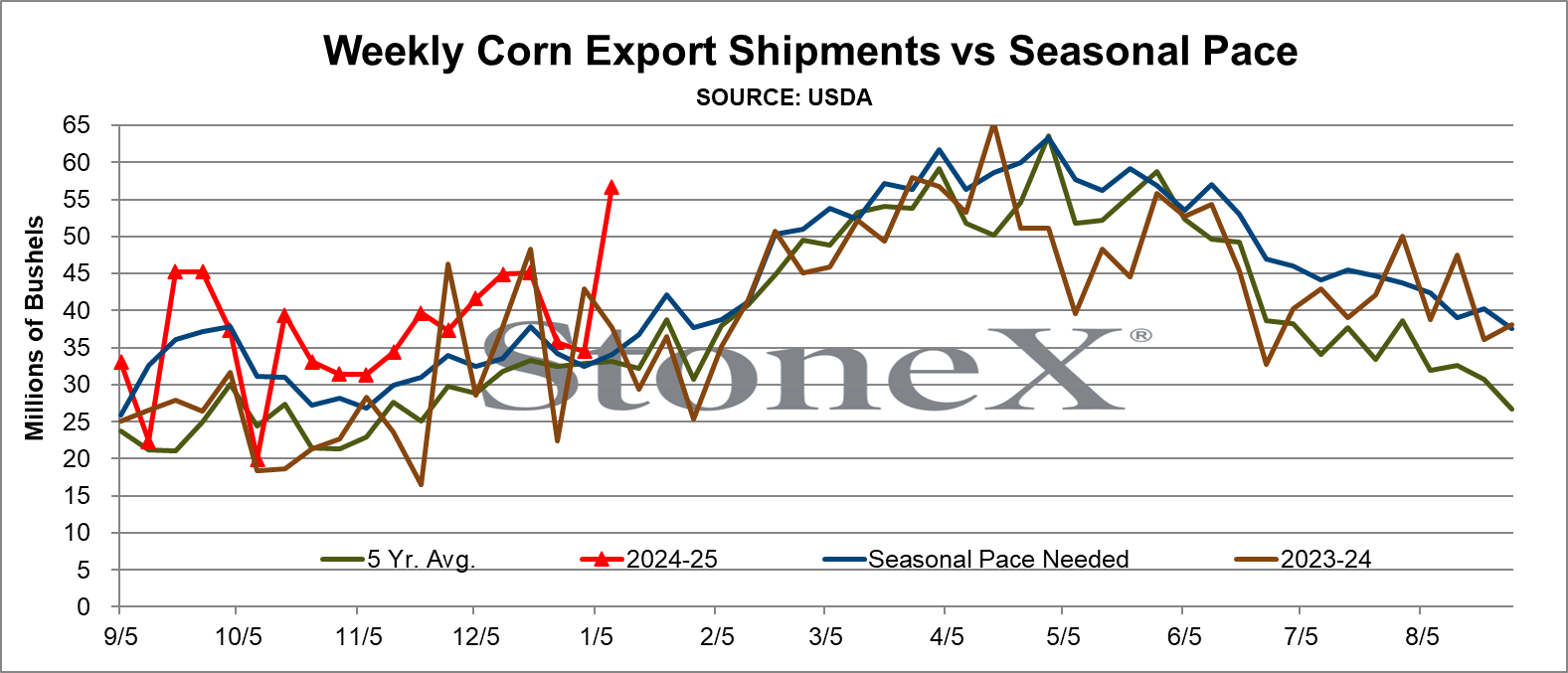
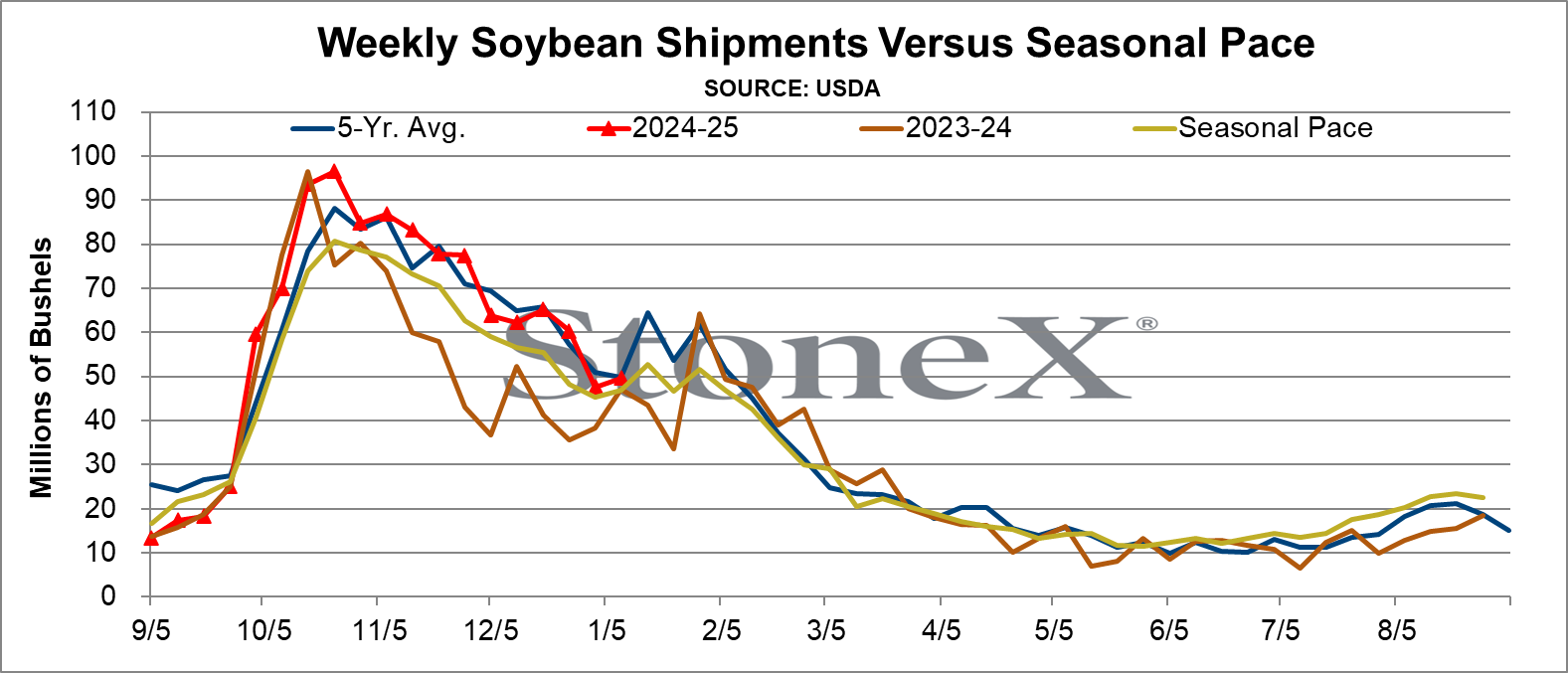
USDA inspected 56.7 million bushels of corn for export shipment in the week ending January 9, as shown below, which was its largest weekly total since last April. Other inspections included 49.6 million bushels of soybeans, 10.6 million bushels of wheat, and 0.03 million bushels of grain sorghum. The above inspections included 19.9 million bushels of soybeans inspected for shipment to China, along with miniscule amounts of corn and grain sorghum. The corn inspections bring marketing year to date inspections for all destinations to 697 million bushels, up 146 million bushels from the previous year's pace, and up 83 million bushels from the seasonal pace needed to hit USDA's target. We're basically the primary source of corn in the world currently until Argentina's harvest in March and April.
Marketing year to date soybean export inspections for shipment to all destinations total 1.151 billion bushels, up 210 million bushels from the previous year's pace, and 136 million bushels above the seasonal pace needed to hit USDA's target. However, harvest of Brazil's massive crop has started, with a solid flow toward the export terminals expected to pick up momentum over the next couple of weeks. Brazilian soybeans priced into Chinese ports for February shipment are currently priced 84 cents per bushel cheaper than soybeans shipped from the U.S. Pacific Northwest, and $1.20 per bushel cheaper than those shipped from the U.S. Gulf. Chinese soybean imports from all sources reached nearly 112 million metric tons in the 2023-24 marketing year that ended on August 31, marking a new record high with some of those soybeans going into its reserve. That helped boost calendar year 2024 imports to a record 105 mmt, reflecting how shipments slowed dramatically in the final quarter of the calendar year. In fact, December imports of an estimated 7.94 mmt are down 19% from the previous year's total for the month. Imports in the 2024-25 marketing year that began on September 1 are expected to total just under 100 mmt, or a 12 mmt (440 million bushel) decline from the previous marketing year to the current one. Meanwhile, Brazil's crop is expected to exceed the previous year's soybean crop by roughly 20 mmt. China's total grain imports in calendar year 2024 dropped to 52.65 mmt, down 16% from the previous year as China seeks to support domestic grain prices.