January 14 - The major stock indices are consolidating either side of Monday's close, as traders turn their attention to tomorrow's consumer price data. The reaction to this morning's producer price data was generally positive, but the reaction didn't last long with the more significant CPI data coming out tomorrow. There's also a bit of caution ahead of Monday's presidential inauguration, which will take place on Martin Luther King, Jr. Day, which will be a holiday for most markets. That's the day when the Trump Administration is expected to potentially sign dozens of executive orders - many of which could have significant market implications. The VIX is near 19 midday, trading a bit more active as stocks rise and fall today, while the dollar index slips to trade near 109.3. Yields on 10-year Treasuries are trading near 4.80% after briefly touching fresh 14-month highs, while yields on 2-year Treasuries are trading near 4.38%, as the yield curve continues to steepen. Crude oil prices are down by 1% as they pull back from yesterday's five-month highs on talk of a potential ceasefire between Israel and Hamas in the Gaza Strip, while the grain and oilseed sector is mixed to weaker.
We're still waiting on word of a ceasefire deal between Israel and Hamas in the Gaza Strip, where negotiations have been making progress in recent days. Hamas says that the talks had reached "the final steps" in the negotiations, while Israel said they reached "a critical phase." President-Elect Trump warned that there "would be all hell to pay" if the remaining hostages are not freed by his inauguration, which is on Monday. That seems to have incentivized greater progress in the negotiations, although it may not make an agreement any more certain. The Gaza Strip war has been going on for 15 months, raising the risks of a broader regional conflict with Iran.
Wheat prices are fighting a losing battle of trying to hold onto modest gains after rising above areas of chart resistance earlier in the session. However, wheat prices are struggling to sustain strength as corn and soybean prices slip into the red, especially with the U.S. dollar still strong. World cash wheat prices have firmed, but the strong dollar continues to keep U.S. supplies largely the market of last resort, except for those customers with which we hold a freight advantage. Both corn and soybean prices have reached a level that have attracted increased farmer selling and end users discomfort with buying. We're not running out of corn, even though the cushion has shrunk, and we certainly are not running out of soybeans with the big Brazilian harvest now started. Yes, Argentina's crop is being hurt by heat and dryness, although it is still too early to claim substantial losses. We are losing yield in southern Brazil as well from the dryness, but those losses are being partially offset by better-than-expected yields in the Center-West part of the country. As such, we expect to see Brazil's crop shrink modestly from current production levels, but still be big overall.
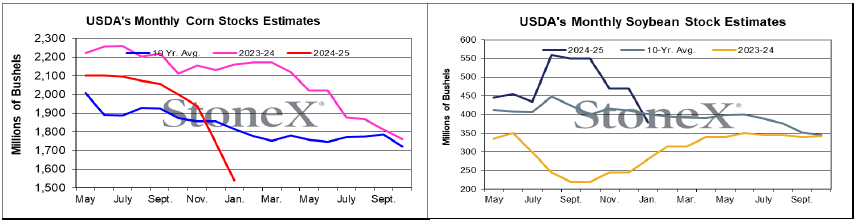
USDA cut its 2024 U.S. national average corn yield by 3.8 bushels per acre on Friday, tying the adjustment it made four years ago as the largest on record for a January crop report. It cut its national average soybean yield by 1.0 bushel per acre, which was the single largest cut for a January report in the past three decades of my records. That resulted in a nearly 200-million-bushel cut to projected ending corn stocks for the 2024-25 marketing year, as shown in the left graphic below, while the 90-million-bushel cut to soybean ending stocks is shown on the right. This puts projected corn stocks at 1.540 billion bushels, which is 10.2% of projected use for the current marketing year, and 622 million bushels below last year's projected ending stocks estimate in the January report. The graphic on the left shows the tendency for USDA's ending corn stocks estimates to trend lower through the marketing year as usage exceeds initial estimates. We see a similar trend for soybeans in the graphic on the right, although that trend has reversed in recent years. Projected ending soybean stocks have actually increased beyond January by the end of the marketing year in four of the past five years, with the increase varying from 48 to 116 million bushels, and the average increase being 71 million bushels. The one exception was the 2021-22 marketing year when final ending stocks ended up being 76 million bushels less than the January estimate. The more recent trend of rising ending stocks estimates has been a product of disappointing demand in the last half of the marketing year.