January 21 - Stocks pushed notably higher at midday, as traders focus on the lack of tariff news coming out of the White House over the past 24 hours, and optimism about future trade and business opportunities. The VIX is trading near 15 at midday, while the dollar index is trading below 108.0. Yields on 10-year Treasuries are trading near 4.58%, while yields on 2-year Treasuries are trading near 4.29% as the yield curve narrows. Crude oil prices are more than 2% lower on expectations that President Trump's policies will increase supply, while the grain and oilseed markets are mostly higher. More on corn and soybeans below, but wheat prices were the big surprise this morning. Prices received a bump from strength in corn and soybeans, but active speculative short covering developed after weekend weather turned colder than expected in the Plains and Midwest winter wheat belt, with greater snow melting ahead of the cold than expected, leaving the crop exposed. The size of the speculative shorts at such low prices amplified the effort to exit those positions. Egypt's interest in buying added a bit of demand to the world balance sheet as well.
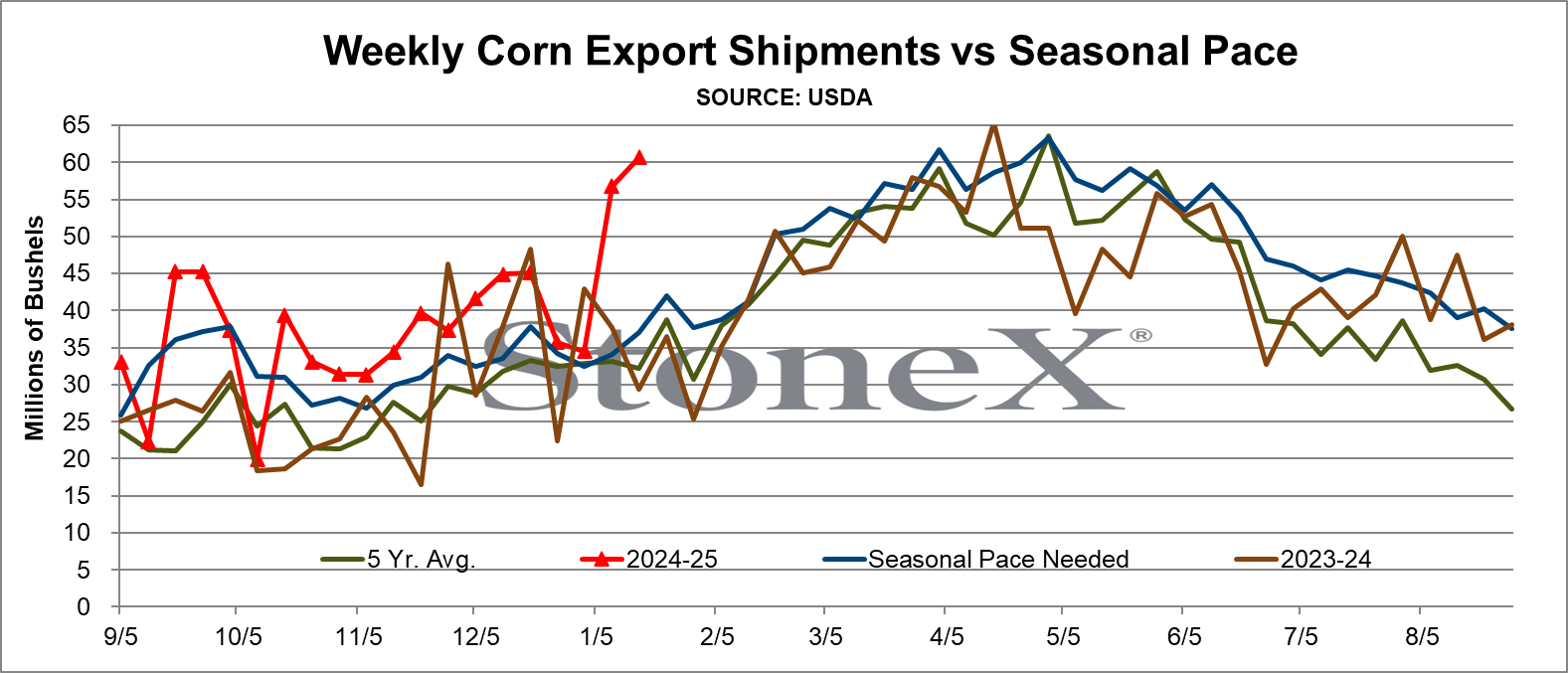
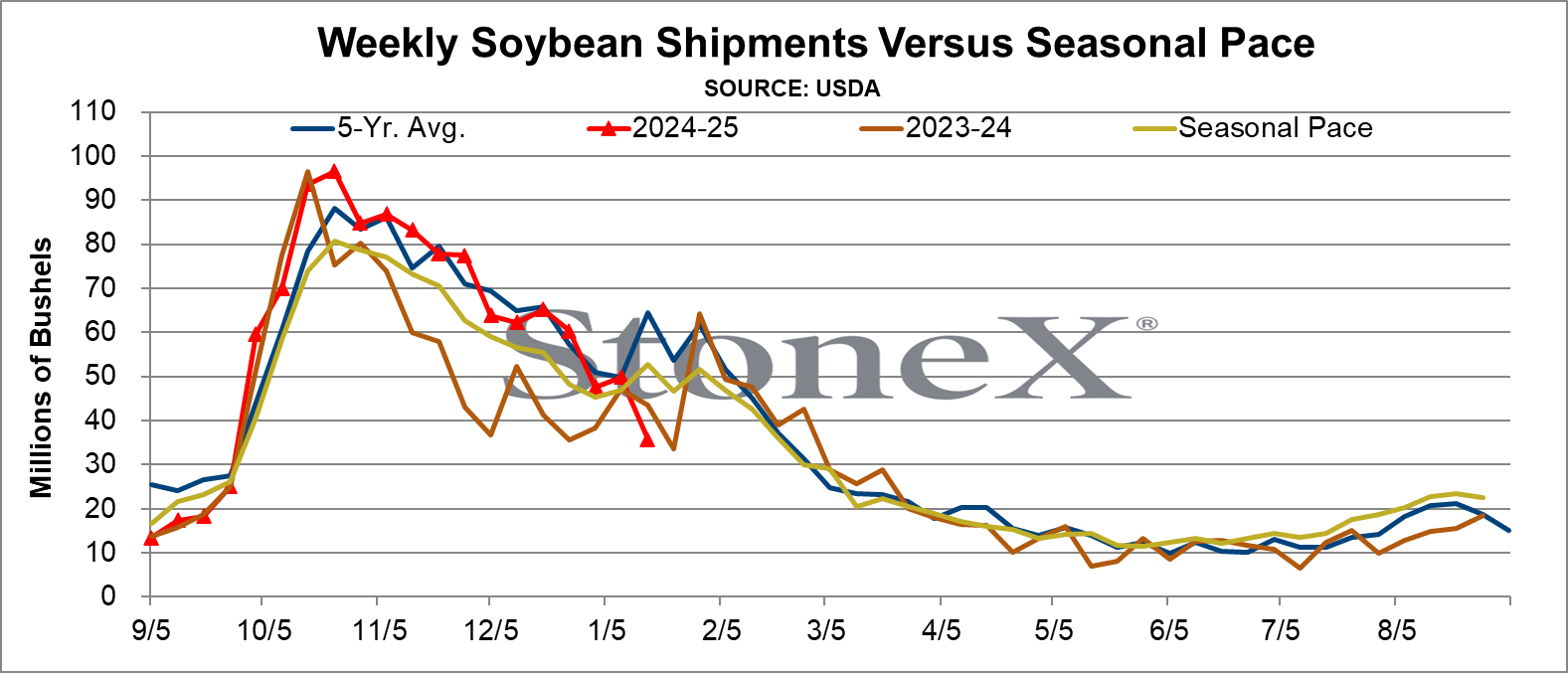
USDA inspected 60.7 million bushels of corn for export shipment in the week ending January 16, as shown below, which is nearly twice the normal pace for this time of year. Additional inspections included 35.8 million bushels of soybeans, 9.6 million bushels of wheat, and 0.4 million bushels of grain sorghum. The portion of the above that was inspected specifically for shipment to China included 18.2 million bushels of soybeans, but little else. The above was supportive for corn, but it was otherwise disappointing for soybeans, wheat and grain sorghum.
Marketing year to date corn export inspections total 758 million bushels, up 177 million bushels or 30% from the previous year's pace, and up 107 million bushels from the seasonal pace needed to hit USDA's target, and the gap continues to grow. That tends to go against our thoughts that much of the strength in buying we saw in recent months was front-loading of demand. My export target was already up at 2.500 billion bushels, up 50 million from USDA's target, but perhaps I too am being too conservative. Marketing year to date soybean export inspections total 1.187 billion bushels, up 203 million bushels or 21% from the previous year's pace, and up 119 million bushels from the seasonal pace needed to hit USDA's target for the year. However, that gap is narrowing as shipments fall off amid a flood of cheaper Brazilian new crop supplies about to hit the market.
However, soybean prices are posting big gains today despite this pending flood of new crop Brazilian soybeans about to hit the market. Part of the price strength comes from disappointing weekend rains in Argentina and southern Brazil, but we're also seeing some headline strength. The market is pricing in some "what if" scenarios. Talk of a possible trade deal with China is being heard in the industry. We're not there yet, and probably won't be for a while if it does happen at all. But there are unconfirmed rumors of China buying some U.S. corn as a good will gesture, along with possibly buying more soybeans as well. U.S. soybeans are quite expensive currently relative to Brazilian supplies, but China has been buying some presumably for its reserves. It does not allow Brazilian soybeans to go into its reserves, believing that they don't store as well. We also heard chatter among our cash sources in China this morning that China's customs department had indicated that it would not accept phytosanitary certificates dated after January 8 for two Brazilian exporters, and dated after January 14 for two others, but we cannot confirm this, nor do we know the reasons and/or durations if it is true. Yet, it helps fuel the speculation about Chinese business with the States.