January 24 - We've seen choppy two-sided trade in stocks this morning amid the release of mixed economic data. Yet, the VIX continues to slide, falling below 15 this morning, while the dollar index fell to fresh five-week lows near 107.2. Yields on 10-year Treasuries are trading near 4.61%, while yields on 2-year Treasuries are trading near 4.25%. Crude oil prices are also mixed to weaker today, while the grain and oilseed complex is mostly weaker. We've seen some strength in the edible oil market today, but otherwise wheat prices are leading the complex lower with double-digit losses, despite the weaker dollar, as this week's short-covering rally is undone. The cattle market remains on fire amid reports of cash cattle selling at new record highs near $210 per cwt in the northern feedlot district this morning.
The consumer sentiment index slipped for the first time in six months to 71.1, down from 74.0 the previous month, and down from 79.0 a year ago. The index of current economic conditions slipped to 74.0, down from 75.1 the previous month and down from 81.9 a year ago. The index of consumer expectations dropped to 69.3, down from 73.3 the previous month, and down from 77.1 a year ago. the University of Michigan reports that assessments of personal finances edged higher for the fifth consecutive month, but all other components pulled back. The decline was seen across all income, wealth and age groups. Buying conditions for durable goods softened this month, but they still remain roughly 30% better than six months ago amid a rising view that prices will increase in the future. Fears about the job market are rising as well. Nearly half of the survey respondents expect the unemployment rate to rise over the coming year. Year-ahead inflation expectations surged to 3.3% this month, up from 2.8% previously. Long-run inflation expectations rose to 3.2%, up from 3.0% previously. Consumers spoke of buying in advance to avoid future price increases, which is evident in robust auto and retail sales data.
Commodity Weather Group estimates that 65% of the U.S. hard red winter wheat crop experienced cold enough temperatures to create winter kill damage in the absence of sufficient snow cover earlier this week, along with 35% of the soft red winter wheat crop. CWG's analysis estimates that total production losses will be in a range of 64 - 94 million bushels. HRW losses are pegged at 52 - 77 million bushels with SRW accounting for the bulk of the rest of the losses. In reality, predicting winter kill losses is extremely difficult. Working in the crop's favor this time around is that the ground was warm ahead of the cold surge, and moisture in the soil over the majority of the belt should have aided in transferring some of that warmth upward to the surface. As such, I'm holding out hope that losses will be less than the above. Yet, we won't know the scope of those losses until the crop breaks dormancy in another four to six weeks.
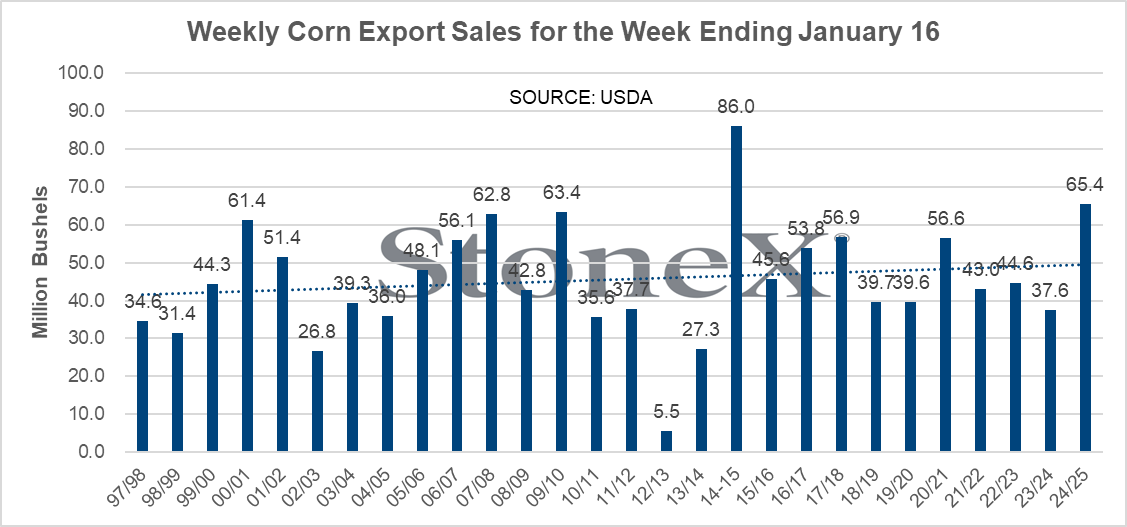
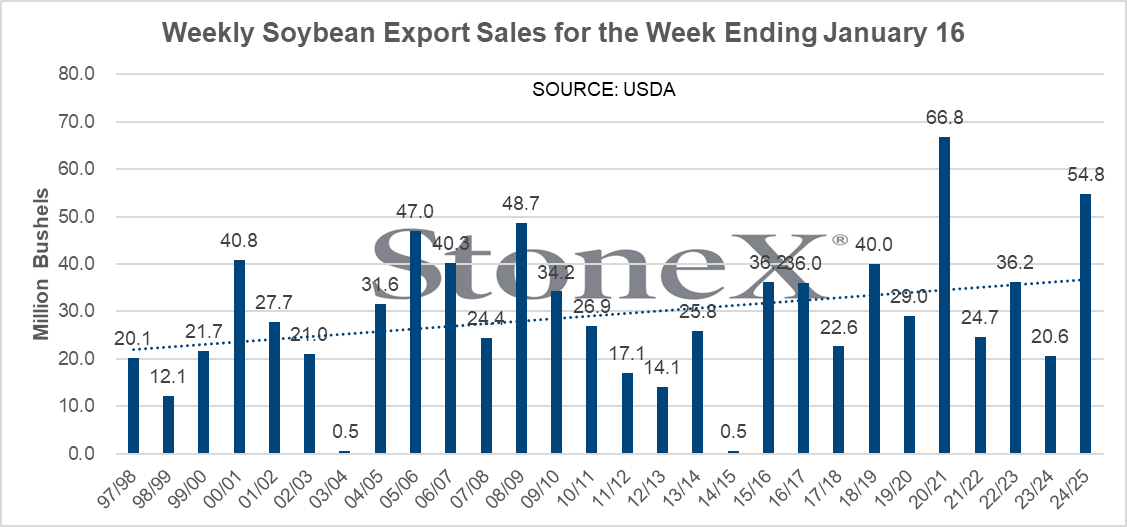
Exporters sold 65.4 million bushels of this past year's corn crop in the week ending January 16, along with 54.8 million bushels of soybeans - both the 2nd largest total for this week of the year of the past several decades. A disappointing 6.1 million bushels of old-crop wheat and 1.9 million bushels of next year's crop was sold during the week, but no milo. Marketing year to date corn export sales exceed the seasonal pace needed to hit USDA's target by 225 million bushels, while soybean sales exceed the pace by 109 million bushels, with the surplus rising in both cases. China was a big buyer of 32.7 million bushels of soybeans as the Brazil harvest is delayed by this year's rainy pattern that boosted yields.