July 1 - The Senate wrapped up a marathon session by passing its version of President Trump's "One Big Beautiful Bill" at midday. Vice-President Vance cast the tie-breaking vote to advance the bill. The bill now goes back to the House, where it will find conservative Republicans who are upset with the changes from what they approved last month. They can either accept the Senate version, or send the bill to a conference committee to iron out the differences. I'll be surprised if the House accepts the bill as is, but that is possible. If so, then President Trump can have his signing ceremony on Independence Day on Friday. If not, then the conference committee work would likely take us deeper into July. The real deadline is to pass it before the Treasury Department bumps against the borrowing ceiling at some point next month.
Trade talks continue as the July 9 deadline looms closer, when the country-by-country reciprocal tariffs announced on April 2 are set to resume once again. Until then, we sit at "just" 10% tariffs on virtually everyone except China, which has a 30% tariff on it. We've frequently heard that trade deal announcements were close over the past couple of months, but thus far we just have a deal with the United Kingdom, and an agreement on a couple of areas of interest with China. President Trump cutoff negotiations with Canada late last week, complaining about its digital services tax that it was about to impose on U.S. tech companies starting Monday, but negotiations restarted when Canada backed down from the tax, with good progress being reported in those negotiations. President Trump threatened to cut off negotiations with Japan because it wouldn't accept U.S. rice, but those negotiations reportedly are continuing as well. The White House is now signaling that it hopes to announce a series of trade deal "frameworks" after the Fourth of July holiday. That's consistent with what I expected over the past couple of months - that trading partners would drag things out until the last minute seeking to get as good of deal as possible. The White House has also signaled that it wants to get all the details of these trade deals ironed out by September 1, while also saying that extensions to the pause are also possible.
Today's JOLTS report revealed that there were 7.769 million job postings at the end of May, up from 7.395 million at the end of April, and well above the average trade guess of 7.300 million. In fact, today's job opening number was well above the highest trade guess of 7.468 million. The increase came at the end of the month that saw the markets stabilize after a tumultuous April, with a general pause on President Trump's reciprocal tariffs. Uncertainty is the biggest threat to the jobs market currently. President Trump's tariff war is a big part of that, as are concerns about whether the 2017 tax cuts will expire at the end of this year. The tax bill moving through Congress attempts to deal with the latter, by making most of the tax cuts permanent, while the tariff uncertainty continues for now.
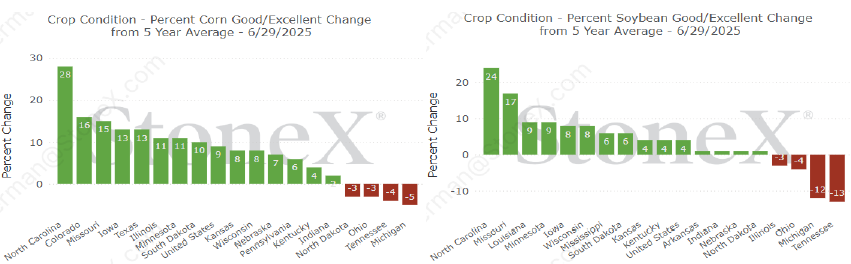
Stocks are mixed to weaker at midday as Wall Street continues to digest the above uncertainty. Yet, the major indices remain near record highs. The VIX slipped below 17 this morning, while the dollar index is trading near 96.9, after posting a fresh three-year low. Yields on 10-year Treasuries are trading near 4.27%, while yields on 2-year Treasuries are trading near 3.78%. Crude oil prices are nearly 1% higher on signs of improving demand, while the grain and oilseed markets are mixed to weaker. Wheat prices are trying to bounce, while corn and soybean prices came under pressure this morning. Both markets are off their session lows, but they're still feeling the pressure of rising yield projections, both here and in South America. StoneX Brazil's July customer survey pegged this year's soybean crop at 168.75 million metric tons, with the corn crop rising nearly 3 mmt this month to 136.1 mmt, as the harvest reveals much higher than expected yields in Center-West Brazil. This will make it difficult to sustain the export pace projected by USDA in its 2025-26 balance sheet. The graphics below show how various state corn and soybean crops fare relative to the five-year average for late June.