July 17 - The tech sector continues to suffer big losses at midday on fears of increased sanctions tied to selling of high-value semiconductor technology to China, while the Dow probes into record high territory once again amid strong industrial output data, and the commodity sector benefits from a drop in the dollar. The VIX continues to trade near 14, just below this morning's nearly 7-week high, while the dollar index is trading near 103.8, representing nearly four-month lows. Yields on 10-year Treasuries are trading near 4.16%, while yields on 2-year Treasuries are trading near 4.45%. Crude oil prices are trading 2% higher back above the $82 per barrel mark, while the grain and oilseed markets are mostly higher as well.
Industrial production rose 0.6% month-on-month in June, doubling analyst expectations of 0.3%, although down from 0.9% growth the previous month. Manufacturing output rose by 0.4% month-on-month in June, up from analyst expectations that it would be flat during the month, although down from a strong 1.0% growth posting the previous month. Capacity utilization rose to 78.8% in June, up from analyst expectations of 78.5%, and up from a downwardly revised 78.3% the previous month. Nonetheless, these numbers show signs of an upward turn in this sector of the economy in June, similar to what we saw in this morning's new home starts numbers. On a related note, the Atlanta Fed's business inflation expectations survey reflected perceptions of higher inflation, with longer-term expectations rising this month to 2.4%, up from 2.3% in June.
Wheat prices led the way higher today, in what is currently seen as a technical bounce. End users see some value at these price levels that find the market oversold. They've been buying hand-to-mount while prices were falling, but we may find that buying pick up the pace if prices show signs of recovery. Producer selling is slowing seasonally for now as well. U.S. supplies are large, meaning that they need to find their way into both the export market and into the domestic feed market. Soybean prices tried to bounce as well, although new-crop soybean prices uncovered some selling on expectations of a big Midwest crop in 60 days. Corn prices also tried to rally, but a wall of corn in farmer storage continues to keep a lid on that market as well until/unless a greater threat to the crop emerges. Thus far, July weather looks favorable for development of this year's crop, although there will be losses in the northwest Midwest from the June flooding and ponding. The protein sector is mixed at midday. Lean hog futures continue to rally after last week's flush selloff, with the product market certainly "feeling" better from a demand standpoint. Live cattle futures are mixed, with some light cash cattle trade near $187 per cwt in the southern feedlot district providing support for nearby contracts, while the deferred contracts are under light pressure. The cash market continues to trade roughly $4 above the spot August futures contract, although there's still time for convergence.
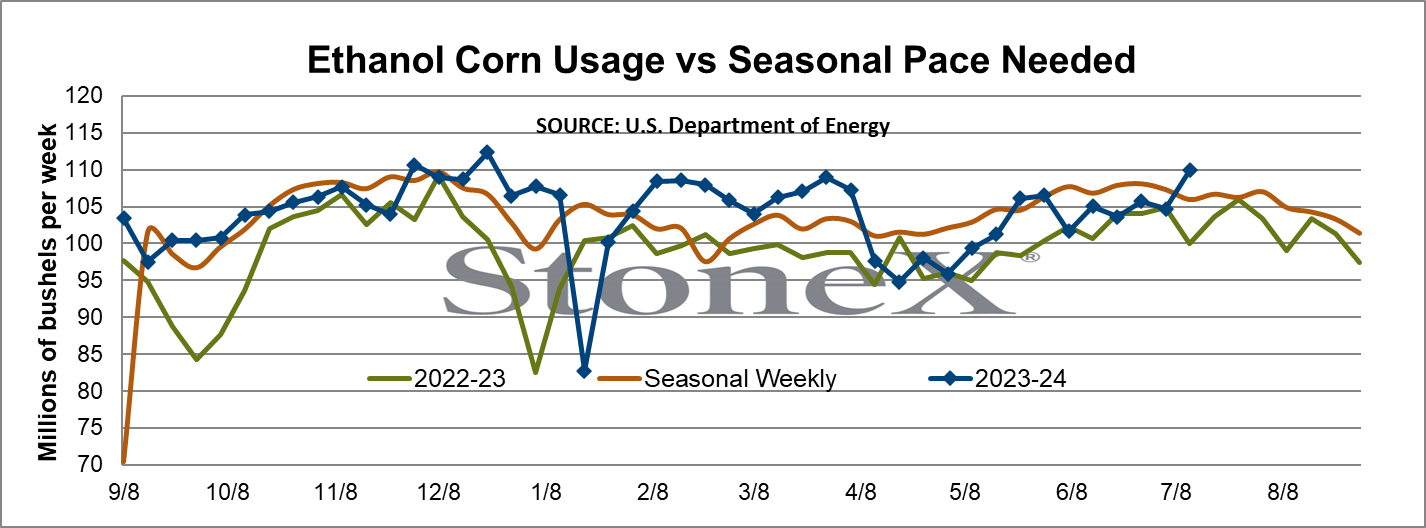
U.S. commercial crude oil stocks fell by 4.9 million to 440.2 million barrels in the week ending July 12, putting them 5% below the five-year average for mid-July. Gasoline stocks rose by 3.3 million barrels, putting them slightly above levels typically seen in mid-July. Distillate stocks increased by 3.5 million barrels, leaving them 7% below levels typically seen at this time of year. Ethanol stocks fell to a five-week low 23.2 million barrels in the week ending July 12, down from 23.6 million the previous week, but matching levels seen in the same week last year. Stocks fell despite a surge in ethanol production to a 29-week high 1,106K barrels per day last week that fell just shy of record levels, up from 1,054K bpd the previous week, and up from 1,070K bpd the previous year. The production of ethanol utilized an estimated 109.9 million bushels of corn last week, up from 104.7 million the previous week, and up from 103.6 million bushels in the same week last year. That brings estimated marketing year to date corn use for fuel ethanol to 4.697 billion bushels, up 213 million bushels or 4.7% from the previous year's pace, meaning that USDA's target can still be achieved if we maintain strong production through August.