July 18 - Both the Dow and the S&P 500 stock indices surged to new highs for the year this morning, while the Nasdaq is poised to test yesterday's 2023 highs at midday, supported by resilient core retail sales data released this morning. The VIX continues to trade below 14, while the dollar index is trading just below 100.0. Yields on 10-year Treasuries are trading near 3.78%, while yields on 2-year Treasuries are trading near 4.74%. We're seeing generally positive money flow thus far today into the broader commodity sector, with crude oil prices up by more than 1.5% on economic optimism, while the grain and oilseed markets are mostly higher as well. Soybeans are the strength of the complex fundamentally, with supplies generally expected to remain tight over the next six month, with the November contract testing resistance near $14 this morning, which has thus far held. Corn and wheat found some support from indications that Russia may not make it easy for Ukraine to continue the grain initiative without it.
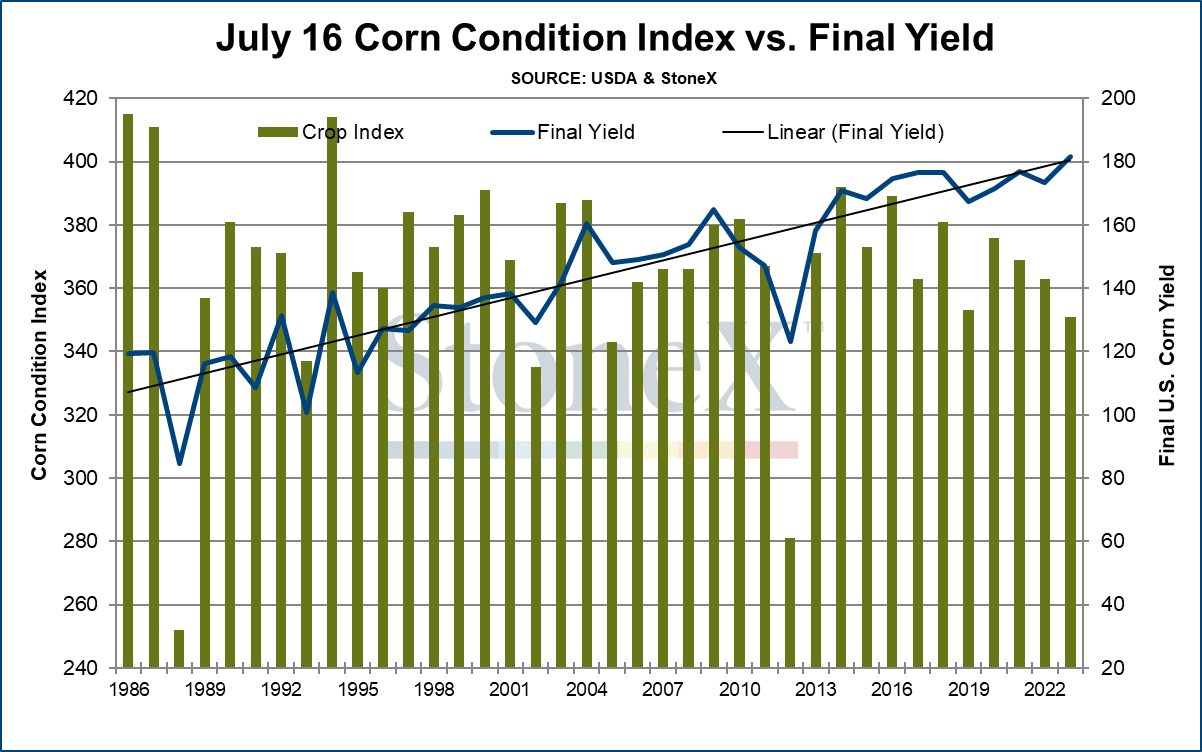
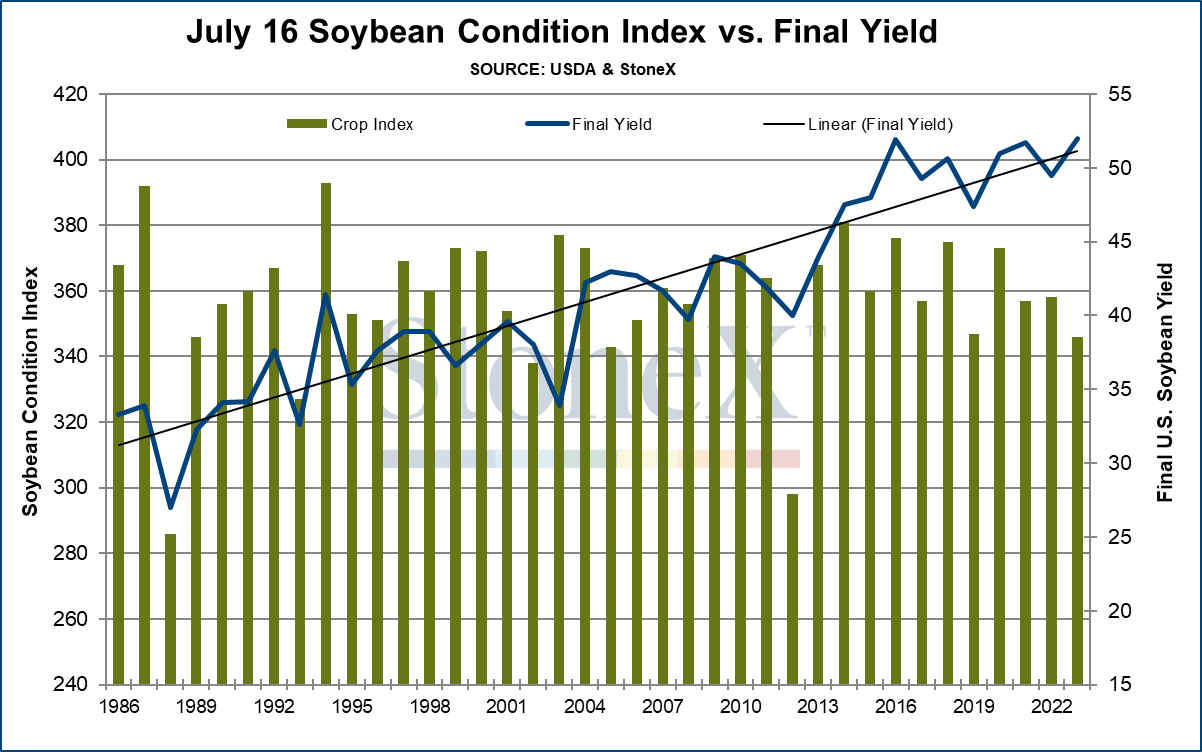
USDA confirmed late Monday that corn and soybean crop ratings continue to improve. In fact, both corn and soybeans only saw condition index score declines in two states this week, with the rest of the major producing states flat or improving from the previous week. The graphics below show that the corn condition index score this week rose to 351, up 4 points on the week and up 11 points over the past two weeks. That's still the lowest condition index score for this week of the growing season since 2012 (281), but it's trending in the right direction. The temptation is to compare it with other years that had a similar score in this week of the year, as I show you in the graphics below, compared to final yields in those years. There's value in doing that, but we also have to look deeper into those years to see if they had a similar June and if the ratings were moving in the same direction at this point.
A lot of focus has been on 1992's above-trend yields after poor ratings in June, but 1992 still saw more rainfall in June than we did this year, putting the crops through less stress. As such, I do not expect a repeat of 1992's above-trend yields at this point. 2019 had a similar rating in mid-July, but it was a very late planted crop due to excessive spring rains. Both 2005 & 2006 had similar mid-July ratings with trend or better final yields, but their ratings were much higher in June, suggesting that the crop was under less stress during early crop development. That's the case with most year's that I looked at. Pollination is rapidly advancing across the Midwest from south to north. Anecdotal reports are coming in of severe ear stunting in areas that were planted early that had the greatest drought stress in June, whereas other areas are seeing potential record yield potential. StoneX will be conducting its annual customer survey on August 2nd to provide a big picture perspective of where we see yield potential. Until then, I feel good about a yield near 177, but we'll see what the survey data says.
The same situation exists with the soybean crop, although it's been slower to recover with improved weather, telling me that perhaps it was hit harder by the June stress. We all say - myself included - that soybeans are made in August. But the bulk of the similar crop ratings in previous years in June saw below-trend yields, suggesting that June matters as well in setting the ceiling for soybean yields. That's why I'm comfortable currently with a 51 bushel yield. I look for another week of improving crop ratings next week, but then a warmer and drier pattern to close out July may cause ratings to pause in their increase, or possibly even pull back a bit. The early take on August looks a lot like the cool grain fill months we had in 2009 and 2017, although again, both of those years had better starts to the growing season. Nonetheless, some lost yield potential can be regained with larger seed size due to favorable weather in August, if the current forecast verifies going forward.