July 23 – Wall Street is taking today’s Japan deal announcement in stride, with the Dow Jones and S&P 500 both pushing higher at mid-day while the tech heavy Nasdaq hangs slightly in the red as Texas Instruments’ weaker-than-expected demand forecast for analog chips has led their peers to sell off and drag the index lower. Progress on U.S. trade negotiations helps to reduce uncertainty and pacify concerns on Wall Street, with the VIX cooling back below the 16 level to hover around 15.9 at the time of writing. Treasuries are pushing higher at mid-day, with 10-year yields trading at 4.38% and 2-year yields rising to 3.87%. Crude oil is again moving lower despite a relatively bullish D.O.E. report this morning, with nearby WTI pushing to a fresh 3-week low as it trades around the $64.80 level. The ags are mostly lower, save for soybeans clinging to small gains and the cattle complex pushing higher as feeder cattle futures again push to fresh all-time highs today.
Russia and Ukraine are meeting for peace talks in Istanbul today, the latest attempt at diplomacy following the recent escalation in the nearly three-and-a-half-year-old conflict. Neither side is expecting a major breakthrough, which is no surprise given the lack of progress in previous direct meetings. The market has become rather desensitized to the conflict over the last few years, but it’s important to keep in mind how much of an impact the Black Sea region has on global ag markets. Ongoing hot, dry weather in the region has perhaps drawn even more attention from traders than today’s peace talks, however, with wheat yields largely disappointing in both Russia and Ukraine thus far and forecasts keeping risks present for the region’s corn crop in the weeks ahead.
U.S. crude oil stocks fell by 3.17 million barrels in the week ending July 18th, much sharper than trade expectations, bringing total crude oil stocks excluding the SPR to 418.99 million barrels, a 3-week low. This was the second consecutive week of strong crude declines. On the refined products, U.S. gasoline stocks fell by 1.74 million barrels, also much sharper than trade estimates, to put total gasoline stocks at 231.13 million barrels. Conversely, U.S. distillate stocks saw a 2.93-million-barrel week-over-week build, moving in the opposite direction of market expectations of a weekly decline. Distillate stocks have built by 6.9% over the last two weeks since hitting a fresh 20-year low in the week ending July 4th but remain very tight relative to historical levels.
The Atlanta Fed’s Business Inflation Expectations fell in July to 2.3% from 2.4% in the month prior. This is now the third consecutive monthly decline in year-ahead inflation expectations since the recent spike to 2.8% in April amid the unveiling of the Trump administration’s “Liberation Day” tariff announcements. Prior to that, business level inflation expectations had fallen to a 4-year low of 2.0% back in December 2024. Longer-term inflation expectations (5-10 years) held steady at 2.8%. When asked by what percentage the firms surveyed had increased their prices in the last 12 months, the median response was +3.8%. However, when asked by what percentage they expect to increase prices over the next 12 months, the median response was +4.0%, the highest since August 2024.
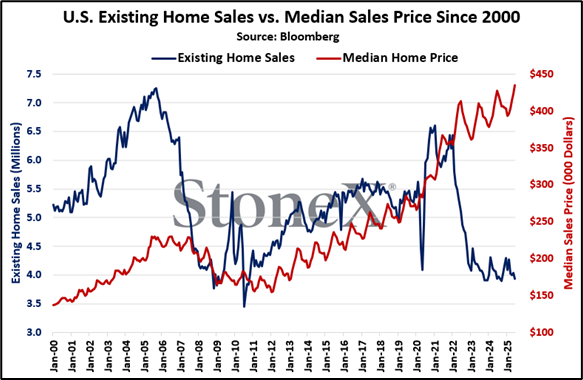
U.S. existing home sales fell 2.7% month-on-month in June to a seasonally adjusted annualized rate of 3.93 million, below market expectations of a more moderate decline to 4.00 million; May was revised slightly higher to 4.04 million from the 4.03 million initially reported. This represents the sharpest monthly decline seen since March and the softest overall home sales since September 2024. The bulk of June’s home sales were in the South (46%), followed by the Midwest (24%), West (18%), and Northeast (12%). Despite the slowdown in sales, the median sales price rose to a new all-time high of $435,300, breaking the previous record set last June by 2.0%. With prices high and average 30-year mortgage rates sitting at 6.84%, it’s not hard to understand why we’re seeing demand softening, especially given the ongoing economic uncertainty and expectations of lower interest rates ahead likely keeping prospective buyers on the sidelines.