July 24 - Active selling pressured tech stocks to six-week lows this morning following disappointing earnings reports from Tesla and Alphabet, lending to questions about the sustainability of the AI led rally that we've seen this year. The VIX is trading at three- month highs above 17 at this hour, while the dollar index is trading near 104.2. Yields on 10-year Treasuries are trading near 4.23%, while yields on 2-year Treasuries fell below 4.40%, to hit their lowest level in nearly half a year amid rising expectations that the Fed will become active in cutting interest rates later this year. Crude oil prices are 1% higher as they bounce following yesterday's big collapse, while the grain and oilseed markets are mixed to higher as well at midday. We see a positive bias again in the commodity sector today, but again we're also seeing selling - much of it farmer selling - limiting the gains. Minneapolis wheat is holding well after the Quality Wheat Council's tour yesterday found an average yield of 52.5 bushels per acre, which was more than 10 bushels above the 10-year average for day #1 of the tour, albeit they also found a "high frequency of scab" in the eastern third of North Dakota, although it was not currently at severe levels.
Freight traffic through the Panama Canal is slowly returning to normal as water levels on the Gatun Lake rise with increased rainfall. The region has received roughly two feet of rainfall over the past two months to help restore water levels on the lake, which are needed for moving ships through the canal system. Panama Canal officials expect lake water levels to continue to rise through September at seasonal levels to facilitate movement of ships through the canal. This should help relieve a little of the stress of moving freight through the Red Sea, where Houthi Rebels continue to attack ships. It should also cut freight rates this fall for ships traveling from U.S. Gulf ports at New Orleans to Southeast Asia, helping U.S. commodities to be more competitive into that market, although a strong dollar is still a factor as well.
The PMI Composite Flash index came in at 55.0 for July today, up from 54.8 previously. However, the data showed two different stories. The manufacturing index fell into contraction territory this month at 49.5, down from analyst expectations that it would hold last month's level at 51.6. Yet, the services index rose to a strong 56.0, reflecting active month-on-month expansion, and up from 55.3 previously. Analysts had expected it to come in at 55.0 for July. A survey of business uncertainty revealed that U.S. firms expect sales growth of 3.90% over the coming year, up from the previous month's estimate of 3.77%. However, they anticipate that employment growth will slow to 4.43% over the coming year, down from 4.55% in the previous month's survey. Other data today showed new home sales slipping to an annualized rate of 617K units, down from 621K the previous month, and below analyst expectations of 640K.
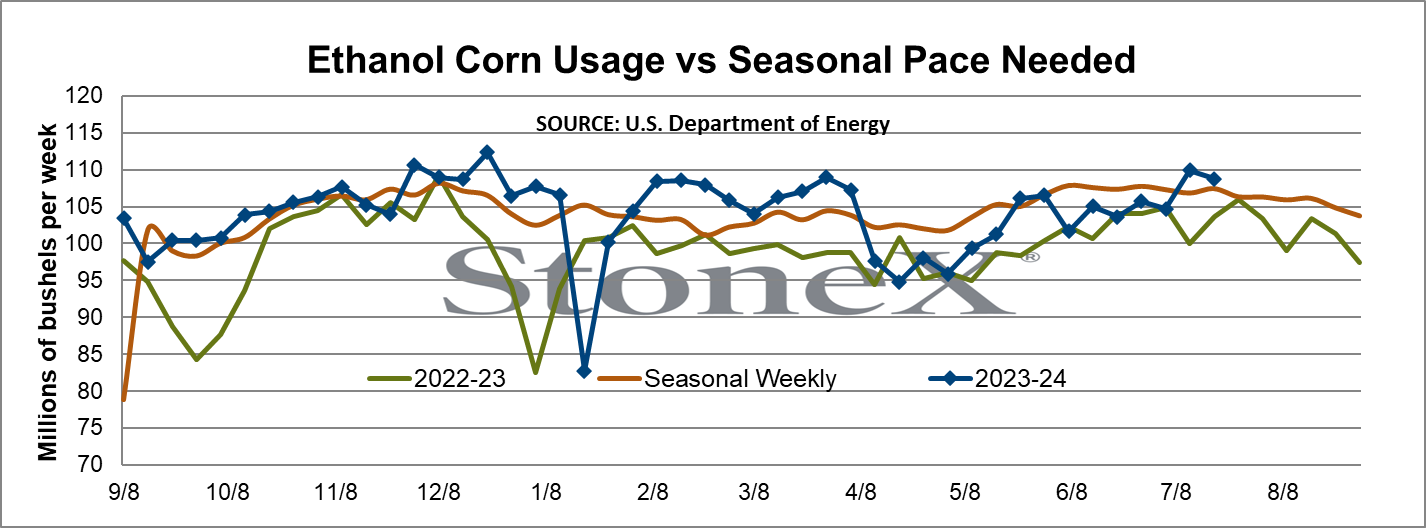
U.S. commercial crude oil stocks (excluding the Strategic Petroleum Reserve) fell by 3.7 million to 436.5 million barrels in the week ending July 19, putting them 5% below levels typically seen in mid-July. Gasoline stocks dropped by 5.6 million barrels, putting them 2% below the five-year average for the week. Distillate supplies slid by 2.8 million barrels, leaving them 9% below seasonal levels. Ethanol stocks rose to 23.7 million barrels, up from 23.2 million barrels both last week and in the same week last year. Ethanol production dipped to 1,095K barrels per day in the week ending July 19, down from 1,106K bpd the previous week, but slightly above the 1,094K bpd in the same week last year. The production of fuel ethanol utilized an estimated 108.8 million bushels of corn last week, as shown in the graphic below, down from 109.9 million bushels the previous week, but up from 105.9 million bushels the previous year. Estimated marketing year to date corn use for ethanol totals 4.806 billion bushels, up 216 million bushels or 4.7% from the previous year's pace, keeping USDA's target within range to hit it if processors can maintain a strong production pace.