July 26 - Stocks have a mixed to weaker tone to them as we approach this afternoon's announcement from the Federal Reserve. Yet, the VIX is trading below 14 once again, reflecting relative calm on Wall Street. The dollar index is trading modestly weaker near 101.1 at midday. Yields on 10-year Treasuries are trading near 3.88%, while yields on 2-year Treasuries are trading near 4.90%. The broader commodity sector feels light headwinds ahead of the Fed announcement, with crude oil prices down less than 1%, while more substantial losses are seen in the grain and oilseed sector.
Recent action in the wheat market reminds me of the volatility experienced following Russia's invasion of Ukraine last year, when we saw alternating limit-up and limit-down days. I'll go back to what I said early last week. Corn and wheat prices initially fell when Russia withdrew from the Black Sea Grain Initiative because we are not facing an immediate shortage of corn and wheat. Brazil is harvesting a record corn crop and Russia still has lots of cheap wheat left over from last year's big harvest. Last week's price strength came from speculative short-covering when Russia stepped up its attacks on Ukraine export infrastructure, creating longer-term concerns about global supplies. Those attacks subsided for now, and Europe is making overtures toward opening up land-based export channels for Ukraine. That doesn't mean that the risks have disappeared, but for now it's allowing the grains to return to trading current known fundamentals, which are weak, with a dose of farmer selling. That's not the case for soybeans, which is why they're holding up well today in the face of heavy selling in the other markets. The soybean balance sheet is tight, and current weather threats risk making it even tighter.
The State Street Investor Confidence Index firmed to 96.2 this month, up from 95.4 the previous month. The increase was led by a 1.3-point increase in the North American index to 90.8, which is still the lowest of the three major sub-indices. The Asian index rose 0.7 points to 97.3 this month, while the European index fell 5.4 points to 99.5, reflecting further erosion in confidence in the European economy. Other data released today showed that U.S. new home sales fell to an annualized rate of 697K units in June, down from analyst expectations of 727K. Furthermore, the May number was revised to 715K, down from the 763K originally reported.
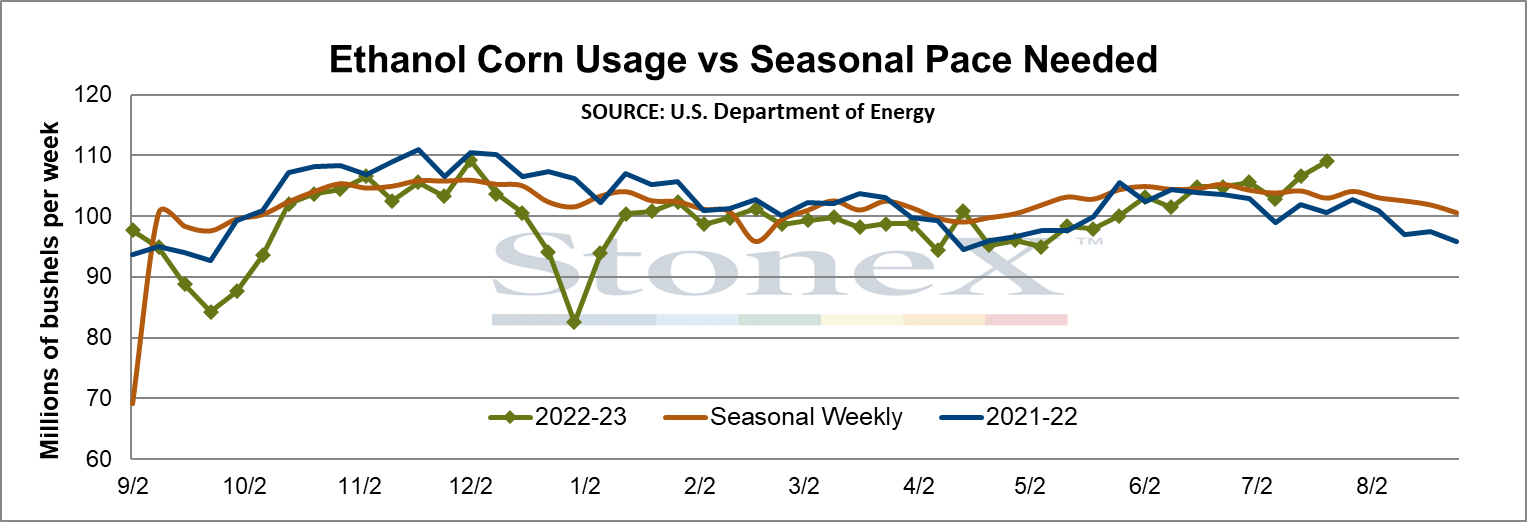
U.S. commercial crude oil stocks (excluding the Strategic Petroleum Reserve) fell by 0.6 million to 456.8 million barrels in the week ending July 21, leaving them 2% above the five-year average for mid-July. Gasoline stocks dropped by 0.8 million barrels last week, putting them roughly 7% below seasonal levels. Distillate stocks fell by 0.2 million barrels, leaving them about 14% below levels typically seen at this time of year. Ethanol stocks were unchanged last week at 23.2 million barrels, which is slightly below the 23.3 million barrels on hand in the same week last year. Ethanol production rose to a fresh 21-month high 1,094K barrels per day last week, up from 1,070K bpd the previous week, and up from 1,019K bpd the previous year. The production of ethanol utilized an estimated 109.0 million bushels of corn in the week ending July 21, up from 106.6 million the previous week, and up from 100.6 million bushels a year ago. Estimated marketing year to date corn use for ethanol totals 4.602 billion bushels, down 160 million or 3.4% from the previous year's pace. However, the recent pickup in processor activity raises my optimism that we can meet USDA's target for the year ending August 31, with one of the three primary demand sectors for corn finally showing some life.