July 27 - Wall Street rallied today on hopes / expectations of a soft landing for the economy, although gains were limited by fears that today's economic data could lead to a more aggressive Federal Reserve at future meetings. The VIX is trading below 13 at midday, while the dollar index is trading solidly higher at 101.7 as the European Central Bank fans talk of a pause in rate hikes following this morning's 25-basis-point rate hike. Yields on 10-year Treasuries are pushing higher on this morning's economic data, trading near 3.94%, which is a two-week high. Yields on 2-year Treasuries are trading near 4.92%. Commodity traders are focused more on the positive economic data that suggests increased demand, with crude oil trading to fresh three-month highs. However, the grain and oilseed market was largely mixed at midday.
Hot dry conditions that threaten spring wheat yields in the U.S. Northern Plains and Canadian Prairies supported Minneapolis wheat today, with spillover support in Kansas City as well. Chicago wheat also found support from an overnight attack on Ukraine export infrastructure in Odessa, but the attack was just two missiles, leading to limited price support. Corn and soybean prices traded lower today, with traders reminded by USDA's latest weekly export sales data how weak demand is currently. Soybean prices are trading at lofty levels due to a projected tight balance sheet for the coming year, with heat stress expected to add to concerns for both corn and soybeans in the days ahead. More on that later. But much of that risk has been priced into the market already, with forecasts looking much better into August. Traders are balancing those weather concerns with weak export demand concerns.
The pending home sales index rose 0.3% month-on-month in June to 76.8, matching analyst expectations. That's a dramatic improvement from the 2.5% decline posted in May, as traffic returns to the housing market as consumer sentiment improves. The problem is that the supply of existing homes for sale remains very low, with 75% of the home loans out there currently having an interest rate at 4% or lower. These homeowners have little incentive to sell if they're going to have to buy a replacement home at a mortgage rate of 7 or 8%. That in turn is increasing demand for new home construction, although labor tightness makes it difficult to build enough homes to meet that demand.
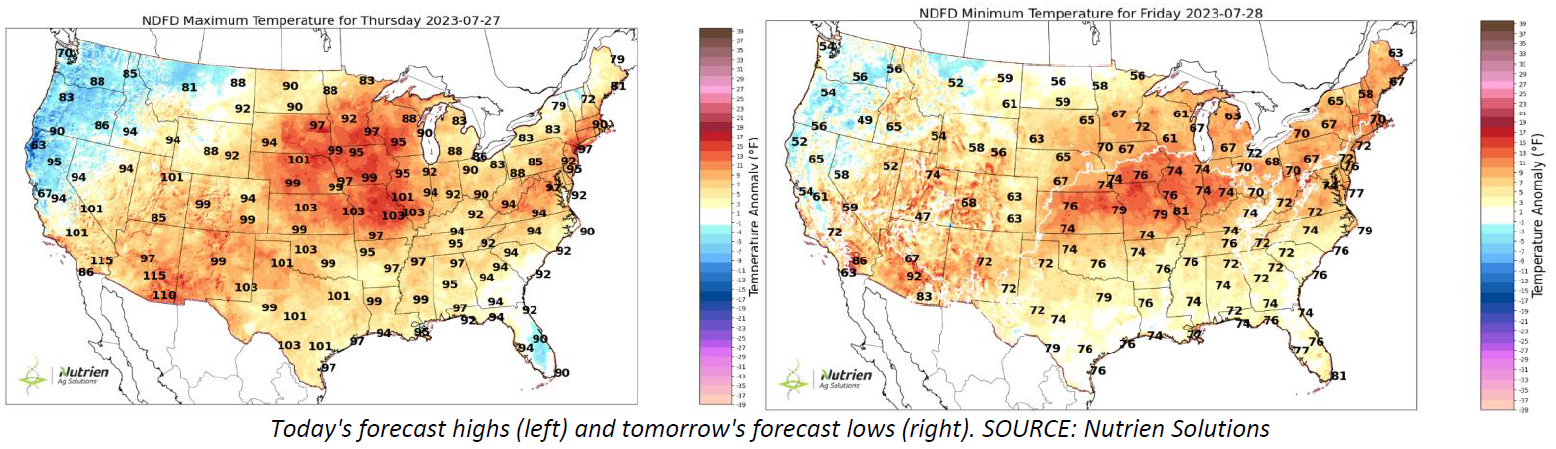
Extreme heat continues to build in the Midwest, with heat indices topping 105 to even above 110°F across portions of Iowa and Illinois in the near-term. The graphic to the left below shows today's projected actual high temperatures, which will combine with winds to create stress on late pollinating and early grain fill corn. The graphic on the right below shows projected overnight low temperatures for tomorrow morning. Both are a problem for the developing corn crop. We generally focus on the effects of extreme daytime heat, but high overnight lows above 70°F do not give the plant a chance to rest, which means that it continues to burn energy needed to fill grain. Fortunately, we're not expecting an extended period of high overnight lows, like we saw in 2010, but the current week's weather still have an impact. My greatest concern would be poor pollination for late pollinating corn, and tip back on the ears for corn that has pollinated already. The scope of the tip back will likely vary considerably by the hybrid being grown. Some hybrids will handle this very well, and others will struggle. This is the time to start walking fields, because pulling back the husks from developing ears will likely reveal something much different than the appearance of the crop from the road. In some cases it will be worse, but in others it will be much better. As such, I expect to see considerable variability in August yield estimates, depending with more consolidation of those estimates as we get into September. The dynamics will be similar for soybeans, related to varying pod counts, but that will take a few more weeks to unfold.