July 5 - Both the Nasdaq and the S&P 500 stock indices hit fresh record highs ahead of the weekend, while the Dow Jones Industrial Average remains range-bound in holiday-like trading today. The markets were closed for the Independence Day holiday yesterday, and some traders decided to extend their holiday into the weekend. The VIX is still trading near 12 late-morning, while the dollar index is trading near 105.0 after posting fresh three-week lows this morning. Yields on 10-year Treasuries are trading near 4.29% at this hour, while yields on 2-year Treasuries are trading near 4.62%, representing a fresh three-month low, narrowing the yield curve inversion. Crude oil prices are modestly higher late-morning, trading at 11-week highs as Hurricane / Tropical Storm Beryl takes aim on the Texas Gulf Coast. The grain and oilseed markets are also higher today, with broad-based buying generally supporting the commodity sector. Wheat is the leader in the grain sector on strong export sales on the recent price break, but end user buying in corn and in the soybean complex are also providing support today. Saturated areas of the northwest Midwest finally warm up and dry out over the coming 10 days, which will be welcome for crops in that region. Heat is generally expected to build into the Midwest as we progress through July, but forecasters are split on rainfall chances for the region as the corn crop heads into pollination. Midwest weather is expected to be the primary driver for the corn and soybean markets in the weeks ahead.
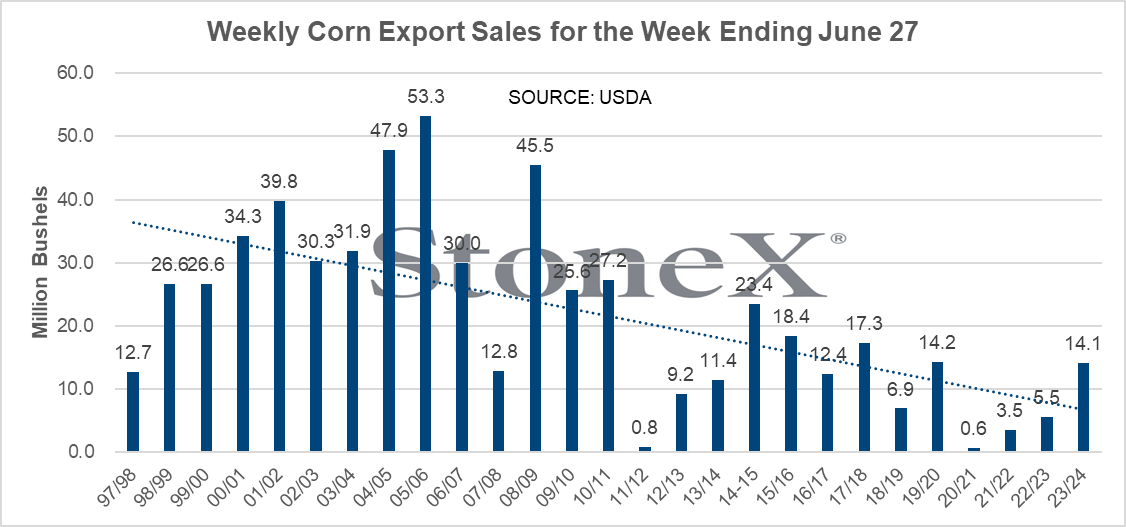
Exporters sold 14.1 million old-crop corn in the week ending June 27, as shown below, along with 12.3 million new-crop bushels. "Unknown destinations" was the featured buyer of the old-crop corn during the week at a net 5.4 bushels, while Mexico was the featured buyer of new-crop corn at 11.8 million bushels. The week's sales brought total old-crop corn commitments for the marketing year to 2.115 billion bushels, up 578 million bushels or 38% from the previous year's pace. Note the graphic below showing weekly sales for the same week of the year over the past quarter century or so. Take note of how weekly sales used to be much stronger this time of year, but both sales and shipments now tend to drop off during our summer months. That's largely due to the expansion of corn production in South America. Argentina and Brazil are both currently harvesting large crops, with that corn making it into the export market. The strong dollar, versus their cheaper currencies, makes their corn much more competitive on the global market currently. Even so, marketing year to date corn commitments still currently exceed the seasonal pace needed to hit USDA's target by 65 million bushels, up from 63 million the previous week.
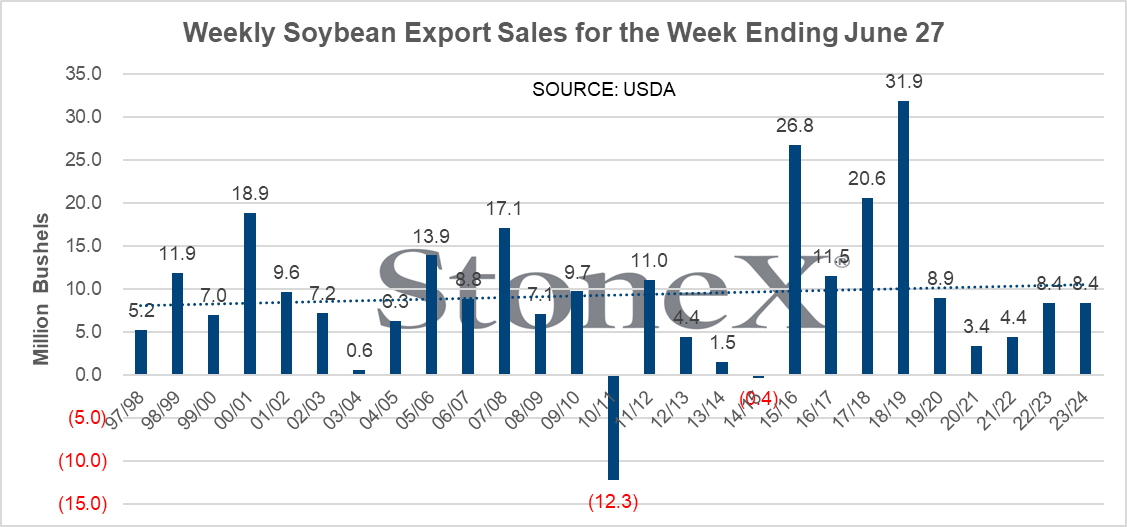
Exporters also sold 8.4 million bushels of old-crop and 5.5 million bushels of new-crop soybeans in the week ending June 27. That brings marketing year to date old-crop soybean export sales to 1.646 billion bushels, down 282 million bushels or 15% from the previous year's pace as Chinese demand for U.S. soybeans continues to decline. You can talk plenty about rising geopolitical tensions between the two countries, but the bottom line is that Brazilian and Argentine soybeans are much cheaper than U.S. soybeans, and both continue to expand their output to meet that demand. Marketing year to date soybean export sales fall short of the seasonal pace needed to hit USDA's target by 50 million bushels, versus being short by 49 million bushels the previous week. Other data from USDA showed that exporters sold 29.6 million bushels of wheat in the week ending June 27, which is the largest weekly sales total for wheat since mid-December, with noteworthy sales to Mexico and to Brazil during the week.