July 5 - Stocks are under pressure at mid-day amid negativity regarding the global economic outlook following a string of negative data releases as U.S. traders return from the Independence Day holiday. The VIX is rising on the day, though still quite low near the 14.1 level. The dollar is firming slightly, trading just above 102.8 at the time of writing. The inverse in treasuries is correcting slightly today, though still very wide, with 10-year yields up to the 3.9% level while 2-year yields fall below the 4.92% level. Crude oil is rallying, with the nearby WTI contract pushing above $72 for the first time in two weeks as concerns over supply restrictions from Saudi Arabia and Russia linger. The ags are largely mixed, with the wheat complex showing strength while much of the sector remains in the red.
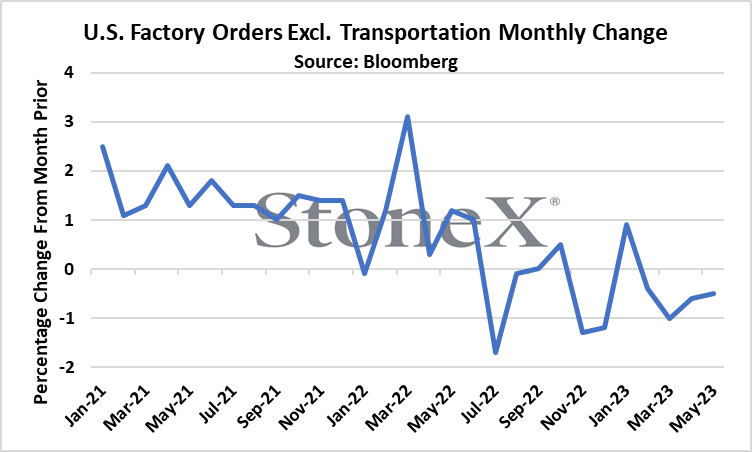
U.S. factory orders missed expectations in May, increasing by 0.3% month-on-month versus market forecasts of a 0.8% increase as the manufacturing sector continues to struggle. New orders for durable goods rose 1.8% in May while orders for nondurable goods fell, down 1.2% month-on-month after a 0.7% drop in April. The main driver of growth continues to be the transportation sector, with its orders rising by 3.8% month-on-month as orders for civilian aircraft and ships remain strong. Excluding transportation, new orders for U.S. manufactured goods fell by 0.5% from the month prior, coming in well below expectations of a 0.5% increase and marking the fourth consecutive month of decline. Although today's readings largely missed the mark on analyst expectations, it shouldn't be too much of a surprise to see confirmation of the weakening demand conditions that have been emerging on recent manufacturing PMI measures, showing the growing cracks in the sector amid further interest rate increases.
Economic conditions in Europe continue to soften, with today's HCOB Eurozone Composite PMI final reading for June being revised down to 49.9 from its preliminary 50.3 a couple weeks ago. This is now the first dip back into contractionary territory for the Eurozone in 2023 after rebounding from an ugly second half of 2022. The real source of concern continues to be the softening European service sector, which had largely been offsetting the negativity in manufacturing. The Services PMI for June was revised down to 52.0 from the preliminary 52.4 reading that had already been taken bearishly by the market as it represented a sharp decline from the 55.1 seen in the month prior. One positive note from today's numbers was an easing of price pressures on both the input and output side, meaning the ECB's aggressive rate hikes appear to be having the desired effect in combatting inflation, albeit while causing some expected turbulence. Coupled with the slowing service sector PMI data out of China, a negative overall global economic outlook is clouding the market today.
The technology battle between the U.S. and China continues on this week, with China announcing export restrictions on gallium and geranium starting August 1st, raising concern that supplies of rare earth metals from China could be restricted in the future as well. Both metals have broad manufacturing uses in the tech and defense sectors and the move by China is seen as a direct response to U.S. measures restricting China's access to some high-tech chips. Tensions between the world's two largest economies continue to simmer despite the recent diplomatic efforts, and the tech sector looks to be one of the main sources of escalation going forward. The move comes before U.S. Treasury Secretary Janet Yellen is scheduled to arrive in Beijing tomorrow for more high-level talks after Secretary of State Antony Blinken's recent visit that was seen as a step in the right direction, adding another layer of complexity to the meeting.