Today's Perspective Video: Tariffs Return: 90-Day Pause Ends - What Markets Need to Know
July 9 - Stocks pushed higher this morning as President Trump continued to outline more reciprocal tariffs that will go into effect on August 1st, with traders hoping that the August 1 implementation date will allow time for some key trade deals to get completed. Optimism remains that we could see deals completed with Canada, Europe, India and more. Earnings season for the second quarter begins next week, which will provide another indication of how the economy is adjusting to the Trump tariff environment, but a VIX trading near 16 suggests that optimism rings eternal on Wall Street for now. The dollar index is trading near 97.6 as it continues to firm off recent three-year lows. Yields on 10-year Treasuries are trading near 4.37%, while yields on 2-year Treasuries are trading near 3.88%. Crude oil prices are modestly higher at midday, while the grain and oilseed sector is mixed, as it finds firmer footing on value buying ahead of Friday's USDA WASDE crop report.
U.S. commercial crude oil stocks (excluding the Strategic Petroleum Reserve) rose by 7.1 million to 426 million barrels in the week ending July 4, leaving them still 8% below the five-year average for early July. Gasoline stocks fell by 2.7 million barrels, putting them roughly 1% blow levels typically seen in the first week of July. Distillate stocks dropped by 0.8 million barrels, dropping them to 23% below seasonal levels as diesel supplies continue to tighten in some regions. Ethanol stocks slipped slightly to 24.0 million barrels in the week ending July 4, down from 24.1 million barrels the previous week, but still above the 23.6 million barrels seen in the same week last year. Ethanol production rose to 1,085K barrels per day last week, up from 1,076K bpd the previous week, and up from 1,054K bpd in the same week last year. The production of fuel ethanol utilized an estimated 104.9 million bushels of corn last week, up from 104.0 million bushels the previous week, and up from 103.6 million bushels the previous year. Estimated marketing year to date corn use for the production of fuel ethanol totals 4.586 billion bushels, down 2 million bushels from the previous year's pace, increasing the likelihood that this year's corn use will fall short of USDA's current target.
USDA will update its domestic and global supply and demand balance sheets on Friday. This week's crop ratings suggest that both corn and soybeans have the potential to produce above trend yields this year, adding to surplus supplies. As such, the market has been driving prices lower to uncover fresh demand to absorb the anticipated increased supply. However, USDA doesn't like to adjust its corn and soybean yield estimates prior to the August crop report. It has only raised its corn yield estimate in the July crop report three times since 1993, with the last time being way back in 2003. It has never raised its soybean yield estimate in the July report, looking back to 1993. It will occasionally lower its corn and soybean yield estimates in July when significant adverse weather has occurred.
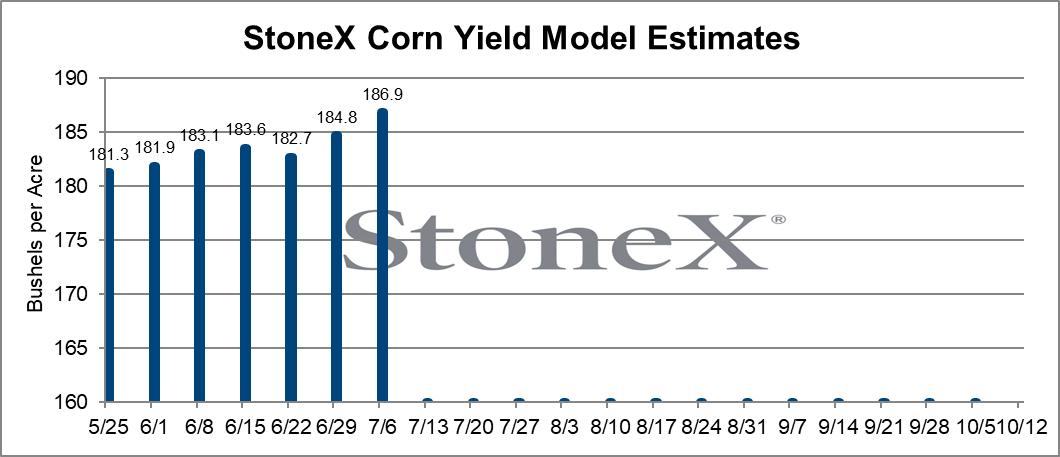
The graphic below shows the week by week adjustments to my seasonally adjusted corn yield model based on changing crop ratings. Note that Monday's USDA crop ratings pushed the corn yield model to 186.9 bushels per acre, while the soybean yield model rose to 53.3 bpa, above USDA's "trend" estimates of 181.0 and 52.5 bpa respectively. This doesn't mean that this year's crops will achieve those lofty yields, but rather it indicates that crop conditions in early July suggest that the crops have the potential to hit those levels at this early point in the growing season. We start to get a better handle on things as we move into August, and StoneX will have its first monthly customer survey of corn and soybean yields on August 4. The survey results will then be our official StoneX yields, updated by the survey monthly through November.