June 17 – Stocks are quietly mixed to start the week, with the S&P 500 and Nasdaq clinging to small gains while the Dow Jones faces small losses at the time of writing. The VIX has cooled through the morning as it falls back below the 13 level. The dollar has fallen back from its morning strength to hover near unchanged around 105.55 after pushing to month-and-a-half highs on Friday. Treasuries are up to start the week, with 10-year yields trading near 4.29% and 2-year yields near 4.76%. Crude oil is adding to last week’s gains, with nearby WTI up ~1.3% on the day to trade close to $79.50/barrel, while the ags are widely lower.
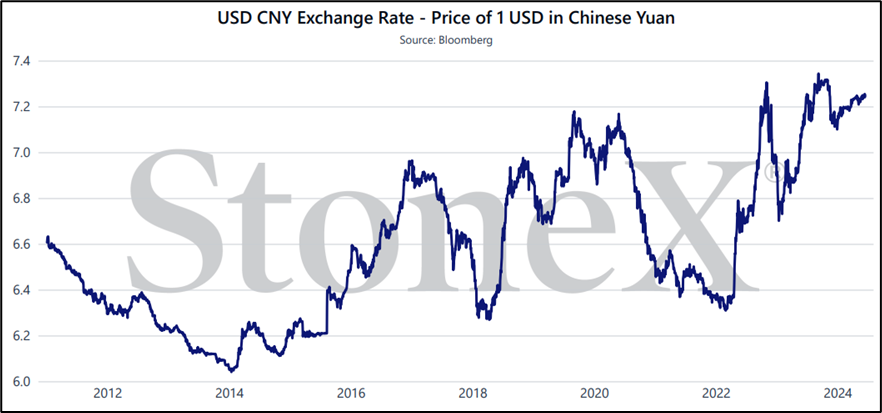
The People’s Bank of China (PBOC) left the medium-term lending facility (MLF) rate unchanged at 2.50%, as expected, with their decision on the loan prime rate (LPR) to be announced on Thursday. The PBOC continues to straddle the difficult position of seeing a struggling Chinese economy that would benefit from an easing of monetary policy while also not wanting to devalue the Chinese Yuan versus the U.S. dollar as they attempt to overtake the dollar’s dominance in global trade. China has implemented a handful of other policies aimed at bolstering their long-struggling property sector, but Chinese home prices just fell by 0.71% month-on-month in May, the sharpest decline in a single month seen since October 2014 and providing evidence of these measures falling short of their goal of stopping the bleeding thus far. Not only did values fall sharply, but demand for housing also continues to struggle, with area sold falling 20.3% over the January – May period compared to the year prior. Additionally, housing inventories continue to climb, reaching 15.81% in May from the 15.61% seen in the month prior. Chinese fiscal policy makers are still holding out hope that their efforts will lead to a recovery in the longer-term, but it appears more pain is in store for the near-term.
Chinese private sector investment grew only 0.1% for the first five months of 2024 compared to the same period last year, falling from the 0.3% growth seen in the first four months. This speaks to the continued lack of confidence among private businesses in China, especially when contrasting against the 7.1% investment growth in the public sector over the same span. Total fixed asset investment in China increased 4.0% in the January – May period compared to the same period in 2023, though again missing expectations of a 4.2% rise. This was boosted largely by 9.6% growth in manufacturing investment as China continues to place emphasis on becoming a world leader in new tech such as the energy transition. However, even this bright spot comes with some amount of shaky footing due to the ongoing rise in trade tensions between China and the West regarding many of these sectors (microchips, electric vehicles, etc.). The de-coupling of economies along geopolitical lines has the potential to cause real damage to China’s economy with so much of the demand for many of these products being found in the countries they are having trade spats with.
Delegates from 90+ countries met in Switzerland over the weekend for a summit on the Ukraine war, though Russia scoffed at the event after not being invited. The goal of the summit was to sway more non-aligned countries to ally with the U.S. and others in their support of Ukraine, but many of such targets (Brazil, India, Mexico, Saudi Arabia, South Africa, Thailand, U.A.E.) opted not to sign the event’s final document backing Ukraine’s territorial integrity. Sticking with the above themes, much of the focus of the event centered around China, whose willing absence from the event served as another showcase of their growing alignment with Russia and adds to the ongoing rift with the West. Meanwhile, Russia is attempting a diplomatic push of their own, with Putin set to make trips to both North Korea and Vietnam this week.