Today's featured video perspective: Update on Middle East Conflict & EPA's Biofuel Mandates
June 17 - Stocks remain under modest pressure at midday as investors remain nervous about the escalating war between Iran and Israel, and the possible ramifications of that escalation. President Trump stated that he wants to see a "real end" to the nuclear dispute with Iran, and that likely means a permanent end to its nuclear program. That appears to be Israel's objective as well. Israel is using military force to achieve that end, while President Trump would like to leverage that to achieve the objective at the negotiating table. Yet, Iran remains committed to maintaining its nuclear program, so the conflict will likely continue to escalate. The United States is reportedly moving more fighter jets into the region, including F-16, F-22 and F-35 aircraft, which have been used to shoot down drones and other projectiles in the past. Stocks are modestly lower, while the VIX is trading near 20. The dollar index firmed to trade near 98.4 at midday. Yields on 10-year Treasuries are trading near 4.41%, while yields on 2-year Treasuries are trading near 3.96%. Crude oil prices are nearly 3% higher, while the grain and oilseed sector is mostly higher as well. The meat sector was under pressure after a media story stated that packing plants are not immune to ICE raids as previously stated.
The NAHB / Wells Fargo Housing Market Index fell to 32 in June, down from 34 in May, continuing to reflect the dismal state of the housing market in the current environment of uncertainty. The single family present sales index dropped 2 points to 35, and down 11 points from the previous year. Meanwhile the single family sales 6 months out index dropped 2 points to 40, which is down from 47 a year ago. However, the traffic of prospective buyers index fell to a very low 21, down 2 points from the previous month, and down 7 points from the previous year.
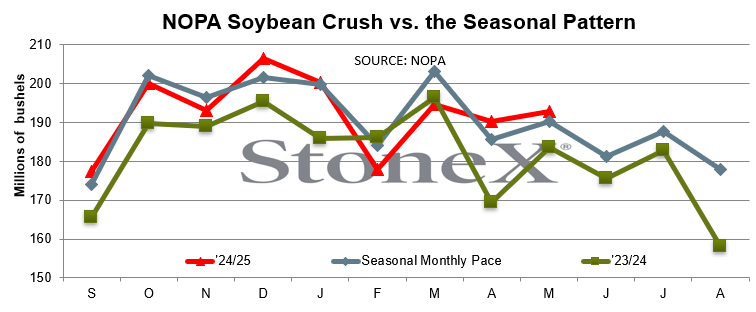
The National Oilseed Processors Association reported Monday that its members crushed 192.8 million bushels of soybeans in May, as shown in the graphic below. That brings marketing year to date NOPA soybean crush to 1.733 billion bushels, up from 1.661 billion bushels at the same point last year. That's roughly 5 million bushels below the seasonal pace needed to hit USDA's target for the soybean marketing year. Expect the crush rate to pick up from this point as the industry starts to build up supplies of soyoil for the anticipated surge in biomass diesel production. Soyoil prices rose nearly 16% over Friday and Monday combined, with December crush spreads pushing above $2 per bushel for the first time this year, and up from $1.50 just last week. My crush target for soybean marketing year 2025-26 is 2.530 billion bushels, up 110 million bushels from USDA's target for the current year, and up 40 million bushels from USDA's estimate for the next marketing year. However, my 2025-26 export target is just 1.650 billion bushels, down 200 million bushels from USDA's target for the current year, and down 165 million bushels from USDA's export target for the new marketing year.
There's quite a bit of discussion around the 45Z funding mechanism for the biofuel program as outlined in the Senate version of the tax bill released late yesterday. As I mentioned this morning, the Indirect Land Use penalty is removed in both the House and Senate versions. The Senate proposes that imported feedstocks get 80% of the credit value of domestically grown feedstocks, while the House version allows for 100% if the feedstock comes from Canada or Mexico, but 0% if it comes from elsewhere. They'll need to work out their differences on that in the weeks ahead. Regardless, the EPA's guidelines that were released on Friday limit imported feedstock to just getting 50% of the RIN value. That's roughly a $1 per gallon disadvantage for imported feedstock, which is expected to draw heavily on domestic feedstock, while it may shift more of the food industry toward imported oils.