Today's Perspective Video: Fed Rate Cuts, Inflation Risks and Global Tensions Rise
June 20 - Stocks are mixed today, chopping on both sides of unchanged, as Wall Street ponders risks for the weekend amid the ongoing and escalating Iran - Israel conflict. The VIX is trading above 20 at midday, while the dollar index is trading near 98.7. Yields on 10-year Treasuries are trading near 4.37%, while yields on 2-year Treasuries are trading near 3.90%. Crude oil prices are modestly weaker - erasing early gains after President Trump stated that he would make a decision on U.S. involvement in the next two weeks. The grain and oilseed markets are under pressure ahead of the weekend.
Traders will again be holding their breath over the weekend, monitoring headlines out of the Middle East. The primary fear of the commodity markets is focused on energy supplies, and the Strait of Hormuz specifically. Iran has previously made threats to close the Strait. It probably would not be successful in totally closing it, but it certainly could be disruptive, raising risks for a fifth of the world's crude oil that flows through the narrow passage. Such a move would also likely result in direct U.S. involvement as it seeks to keep the Strait open. Fertilizer prices are soaring as supplies tighten. Iran is the #3 exporter of urea fertilizer, which has largely been shut down. Egypt is the #4 exporter, and its production has also been shut down after natural gas supplies from Israel were shut down pre-emptively. Russian production is also down after a major fertilizer plant was recently hit by Ukraine. Regardless, Wall Street's primary focus will continue to be the impact on energy prices, which could have a significant impact going forward on economic growth, as well as on inflation trends.
The index of Leading Economic Indicators is a compilation of other pre-existing indicators constructed to have a value of zero when the economy is growing a trend rate. The index for May came in at -0.1. That matched analyst expectations, but it was a significant improvement from the lower revised -1.4 recorded in April. In other words, the economy slowed down in April as the reciprocal tariffs were announced and consumer buying pulled back as consumer sentiment plummeted amid increased fear about where we were headed. But consumer sentiment started rising again in May, and consumer buying started to firm again, with the overall economy essentially growing at trend levels in the month of May.
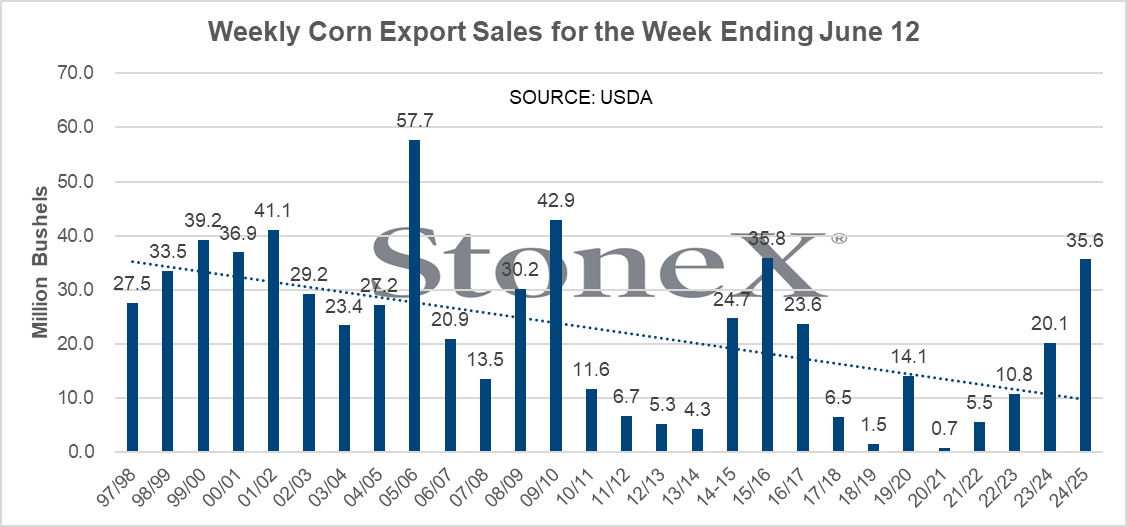
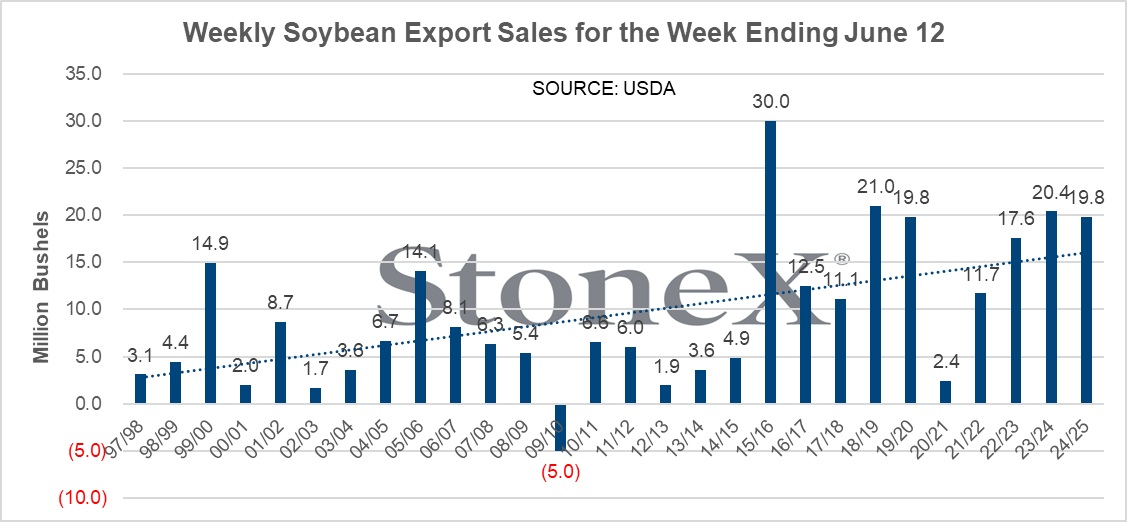
Exporters sold 35.6 million old-crop and 6.1 million bushels of new-crop corn in the week ending June 12, along with 19.8 million old- and 2.8 million bushels of new-crop soybeans, 15.7 million bushels of wheat, and 2 million bushels of grain sorghum - the latter all going to Mexico. Today's export sales numbers were supportive overall - coming in at seasonably solid levels. Japan was the featured buyer of U.S. corn during the week at a net 14.4 million bushels, including 3.1 million bushels that was switched from previous sales to "unknown destinations." Germany was the featured buyer of U.S. soybeans at a net 4.5 million bushels. Marketing year to date corn export sales total 2.631 billion bushels, up 551 million bushels or 26% from the previous year's pace, and 154 million bushels above the seasonal pace needed to hit USDA's newly revised target for the year ending August 31. Marketing year to date soybean export sales total 1.805 billion bushels, up 180 million or 11% from the previous year's pace, but down 10 million bushels from the seasonal pace needed to hit USDA's target. China was again absent from the sales report this morning, although we closed the seasonal pace deficit a bit as other countries stepped up their purchases.