June 25 - The Dow tumbled from Monday's one-month highs, while the S&P & Nasdaq consolidate ahead of Friday's key inflation numbers. The VIX continues to trade near 13 at midday, with the dollar trading near 105.7. Yields on 10-year Treasuries are trading near 4.26%, while yields on 2-year Treasuries trade near 4.76% as both also consolidate ahead of Friday's data release. The broader commodity complex remains in the red today, including the energy sector and the grain and oilseed sector, with lower crop ratings doing little to turn the tide of momentum trading Algos in the grain and oilseed sector.
The Federal Housing Finance Agency house price index rose 0.2% month-on-month in April, up from being flat in March, but below analyst expectations of 0.3% growth. The index was up 6.3% year-on-year in April, which is down from 6.7% the previous month. Home sales have slumped in recent months, but home prices have not due to the ongoing tightness of that market. On a related note, the Conference Board's consumer confidence index slipped to 100.4 for June, down from 101.3 in May, but above analyst expectations of 100.0. The index remains within a narrow range that has largely held it over the past two years as strength perceptions about the current labor market continue to outweigh concerns about the future. In fact, their view of the present situation improved slightly this month, driven by an uptick in sentiment about the labor market. But the consumer's concerns about the current business conditions increased this month, while they also became more pessimistic about the future of the labor market. Most of the decline in confidence this month came from those who are 35 - 54 years of age, while sentiment improved for those consumers who are both younger and older than that group.
USDA slashed its condition ratings for the corn and soybean crops this week, but the market's reaction to the lower ratings says a great deal about the details of those ratings. Let's face it - the weekly crop ratings that come from USDA each Monday afternoon amount to a beauty contest. Thousands of observers across the major growing regions are turning in their subjective estimates of the portion of each crop that rate Excellent, Good, Fair, Poor, and Very Poor. The industry focuses on the portion of each crop that is rated Good to Excellent, which in most years correlates well to the yield potential of the crop. I however utilize all five categories to construct a condition index score constructed such that 500 would be a perfect crop - never happens - and 100 would be a "very" poor crop. The Good to Excellent ratings do a good job of assessing the crop in most years, while the condition index score does a better job in years in which localized problems send a significant portion of the crop into the Poor to Very Poor categories. Seven percent of the nation's corn crop fell into these lower categories this week, up from five percent the previous week.
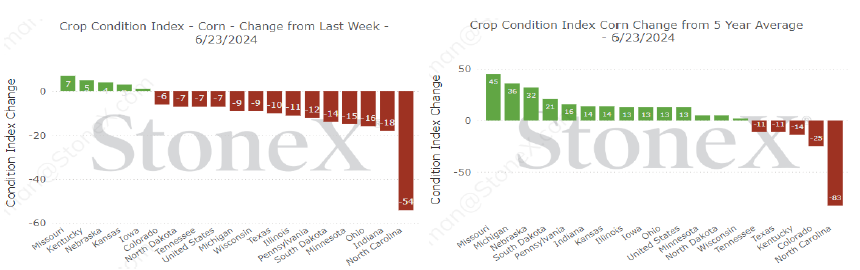
This week's corn condition index score for the crop is 374, down from 381 the previous week, but up from 339 in the same week last year, and above the long-term average of 371. The graphic on the left below provides a state-by-state breakdown of the changes in the score from the previous week, whereas the graphic on the right below shows how each of the significant production states condition scores compare to their respective five-year averages for the week. The bulk of the nation's corn is produced in 18 states focused primarily in the Midwest. Thirteen of those 18 states saw their ratings decline in the past week, led by North Carolina, where the condition index score dropped by 54 points due to persistent drought in the region. Ironically, 13 of the 18 states still have condition index scores that remain above the five-year average for the week, even with recent declines. Remember, this crop saw historically high ratings to start the growing season. None of the five states that have condition index scores below the five-year average for the week are considered major production states that the market cares about. That may change at some point, but for now, traders lack justification for rationing demand with higher prices. The picture is very similar for the soybean ratings as well.