June 25 - Stocks traded mixed to higher through the morning, with the tech sector being the strength of the equity markets following the apparent move toward peace in the Middle East. The S&P 500 stock index, and the Nasdaq stock index, continues to trade just below all time highs. The VIX is trading near 17 at midday, while the dollar index is trading near 97.9. Yields on 10-year Treasuries are trading near 4.31%, while yields on 2-year Treasuries are trading near 3.79%. Crude oil prices are nearly 2% higher as they bounce off areas of chart support following this week's price collapse, while the grain and oilseed markets are mostly lower again.
The selloff in the grain and oilseed complex continues as fund managers punish the sector. Wheat prices led the complex lower over the past couple of days as the winter wheat harvest gains momentum. World cash wheat prices are set by the Black Sea, and Russian wheat prices are quite cheap. We do have some areas of concern - both domestically and globally. Excessive rain hurt quality in portions of both the soft red and hard red winter wheat crops, while areas of dryness are hurting the hard spring crop either side of the Canadian border. Russia's spring wheat acreage will drop due to persistent wetness, but overall production estimates are still on the rise. Back home, winter wheat production estimates are rising as well, despite the quality issues. Wheat simply lacks a story to go against the trend currently. Add to that now private corn production estimates surging higher for Brazil's safrinha crop as harvest gains momentum, reflecting impressive yield results. We will get updated production estimates from StoneX Brazil's customer survey results on Tuesday of next week. I continue to argue that rising production estimates for Brazil put USDA's new-crop domestic demand estimates several hundred million bushels too high. On a related note, Brazil just raised its mandatory ethanol blending rate in gasoline to 30%, up from 27% previously.
Meanwhile, the U.S. growing season continues to progress well overall, suggesting large crops will be harvested this fall. That may change, but thus far the two-week outlook - which is largely what the markets focus on - continue to be favorable. Work done by Eric Snodgrass suggests that 70% of yield loss in short-crop years is due to heat, and 30% is due to a lack of rainfall. We're transitioning into more of a summer-time rainfall pattern, which means that we get more thunderstorm clusters that dump heavy rains - and sometimes high winds - on some areas, while other areas get missed. But generally, most areas are expected to get some rain. This week's heat is expected to transition to a more seasonal temperature pattern as we move into the weekend and into the first part of July, easing crop stress. A look at projected late June overnight lows for the Midwest, including forecasts through Friday, are the highest of the past 45 years, according to Commodity Weather Group. CWG looked at other similar years, and found that 7 out of 10 analog years saw a tendency for July to be cooler following a hot June, which would be favorable for corn pollination.
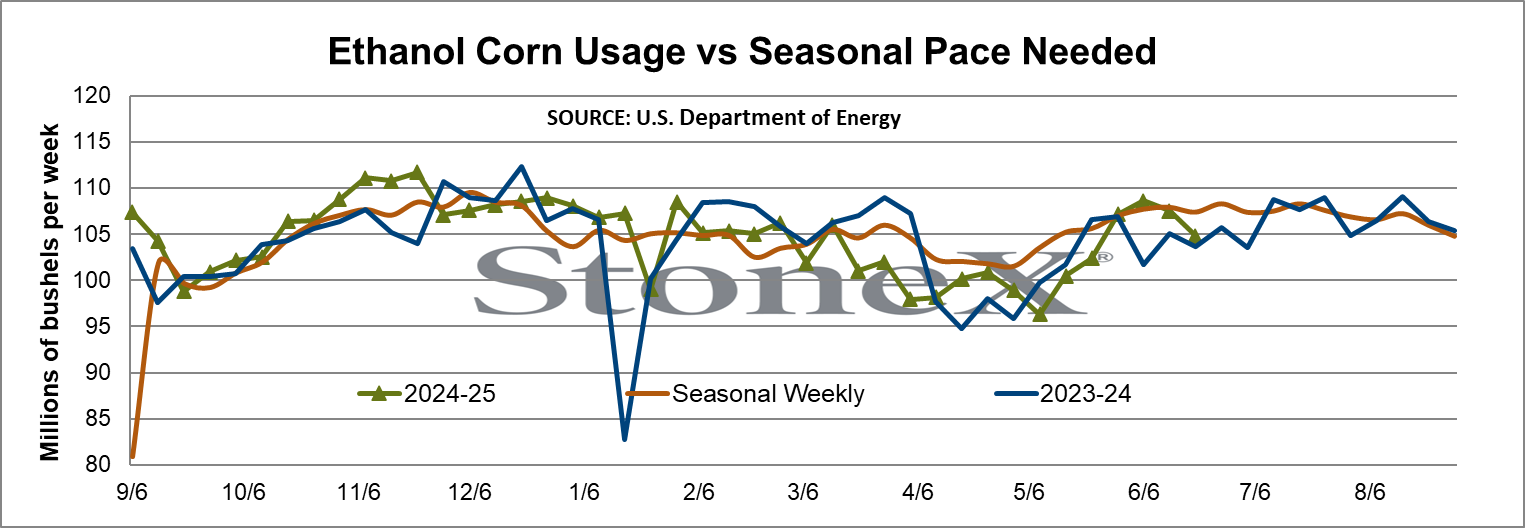
U.S. crude oil inventories (excluding the Strategic Petroleum Reserve) fell by 5.8 million to 415.1 million barrels in the week ending June 20, putting them 11% below the five-year average for the week. Gasoline stocks dropped by 2.1 million barrels, leaving them 3% below seasonal levels. Distillate stocks slid by 4.1 million barrels, putting them 20% below the levels typically seen at this time of year. Ethanol stocks rose to 24.4 million barrels in the week ending June 20, up from 24.1 million barrels the previous week, and up from 23.4 million barrels the previous year. Ethanol production slid to 1,081K barrels per day last week, down from 1,109K bpd the previous week, but up from 1,043K bpd in the same week last year. The production of ethanol utilized an estimated 104.8 million bushels of corn in the week ending June 20, down from 107.5 million bushels the previous week, but up from 103.7 million bushels in the same week last year. Estimated marketing year to date corn use for fuel ethanol totals 4.382 billion bushels, up 4 million bushels from the previous year's pace at this point in June.