June 5 - The tech sector pushed to new record highs this morning, supported by expectations of Fed rate cuts sooner rather than later. However, The Dow Jones Industrial Average came under modest pressure, even as the service sector produced strong results this morning. Meanwhile, Treasury yields hit fresh two plus month lows. The VIX slipped below 13 this morning, while the dollar index traded near 104.4. Yields on 10-year Treasuries are trading near 4.33%, while yields on 2-year Treasuries are trading near 4.75%. Crude oil prices are modestly lower as we approach late morning, while the grain and oilseed markets are mixed. Wheat finds support from another reduction in the size of Russia's wheat crop, but it was unable to sustain those gains this morning. Meanwhile, corn and soybean prices continue to find buying interest on this week's price break, while still struggling to sustain gains.
The final PMI composite reading for May came in at 54.5, up slightly from the flash number at 54.4, and up from 51.3 in April. The final service index came in at 54.8, matching the previous flash report, but also up from 51.3 in April. A number above 50 indicates month-on-month growth, and these are solid numbers for the service sector, where much of this year's lingering inflation risks have resided. The ISM services index came in at 53.8, up from 49.4 the previous month, and well above analyst expectations of 50.7.
China will boost purchases of wheat from its farmers to support prices as this year's harvest reaches its midpoint. That harvest has already surpassed 80% in key production areas, with yields coming in roughly 2% above year ago levels. Keep in mind that last year's crop was massive, although it had considerable quality problems due to persistent rains at harvest. This year's crop looks to be even larger, which may be one reason why China cancelled some previous purchases of U.S. soft red winter wheat. The wheat that the government purchases will go into its reserve for release during leaner times. China's goal is to be self-sufficient, although it regularly imports some higher quality milling wheat to be blended with its supplies. Wheat feeding, that displaced corn demand, surged a year ago when persistent rains lowered to quality of at least 20 million metric tons of wheat. The current wheat / corn cash price ratio favors wheat feeding once again, due to the size of this year's harvest. It's yet to be seen whether that price relationship will continue long enough to offset significant quantities of corn in feed rations, as it did a year ago. Dryness is currently a concern over a quarter of the North China Plain area where corn is grown, but showers are currently in the forecast that would be expected to provide valuable relief for the crop. The United States used to be China's primary source for imported corn, but it now depends on Ukraine and Brazil to supply its primary needs.
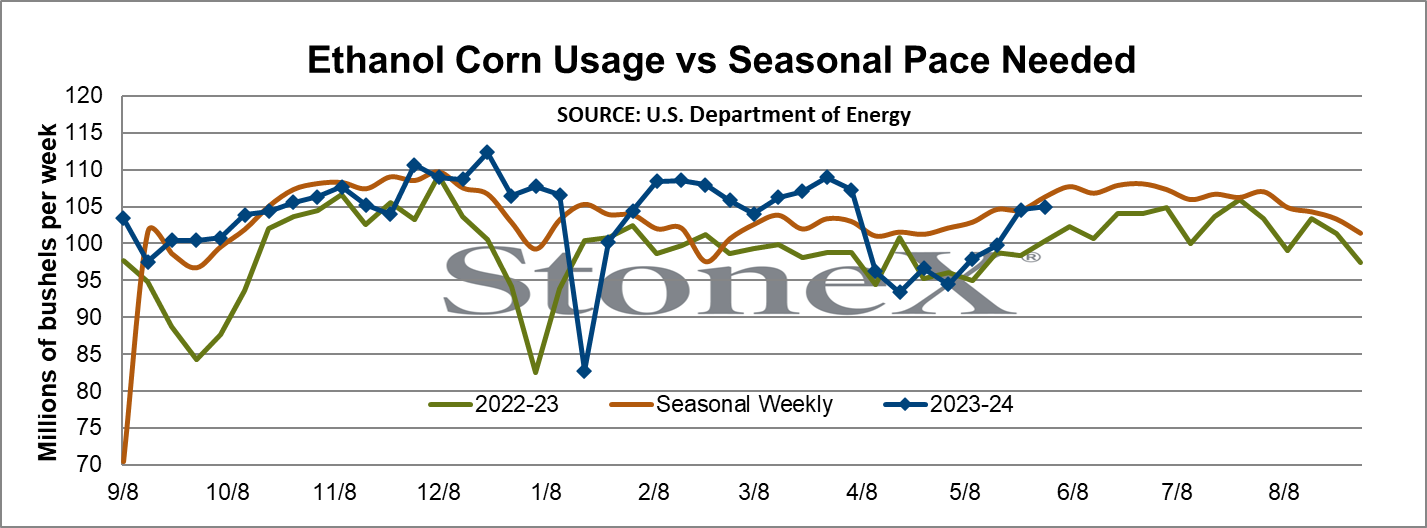
U.S. commercial crude oil stocks (excluding the Strategic Petroleum Reserve) rose by 1.2 million to 455.9 million barrels in the week ending May 31, putting them roughly 4% below the five-year average for the end of May. Gasoline stocks rose by 2.1 million barrels, leaving them 1% below seasonal levels. Distillate stocks increased by 3.2 million barrels, but that still left them 7% below typical levels for late May. Ethanol stocks slipped to 23.1 million barrels in the week ending May 31, down from 23.2 million the previous week, but up from 22.9 million barrels in the same week last year. Ethanol production rose to a nine-week high 1,072K barrels per day last week, up from 1,068K the previous week, and up from 1,036K bpd in the same week last year. The production of ethanol utilized an estimated 105.0 million bushels of corn last week, up from 104.6 million the previous week, and up from 102.3 million bushels the previous year. Estimated marketing year to date corn use for ethanol totals 4.055 billion bushels, up 188 million bushels, or 4.9% from the previous year's pace, and 49 million bushels above the seasonal pace needed to hit USDA's target for the year as margins continue to support active grind at the processor level.